
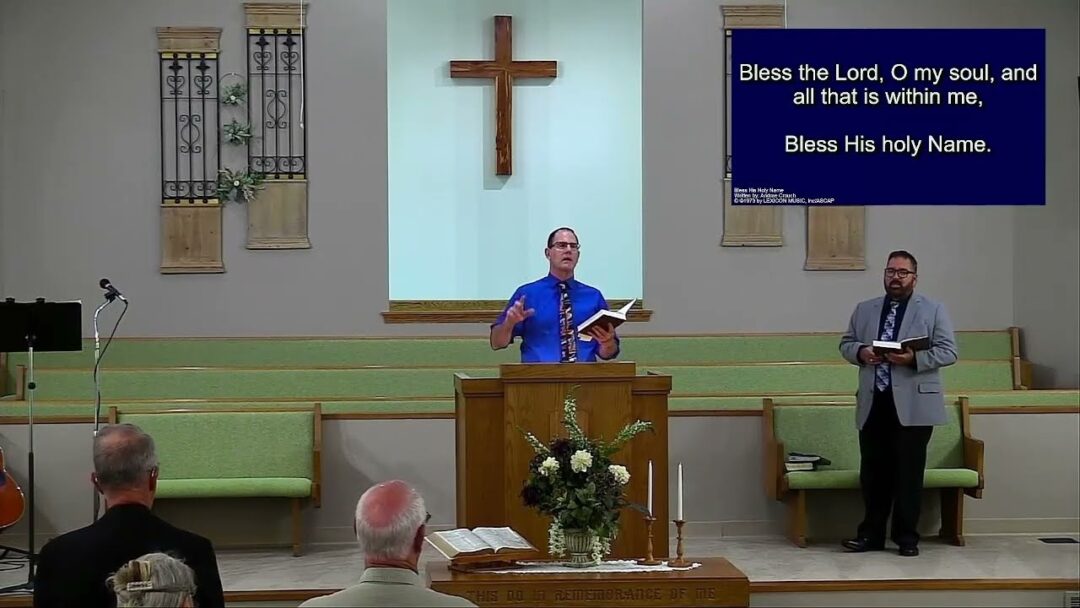
From our Journey Through James series, our Sunday service on May 21, 2023, James 3. Watch the full message: A Journey Through James 3 on YouTube.
A while back we started our journey through the book of James, and we had a little delay because of Mother’s Day and a youth activity, but we are finally picking it back up. In the first message we looked at the introductory passage in chapter 1, which introduced the key idea of the book: pure religion. What does it look like? Today we would call it a relationship with Jesus Christ, since we don’t like the word religion anymore because it carries the idea of a strict set of rules. If you have a relationship with Jesus Christ, it will show in a life of pure religion. In chapter 3 we have two more lessons: God wants you to control your tongue, and God wants you to have a wise lifestyle.
Control Your Tongue
The first thing James says is “be not many masters.” Is that a master-slave or boss-employer situation? No, in this case it means being a teacher, with the idea of putting yourself forward as a spiritual authority. Why? Because we will receive greater condemnation, and we have to give an account to God for the words we speak. If you put yourself in the position of a spiritual teacher, your words carry more weight, and so does the damage when you stumble. In Greek, the word for offend carries the idea of stumbling or tripping up. The point is not that someone takes offense in his heart but that you make him stumble. You cannot teach somebody without using your tongue, and James is about to tell us about the dangers of the tongue.
A Bit and a Rudder
James does what all preachers do and uses illustrations, and he picks two: bits and ships. We live near Amish country, so we know about the horse and buggy and how a small bit in a horse’s mouth can turn about the whole body. Your tongue is a small part of your body, but what it does has a huge effect on your effectiveness as a Christian. The second illustration is the ship. James is talking about giant cargo ships driven by the wind. The wind is a powerful force. How many of us have seen a hurricane and what it can do? And yet a small rudder turns that whole ship. The tongue is a little member that boasts great things. Isn’t the tongue powerful? Don’t we love to use our words? Doesn’t it feel powerful to speak your mind?
Even so the tongue is a little member, and boasteth great things. Behold, how great a matter a little fire kindleth! And the tongue is a fire, a world of iniquity: so is the tongue among our members, that it defileth the whole body, and setteth on fire the course of nature; and it is set on fire of hell.
James 3:5–6
A Little Fire
Those are pretty strong words. The tongue is a small part of the body, but it makes a big difference. It is the ember, the tiny thing that starts a fire. Consider how much of a forest a little fire can kindle. The phrase translated “the course of nature” is literally “the wheel of existence” in the Greek, a Roman idiom for your whole lifetime. So the tongue does not just defile a moment. It can set the course of a whole life on fire. And James does not stop there. He says it is “set on fire of hell.” It is wicked and corrupting. Don’t think you can let your tongue run and treat it as a small thing.
But the tongue can no man tame; it is an unruly evil, full of deadly poison. Therewith bless we God, even the Father; and therewith curse we men, which are made after the similitude of God. Out of the same mouth proceedeth blessing and cursing. My brethren, these things ought not so to be.
James 3:8–10
The Untamable Tongue
We are all familiar with the Coliseum in Rome, which was up and operating at this time in history. Lions and tigers and bears were trained not to attack the people caring for them but to attack the combatants in the arena. James says you might be able to tame the bear, the lion, and the snake, but there is a part of your life you will never be able to tame, and if you think you can, you’re a fool. “The tongue can no man tame” means nobody, not me and not you. If somebody tells you they have a venomous snake they have never been able to control and asks whether you would like to hold it, what is your answer? “No, are you crazy?” James is saying that is what the tongue is like. It is an unruly evil, full of deadly poison. Therewith bless we God, even the Father; and therewith curse we men, which are made after the similitude of God. Out of the same mouth proceedeth blessing and cursing. My brethren, these things ought not so to be. How many of you have gone backpacking? My dad and I used to go when I was younger, and getting nice, fresh spring water gushing from a rock after a long hike is so refreshing. But James is talking about a hypothetical spring that is inconsistent: one day it is fresh, refreshing water, and the next day it is bitter sulfur water that is disgusting. A spring does not produce both. Would you want to go to the believer who is sometimes happy to talk to you, and other times ready to curse you or talk bad about you behind your back? The fig tree makes the same point. If I plant a fig tree, it does not grow olive berries. If you plant good speech, you will grow good speech, and if you plant bad speech, you will grow bad speech. If blessing and cursing come out of the same mouth, something is wrong at the source.
Sins of the Tongue
There are sins of the tongue that show this. Lying is trying to defend yourself by not being truthful, which the Old Testament calls bearing false witness. Somebody confronts you about a job you were given, and you change your story a little: “You didn’t give me that, you must have forgotten.” That taints your reputation as a Christian. Gossiping poisons the water supply: “Did you hear what so-and-so did?” Criticizing, instead of being constructive and lifting people up, just beats them down. Careless speech is how easy it is to say something reactively that offends somebody. Maybe we did not mean it that way, but the way it came out was not good. Overspeaking I did not realize was in there. Maybe we had a right to speak up in the beginning, but then we went too far. A very common situation is correcting someone, especially a young person, and being overly cruel by beating it in over and over. Yes, you have corrected the problem, so now release it. What did Jesus say to the woman caught in adultery? He did not beat on her. He said, “Neither do I condemn thee: go, and sin no more.” James wants us to see that the tongue is not a side issue. It is how we stumble other people, how we bless God on Sunday and tear down a brother on Monday.
But the wisdom that is from above is first pure, then peaceable, gentle, and easy to be intreated, full of mercy and good fruits, without partiality, and without hypocrisy.
James 3:17
The Wisdom from Above
Lesson four is to live a wise lifestyle. If you want wisdom, which is skill for living, show it by a good conversation. That word carries the idea of a lifestyle or behavior. It is one thing to be wise and another to tell everyone you are smart. James is saying not to go around announcing, “I’m so smart, I’ve got skill for living,” but to show it through your actions, in humility. There is also a wisdom that is earthly, sensual, and devilish, and where envy and strife are, there is confusion and every evil work. But the wisdom from above is first pure, then peaceable, gentle, and easy to be entreated, full of mercy and good fruits, without partiality, and without hypocrisy. Gentle, in the Greek idea, is having the ability to harm somebody else but choosing not to, like a bodybuilder deciding not to beat somebody up. He has more than enough ability to cause harm, but he knows it and chooses not to use it. When people make mistakes and we correct them, we have the ability to correct, but knowing in wisdom how far to go is a different story.
Easy to be entreated means compliant. Say somebody comes to you with a wise heart and says, “I looked at your report and I know you’re working hard, but something’s not working and we need to redo it.” The fool says, “I’m doing my best, and you don’t appreciate me.” The wise person says, “Let me take time to consider that,” and comes back with some new ideas. You may think, “I don’t trust anybody. I’ve learned in my life that the only person I can trust is me, and maybe my wife sometimes.” If that is your wisdom, the Bible says it is not wisdom but foolishness, and you are lying against the truth. That wisdom descendeth not from above but is from Satan, a deceit to keep you from the joy God wants you to have. It is earthly, sensual, which means self-focused, and devilish. James says you have been singling yourselves out from the rest of Christianity, so proud of yourself that you think you are the only person you can trust. Stop it. Where envy and strife are, there is confusion and every evil work. The fruit of righteousness is sown in peace of them that make peace. If you are going to be a Christian who grows fruit, you have to plant your fruit in peace, not in conflict with other people. Those conflicts deprive the fruit of the tree of our Christian life of the sustenance it needs to survive, or, in the other illustration, the fire will burn it down. Control the tongue. Live a wise lifestyle. Sow in peace.
Recent Comments