
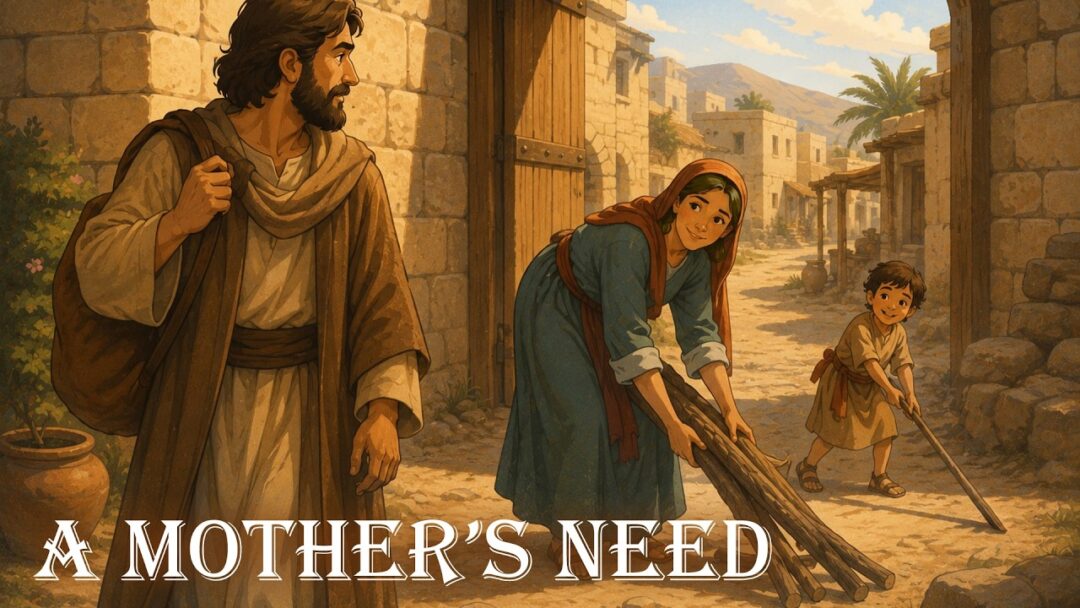
From our Mother’s Day service on May 10, 2026, 1 Kings 17. Watch the full message: A Mother’s Need on YouTube.
This is a Mother’s Day story about need. We meet Elijah as God sends him to a widow in Zarephath, a woman at the end of her resources, and we discover that he needs her as much as she needs him. Through His providence, God brings them together so that each can meet the other. The lesson of the passage is not only that a miracle happened, but that God had already seen a person others might have overlooked. God wants you to know that He sees those who need Him the most. Mothers, and anyone who has felt that help is out of reach, this account is for you.
A Prophet Sent Away, Then Sent Again
Elijah the Tishbite, of the inhabitants of Gilead, stands before Ahab and announces that there will be no dew or rain except according to his word. His name means that Yahweh is his God, and that confession is already a confrontation. Ahab has promoted the worship of Baal, the storm god, under the influence of Jezebel of Sidon. Israel’s king has represented a false god rather than the Lord. So God sends Elijah with a judgment that strikes at the heart of that claim. The rain will stop, and it will not return until God speaks again.
Then the Lord tells Elijah to leave and hide by the brook Cherith, east of the Jordan. The name of the place means a cutting, and it fits the moment. Elijah is being cut off from Israel for his safety. There he drinks from the brook, and ravens bring him bread and flesh morning and evening. Even the manner of the provision marks a kind of separation. Ravens were unclean, and a Jewish hearer would have felt the strangeness of being sustained that way. God keeps him, but He also keeps him apart.
When the drought does its work, the brook dries up. That is no surprise. Elijah himself has said that rain would not come. Then the word of the Lord sends him still farther, into the very region tied to Jezebel’s family:
And the word of the LORD came unto him, saying, Arise, get thee to Zarephath, which belongeth to Zidon, and dwell there: behold, I have commanded a widow woman there to sustain thee. So he arose and went to Zarephath. And when he came to the gate of the city, behold, the widow woman was there gathering of sticks: and he called to her, and said, Fetch me, I pray thee, a little water in a vessel, that I may drink. And as she was going to fetch it, he called to her, and said, Bring me, I pray thee, a morsel of bread in thine hand. And she said, As the LORD thy God liveth, I have not a cake, but an handful of meal in a barrel, and a little oil in a cruse: and, behold, I am gathering two sticks, that I may go in and dress it for me and my son, that we may eat it, and die.
1 Kings 17:8–12
Zarephath belongs to Zidon. It is a wealthy harbor city, known in its day for trade, metalwork, and costly goods, and it lies in enemy territory. Jesus later points to this same moment and says that many widows were in Israel during the famine, but Elijah was sent to none of them except a woman in Sarepta of Sidon. God is not sending His prophet to the place of greatest comfort or to the people we would expect to be first in line. He is sending him to someone in need far from the center of Israel’s life. Elijah does not argue. He rises and goes.
A Widow at the End of Her Rope
At the gate he finds the widow gathering sticks. He asks for water, and she goes to fetch it without protest. Her heart is willing. Then he asks for a morsel of bread, and she tells him the truth. She has only a handful of meal and a little oil. She is gathering two sticks to prepare a last cake for herself and her son, and then they expect to die. She swears by the Lord his God, which shows that she already knows whom Elijah worships. She is not unwilling. She is empty. How many of us have wanted to help and had to say that we had nothing left to give?
She is a Phoenician, not an Israelite, and yet God has already said that He has commanded a widow there to sustain Elijah. She is the mistress of a house, a landowner, but property cannot feed a family when the famine has closed every ordinary supply. She has a young son. She has come to the end of her options. Into that moment Elijah speaks a hard word and a sure promise:
And Elijah said unto her, Fear not; go and do as thou hast said: but make me thereof a little cake first, and bring it unto me, and after make for thee and for thy son. For thus saith the LORD God of Israel, The barrel of meal shall not waste, neither shall the cruse of oil fail, until the day that the LORD sendeth rain upon the earth. And she went and did according to the saying of Elijah: and she, and he, and her house, did eat many days. And the barrel of meal wasted not, neither did the cruse of oil fail, according to the word of the LORD, which he spake by Elijah.
1 Kings 17:13–16
Fear not, he says, but make him a little cake first, and afterward make for herself and her son. The barrel of meal will not waste, and the cruse of oil will not fail, until the Lord sends rain. It is a bold request. She is being asked to give the last of what she has before she sees the provision. She takes him at his word. She is not an Israelite by birth or by location, but she believes the God of Israel enough to obey. She makes the bread for him first, and when she returns, the meal and the oil are still there. God keeps them, and her household, for many days.
See how God has joined two needs. The widow is out of options, and the prophet in exile is out of options as well. God brings two believers together and uses each to help the other. That is a picture of how His people can meet one another in His will. The miracle of the barrel and the cruse is famous, but the story does not end with bread.
When a Mother Asks If God Is Against Her
After these things, the son of the woman falls sick, and the sickness is so severe that there is no breath left in him. She has already lost her husband. She has already come near death herself. Now she faces a mother’s worst grief. The daily miracle of food has not prevented this. She turns on Elijah with the question many hurting people have asked: has God brought this man into her house to call her sin to remembrance and to slay her son? Was the blessing only a way of raising her hopes so that the blow would fall harder? She can understand dying together. She cannot understand surviving while her child is gone.
Elijah does not answer from his own opinion. He takes the child, carries him to the loft, and brings the question to God. He asks whether the Lord has brought evil upon the widow with whom he sojourns. Then he stretches himself upon the child three times and prays that the child’s soul would come into him again. The answer does not come at the first cry. He persists. He asks God to show that He is for His people and that He cares for this woman:
And the LORD heard the voice of Elijah; and the soul of the child came into him again, and he revived. And Elijah took the child, and brought him down out of the chamber into the house, and delivered him unto his mother: and Elijah said, See, thy son liveth. And the woman said to Elijah, Now by this I know that thou art a man of God, and that the word of the LORD in thy mouth is truth.
1 Kings 17:22–24
The Lord hears, and the child lives. Elijah brings him down and says, “See, thy son liveth.” That is the answer to her question. God does care. The never-failing meal had not been enough to convince her that Elijah was a man of God, but the return of her son is. She now knows that the word of the Lord in his mouth is truth. God has seen her at the end of her rope, and He has not forgotten her.
From the beginning of the famine to its end, God provided for this widow. She was not powerful, not near the temple, and not the kind of person a kingdom would consider first. Yet she was exactly the kind of person God delights to show mercy to: empty enough to trust Him, needy enough to depend on Him, and willing enough to obey Him. When her heart asked whether God was against her, He answered not with a long explanation, but with compassion, by giving her back her son.
That is the message for us as well. God sees those who need Him the most. He sees you when the food is almost gone, when death enters the family, and when your heart is asking whether He has forgotten you. The question is not whether God sees your need. The question is whether you will trust Him with it. The widow had to give the little she had before she saw the miracle. Elijah had to pray before he saw the boy breathe. Faith means obeying God before we understand what He is doing. Bring Him the empty barrel, the little oil that remains, the grief, the fear, and the impossible situation. The God of Elijah is still the God who provides. God wants you to know that He sees those who need Him the most. Will you trust Him and allow Him to do the impossible for you?
Recent Comments