
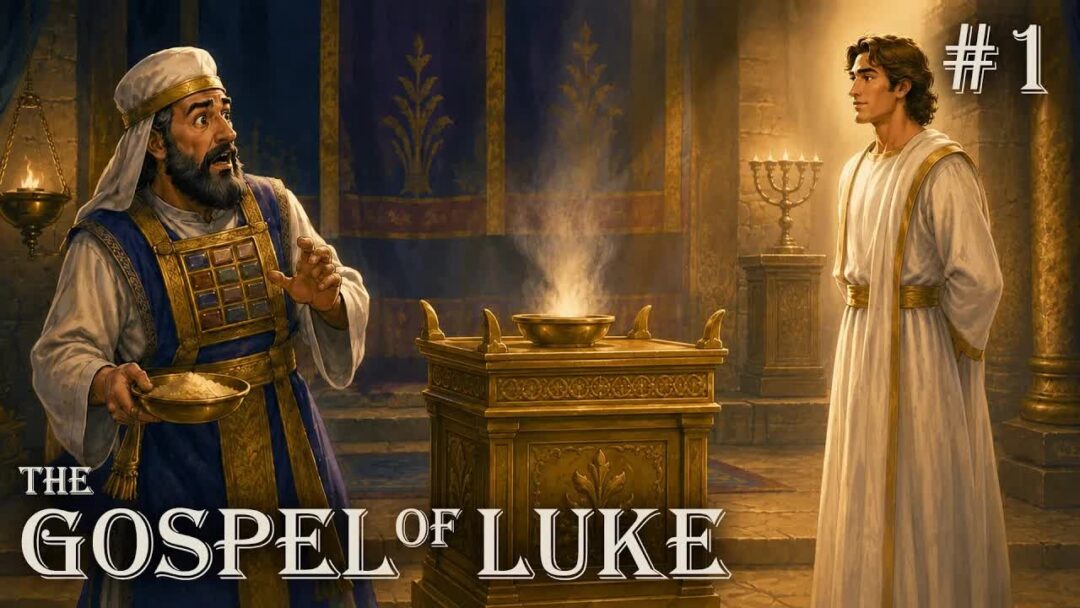
From our Sunday service on May 24, 2026, Luke 1:1-25. This is part 1 of our Gospel of Luke series. Watch the full message: A New Era Begins – The Gospel of Luke #1 on YouTube.
After a long silence, God begins the Gospel story by answering both a national promise and a personal prayer. Israel has been waiting for the prophet who would prepare the way of the Lord, and a faithful couple has been waiting for a son. In one announcement, both of those longings meet. I want us to see that God’s silence is not the same as His absence. He has been listening, and when the time comes He acts. God wants you to know He hears you when life feels silent.
A Record We Can Trust
Luke writes so that Theophilus, and others like him, may know the certainty of the things they have been taught. Many have already undertaken to tell the story, and Luke has followed the testimony of those who were eyewitnesses from the beginning. He is not arranging a collection of loosely remembered sayings. He is setting the account in order, placing the life of Jesus within real history so that people who did not grow up in Israel can understand what happened and why it can be believed:
Forasmuch as many have taken in hand to set forth in order a declaration of those things which are most surely believed among us, Even as they delivered them unto us, which from the beginning were eyewitnesses, and ministers of the word; It seemed good to me also, having had perfect understanding of all things from the very first, to write unto thee in order, most excellent Theophilus, That thou mightest know the certainty of those things, wherein thou hast been instructed.
Luke 1:1–4
Matthew and Mark were written for particular theological purposes, and they do not always arrange events in the sequence we might expect. As the church spread among people who had never walked the streets of Jerusalem or followed its political life, questions naturally arose about how the story fit together. Luke answers those questions by writing a chronological narrative with names, places, and the testimony of witnesses. This is not a comforting tale detached from the world. It is a record of things that took place, preserved so that those who love God may have confidence in what they have received.
Luke himself is a Gentile, a physician, and a careful writer. He later travels with Paul and cares for him in the hardships of ministry. He traces the story from the eyewitnesses and then records the work of the apostles as it unfolds. Whether Theophilus was a Roman official, someone seeking assurance, or even involved in a legal defense of the Gospel, the title “most excellent” tells us he holds a recognized place. Luke writes to a real person, and through that person to all who want to know that the story of Jesus stands in history.
Waiting Through the Silence
The setting of this opening is a long quiet. After Malachi, there have been no new prophets and no new words from God for four hundred years. During that time, God has not been idle. Rome has been allowed to rise, and the very roads and reach of that empire will later carry the Gospel far beyond Israel. But for the people waiting, the silence has been real. They have lived with the last promise God gave, that Elijah would come before the day of the Lord and turn hearts in preparation for what God would do:
Remember ye the law of Moses my servant, which I commanded unto him in Horeb for all Israel, with the statutes and judgments. Behold, I will send you Elijah the prophet before the coming of the great and dreadful day of the LORD: And he shall turn the heart of the fathers to the children, and the heart of the children to their fathers, lest I come and smite the earth with a curse.
Malachi 4:4–6
Many were watching for that moment. Some among the priests and Pharisees were ready to ask whether a new preacher might be the Messiah, Elijah, or the prophet like Moses. The Samaritans knew the Messiah was coming. The Zealots expected a leader who would overthrow Rome. Wise men in the East were looking for a sign, and the Essenes believed the time was near. The whole atmosphere is one of expectation. The silence has lasted a long time, but it has not erased the promise. People are waiting for God to speak again.
A Faithful Couple and an Answered Prayer
When God does break the silence, He does not begin with a king. He comes to a humble priest and his wife. Zacharias, of the course of Abia, and Elisabeth, also of Aaron’s line, are righteous before God, walking in His commandments. They are also old, and Elisabeth is barren. The grief of childlessness has been heavy, and it would have been easy to conclude that a life of faithful service had gone unnoticed. Yet they have continued to wait and to pray. In the days of Herod, as Zacharias serves in the temple and the lot falls to him to burn incense, God meets him at the altar:
But the angel said unto him, Fear not, Zacharias: for thy prayer is heard; and thy wife Elisabeth shall bear thee a son, and thou shalt call his name John. And thou shalt have joy and gladness; and many shall rejoice at his birth. For he shall be great in the sight of the Lord, and shall drink neither wine nor strong drink; and he shall be filled with the Holy Ghost, even from his mother’s womb. And many of the children of Israel shall he turn to the Lord their God. And he shall go before him in the spirit and power of Elias, to turn the hearts of the fathers to the children, and the disobedient to the wisdom of the just; to make ready a people prepared for the Lord.
Luke 1:13–17
An angel appears, and Zacharias is afraid. After so many years, and with the danger that attended unworthy service in the temple, it is understandable that he would think judgment had come. Instead, the first word is that his prayer has been heard. Elisabeth will bear a son, and they are to name him John. This child will be a joy not only to his parents but to many. He will live as one set apart, filled with the Holy Ghost from his mother’s womb, and he will go before the Lord in the spirit and power of Elias. The last words of the Old Testament are being taken up again. The prophet who prepares the people for the Messiah is going to be born in this faithful home.
Notice how personal this is, and how large. God is answering a couple who have asked for a son, and at the same time He is keeping His word to the nation. John’s name means that Yahweh gives grace. His work will turn many in Israel to the Lord and make ready a people prepared for Him. The years of waiting have not been wasted. God has been listening, and His timing is now bringing together the promise of a child and the promise of a forerunner.
When the Answer Does Not Fit Our Timing
Zacharias’s response, however, is not praise. He asks how he can know this, since he and his wife are old. The difficulty that has shaped their prayers now becomes a reason to doubt the word that answers them. The angel identifies himself as Gabriel, who stands in the presence of God and has been sent with these glad tidings. This is no casual messenger. Yet Zacharias has measured the promise by what seems possible, and he has concluded that the timing is too late:
And Zacharias said unto the angel, Whereby shall I know this? for I am an old man, and my wife well stricken in years. And the angel answering said unto him, I am Gabriel, that stand in the presence of God; and am sent to speak unto thee, and to shew thee these glad tidings. And, behold, thou shalt be dumb, and not able to speak, until the day that these things shall be performed, because thou believest not my words, which shall be fulfilled in their season.
Luke 1:18–20
Because he does not believe the words, he will be unable to speak until they are fulfilled. Gabriel makes the issue plain: these things will be performed in their season. God is not late, even when we have decided that He has delayed too long. The very angel who has been bound up with the timeline of the Messiah’s coming now tells a faithful priest that God’s word will stand in God’s time. Zacharias had been praying, but he was not ready to receive an answer that arrived after the years of strength had passed. The lesson is a hard one. It is good to pray, and it is good to have faith, but it is not good to talk back to God when He does not work in the way we expected.
Outside, the people wonder why he remains so long in the temple. When he comes out and cannot speak, they perceive that he has seen a vision. He cannot yet tell them what God has promised. After his days of service, he goes home, and Elisabeth conceives. She hides herself for five months, receiving the gift with gratitude rather than making a public display of it. The Lord has looked on her and taken away her reproach. The prayer has been heard, even though the first response to the announcement was unbelief. God still keeps His word.
This is how the Gospel begins: after a long silence, with a promise kept and a prayer answered. God’s silence does not mean He has forgotten His people. He has been working all along, and when the time is right He speaks, fulfills His word, and begins preparing the way for Jesus. We must not be like Zacharias, doubting that God is at work because the situation looks messy or the timing seems delayed. God wants you to know He hears you when life feels silent. Will you trust Him to keep His word in His time?
Recent Comments