
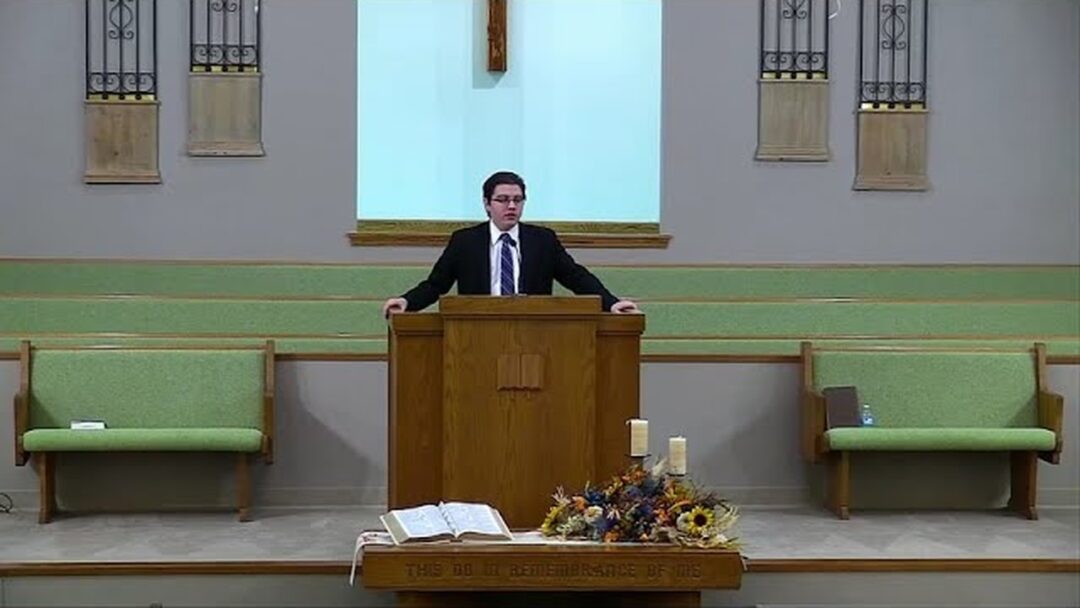
From our Sunday service on September 29, 2024, the book of Jude. Watch the full message: Being the Difference on YouTube.
We’re looking at the book of Jude. You don’t need a chapter, because it’s just one. We’ve been doing a series on 2 Peter. Second Peter has a famous connection to Jude, and they cover a lot of the same topics. Jude was written after 2 Peter, and it’s very similar to those teachings. We’ve been talking about how there are false teachers spreading false doctrine. Second Peter focuses on the false teachers. Jude says a lot of the same things, but he focuses on the false followers. Second Peter tells us how to protect ourselves, and the key theme there was that we need to be in the word. Jude also includes a clear calling for believers on how to respond proactively. The main idea we get from this is that God wants your life to affect others for the better. God wants you to use your Christianity to make people more like Christ.
Sanctified, Preserved, and Called
Jude was written in response to those early Gnostic sects creating secret teachings. He is famously known as the half brother of Jesus and the brother of James, who was the leader of the Jerusalem church.
Jude, the servant of Jesus Christ, and brother of James, to them that are sanctified by God the Father, and preserved in Jesus Christ, and called: Mercy unto you, and peace, and love, be multiplied.
Jude 1:1–2
Notice something interesting. Jude never identifies himself as the half brother of Jesus. You would think that being one of the big aspects of your life, you’d mention it. But Jude chooses humility. He says, “the servant of Jesus Christ, and brother of James.” There are two types of so-called Christians in this day. There are the true Christians he’s writing to, who have three qualities: sanctified, preserved, and called. And there are the false Christians. Sanctified means made holy, in this context through salvation in Christ. Preserved in Jesus Christ goes back to what we’ve said about the Holy Spirit being our down payment and our seal of salvation. If you don’t have these three aspects in your life, you might want to wonder which group you’re in. Then Jude gives his greeting: “Mercy unto you, and peace, and love, be multiplied.” That’s the end result the letter is supposed to have among all of you.
Jude says that when he gave all diligence to write unto them of the common salvation, it was needful to exhort them that they should earnestly contend for the faith which was once delivered unto the saints. “The common salvation” is the one everyone agrees on, as opposed to the false salvation these other sects are teaching. The common salvation is the truth that there can be a Catholic who is saved if they believe the doctrines of salvation, just as there can be a Baptist who is lost if they do not. “Contend” is literally a sporting term. It’s wrestling, which was a very old sport in ancient Greece, with matches held in the coliseums. Jude is telling us this will take effort. Who gave the faith? Jesus Christ. It was passed from Jesus to the apostles to the church, and as it got passed around, other people said, “I want to add my ideas to it.” Why? Because “certain men crept in unawares.” These people secretly snuck into the church. They didn’t like the moral teachings the church had, which were disagreeable with Greek culture. They didn’t like the monogamous attitude. Jude warns that they are ungodly men who turn the grace of God into lasciviousness, giving in to sinful desires, and that they are denying the only Lord God, and our Lord Jesus Christ.
Lessons from the Old Testament
One thing Jude likes to do is go to the Old Testament, and I’m thankful God allowed him to do this, because it shows how important the Old Testament still is. First, the Lord saved the people out of the land of Egypt and afterward destroyed them that believed not. Because of their unbelief, God made them wander in the wilderness for forty years. Every person who didn’t have belief in Him was going to die before entering the promised land, and the only two who would make it were Joshua and Caleb. God might not destroy you if you lack belief, but He’s not going to bless you if you lack belief. What they missed out on was some of the greatest things they could have had.
The second example is the angels “which kept not their first estate, but left their own habitation.” There are angels who crossed a line. Verse 7 gives the example of Sodom and Gomorrah, giving themselves over to fornication, and going after strange flesh. Verse 8 concludes: “these filthy dreamers defile the flesh, despise dominion, and speak evil of dignities.” You might think that’s not really a thing, but right before the first service I opened Twitter, and the first thing that popped up was a Pentecostal church doing a worship service where they said the music would cast out demons. Even Michael the archangel, when he disputed with the devil about the body of Moses, durst not bring against him a railing accusation, but said, “The Lord rebuke thee.” Satan wanted the body so that the Israelites could worship Moses’s bones. Michael didn’t say, “I cast you out in the name of Michael.” Animals do have a sort of wisdom. My cat breaks into my cabinet and steals my loaves of bread, and that takes some level of intelligence. But they don’t have the long-term intelligence to understand the consequences of their actions. These false teachers aren’t thinking about the long term. They’re thinking, “I can be famous for my ability to cast out demons. I can indulge in pleasures.”
Woe unto them, for they have gone in the way of Cain, and ran greedily after the error of Balaam for reward, and perished in the gainsaying of Core. The way of Cain is despising those who do right. Cain brought from the fruit of the ground, but Abel took the time to find the best of his flock. They ran greedily after the error of Balaam for reward: there are believers who have betrayed God for money. And the gainsaying of Korah: Korah complained against godly leadership, and what’s interesting is that he was actually a minister. He had a ministry role as a Levite, part of the priests.
Jude then gives analogies. “Spots in your feasts of charity,” the love feasts, which today we’d call fellowship meals. “Spot” is actually a Greek word for a reef under the water. You’re walking along the shore and you don’t see it until you’ve wrecked. They are “clouds without water,” useless, bringing no nourishment. They are “trees whose fruit withereth,” which in the Greek is an autumn tree, one that should have already produced its fruit. They are “raging waves of the sea, foaming out their own shame,” that nasty seafoam on the seashore. And they are “wandering stars,” either shooting stars or planets. When you’re navigating a ship, you use the fixed stars, not the ones that wander. Enoch, the seventh from Adam, prophesied that the Lord cometh with ten thousands of His saints to execute judgment. Enoch walked with God, and even then a righteous man was preaching that judgment is coming. These are murmurers, complainers, walking after their own lusts, speaking great swelling words, having men’s persons in admiration because of advantage. They’ll tell you whatever you want to hear.
Being the Difference
But ye, beloved, building up yourselves on your most holy faith, praying in the Holy Ghost, Keep yourselves in the love of God, looking for the mercy of our Lord Jesus Christ unto eternal life.
Jude 1:20–21
This is contrasted with something else: “But ye, beloved.” They don’t have the Spirit, but you true believers have the Spirit. So use it. Keep yourselves in the love of God. Live in that love. Build yourselves up on your most holy faith, praying in the Holy Ghost, looking for the mercy of our Lord Jesus Christ unto eternal life.
And of some have compassion, making a difference: And others save with fear, pulling them out of the fire; hating even the garment spotted by the flesh.
Jude 1:22–23
We’ve kept ourselves in the love of God, and we have the Spirit. What does it look like to respond to those who don’t? Jude gives us two ways. The first is “of some have compassion, making a difference.” The word “making a difference” in the Greek includes the idea of doubt, so another way to translate it is to have compassion on those who have doubts. The second option is more intense: “others save with fear, pulling them out of the fire.” This is a tender way of approaching salvation, compassion, kindness, discussion, and then a little more intense form. “Hating even the garment spotted by the flesh” is the idea of a stain. What’s often missed here is the motivation. They do not hate the sinner. They hate the stain. It doesn’t matter if they’re good people or how many stains they have. It could be just one stain. It could be the biggest entrepreneur who created a huge business and ended up making a nonprofit. One stain is still a stain.
Jude concludes: “unto him that is able to keep you from falling, and to present you faultless before the presence of his glory with exceeding joy.” Good news: if you’re in the right group, in Christ, He can keep you from falling. You are secure, you will be presented faultless, and you will have exceeding joy. There are false teachers and false believers who will always exist. Our focus should not be on eliminating false teachers altogether, but on how we respond to save as many people as possible. Jesus is the one who keeps us pure in our faith. Jesus is the one who allows us to be faultless. Jesus is the source of our joy. God wants your life to affect others for the better. Will you be the difference today?
Recent Comments