
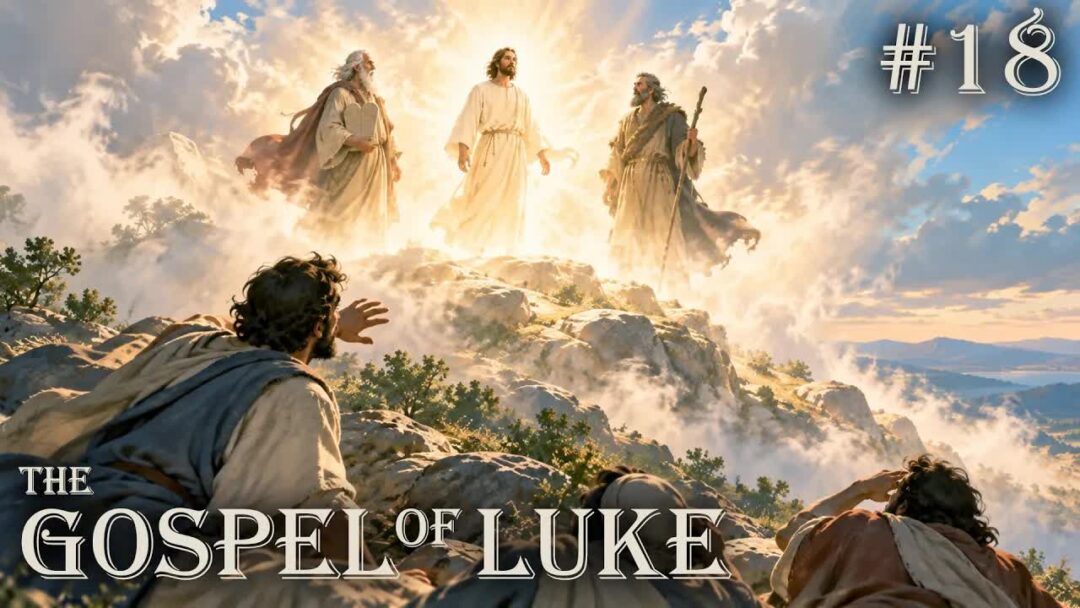
From our Sunday service on October 4, 2026, Luke 9:27-45. This is part 18 of our Gospel of Luke series. Watch the full message: Glory and Death Foretold – The Gospel of Luke #18 on YouTube.
Jesus has warned His disciples that following Him may cost them their lives. He does not leave them with that warning alone, however. He gives them a glimpse of His glory and then shows them His power in a situation they cannot handle themselves. The two scenes belong together. On the mountain they learn who He is; at the foot of the mountain they discover how much they need Him. I want us to learn the same lesson, because knowing Jesus and having served Him before do not keep us from trying to manage the next difficulty in our own strength. You need to depend on Christ and His power.
A Glimpse of the Glory Ahead
After telling the disciples to take up their cross and follow Him, Jesus promises that some standing there will see the kingdom of God before they die. Peter later points to what happened on the mountain as evidence that the apostles had not followed fables. They were eyewitnesses of Christ’s majesty and heard the Father’s voice themselves. That matters because Jesus was asking these men to trust Him even in the face of death. Their confidence would not rest on a story someone had passed along, but on the glory He allowed them to see.
Jesus takes Peter, James, and John up a mountain to pray, and while He prays, His appearance changes. His clothing becomes white and glistening, and two men appear with Him. These are not merely visitors whose presence makes the scene more impressive. Moses and Elijah connect what the disciples are seeing with everything God has already revealed through the law and the prophets:
And as he prayed, the fashion of his countenance was altered, and his raiment was white and glistering. And, behold, there talked with him two men, which were Moses and Elias: Who appeared in glory, and spake of his decease which he should accomplish at Jerusalem.
Luke 9:29–31
Moses represents the law, and Elijah the prophets; both point toward Jesus and the work He will accomplish. Notice what they talk about. In the midst of this glory, their subject is His death at Jerusalem. The cross is not something that interrupts His mission. It is the work toward which the law and the prophets have been pointing. When Jesus tells His followers to take up their cross, He is not excluding Himself. His will be the first and most significant cross of all of Christianity. The disciples are being shown the glory of the kingdom while being prepared for the sacrifice that lies ahead.
Peter and the others have been heavy with sleep, but when they are awake, they see His glory and the two men standing with Him. As Moses and Elijah prepare to leave, Peter suggests building three tabernacles, one for each of them. He is frightened and does not know what to say, yet he knows he does not want this moment to end. What he has been given is only a glimpse of what awaits the Christian. He wants to hold on to it a little longer, but the lesson is not finished. A cloud overshadows them, and the Father speaks:
And there came a voice out of the cloud, saying, This is my beloved Son: hear him. And when the voice was past, Jesus was found alone. And they kept it close, and told no man in those days any of those things which they had seen.
Luke 9:35–36
Listen to the One Who Remains
The Father’s command tells the disciples what to do with everything they have seen. Moses and Elijah have fulfilled their purpose in pointing to Christ; now Jesus alone remains, and they are to listen to Him. He is the promised Messiah, and He truly is the Son of God. This is not merely something a demon has cried out during an exorcism. The Father Himself confirms it. Everything Jesus is going to teach them is true and valuable, so they can obey and follow with confidence. When they take up their cross, they can know whom they are carrying it for.
Coming down the mountain, Jesus tells the three not to speak of what they have seen until He has risen from the dead. They keep the instruction to themselves, but they do not understand what rising from the dead means. They have seen His glory and still have not understood His suffering. When they ask about Elijah coming first, Jesus points them to John the Baptist and also brings them back to the Scriptures about the Son of man’s suffering. He is preparing them for His death, but their questions show how much they still need to hear and understand. Seeing a great thing does not mean we have learned everything it was meant to teach us.
Bring Him the Faith You Have
At the foot of the mountain, the disciples face a need they cannot meet. A father has brought his only son, tormented by a spirit that hurts him and has tried to destroy him by throwing him into fire and water. The disciples have tried to cast it out and failed. That is a surprising failure, because they have already traveled from city to city preaching and casting out demons. Now the scribes are arguing with them, while the father still has a suffering child. Past experience has not given them the power to deal with what is in front of them.
The father appeals to Jesus for compassion and help. Think about what he has endured: his son’s torment has continued since childhood, and now even the disciples have been unable to help him. Jesus calls him to believe, and the man’s answer is not a claim that he has everything settled. He brings his faith and his doubts to the same Lord:
Jesus said unto him, If thou canst believe, all things are possible to him that believeth. And straightway the father of the child cried out, and said with tears, Lord, I believe; help thou mine unbelief.
Mark 9:23–24
I think we need to be honest about how hard that situation would be. The father believes Jesus can help, but he also knows the weakness of his own confidence. Instead of pretending otherwise, he asks Jesus to help him with it. That is what sets him apart from the disciples in this scene. He knows he needs help, and he is willing to say so. Jesus takes the faith he has and acts on his son’s behalf, rebuking the spirit and commanding it to leave and never enter the boy again.
The spirit comes out violently, and the boy lies so still that many people think he is dead. Jesus takes him by the hand, lifts him up, and he arises. The passage does not give enough detail for me to say whether Jesus raises him from death here, but it makes the result clear: the boy is healed. Even this destructive spirit cannot defeat the power of God. The father has brought a need he cannot solve to the one who can, and Jesus has done what the disciples could not do.
Depend on His Power, Not Your Own
Naturally, the disciples want to understand their failure. They come to Jesus privately and ask why they could not cast the demon out. They had given the command, yet nothing had happened. Jesus does not tell them to become more confident in their own ability or to repeat their previous successes. He identifies their unbelief and directs them toward dependence on God:
And Jesus said unto them, Because of your unbelief: for verily I say unto you, If ye have faith as a grain of mustard seed, ye shall say unto this mountain, Remove hence to yonder place; and it shall remove; and nothing shall be impossible unto you. Howbeit this kind goeth not out but by prayer and fasting.
Matthew 17:20–21
Prayer and fasting express utter dependence upon God for the outcome. We come to the point where we recognize that we cannot fix the situation and must put it into His hands. That is what the disciples had failed to do. They were trying to act in their own power, by their own command, instead of seeking the power of Jesus. You cannot do it alone. So pray and seek God’s help, and then act in His power, not your own. The problem was not that Christ lacked authority over the spirit, but that His followers were not relying on Him.
While the people marvel at the mighty power of God, Jesus again tells the disciples that He will be delivered into human hands. They do not understand and are afraid to ask. Yet this is exactly why they need to learn dependence: He will not always be walking beside them as He is now. They cannot build their ministry on their own abilities or on the memory of having done miracles before. The one left standing on the mountain is the one whose power they need. His glory gives them reason to trust Him, and their failure gives them reason to stop trusting themselves.
We can know Jesus, have experiences of serving Him, and still try to handle things without seeking His help. The father’s prayer gives us a place to begin: bring both our needs and our struggles of faith to God. What are you facing that you have been trying to handle without the Lord’s help? Where do you need to listen to His Word and trust what He has said? The one who calls you to take up your cross is the gracious Son of God. God wants you to depend on Christ and His power. So bring Him your weakness, ask for His help, and follow where He leads.
Recent Comments