
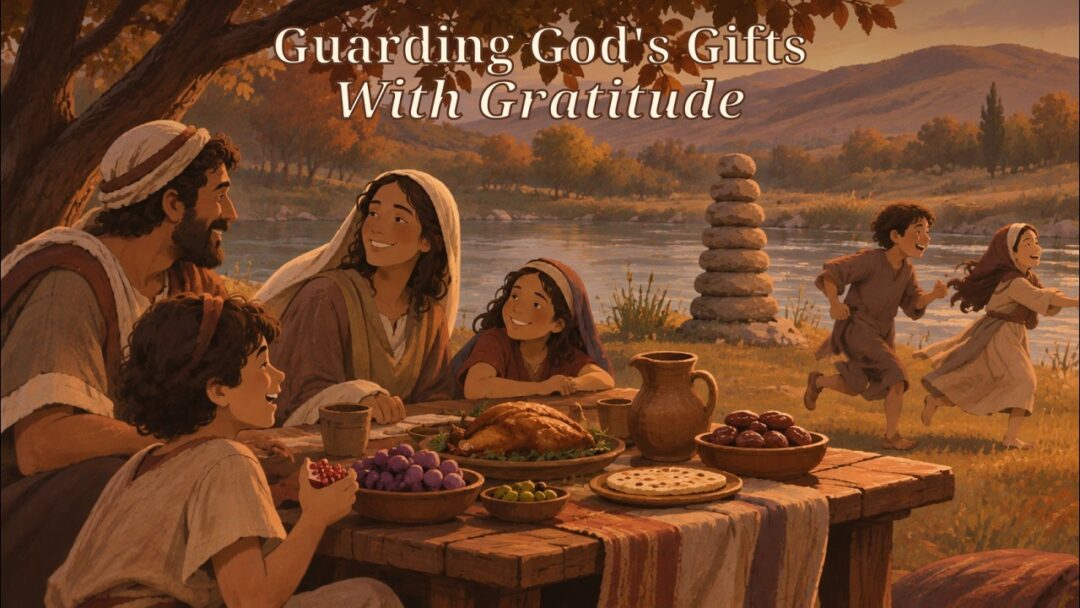
A summary of our Sunday service on November 22, 2026 (Thanksgiving), Psalm 78:1-8. Watch on YouTube.
Thanksgiving is a time to stop and reflect on the good things God has done for us, and it matters that we stop. One of the greatest dangers we face is that the longer we enjoy something good, the easier it becomes to forget how we received it, how much it meant to us, and what it takes to preserve that goodness for the future. Psalm 78 shows us how remembering God’s goodness keeps us faithful to Him and helps us pass that faithfulness on to those who follow us. God wants you to remember His past goodness so that you and your children can continue to receive the blessings of His goodness in the future.
Why Asaph Remembered
When Asaph wrote this psalm, Israel had been in the Promised Land for over 400 years. They had known seasons of remembering God’s goodness and seasons of forgetting it, and they had learned how important it is to set aside time and memorials to thank Him.
Give ear, O my people, to my law: incline your ears to the words of my mouth. I will open my mouth in a parable: I will utter dark sayings of old: Which we have heard and known, and our fathers have told us. We will not hide them from their children, shewing to the generation to come the praises of the LORD, and his strength, and his wonderful works that he hath done.
Psalm 78:1–4
The rest of the psalm recounts how God miraculously provided for Israel, but this introduction tells us why the next generation needed to hear it. Asaph wanted them to know “the praises of the LORD,” so that their gratitude would grow. He wanted them to see “his strength,” because God is not merely a God of ideas or morals but an active, acting God with real power to do real things in this world, and when people see that power, their faith grows. And he wanted them to see “his wonderful works,” because although we cannot look God in the face the way we talk with a neighbor, His attributes are clearly taught through His actions: His goodness, faithfulness, longsuffering and patience, and His mercy and grace to forgive our sins. That is why we should intentionally stop to remember what God has done. It increases our appreciation of His provision, increases our reliance on Him, and reminds us who He really is.
Telling Our Souls Not to Forget
Israel was commanded not to forget the Lord when they entered the land, and they did a few little things to remember Him, but they never grasped that staying thankful takes intentional effort. Even David had to command his own soul: “Bless the LORD, O my soul, and forget not all his benefits” (Psalm 103:2). You might wonder how anyone could forget all of God’s benefits, yet we do it constantly. Gratitude does not come naturally, and if David struggled to find time for it as king, we will struggle all the more in a work, work, work society where so much fights for our attention. So we have to tell our souls not to be so busy that we forget what God has done.
We also forget because we fix our eyes on what we wish were different and overlook the good God has already put in our lives. David names those simple, daily gifts.
Who forgiveth all thine iniquities; who healeth all thy diseases; Who redeemeth thy life from destruction; who crowneth thee with lovingkindness and tender mercies; Who satisfieth thy mouth with good things; so that thy youth is renewed like the eagle’s.
Psalm 103:3–5
Because God gives us these things almost every day, we stop noticing them. If we are alive, we still have some health to be thankful for; if we are not hungry, God has kept us full when we could be starving; and He has forgiven sins we committed without a second thought. Once His help is weeks or months behind us, we become like the Israelites who, freed from slavery, missed the fruit and vegetables of Egypt. At the end of our rope everything works out for good just as the Bible told us it would, and we promise never to stress again, but when the next trial comes we ask, “What will I do now?” We repeat the cycle of thanking God and then getting angry at Him for something else we wanted.
When Blessing Breeds Forgetfulness
If remembering matters this much, we need to see what happens when a people forgets, and that is why God commanded His people to teach their children.
For he established a testimony in Jacob, and appointed a law in Israel, which he commanded our fathers, that they should make them known to their children: That the generation to come might know them, even the children which should be born; who should arise and declare them to their children.
Psalm 78:5–6
The children born in the land would never know the wilderness wanderings or the hard conquest of Canaan. It is a joy for children to be spared that hardship, but it brings a challenge, because it is hard to appreciate God when you have never seen Him do the miraculous. Many of us once scraped by to pay the bills, and after twenty or thirty smooth years we have forgotten those days, while our children never knew them. What one generation learns through hardship, the next may enjoy without knowing what made it possible. If we want our children to appreciate the blessings they inherit, we must teach them about the God who provided them.
Moses warned Israel of exactly this before they entered the land. When they had eaten and were full, built goodly houses, and watched their herds, silver and gold multiply, they were to beware, “Lest…thine heart be lifted up, and thou forget the LORD thy God” (Deuteronomy 8:12, 14). The hungry man remembers his need for food, but when our needs are met we easily forget our dependence on God, and prosperity becomes dangerous when it makes us forget the One who gave it. Israel was blessed because of their gratitude toward God and their living by His principles. God was driving out the Canaanites for their child sacrifice and idolatry and giving their wealth to a people who followed Him, and if Israel forgot Him, they would share the Canaanites’ fate: “As the nations which the LORD destroyeth before your face, so shall ye perish” (Deuteronomy 8:20).
At first Israel took this seriously. After they crossed the Jordan on dry ground, Joshua set up twelve stones at Gilgal, one for each tribe, so that “When your children shall ask their fathers in time to come, saying, What mean these stones?” the fathers could tell them what God had done at the Jordan and at the Red Sea (Joshua 4:21). A father could point to those stones and tell his son that God had given them victory because they were faithful, and that if he were faithful, God would do the same for him. It was a beautiful attempt to keep the knowledge of God’s goodness from dying with one generation.
Gratitude That Must Be Lived
The question is whether it was enough. Judges tells us that “the people served the LORD all the days of Joshua, and all the days of the elders that outlived Joshua,” but then “there arose another generation after them, which knew not the LORD, nor yet the works which he had done for Israel,” and they “forsook the LORD, and served Baal and Ashtaroth” (Judges 2:7, 10, 13). That generation heard the stories at Sabbath meals and they saw the stones, but hearing about God’s goodness from their parents was not the same as knowing it in their own lives. They had not seen God do anything for them, because their parents never set them up to live out God’s will in a way that God would work miraculously for them. When their parents died, they said, in effect, “Those were good stories, but what’s in it for me?”
We cannot assume that those who inherit our blessings will immediately inherit the faith that got us those blessings. Being around memorials of God’s goodness is no substitute for living in gratitude yourself. The Israelites solved all their children’s problems, so their children never had to rely on God and decided they did not need Him. Parents, give your children opportunities to need God, to serve in the church and the community and step out of their comfort zone until they have to say, “God, You’re going to have to carry me the rest of the way.” Asaph’s goal was that the next generation “might set their hope in God, and not forget the works of God, but keep his commandments” (Psalm 78:7). Their fathers became stubborn and rebellious because they thought faithfulness was extra, as though they could stop obeying and keep the blessings, but God had blessed them because He saw their faithfulness.
So what should we teach them to give? The psalmist asks, “What shall I render unto the LORD for all his benefits toward me?” and answers, “I will pay my vows unto the LORD now in the presence of all his people” and “I will offer to thee the sacrifice of thanksgiving” (Psalm 116:12, 14, 17). We pay our vows by keeping His commandments, being a light and serving Him, and when our children serve alongside us, they will see the Lord in ways they never would from the sidelines. We can never repay God or impress Him, but we can devote ourselves to Him in response to His goodness and then sit down with our households to thank Him.
Remembering God’s goodness is essential to preserving our faithfulness. It strengthens our confidence in Him and renews our commitment to obey Him, while forgetting lets us enjoy His blessings as we abandon the principles by which He gave them. This Thanksgiving, let’s do more than count our blessings. Are we trusting God more because of what He has done and teaching those who follow us to do the same? The best way to guard tomorrow’s blessings is by cultivating gratitude today that produces lasting faithfulness to God. God wants you to remember His past goodness so that you and your children can continue to receive the blessings of His goodness in the future.
Recent Comments