
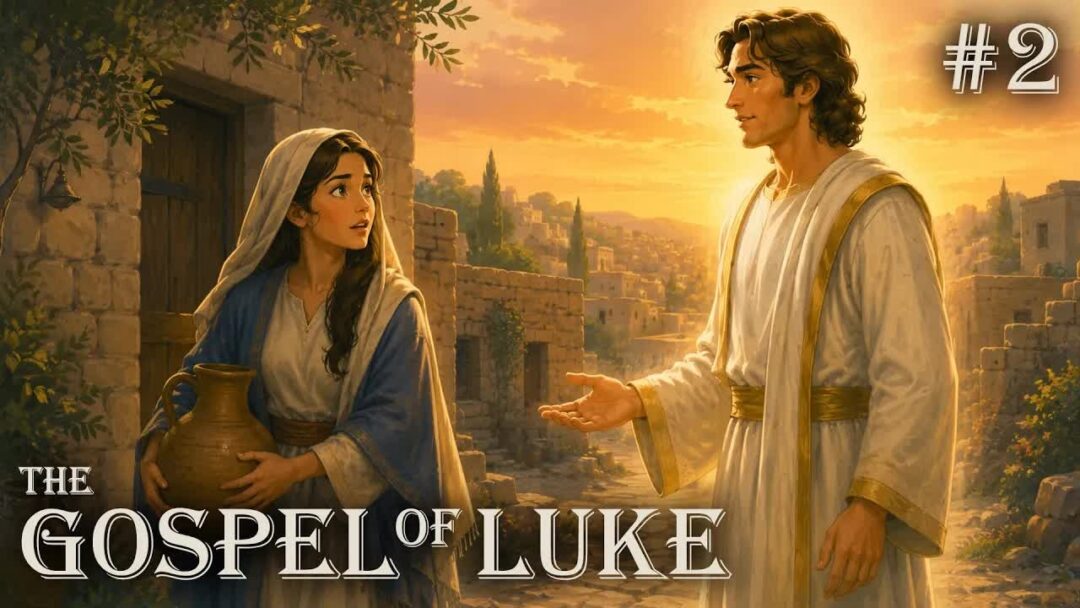
From our Sunday service on May 31, 2026, Luke 1:26-56. This is part 2 of our Gospel of Luke series. Watch the full message: The Handmaid of the Lord – The Gospel of Luke #2 on YouTube.
God brings good to those who are humble. That is the truth this passage sets before us as Gabriel goes to Mary with the news that she will be the mother of the Messiah. After long years of waiting, the promise of God is moving forward, but it does not come first to a person of wealth or public importance. It comes to a young woman in a small town, and her response shows us what humble faith looks like when God’s word is both wonderful and costly.
A Humble Place and a Costly Calling
Gabriel is sent to Nazareth, to a virgin espoused to Joseph of the house of David. Nazareth is not a place people expected to produce something great. It is a small rural town, and Nathanael later asks whether any good thing can come from there. Yet God has chosen this setting for the coming of the Messiah. Mary is also a virgin, which matters because the Messiah is to be born as Isaiah promised. And she is betrothed to Joseph. That betrothal is already a legal bond, not a casual promise that can be set aside lightly. Ending it would require a divorce, and unfaithfulness during that period could bring the most severe consequences.
Those facts help us understand the weight of what she is about to hear. To receive this child will mean trusting God when her reputation, and even her life, may be put at risk. She will also have to trust Joseph, because if he does not believe her, the cost could be terrible. The humility God honors here is not merely a gentle personality. It is a willingness to place herself under His word when obedience will not be easy.
And the angel came in unto her, and said, Hail, thou that art highly favoured, the Lord is with thee: blessed art thou among women. And when she saw him, she was troubled at his saying, and cast in her mind what manner of salutation this should be. And the angel said unto her, Fear not, Mary: for thou hast found favour with God. And, behold, thou shalt conceive in thy womb, and bring forth a son, and shalt call his name JESUS. He shall be great, and shall be called the Son of the Highest: and the Lord God shall give unto him the throne of his father David: And he shall reign over the house of Jacob for ever; and of his kingdom there shall be no end.
Luke 1:28–33
When the angel greets her, Mary is troubled by his words rather than by some terrifying appearance. From her point of view, a man is speaking to her in a way that would be inappropriate for a betrothed woman, and she does not yet understand what he means. Gabriel then makes the meaning clear. She has found favour with God. She will conceive and bring forth a son named Jesus, which means that the Lord is salvation. This child will be called the Son of the Highest, will receive the throne of David, and will reign over a kingdom that has no end. The greeting that first confused her is the announcement of a divine calling.
Faith That Asks, Then Obeys
Mary’s question is a sincere one. She has not known a man, and it would be wrong for her to act as though the time of marriage had already come. How, then, can this happen? She is not refusing the word; she wants to understand the path she is being asked to walk. Gabriel answers that the Holy Ghost will come upon her and the power of the Highest will overshadow her. The child will be called the Son of God because His conception will be the work of God Himself.
And the angel answered and said unto her, The Holy Ghost shall come upon thee, and the power of the Highest shall overshadow thee: therefore also that holy thing which shall be born of thee shall be called the Son of God. And, behold, thy cousin Elisabeth, she hath also conceived a son in her old age: and this is the sixth month with her, who was called barren. For with God nothing shall be impossible. And Mary said, Behold the handmaid of the Lord; be it unto me according to thy word. And the angel departed from her.
Luke 1:35–38
God also gives her something she can go and see. Elizabeth, known to be barren, is already six months with child. What has been impossible with man is possible with God. That is the meaning of the words we often remember: with God nothing shall be impossible. Every word He speaks, He is able to perform. Mary does not continue to argue about the mechanism or delay until every difficulty has been removed. She answers as a servant: Behold the handmaid of the Lord; be it unto me according to thy word. She places herself under His authority and receives what He has said.
That yes is not cheap. Pregnancy under these circumstances could bring shame, misunderstanding, and even the danger of death. Later we see how heavy that cost could be. Even her own children, during Jesus’ ministry, did not believe He was the Messiah, which means they did not believe their mother’s account of His birth. For years she would carry a testimony others refused to receive. Yet she still said, Let it be done according to Your word. Humble faith is not the absence of cost. It is the decision to trust God when the cost is already in view.
Confirmation and a Song of Humility
Mary then goes with haste to visit Elizabeth, just as she has been told. The meeting itself becomes a confirmation of the promise. When Elizabeth hears Mary’s greeting, the child leaps in her womb, and Elizabeth, filled with the Holy Ghost, speaks words Mary has already heard from Gabriel. No one has had to explain the situation to her. God is showing Mary that this is His work:
And it came to pass, that, when Elisabeth heard the salutation of Mary, the babe leaped in her womb; and Elisabeth was filled with the Holy Ghost: And she spake out with a loud voice, and said, Blessed art thou among women, and blessed is the fruit of thy womb. And whence is this to me, that the mother of my Lord should come to me? For, lo, as soon as the voice of thy salutation sounded in mine ears, the babe leaped in my womb for joy. And blessed is she that believed: for there shall be a performance of those things which were told her from the Lord.
Luke 1:41–45
Elizabeth calls her the mother of her Lord and blesses her because she has believed. There shall be a performance of the things told her from the Lord. The contrast with Zacharias is plain. He doubted and was left unable to speak. Mary believes, and she is commended. Though she could not yet see how everything would work, she received God’s word as true and acted on it. That faith is now being confirmed in the presence of another servant who has also seen God do what seemed impossible.
Mary’s response is praise. She magnifies the Lord and rejoices in God her Saviour, because He has regarded the low estate of His handmaiden. She knows what she is: a poor woman from a town of little reputation, someone the world would not have noticed. Yet God has seen her humility and chosen to do a great work through her. All generations will call her blessed, not because she has made herself great, but because the Mighty One has done great things for her.
And his mercy is on them that fear him from generation to generation. He hath shewed strength with his arm; he hath scattered the proud in the imagination of their hearts. He hath put down the mighty from their seats, and exalted them of low degree. He hath filled the hungry with good things; and the rich he hath sent empty away. He hath holpen his servant Israel, in remembrance of his mercy; As he spake to our fathers, to Abraham, and to his seed for ever.
Luke 1:50–55
She then teaches the pattern of God’s dealings. He shows mercy to those who fear Him. He scatters the proud, puts down the mighty, and exalts those of low degree. He fills the hungry with good things and sends the rich empty away. This is not a promise that the poor will receive every comfort they want. It is the truth that God gives what is good to those who come to Him in humility, while those who cling to pride and hoarded riches may be left with nothing more than what they have already chosen. Mary also connects her blessing to God’s faithfulness to Israel. He has remembered His mercy and His promise to Abraham. She does not keep the joy as a private possession. If God has done this for someone so lowly, He can be trusted to keep His word to others as well.
Mary stays with Elizabeth about three months before returning home. Soon she will have to face Joseph and explain what has happened. But the heart of the account is already clear. God does not work according to the world’s honor of power, wealth, and status. He delights to bless those who humbly trust Him. Mary did not understand the whole plan, but she knew the calling would be costly, and she still placed herself in His hands. Because she believed that if God had spoken, He would perform it, God brought good to her, and through her He brought Jesus Christ into the world.
Will we humble ourselves as she did? Will we trust His word when we do not see the whole plan, and obey even when the calling is difficult? God wants you to know He brings good to those who are humble. Will you dedicate yourself to follow Him humbly today?
Recent Comments