
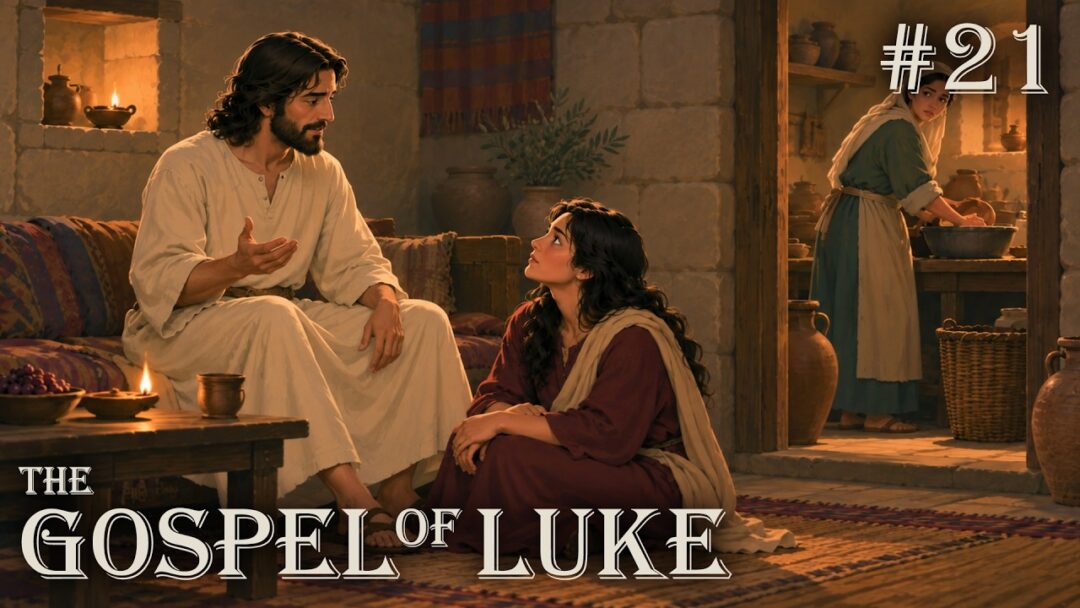
From our Sunday service on October 25, 2026, Luke 10:25-11:13. This is part 21 of our Gospel of Luke series. Watch the full message: Three Pillars of Faithful Discipleship on YouTube.
I want you to see how three lessons in Luke 10:25-11:13 belong together. We meet religious men who know God’s law but will not help a dying man, a woman whose serving keeps her from listening to Jesus, and disciples who recognize that they need to learn to pray. Each shows us something that can be missing even when we are doing something right. Knowing the Scriptures, keeping busy, and following Jesus about are not enough by themselves. Faithful discipleship requires service, study, and prayer, because each strengthens the others. God wants you to strengthen your relationship with Him and others through service, study, and prayer.
Service: Becoming a Neighbor
The first lesson begins when a lawyer, an expert in the Mosaic law, stands up to test Jesus. He asks what he must do to inherit eternal life, but Jesus turns the question back on him, asking what the law says and how he understands it. That distinction matters. You could memorize the Bible from cover to cover, and that would be great, but if you don’t know what its words mean, the memorizing won’t do you any good. The lawyer knows the words well enough to give the right answer:
And he answering said, Thou shalt love the Lord thy God with all thy heart, and with all thy soul, and with all thy strength, and with all thy mind; and thy neighbour as thyself.
Luke 10:27
Jesus tells him he has answered correctly. If you loved God and your neighbor that way throughout your entire life, you would never have sinned; you would be perfect, just like Jesus. What are the chances we actually pull that off? Zero. None of us can live up to that standard perfectly. But the lawyer wants to justify himself, so he asks who his neighbor is. Some religious leaders defined the word narrowly, excluding Samaritans and other non-Jews, and he wants to know whether Jesus will accept that definition. Jesus answers with a story that makes him look at the question differently.
A man traveling from Jerusalem to Jericho falls among thieves who strip him, wound him, and leave him half dead. A priest sees him and passes on the other side; a Levite comes, looks, and does the same. These men knew God’s law, which required them to help even a brother’s animal injured by the roadside. If I am supposed to save my brother’s donkey, I should certainly save my brother. Yet when someone needed them, they treated him as an inconvenience and walked away from the responsibility their knowledge should have made plain.
The Samaritan does what those religious men will not do. His compassion leads him to bind the man’s wounds, put him on his own animal, and bring him to an inn, where he stays to care for him. When he must leave, he pays the innkeeper and promises to cover whatever more is needed. Helping costs him time, comfort, and money, and the injured man might not even have wanted to speak to him under other circumstances. None of that stops him from doing what his neighbor needs. Jesus then asks the lawyer to judge what he has heard:
Which now of these three, thinkest thou, was neighbour unto him that fell among the thieves? And he said, He that shewed mercy on him. Then said Jesus unto him, Go, and do thou likewise.
Luke 10:36–37
The lawyer has to acknowledge that the person he excluded was the one who acted as a neighbor. He wanted to know which people qualified for his help; Jesus shows him that he needs to become the person who helps. So stop asking who your neighbor is, and go be a neighbor like the Samaritan. Don’t serve people you think deserve to be served; serve those who need to be served. The question becomes much simpler when we ask, ‘Does this person need me?’ If so, I need to go serve that person, helping and caring for him no matter what it costs me.
Study: Having Something to Give
Service of that kind is necessary, but Martha shows us what happens when serving takes the place of listening to God. She welcomes Jesus into her home, while her sister Mary sits at His feet as a student, hungry to hear His word. Martha has so much to do for her guests that she becomes distracted, anxious, and frustrated. Finally she asks Jesus whether He cares that Mary has left her to serve alone. She wants Him to send Mary away from His lesson to help her, because the preparations have become more important to her than the truth being taught in her own home.
And Jesus answered and said unto her, Martha, Martha, thou art careful and troubled about many things: But one thing is needful: and Mary hath chosen that good part, which shall not be taken away from her.
Luke 10:41–42
Both physical and spiritual service are important, but they are not equally important. Picture a church fellowship where we are so concerned about the food, the table decorations, and everything running smoothly that we miss the Word of God. We may have made everything look good, but when the service is over, we have given people nothing lasting. That is the difference between the sisters’ choices. Martha would have a nicely decorated dinner, but Mary would have learned truth she could use for the rest of her life. She wanted to know how to be more like her Lord, and that would remain with her after He left.
I want us to recognize how easily we can become like Martha. We can go through the motions of serving, worried about the presentation and angry about the work, while neglecting the relationship with Christ on which ministry depends. Never serve in an area where your heart is not in it, because serving that way will only cause more harm than good. We need to give people eternal, valuable things, and we cannot do that by neglecting God’s Word ourselves. Serving at the cost of study is trying to serve out of an empty bucket. We must keep filling ourselves with His Word so that our service comes from spiritual intimacy rather than mere obligation.
Prayer: Depending on Our Father
The disciples had listened to Jesus and served alongside Him, yet they also recognized something they still needed. They had seen Him pray and seen God work through Him, so they asked Him to teach them to pray. Their request brings us to the third pillar, because learning and serving do not mean we can depend on our own strength. Jesus gives them a model that teaches us what to seek from our Father:
And he said unto them, When ye pray, say, Our Father which art in heaven, Hallowed be thy name. Thy kingdom come. Thy will be done, as in heaven, so in earth. Give us day by day our daily bread. And forgive us our sins; for we also forgive every one that is indebted to us. And lead us not into temptation; but deliver us from evil.
Luke 11:2–4
We begin by praising God and asking that His name be set apart, both in our lives and in the world. He must not be merely another part of life, but the most important thing to us and to others. That leads us to ask for His kingdom and His will, rather than our own desires or the world’s. We are asking for earth to be a little more heavenly each day. When we ask for daily bread, we ask for enough for our needs, not excess or luxury, and we ask for the contentment to receive what He provides. We seek forgiveness while forgiving those who have wronged us, and we ask to be delivered from evil so that we move away from sin and remain obedient to Him.
Jesus wants us to understand how willing God is to answer when we pray this way. He tells of a man whose unexpected guest arrives at night when he has no bread. The man goes to a friend’s house and asks for three loaves, but his friend is in bed with his children and does not want to get up. Even that reluctant friend will eventually give him what he needs if he keeps asking. Jesus uses that familiar inconvenience to teach us not to stop knocking:
And I say unto you, Ask, and it shall be given you; seek, and ye shall find; knock, and it shall be opened unto you. For every one that asketh receiveth; and he that seeketh findeth; and to him that knocketh it shall be opened.
Luke 11:9–10
Pray like Jesus prays, and your prayer will be answered every single time, no exceptions. God is much better than the friend in the story: He is a perfect Father, and a loving father would never withhold food from his son when his son needs it. If we know how to give good gifts to our children, why are we so afraid to ask our heavenly Father for what we need? If you want to serve well, ask Him to help you serve well. As a loving Father, He will help you do that every single time. We have no excuse not to serve the Lord, because we can pray, and God will help us.
Strengthen What Is Missing
The three lessons show us why we need all three pillars. The religious men had knowledge without service; Martha had service while neglecting study; the disciples were learning and serving but still needed to grow in prayer. Through study we learn God’s will, through prayer we depend on His strength, and through service we put what we have learned into practice by showing His love to others. Neglect one, and the other two suffer. So ask yourself which is weakest in your life. Are you studying God’s Word, serving others, and regularly seeking Him in prayer? God wants you to strengthen your relationship with Him and others through service, study, and prayer. Dedicate yourself to strengthening these three pillars of faith.
Recent Comments