
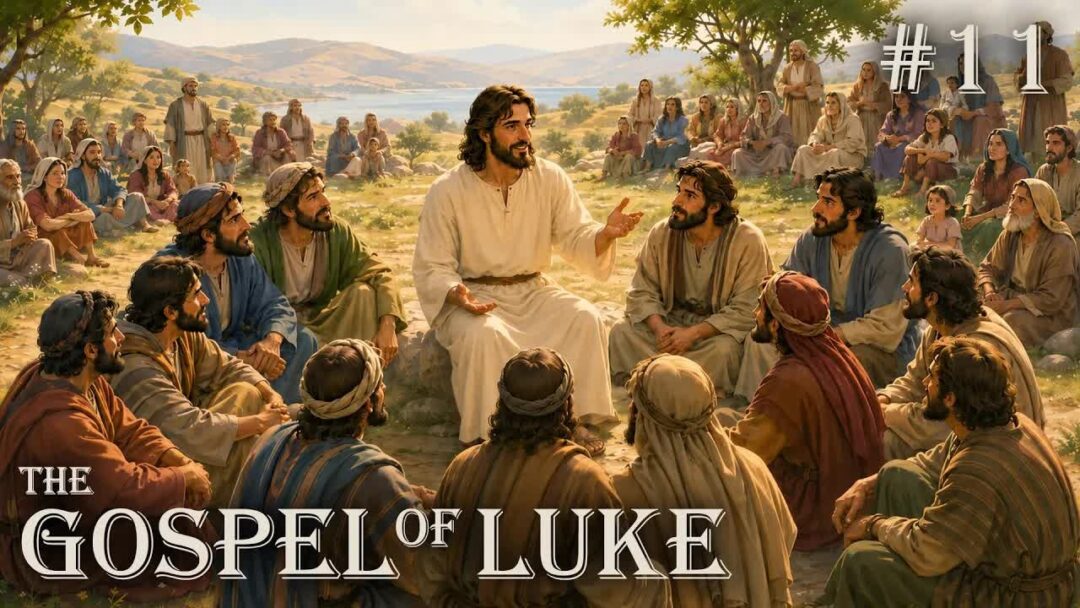
From our Sunday service on August 9, 2026, Luke 6:12-36. This is part 11 of our Gospel of Luke series. Watch the full message: Training the Twelve: Part I – The Gospel of Luke #11 on YouTube.
Jesus is preparing His disciples for something they cannot do merely by listening to a few messages. They will represent Him, carrying His teaching into places He does not personally visit. Before they can be sent, they need to understand what following Him means. They must become the kind of people whose treatment of others reflects the God they serve. That is where this passage leads us, and it is the truth I want us to carry into our own lives: God wants you to be merciful like He is merciful.
Prepared to Represent Him
The preparation begins with Jesus Himself in prayer. Before choosing the twelve, He goes into a mountain and spends the night praying to God. This is a serious moment in His ministry, and He does not treat it casually. These men will carry His name beyond His earthly ministry, and the task before them is enormous. We see the Son alone with the Father before He calls them to this work:
And it came to pass in those days, that he went out into a mountain to pray, and continued all night in prayer to God. And when it was day, he called unto him his disciples: and of them he chose twelve, whom also he named apostles;
Luke 6:12–13
I do not pretend to understand every limitation involved in the incarnation. But I do want us to recognize how important prayer is in the life of Jesus. He is fully God and fully man, and yet He takes time to be alone with the Father. How much more do we need that time? The choice of these men matters, and Jesus gives that choice the attention of a whole night in prayer.
Luke calls them both disciples and apostles, and the distinction helps us understand their responsibility. A disciple is a student; an apostle is a sent representative, an envoy. From among His students, Jesus chooses twelve to represent the kingdom of heaven. They are not an impressive collection of the people we might consider best qualified. There are fishermen, a tax collector, and a man called the Zealot. But Jesus equips the people He calls. Their ability to represent Him will depend on learning His teaching and letting that teaching form the way they live.
What Following Him Will Cost
When Jesus comes down with them, a great crowd is there, bringing sickness and the need for deliverance. He heals them, but His teaching is directed to His disciples. They are the ones He is preparing for ministry. His first words do not promise them an easy road. They have left work and security to follow Him, and He speaks to the sacrifices that discipleship involves. Wealth, comfort, happiness, and public approval will not be the standards by which they can judge whether following Him is worthwhile:
And he lifted up his eyes on his disciples, and said, Blessed be ye poor: for yours is the kingdom of God. Blessed are ye that hunger now: for ye shall be filled. Blessed are ye that weep now: for ye shall laugh. Blessed are ye, when men shall hate you, and when they shall separate you from their company, and shall reproach you, and cast out your name as evil, for the Son of man’s sake. Rejoice ye in that day, and leap for joy: for, behold, your reward is great in heaven: for in the like manner did their fathers unto the prophets.
Luke 6:20–23
The blessing on the poor speaks directly into the lives of men who have left their employment to follow Christ. Their pursuit of wealth has given way to service in His kingdom. Jesus tells them that they have not made a foolish exchange. What they receive in the kingdom of God is greater than the wealth they have surrendered. The same is true of comfort. There will be hunger and uncertainty in their ministry, but He promises to sustain them. Discomfort will be real; it does not mean He has abandoned the people He sends.
Neither will His service spare them sorrow or conflict. Serving people takes us into circumstances that break our hearts. The disciples will know the grief of offering God’s truth to people who refuse it. Yet their ultimate reward is joy over having done the Father’s will, even when obedience brings tears. Rejection for Christ’s sake is not evidence that their mission has failed. The prophets before them were also rejected. Jesus calls them to look beyond the painful response of the moment to the reward that awaits faithful service.
The blessings become clearer when Jesus places the opposite choices beside them. He pronounces woes on those who choose wealth, indulgence, pleasure, and popularity instead of following Him. These are not merely less satisfying ways to spend a few years. The stakes are eternal. Those who pursue these things over Christ and reject His call will not make it to heaven. He does not offer His disciples the comforting idea that they may set Him aside and still gain everything that matters. He warns them plainly:
But woe unto you that are rich! for ye have received your consolation. Woe unto you that are full! for ye shall hunger. Woe unto you that laugh now! for ye shall mourn and weep. Woe unto you, when all men shall speak well of you! for so did their fathers to the false prophets.
Luke 6:24–26
This is not a command never to laugh. The issue is what we choose when pleasure competes with obedience. Nor can religious popularity make rejection of God safe. False teachers have often received the praise of people who like what they hear. But twisting God’s Word to secure admiration does not win His approval. Those who choose popularity over following Him will share the condemnation of the false prophets. Praise now cannot replace the blessing of God or cancel the judgment to come.
Mercy When There Is Nothing in It for Us
Jesus does not leave these blessings and warnings as ideas for His disciples to admire from a distance. He shows them what obedience looks like, and His practical command reaches the heart of the whole lesson: love your enemies. Doing that turns us away from living entirely for ourselves. We cannot make our own comfort and advantage the center of everything while sincerely giving ourselves to people who hate us. The mercy He commands is not simply a pleasant feeling toward people who already make us happy:
But I say unto you which hear, Love your enemies, do good to them which hate you, Bless them that curse you, and pray for them which despitefully use you.
Luke 6:27–28
He describes a response very different from the instinct to retaliate. If someone strikes us, we are not to answer evil with evil. We are to show mercy and leave judgment to God. If someone takes a garment, Jesus directs our attention beyond revenge to the other person’s need. We should be willing to help, not merely determined to recover what we lost. This is not a clever way of protecting our honor or transferring shame to the offender. Such an interpretation misses the reason Jesus gives: we are to be merciful because our Father is merciful.
And unto him that smiteth thee on the one cheek offer also the other; and him that taketh away thy cloke forbid not to take thy coat also. Give to every man that asketh of thee; and of him that taketh away thy goods ask them not again. And as ye would that men should do to you, do ye also to them likewise.
Luke 6:29–31
That principle reaches into ordinary situations. If someone is stealing bread because his family is starving, the merciful response is to see the hunger and offer help rather than seek punishment. If someone asks for help, we should be willing to give where we can. Think about the times you struggled and wished somebody had stepped in. You can take that remembered need and look for someone now facing what you once faced. Then do for that person what you wished someone had done for you. That is a practical way to treat others as we would want to be treated.
The Family Resemblance
Why does Jesus place so much emphasis on people who may give us nothing back? Because it is easy to mistake an exchange for mercy. When we love only those who love us, their love is part of what we expect to receive. When we help someone because he has already helped us, we may simply be repaying a debt. When we give only because we expect a return, we have made a business arrangement. Jesus calls us beyond that calculation:
But love ye your enemies, and do good, and lend, hoping for nothing again; and your reward shall be great, and ye shall be the children of the Highest: for he is kind unto the unthankful and to the evil. Be ye therefore merciful, as your Father also is merciful.
Luke 6:35–36
An enemy gives us no ordinary reason to expect affection, gratitude, or repayment. Loving that person therefore shows something that a transaction cannot show. We have no debt to discharge and no personal advantage to secure, yet we choose to do good. God promises His blessing on that mercy, but its deepest significance is the resemblance to Him. He is kind to the unthankful and the evil. He shows mercy every day to people who do not deserve it. If we are learning to follow Him, we must learn to see and treat people in that light.
This was preparation for men who would represent Jesus to the world, and the same principle applies to us as His church. People should be able to see our heavenly Father in the way we treat them, especially when they have hurt us. The very moment when someone gives us a reason not to show mercy may be our greatest opportunity to show what God is like. Following Jesus does not mean waiting until kindness becomes easy or profitable. God wants you to be merciful like Him. So will you choose to be a person who shows mercy today?
Recent Comments