
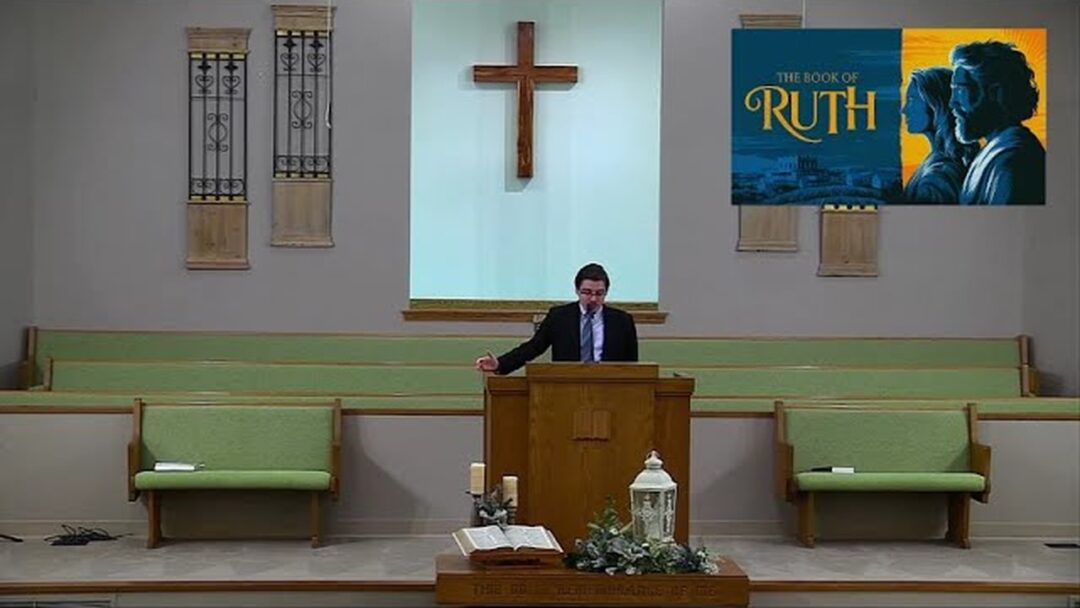
From our Sunday service on February 2, 2025, Ruth 1. This is the first message in our Book of Ruth series. Watch the full message: When Life Falls Apart – Ruth Series #1 on YouTube.
This is a story about a woman who loses everything. Today we’re not talking much about Ruth, though she’s in it. We’re mostly focusing on Naomi and her family, and how they make mistakes that cost her greatly. If you get anything from this message, I want you to understand that God wants you to be where you’re supposed to be.
Leaving Where God Put Them
The Book of Ruth takes place sometime around 1350 to 1050 B.C., likely near the end of that, not far from the time of the Trojan War or Ramesses II in Egypt. Israel had conquered Canaan under Joshua, but they left remnants there, fell into those nations’ idols, and God brought judgment. In Ruth we see a famine in the land because of their sin. God called unelected judges as military leaders, arbiters, and spiritual reformers. They were to view God as their King. There was no central government.
Now it came to pass in the days when the judges ruled, that there was a famine in the land. And a certain man of Bethlehemjudah went to sojourn in the country of Moab, he, and his wife, and his two sons. And the name of the man was Elimelech, and the name of his wife Naomi, and the name of his two sons Mahlon and Chilion, Ephrathites of Bethlehemjudah. And they came into the country of Moab, and continued there.
Ruth 1:1–2
That word “sojourn” is very specific. It means to lodge temporarily as a foreign resident, kind of the idea of a refugee. Elimelech means “my God is King.” Because Israel had no king, their King was God, so this man’s parents dedicated him to that idea. They were godly people, but he himself started to draw away. Then we get two really sad names. You would not choose Mahlon and Chilion for a baby. Mahlon means “sickly.” Chilion means “pining” or “wasting away.” From the beginning of their abandonment, their life takes a turn for the worse.
They lost God’s protection. God called the Israelites to possess the land, not abandon it. Elimelech said, “There’s difficulty here, and rather than trying to turn them back, I’ll go to Moab where they have food, and I’ll raise my family there while my people suffer.” They left Bethlehem, which means “the house of bread,” an agricultural center. This is similar to Jonah, who goes the opposite way from Nineveh when God calls him. It was illegal to marry Moabites, pagans who worshiped false idols, in direct violation of Deuteronomy 7:3 and 23:3.
Was the immediate suffering divine punishment? I believe so, but it’s hard to say with 100% certainty. We can say that God did not protect them from the consequences of their own actions. It’s like the people who didn’t drive out the Canaanites: “I would have taken care of those difficulties if you followed Me, but My protection is gone.” That word “left” means to remain on your own. Had she been in Israel, she would have had a levirate marriage, a safety net. Out of the nation, she remained alone with her two sons.
Hey, that’s our series’ main character, and she’s a pagan from Moab. Interesting. I thought she would be somebody better. Nope, that’s where we start. “They dwelled there about ten years.” Compare that with the first verse: they were going to sojourn, to lodge temporarily. A seasonal stay to wait out that famine became a decade. They got comfortable in this sinful nation and said, “It’s not so bad here. It’s a lot of effort to move back to Bethlehem.” Then Mahlon and Chilion, who had been sick since birth, both died. Now Naomi is alone. She’s lost her husband and her two kids, and all she has left are her daughters-in-law.
Naomi Heads Home
While she was in Moab, she heard that the LORD had visited His people in giving them bread. That word “visit” is kind of like a caretaker. After she left she found out God was going to provide for Israel anyway. If she had just stuck it out a little longer, there would have been bread in the house of bread. Like many wise women, Naomi realizes she had placed herself outside of God’s will.
Jewish tradition says they went about four miles outside the city before Naomi turned around and said, “Okay, you’ve got to stop.” Orpah and Ruth are still pagans, and as a single woman in Israel you’d be scraping by on the corners of fields with no hope of marriage. Naomi is being very honest, looking at their needs, not her own. She prays that they may find rest, each in the house of her husband. Marriage is supposed to bring rest. If yours doesn’t, there’s something you need to work on. Then she says, “Am I able to have children again? Even if I could, are you going to wait twenty or thirty or forty years? Following me is a dumb decision.” It grieves her, because this is partially her fault. Had they not left Israel, these women wouldn’t be widows. God forbid we ever feel that being part of someone’s life has just made it worse.
And Ruth said, Intreat me not to leave thee, or to return from following after thee: for whither thou goest, I will go; and where thou lodgest, I will lodge: thy people shall be my people, and thy God my God: Where thou diest, will I die, and there will I be buried: the LORD do so to me, and more also, if ought but death part thee and me.
Ruth 1:16–17
That word “kissed” carries the idea of a goodbye kiss. Orpah says, “I’m going to listen to you, Naomi, and I’ll leave you.” But Ruth “clave unto her,” the idea of gluing herself, adhering to Naomi. Ruth makes a very large commitment. Naomi may not have been living for God for the last ten years, but Ruth sees the faith Naomi has to go home alone. Naomi probably knew a lot of people in Moab who would have taken care of her. Even the pagan nations had laws for helping widows. But Ruth doesn’t just say, “I’ll follow you where you go.” She says, “I want your God to be my God.” At this point Ruth is no longer a Moabite but joins the nation of Israel, because she makes a statement of faith in the true God. Now she’s valid for marriage, as long as people believe that what she says is true. “The LORD do so to me, and more also” is a statement of promise in the ancient world, like “May the gods do worse to me.” It’s very serious: if I abandon you, I want God to be harder on me than He was on you. That was enough to shut Naomi up. The Hebrew almost has the idea of closing her mouth the way you would shut a door.
Naomi Returns Empty
They get into Bethlehem and the city is moved about them. They recognize Naomi and yet don’t. She left young and married, probably with enough wealth to travel. Now she comes back widowed, with a daughter-in-law, no goods, no home. “Is this Naomi?”
And she said unto them, Call me not Naomi, call me Mara: for the Almighty hath dealt very bitterly with me. I went out full, and the LORD hath brought me home again empty: why then call ye me Naomi, seeing the LORD hath testified against me, and the Almighty hath afflicted me?
Ruth 1:20–21
“Don’t call me Naomi anymore. Naomi is a good name. Call me Mara.” That’s the word used when the water was bitter in the wilderness after they fled Egypt, that bitter, nasty flavor you want to spit out of your mouth. “The LORD hath testified against me” means He stood up before the judge and gave an account that she had done something wrong. And “afflicted” means to shatter or break into pieces. Sometimes God has to shatter us when we run away from Him. She left so blessed. The famine wasn’t anything against her. Had she stayed, that blessing would have come. She left blessed and returned broken.
Ruth is an example of hope. Naomi’s relationship with Israel was one of convenience: when Israel is blessed, I’ll stay, but when Israel is cursed, I’ll go. Ruth did the opposite. I think it’s appropriate that this is a mother-in-law relationship. There are many jokes about mothers-in-law. Ruth had the option to get rid of her, and no one would have thought anything of it. But she says, “Maybe that means I never get married again, maybe I’m never wealthy again, maybe I’m homeless, but I’m going to take care of her because she’s my family.” How many of us would do this for our own mother-in-law, or for our friends and family?
When life falls apart, you have to ask yourself why. There are usually two reasons: either you’re running away from God and He’s trying to get your attention, or God is allowing you to be tested for your growth, as you see in the Book of Job. Hardship comes either way. But it’s usually very obvious in your heart if you’re running from God. I don’t think anybody running from God doesn’t know they’re doing it. Waiting it out isn’t going to work. Naomi tried to wait it out. But no, God will win. It’s better to turn now. When I was training to be a pastor, I didn’t really want to do it at first. God called me to it, but I wanted to run away. It wasn’t until a month before Bible college that I thought, “Do I want to waste four years and then go do it, or get right with God now?” If I had waited, God wouldn’t have given up. He would have said, “Now you’ve wasted four years, go spend four more.” I’m so thankful I turned before I lost everything. Naomi did enjoy Moab for a bit. That year when food was scarce, they did have more on the table. But sin only has pleasure for a season.
God wants you to be where you’re supposed to be. Are you where God wants you to be today, or have you put Him off? Are you following God’s path, or have you stood still?
Recent Comments