
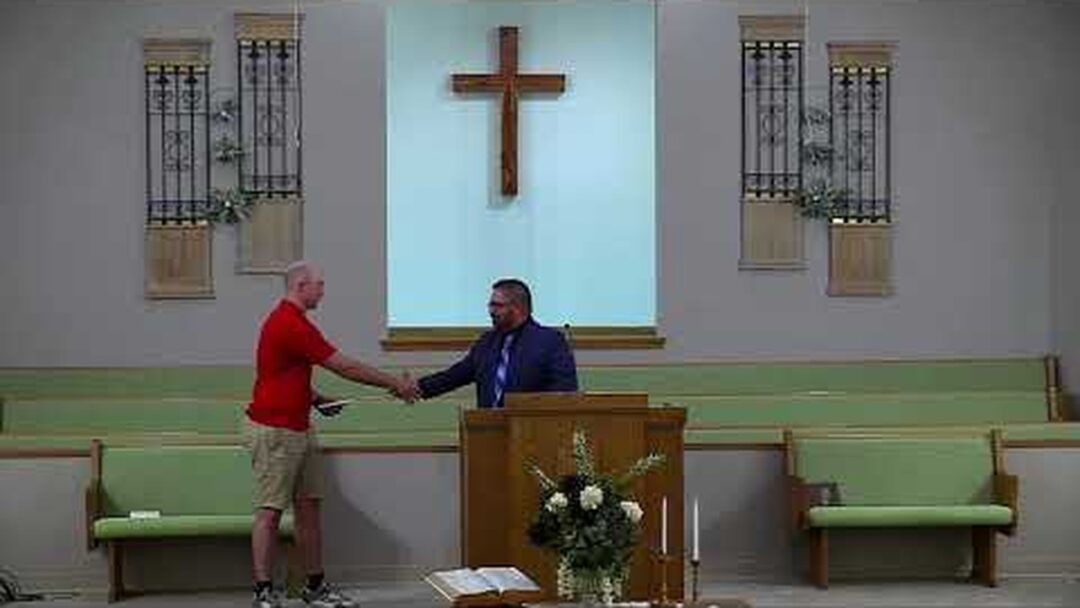
From our Journey Through James series, our Sunday service on June 4, 2023, James 4 (with a quick detour to Hebrews 4). Watch the full message: A Journey Through James 4 on YouTube.
A Quick Detour: The Word Is Alive
Usually when I’m with teens I share anything I found in my personal Bible study, on passages I’ve read a million times, where something didn’t stick out to me until just this last time. I like to emphasize that we are never done learning. Even those with a master’s degree still have something to learn from the Bible. So before we get into the message, I’m taking a quick detour to Hebrews 4.
For the word of God is quick, and powerful, and sharper than any twoedged sword, piercing even to the dividing asunder of soul and spirit, and of the joints and marrow, and is a discerner of the thoughts and intents of the heart.
Hebrews 4:12
This verse is very familiar to us. When I went to college I learned how to study Greek, and I was reading online what other people had written, and somebody had made a translation of it that said the word of God is “alive and active.” I thought, “That’s not what it says. It says quick, you know, fast.” So I got out my language study tools and looked it up, and the word is zoe. It clicked in my head that I had been reading this verse wrong my entire life. The Bible says God will quicken the dead, meaning He will make the dead alive. That word quick is not quick as in fast. It is life. And the word powerful is energia, which might sound familiar: energy, like when you plug something in and it is active. Read with that understanding, it says so much more: the word of God is alive and active, sharper than any two-edged sword.
That blew my mind. How many times have I read, studied, and taught on that verse, and yet I didn’t have the full scope? As believers we are never done learning about the Bible. Any pastor who says he did all his studying in Bible college and doesn’t need to study anymore is wrong. There is always more to learn, and the Bible is full of in-depth knowledge for us to take into our lives.
Where We Have Been in James
We began our journey through the book of James a month or so ago. James was written by the half-brother of Jesus Christ, the pastor of the Jerusalem church, to a scattered church under persecution from the Roman Empire, facing famine, persecution, and poverty. There are twelve lessons in this book, and today we will look at three. To remind you where we have been:
Lesson one: God wants you to show love, not favoritism. People in the church were favoring the rich and powerful, giving them good seats and pushing the poor and the less good-looking into the back, where they would be ignored. We need to show love to everyone, just as Christ did to us.
Lesson two: God wants you to show genuine faith through your works. Many in the church talked about what the Bible said but did not do it. They came to church every week and listened to the words, but the words never changed their hearts. So James says to start living the word instead of just talking about it.
Lesson three: God wants you to control your tongue. It is a fire, a world of iniquity, set on fire of hell, and one slip-up can ruin our lives. We should not be many masters, because we are accountable for the words we say.
Lesson four: God wants you to have a wise lifestyle. The behavior you have before others should represent Christ well.
Today’s three lessons are that God wants you to be at peace with your Christian family, that God wants you to avoid condemning others, and that God wants you to control your arrogance and humble yourself.
Lesson Five: Be at Peace with Your Christian Family
From whence come wars and fightings among you? come they not hence, even of your lusts that war in your members?
James 4:1
James is talking about agreements and disagreements in the church. We often forget the context: this book is not written to everyone in Rome or to believers and unbelievers. It is written only to believers, to his scattered flock. “Wars and fightings among you” is a conflict inside the church, a church that is not getting along. If we are going to solve fighting in the church, we need to know the root cause, and James says it is “your lusts that war in your members.” Lust here covers all the different parts of your body and the different ways you can lust, the lust of the eyes, the pride of life. All these desires are putting you at odds with your Christian brothers and sisters.
Ye lust, and have not: ye kill, and desire to have, and cannot obtain: ye fight and war, yet ye have not, because ye ask not. Ye ask, and receive not, because ye ask amiss, that ye may consume it upon your lusts.
James 4:2–3
Verses 2 and 3 are the strong point, but they can trip us up with all the “and, and, and.” It is important to remember that the Bible was not written in English. When it was written there were no commas, semicolons, or punctuation of any kind, and in the Hebrew and Greek there were not even spaces between words. The commas and semicolons we have today are there to help us. When the King James translators had a differing opinion on how to translate something, they would translate it as you would read it in the original language. So we have a long series of “ands,” and we need to focus if we want to absorb it, because as English speakers we like a subject-verb-object order, and that is not how the original authors wrote.
Let’s break it down as a step-by-step process, paraphrasing the structure. James is asking where this starts and where it ends up.
Step One: You Lust and Do Not Have
This is where we all start. You have a lust or a desire, or some people would call it a passion, something you are very passionate about. It is not always a sin of lust. It can be any strong desire. You can be passionate about cars, say a Lamborghini or a Mustang, and lust after it. It could be a sensual lust, a person you are lusting after. It could be anything in our lives. The initial problem is that we have these desires to obtain things.
In America we are more materialistic than most cultures, so this is more true of us than of a lot of people in Rome at the time, especially the Jews, whose Judaism taught them not to be materialistic. From the time you are born, they give you a toy like a McDonald’s playset that teaches you to work and get money before you are even old enough to know what a job is. James says the church’s problem is that you lust and don’t have, and this is where everything goes wrong. The Bible says godliness with contentment is great gain, and the church there had not quite figured that out.
Step Two: You Kill and Desire to Have
What does that lust make you do? “Ye kill, and desire to have, and cannot obtain.” Are church members literally going out and killing other church members? No. They were not killing each other. Look at 1 John 3:15:
Whosoever hateth his brother is a murderer: and ye know that no murderer hath eternal life abiding in him.
1 John 3:15
You see this concept in multiple books of the Bible: hating your brother is the same as killing your brother. The people were lusting for things others had, and because they didn’t have them, they hated their brothers and sisters. Your lust causes anger against your brother and the desire to destroy him, and you still can’t obtain what you wanted, so why give it so much energy in the first place?
Step Three: You Fight and War, but You Do Not Have
This is a paraphrase, but you do not have it because you do not ask for it. In your heart you are at war with other church members because you are jealous, envious, and angry at them for having something you don’t have. It might not be a material thing. You can be the best parent in the world and your kids still go their own path, and then you see someone else in the church with the family relationship you always wanted. It might make you prejudiced toward them, or a little more eager to call out flaws, because inside you want what they have.
God says you are not asking. You haven’t come to Him for it. James says a lot of the problems in the church would be solved if people just came to God to solve their problems. These people were not praying for God to fulfill their needs. They were just bitter and angry about what they didn’t have, and they did not spend time trying to align their hearts with God.
Step Four: You Ask Amiss
Some of them do ask, but verse 3 says you ask and do not receive because you ask improperly, so that you can spend it on your lusts. When I was growing up I learned that a lot of my prayers were kind of selfish. In junior church we weren’t really taught what we should pray for and what we don’t really need to pray for. We think, “My passion is for that Lamborghini, so I’m going to pray for the Lamborghini,” and we pray improperly because we are praying our will, not God’s.
Does that mean you can never pray for anything you want? No. When I was graduating with my master’s degree, I had always played a video game series called Ratchet and Clank, and I made it a tradition to get every new one no matter how old I got. The new one came out on the PlayStation 5, and because of COVID it was impossible to get one unless you bought it from a scalper for a thousand dollars. So I said, “God, I know this is a dumb request and kind of selfish, but I spent eight years here training for the ministry. Could you give me this one thing? I’ll always be able to use it as a testimony later.” I prayed God’s will for it, left it with Him, and didn’t pray every day.
About two or three weeks later, a friend of mine had a friend who entered a contest to win the opportunity to buy a PlayStation 5. He didn’t want one, but he knew I did, so he put in for it, and he won. I got a phone call: “Do you want a PlayStation 5?” He said it would be $500, five percent off. I was sure it was a scam or a prank, and I met him in the common area of the college with $500, still expecting the box to be empty. I opened it, and it was a real PlayStation 5. I couldn’t even have gone out and bought one if I wanted to, and God gave it to me at five percent off. He did abundantly above what I asked or thought was possible.
That might be a selfish prayer if you are doing it every day, but every once in a while God will give you some things you want. What matters is that your prayer life is not just going to God for what you want, as in, “God, you got me a Lamborghini last week, I think a second one would look really good next to it, could you give me a trip to Cancun?” Pastors always talk about that: if all you do is give me, give me, give me, that is a one-way relationship. James is talking about asking without the right attitude. Had I gone in saying, “God, I deserve a PlayStation 5, I gave up eight years of my life for you,” that is not how you ask God to give to you, and if ministry is that kind of sacrifice for you, you probably shouldn’t be in it. You go humbly: “God, I don’t deserve what I’m asking for. I’m flawed, but I know you are gracious and you have told me you have grace.”
God loves to be reminded of His character attributes. David in the Psalms always reminds God of what He said in His word, and that puts our heart in the right place to ask the right way: “God, you’ve promised me your mercy. You said it’s new every morning, and today is a new morning.” When we have that dialogue with God through His word, He is talking to us as we talk to Him, and that is what we should have when we ask the Lord for things.
An Unfaithful Bride
Ye adulterers and adulteresses, know ye not that the friendship of the world is enmity with God? whosoever therefore will be a friend of the world is the enemy of God. Do ye think that the scripture saith in vain, The spirit that dwelleth in us lusteth to envy? But he giveth more grace. Wherefore he saith, God resisteth the proud, but giveth grace unto the humble.
James 4:4–6
These Christians wanted wealth, possessions, status, a cool possession to set them apart, or maybe just more power in how people viewed them, and God says through James that they are going after it the wrong way. “Ye adulterers and adulteresses” hearkens back to the Old Testament, to the book of Hosea, where Israel is the unfaithful bride, the adulteress. We are familiar with the idea of the bride of Christ, and these Christians are supposed to be that bride, but their friendship with the world is more important.
“Do ye think that the scripture saith in vain?” This is not a reference to one specific scripture but to the Scriptures in general. Do the Scriptures teach us for no reason that “the spirit that dwelleth in us lusteth to envy”? This points back to passages like Exodus 20:5:
Thou shalt not bow down thyself to them, nor serve them: for I the LORD thy God am a jealous God, visiting the iniquity of the fathers upon the children unto the third and fourth generation of them that hate me;
Exodus 20:5
God says, “I don’t want you to bow down to other idols. I’m a jealous God.” Usually we think of jealous negatively, but here it is not negative. It is a strong desire from God to have a relationship with us. He longs for a relationship with His creation, and that is what we are supposed to get out of this. Do you think the Scriptures emphasize that God strongly desires a relationship with you for no reason? He longs for you to be the bride of Christ, and your friendship with the world is more important. Then verse 6 says, “But he giveth more grace.” No matter how far you have gone, God gives more grace than you have gone away from Him.
James continues, “God resisteth the proud, but giveth grace unto the humble.” If you are curious what verse that is, it is Proverbs 3:34:
Surely he scorneth the scorners: but he giveth grace unto the lowly.
Proverbs 3:34
Those who go to God in pride, who pray in pride, will not have their prayers answered. God gives grace to those who are humble. If you live with pride in your life, God is not going to hear you, because you already think you’re all that, so what do you need Him for? You cannot go through life pretending you have everything together and then go to God to get the things you don’t have. But God gives more grace. At any point, no matter how far down the wrong road you have gone, you can turn around and go back.
Submit, Draw Near, Humble Yourselves
Submit yourselves therefore to God. Resist the devil, and he will flee from you. Draw nigh to God, and he will draw nigh to you. Cleanse your hands, ye sinners; and purify your hearts, ye double minded. Be afflicted, and mourn, and weep: let your laughter be turned to mourning, and your joy to heaviness. Humble yourselves in the sight of the Lord, and he shall lift you up.
James 4:7–10
First, give up that pride and submit yourself to God. “Resist the devil, and he will flee from you.” Why would the devil waste his time on somebody who will fight him when there are probably hundreds of others who won’t? For every person willing to resist the devil there are many who won’t, so resist him and he will flee. He has better things to do.
Then “draw nigh to God, and he will draw nigh to you.” Notice that we don’t have to go all the way to God. It is more like I go one step and then God goes the rest, and immediately He is there. We don’t have to make some big journey past every sin we ever committed. God says, “Oh, they’re ready to change their life? Let’s start working on it now.” He does not say, “I’m going to make them suffer a little longer because of the way they talked to me last week, when they said, ‘God, why weren’t you here? Where were you?'” God doesn’t say, “You made me wait a week, so I’ll make you wait a week.” He doesn’t make you wait. When you are ready to make things right, He says, “Let’s restore this fellowship and get you back on track.”
“Cleanse your hands, ye sinners” is the picture of the Levitical priesthood. At the temple there was a basin filled with water, and the priests washed their hands before the sin sacrifice as a symbol of being ready and giving off the sins. So surrender your sins to God and wash them off. “And purify your hearts, ye double-minded.” We talked about double-mindedness the first week. It is the idea of a split soul: two parts of you that are totally different, one that wants what the world wants and one that wants what the Bible wants, fighting in your heart. You have to unify your heart. You are living as two separate people, the dead man and the new man, and you need to put the old to death. That is not an easy or pleasant task.
“Be afflicted, and mourn, and weep: let your laughter be turned to mourning, and your joy to heaviness.” That does not sound pleasant, because when we admit we are wrong, it hurts. Often we fight and fight and never admit we are wrong, because it is easier to keep up a lie than to admit our faults. I was trying to find the quote, but I could not. I believe it was C.S. Lewis who said that humbling yourself is like having a little bit of hell’s fire purify you early. It stings. How hard is it to go to someone you’ve wronged and admit it? It burns within you. The Bible describes the work of God as a fire that purifies, and part of that process is the hard work of admitting your fault, confessing it, and trying to make it right.
So let it hurt. You messed up, you did wrong, so mourn it, weep over it, and tear it out. Let your laughter be turned to mourning, that pride and arrogance. Cry over what you did, get that emotion out, and process it. But is it all suffering? No: “Humble yourselves in the sight of the Lord, and he shall lift you up.” It is not an ongoing thing. It is not like the penance the Roman Catholics taught centuries ago, where you had to climb up the stairs on your knees to get right with God. There is hardship in getting right with God and some hurt in the heart as you understand what you have done wrong, but it should not stay there. A healing comes when you humble yourself before God, and He will lift you up. We must approach God in purity and sincerity. Humbling yourself is a painful experience and hard to deal with, but if you deal with the pain, you have room to grow after.
Lesson Six: Do Not Condemn Others
Speak not evil one of another, brethren. He that speaketh evil of his brother, and judgeth his brother, speaketh evil of the law, and judgeth the law: but if thou judge the law, thou art not a doer of the law, but a judge. There is one lawgiver, who is able to save and to destroy: who art thou that judgest another?
James 4:11–12
Why can’t we talk bad about others? James is getting this from the Sermon on the Mount, from Jesus Himself in Matthew 7:
Judge not, that ye be not judged. For with what judgment ye judge, ye shall be judged: and with what measure ye mete, it shall be measured to you again. And why beholdest thou the mote that is in thy brother’s eye, but considerest not the beam that is in thine own eye? Or how wilt thou say to thy brother, Let me pull out the mote out of thine eye; and, behold, a beam is in thine own eye? Thou hypocrite, first cast out the beam out of thine own eye; and then shalt thou see clearly to cast out the mote out of thy brother’s eye.
Matthew 7:1–5
Notice that you cannot see clearly. We are human and flawed, and our judgment system that we think is so right is very blurred, like walking around without the glasses you need. Jesus says to be careful when you push your standard on someone else, because they will measure it right back on you. And fun fact: you are never going to measure up.
James continues by saying there is one lawgiver. Do you not understand the purpose of the law? Over hundreds of years the Jews forgot it. The law’s major punishments were death. If you were disrespectful to your parents you could be put to death. Was that in there because they were actually going to put children to death? No, it was to make a point: if everyone is disrespectful to their parents, then everyone is worthy of death, and the same goes for adultery and bearing false witness. The whole law condemns you to death, and that was the point. Only one person was not worthy of the death penalty, Jesus Christ. So who are you to judge someone else based on the law? The point of the law is to condemn you, not to save you.
If you speak evil of your brother, you are speaking evil of the law and judging the law, and if you judge the law, you are not a doer of the law. The law was supposed to be your schoolmaster, the Bible says, your teacher to bring us to Christ. It was there to make us know we need a Savior. Jesus told the Pharisees that if He had not come and called them out on their hypocrisy, they would not have condemnation, but now they had no excuse. Without the law there was no condemnation. James says you are condemning your fellow believers, and that is not your place. There is one lawgiver, God, who is able to judge.
We are not responsible for other people’s walks. I think this is a trap we fall into as Christians, thinking our main relationship with God involves correcting other people. I am not responsible for Pastor Shank’s walk with God. I shouldn’t concern myself with everything he does in his life or look at him to find the place where he might slip up and help him. My concern as a Christian is my walk. The Bible says we wrestle not against flesh and blood but against principalities and powers and spiritual darkness, and my battle is not Pastor Shank’s battle. At the judgment seat, Jesus is not going to ask me what I did about Pastor Shank’s walk this week. He will say, “I want to talk about your walk with me.” These Christians were more concerned about what other people did than about their own walk with God.
Our walk with God is a personal walk. While we can help our brothers, our main concern should be that we are on the right path, and if we are, everything else will fall into place. We should not talk bad about those who trip up and stumble, because we too have tripped up and stumbled. You are neither their condemner nor their savior.
Lesson Seven: Control Your Arrogance
Go to now, ye that say, To day or to morrow we will go into such a city, and continue there a year, and buy and sell, and get gain: Whereas ye know not what shall be on the morrow. For what is your life? It is even a vapour, that appeareth for a little time, and then vanisheth away. For that ye ought to say, If the Lord will, we shall live, and do this, or that. But now ye rejoice in your boastings: all such rejoicing is evil. Therefore to him that knoweth to do good, and doeth it not, to him it is sin.
James 4:13–17
Here we find out something else about the church of that day: it was full of businessmen and businesswomen, deeply involved in the marketplace. The example is people saying, “I’m going to a city at a certain time and spend a year there, buying and selling, making some money and getting gain.” Today that would be like telling somebody, “I started a new business, we’ve just made a deal with a company, and we’re going to New York to open a new office. We’ll do a contract there and make millions of dollars.” The people in the church were going around talking about their business doings.
There is a very fine line between just telling people what you are doing and bragging about it, and I think about it all the time. Why do we tell people this? Do we genuinely want them to know what is going on, or are we bragging unaware? How often am I telling people because I’m excited, and how often am I unknowingly bragging? James says that when you go around telling people your plans, you rejoice in your boasting, and such rejoicing is evil.
I don’t have the perfect answer, because I wrestle with it myself, but I think in our hearts we know when we do it. People are going to ask how your day is, and you can tell them about your week. But James talks about a year in advance, the big picture, “I’m going to be the next big thing,” me, me, me. You can even do it with your kids: “My kid’s going to college on a scholarship, they’re so smart,” which is humbly bragging that my kid is smart because they have my DNA. The Bible says this kind of rejoicing is evil, and I think we do it and don’t even realize it.
James then makes a logical argument: you don’t know what tomorrow will bring. Your kid is there on a basketball scholarship and breaks a leg. Your business deal in New York City falls through. The sale of your house for retirement in Florida falls through, which my parents learned the hard way. We are not promised tomorrow, and Jesus teaches us to live day by day: sufficient unto the day is the evil thereof.
We are studying Joseph in youth group. Joseph had visions of being the leader of his family and was really proud of it, and it did not go the way he thought. Joseph is one of the few people the Bible has nothing bad to say about, so he is not the bad guy. But if he had said, “By this time next year I’ll be ruling over you, because I had this dream,” how wrong would he have been? He was sold into slavery, fired from his job, thrown into prison, and left there when he was supposed to get out. God’s plan for us is not that clear. If somebody asks where you see yourself in five years, I think the most biblical answer is, “I don’t know where God has me tomorrow, but wherever it is, I know it’s going to be good.”
Verse 15 says what you should do: “If the Lord will, we shall live, and do this or that.” We use the phrase “God’s will” all the time, and that gives the word will a different connotation than it has in the Bible, where it just means a want or desire. So if it is what God wants for me, then I will do this or that. Look at the difference. One person says, “I have a business plan in New York City, we’re going to make a lot of money, and my kids will go to a good college.” Another says, “I have plans to do a business and I’m praying that God blesses it. Even if He doesn’t, that’s fine, but if He does, praise the Lord, my kids will be able to get a good education.” One gives us all the credit, and the other praises the Lord for how good He is to us. We can make everything about us, or we can be good Christians and make it all about how good God is.
Verse 17 is a little tidbit James throws in: “to him that knoweth to do good, and doeth it not, to him it is sin.” It is really easy to figure out what is a sin and what is not. In high school I thought I would make a list of every sin in the Bible, which was naive, because not every sin is listed. It is very simple: is this good or is it bad? You know. If you think something might be bad, it is sin, and if you are convicted of it and do it anyway, you have sinned. If you think that boasting about something might go the wrong way and you do it anyway, that is sinful. And if you know in your heart that God wants you to do something and you don’t do it, it is just as much a sin as doing what you know He doesn’t want. It works both ways.
What is the Lord’s will, His desire? A lot of times we don’t know God’s full plan. We often don’t see it until we have walked through at least half of it, so we can’t say with confidence that anything is set in stone until God has walked us every step of the way.
Wrapping Up
God wants us to be at peace with our Christian brothers and sisters. How are you treating those around you? Are you jealous of other people’s success, lifestyles, and enjoyments? Are you content with the path God has laid for you, or bitter that the path you wanted did not look the way you thought or did not go as far as you thought? A lot of times that is the case, and we just have to give it to God and keep walking. Don’t let it ruin your relationship with the other people in the church.
God wants us to avoid condemning others. How do you deal with others? Are you gracious like God is to you? Do you understand that you are not perfect? Are you talking negatively with others about other Christians’ walks? If you are going to correct someone, it should not be in front of other people. It should be between you and them. And are you focusing on your own walk first? If your primary focus is not on your walk with God, you have no place to focus on somebody else’s. We must give an account of ourselves to God.
God wants you to control your arrogance and humble yourself. Do you take joy in talking about all your plans? If you do, maybe it is time to step back and reevaluate how God wants you to view yourself. Is this really a godly representation of a humble spirit? Do you give God room to work out His plans in your life, or do you make all your plans yourself? Or do you say, “I have a general idea, God, take me the rest of the way”?

Recent Comments