
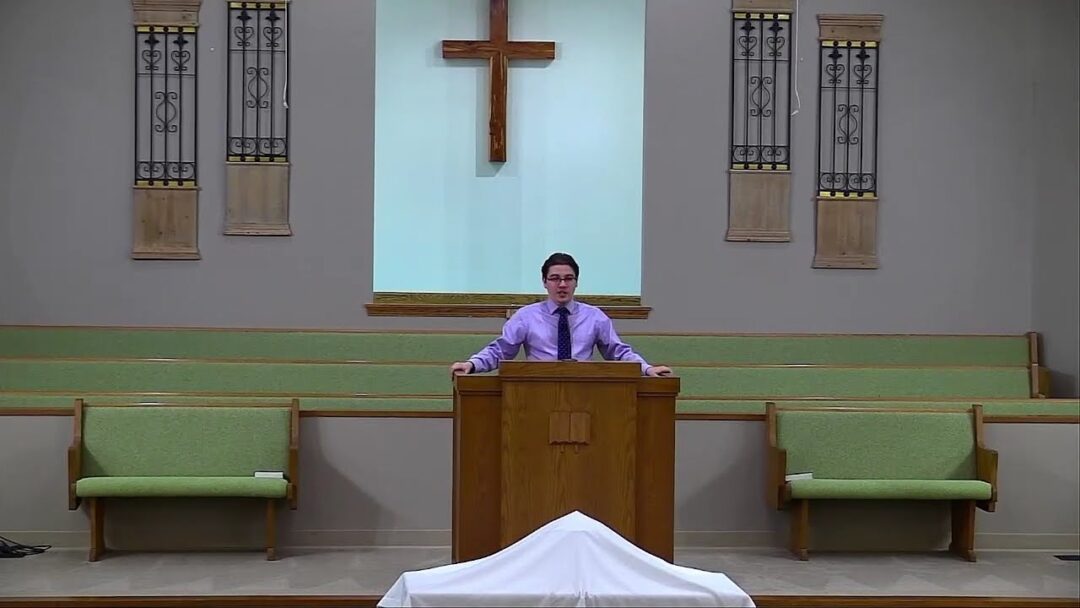
From our Sunday service on December 15, 2024, Genesis, Jeremiah, Isaiah, and Micah. Watch the full message: A Time Foretold: The Prophecies of Christmas on YouTube.
Today we have the pleasure of talking about Christmas. It’s December, we’re weeks away, and I’m sure the kids have already begun counting down the days. I love a little prophecy, but there is so much prophecy in the Bible that there’s no way I can do it all in one message. If I wanted to cover every prophecy of Christmas, we’d need at least a month or two of series. So we won’t hit every one, but it’s important to know these prophecies because they tell us why Jesus came and what his purpose was, and they confirm that Jesus was who he said he was.
Christmas is ultimately the celebration of the fulfillment of God’s greatest promise to mankind. If you know anything about the Bible, you know the unifying thread between every book is the foreshadowing of Jesus Christ and the telling of his ministry and teachings. If we want to be good Christians and understand the word of God, we need to understand the prophecies about Jesus and how he fulfilled them. Rather than stop at every point on this rail line, I’m going to stop at a few stations.
What Is Prophecy?
Here’s the definition I use: prophecy is God telling in advance what he will do. Prophecy is never about what other people are going to do. If somebody else is involved, it’s because God is calling them to do it. God is saying, “I’m going to do this down the road, and when it happens, I want you to know it wasn’t coincidence or circumstance. It was me.”
It would be easy to dismiss the prophecies of Christ if there were no specifics. Take his birth in Bethlehem. We talked in teens about how there are five or six layers of depth to why Jesus was born in Bethlehem, and it only makes sense in all the prophecies together. God says, “Before I do something, I’m going to give you a bunch of signs and details, so when it happens you can’t say it’s coincidence. There are so many parts that it’s impossible for it to be anything other than God.” That’s why we have prophecy and promises in the Bible: so that God gets the glory for what he’s done, and so that we can know Jesus was who he said he was.
The First Promise: Genesis 3
For context, this is the Garden of Eden, with Adam and Eve.
And when the woman saw that the tree was good for food, and that it was pleasant to the eyes, and a tree to be desired to make one wise, she took of the fruit thereof, and did eat, and gave also unto her husband with her; and he did eat. And the eyes of them both were opened, and they knew that they were naked; and they sewed fig leaves together, and made themselves aprons.
Genesis 3:6–7
Here is the first sin of mankind, eating from the forbidden tree of the knowledge of good and evil, and because of it sin entered the world, and through Adam death came upon all men. Jesus is the gospel, and gospel means good news. To understand the good news and the promises fulfilled, we first have to know the bad news: mankind failed God. They didn’t believe God’s instructions were truthful or for their greatest benefit. When Eve looked at the tree, she questioned God. She doubted that God knew what was best, and she did it herself. She gave it to her husband, he ate it, and sin entered the world. Now we have a problem that needs to be solved.
And he said, Who told thee that thou wast naked? Hast thou eaten of the tree, whereof I commanded thee that thou shouldest not eat? And the man said, The woman whom thou gavest to be with me, she gave me of the tree, and I did eat. And the LORD God said unto the woman, What is this that thou hast done? And the woman said, The serpent beguiled me, and I did eat. And the LORD God said unto the serpent, Because thou hast done this, thou art cursed above all cattle, and above every beast of the field; upon thy belly shalt thou go, and dust shalt thou eat all the days of thy life: And I will put enmity between thee and the woman, and between thy seed and her seed; it shall bruise thy head, and thou shalt bruise his heel.
Genesis 3:11–15
Notice Adam blaming the woman, and the woman blaming the serpent. “Beguiled” means tricked. And in verse 15 we get the first promise of Jesus Christ. From the beginning, when God sends Adam and Eve out of the garden, he doesn’t leave them without hope. Something is going to happen with Satan. There will be enmity between mankind and him, and a seed, singular, a child born from Eve, who will bruise Satan’s head while Satan bruises his heel.
“Bruise” here means a wound. This is an ancient text, and they didn’t have as many words to choose from when it was written. A wound to the head is lethal. If you take a sword in the head, you’re done. That’s the picture for Satan: he has already lost, with a deadly wound. Mankind, by contrast, just has a wound to the heel. If you get hit with a sword in the heel, it’s going to do some damage and you might lose your foot, but you won’t lose your life. They can amputate and keep you alive.
That’s the prophecy. Though sin has entered the world and Satan has deceived us, a promised child will come who will defeat Satan, and though mankind will be wounded, ultimately their life will be saved. This is called the Protoevangelium, the first gospel or first good news, and it’s our first prophecy. It also answers why Jesus came: mankind has been wounded by sin and needs to be saved from death, and God came to save us through Jesus Christ.
Through Abraham, Judah, and David
And the angel of the LORD called unto Abraham out of heaven the second time, And said, By myself have I sworn, saith the LORD, for because thou hast done this thing, and hast not withheld thy son, thine only son: That in blessing I will bless thee, and in multiplying I will multiply thy seed as the stars of the heaven, and as the sand which is upon the sea shore; and thy seed shall possess the gate of his enemies; And in thy seed shall all the nations of the earth be blessed; because thou hast obeyed my voice.
Genesis 22:15–18
If a seed is coming, who is he coming from? This is after Abraham was told to sacrifice his son Isaac and the angel stopped him. Jesus is prophesied here as the seed who will bless all nations. A lot of times the Israelites like to think God is only for them, but Abraham, the progenitor of his children, was told from the very beginning that the seed was not just for Israel but for all nations of the earth.
God says, “I want to bring my Messiah through somebody who loves me.” So he takes Abraham up the mountain and says, “I gave a promise to you, and now I want to see if you’re willing to give it back.” Abraham, as a faithful man of God, says he’ll do whatever God calls him to do. Of course God doesn’t take the life of his son. He stops him and says, “I know you love me and you’re dedicated to me, so I’m going to use you to bring forth this Messiah.”
Notice verse 16: “By myself have I sworn.” Often a covenant is an agreement between two people, and if one breaks it, the promise is null and void. But God says, “I’m not going to make a covenant with you that’s conditional on your ability to keep up your end of the deal. I’m going to promise by myself, on my own name and reputation, that this prophecy will come to pass and this seed will be a blessing to all nations.” So the Messiah will not just come through Eve but through Abraham’s children, and all nations will get an opportunity to be blessed by him.
The sceptre shall not depart from Judah, nor a lawgiver from between his feet, until Shiloh come; and unto him shall the gathering of the people be.
Genesis 49:10
Genesis 49 gives more specifics: the Messiah will come from Judah. This is Jacob, the father Israel, giving a prophecy regarding the twelve children he has. All of them will have prophecies about them, but Judah has a very special responsibility. The scepter, the ruling scepter, will not depart from Judah’s family line. Just as Abraham was promised that the seed would come, the seed will come through Judah, until “Shiloh” comes. That name speaks of the one who brings peace and tranquility. Until the Peacemaker comes, the scepter will not depart from Judah.
“And unto him shall the gathering of the people be.” The word “people” in Hebrew is also often used as a replacement for “nations.” Before, we knew Abraham’s seed would bless all nations. Now we’re told the nations will be gathered to him. This is a prophecy of the church: Jesus will bring not just the Jewish people to follow him, but people from every nation and tribe on earth, gathered together in the name of Jesus in faith.
Behold, the days come, saith the LORD, that I will raise unto David a righteous Branch, and a King shall reign and prosper, and shall execute judgment and justice in the earth. In his days Judah shall be saved, and Israel shall dwell safely: and this is his name whereby he shall be called, THE LORD OUR RIGHTEOUSNESS.
Jeremiah 23:5–6
In Jeremiah 23 we’re told the Messiah would come through David’s line. Another way to translate his name is “the Lord is our righteousness.” Even here we have great prophecies about what the Messiah will do. He’s a branch from David, which means he’ll be descended from him. He’ll be a king, bringing judgment and justice. And he will bring salvation: Judah shall be saved, and Israel will dwell safely. More than that, his name brings great meaning to his purpose. The Messiah is not only going to come and free Israel, but his righteousness is going to be placed upon us. That’s a very clear picture of what happened on the cross. When we’re saved, it’s not our righteousness that gets us to heaven. It’s Jesus’s. Christ would be our righteousness, placed upon us through salvation.
How and Where He Would Come
And he said, Hear ye now, O house of David; Is it a small thing for you to weary men, but will ye weary my God also? Therefore the Lord himself shall give you a sign; Behold, a virgin shall conceive, and bear a son, and shall call his name Immanuel.
Isaiah 7:13–14
Now we know who he’s coming through, and we have a good idea where to look. But how do we know when he comes? Here we’re given the sign of Jesus’s birth: he will be born of a virgin. It’s not going to be a normal birth, like the judges who were born to random people. Not only would he be from the line of Judah, he would be born in a miraculous, impossible way. And he will be called Immanuel, meaning “God with us.” The Messiah is not only going to be a representative of God. He’s going to be God, living alongside of us on the earth. When we see that virgin birth, we should know that God has come to us.
This can bring us great comfort, because Jesus experienced what it was like to live on this earth, both the good and the bad. It wasn’t a very peaceful time. Rome had conquered Israel, and there was a lot of abuse of power by the Roman soldiers. Don’t think Jesus just lived a perfect, enjoyable life for the thirty years before his ministry. He lived in towns where centurions would rip off people three or four times, taxing them as they brought their goods through a city, and where they would force you to carry luggage for miles. He dealt with an oppressive government every day of his life.
The great thing about Jesus coming as a man is that when we pray, we’re not praying to a God who doesn’t know what it’s like to be a man on this earth. Jesus watched people suffer through disease and illness. He saw people struggle with fertility issues. He saw oppressive governments abuse their power and the rich steal from the poor. He saw all the wickedness of the world and faced the consequences in his daily life. It wouldn’t have been nice if the Messiah just came down one day at thirty years old and saved all mankind, but God says, “I’m not going to take the easy way out. I want you to know how much I love you, and that I understand what it’s like. I don’t want you to ever accuse me of putting you on this earth to suffer while I’m untouched by it.” Atheists do this all the time: “God is so unfair to make us go through all this. He has no idea what it’s like.” Well, for thirty years Jesus knew exactly what it was like to live in a sinful world, before the time came to sacrifice himself on the cross. So we see in this prophecy that God is not just going to send the Messiah to be a regular guy. It will be a miraculous conception, and he will live alongside us.
Now gather thyself in troops, O daughter of troops: he hath laid siege against us: they shall smite the judge of Israel with a rod upon the cheek. But thou, Bethlehem Ephratah, though thou be little among the thousands of Judah, yet out of thee shall he come forth unto me that is to be ruler in Israel; whose goings forth have been from of old, from everlasting. Therefore will he give them up, until the time that she which travaileth hath brought forth: then the remnant of his brethren shall return unto the children of Israel.
Micah 5:1–3
We know how he’s going to come, but where? Here, in a place we probably wouldn’t expect big prophecies about Jesus, we see that the Messiah will come specifically to the city of Bethlehem, a little rural town. Why would the Messiah come here? We talked about it in teens: Bethlehem is the place where most of the temple sacrifices, the lambs and sheep, were born. Most of the sacrificial lambs that were burnt on the altar of the temple were born in Bethlehem. That’s where the temple’s inventory came from. So there’s a picture here of Jesus being born in Bethlehem as the sacrificial lamb alongside all the other sheep that were going to the temple. Who are the first people to go see Jesus? The shepherds, and they were raising the lambs for the temple. Even during the time of David, the sacrifices came from Bethlehem, and David was raising sacrificial sheep. So the Messiah would be born in the city where the sacrifices are born, and this foreshadows his role as our Messiah.
How do we know this is God himself? Verse 2 says he’ll be a ruler in Israel “whose goings forth have been from of old, from everlasting.” There is no human person whose goings forth have been from eternity. This is somebody ancient, somebody eternal, and who fits that description except God himself? So we are told that God himself is coming to Bethlehem, the place of sacrifice.
What the Messiah Would Do
Who hath believed our report? and to whom is the arm of the LORD revealed? For he shall grow up before him as a tender plant, and as a root out of a dry ground: he hath no form nor comeliness; and when we shall see him, there is no beauty that we should desire him. He is despised and rejected of men; a man of sorrows, and acquainted with grief: and we hid as it were our faces from him; he was despised, and we esteemed him not. Surely he hath borne our griefs, and carried our sorrows: yet we did esteem him stricken, smitten of God, and afflicted. But he was wounded for our transgressions, he was bruised for our iniquities: the chastisement of our peace was upon him; and with his stripes we are healed.
Isaiah 53:1–5
Isaiah 53 answers the question of what the Messiah will do. We see that Jesus will come to suffer, and, as I said, that God is with us and familiar with our difficulties. Verse 3 brings that out even more: “despised and rejected of men, a man of sorrows, and acquainted with grief.” He wasn’t familiar with grief only through the cross. His whole life he knew what it feels like to have sorrow over loss. He was despised and rejected by people. I’m sure that when he worked as a craftsman and a carpenter, Jesus had a boss or two who wasn’t enjoyable. Jesus came to this earth and experienced it alongside us. But he didn’t just experience pain beside us. He purposely went out of his way to take on the sins of the world.
Yet it pleased the LORD to bruise him; he hath put him to grief: when thou shalt make his soul an offering for sin, he shall see his seed, he shall prolong his days, and the pleasure of the LORD shall prosper in his hand. He shall see of the travail of his soul, and shall be satisfied: by his knowledge shall my righteous servant justify many; for he shall bear their iniquities. Therefore will I divide him a portion with the great, and he shall divide the spoil with the strong; because he hath poured out his soul unto death: and he was numbered with the transgressors; and he bare the sin of many, and made intercession for the transgressors.
Isaiah 53:10–12
Not only does he come to earth and experience what it’s like to be human, and get familiar with what it’s like to be hurt by a sinful world, but at the end he’s going to satisfy the Lord’s justice. He’s going to take on the sins of the world, and through his suffering pay for the sins of many. That “many” is anybody who chooses to accept the gift. The Bible tells us that Christ died for everyone, and everybody’s sins are paid for. The only question is whether you’re willing to take the money for the payment or just leave it on the table and walk away.
A New Covenant
Jeremiah 31 tells us the effect of Christ taking on the sins of the world.
In those days they shall say no more, The fathers have eaten a sour grape, and the children’s teeth are set on edge. But every one shall die for his own iniquity: every man that eateth the sour grape, his teeth shall be set on edge.
Jeremiah 31:29–30
Jeremiah is talking about the grief of Israel, how sinful and evil they are. Everybody right now is going to die for their own sin. Like a sour grape, a spoiled grape, it’s bitter and unpleasant, and you’re going to have to take it. You’re going to die in your sins, and there’s no hope without the Messiah.
Behold, the days come, saith the LORD, that I will make a new covenant with the house of Israel, and with the house of Judah: Not according to the covenant that I made with their fathers in the day that I took them by the hand to bring them out of the land of Egypt; which my covenant they brake, although I was an husband unto them, saith the LORD: But this shall be the covenant that I will make with the house of Israel; After those days, saith the LORD, I will put my law in their inward parts, and write it in their hearts; and will be their God, and they shall be my people. And they shall teach no more every man his neighbour, and every man his brother, saying, Know the LORD: for they shall all know me, from the least of them unto the greatest of them, saith the LORD; for I will forgive their iniquity, and I will remember their sin no more.
Jeremiah 31:31–34
Here we see that Christ’s death on the cross is salvation. Before, every man was going to die in his own iniquity. Every transgression, every mistake, every purposeful or accidental action against God was building up wrath for the day of judgment, and people were going to have to take that bitterness and suffering and pay it out for all eternity. But God says, “I’ve got something coming, and I’ve been talking about it for a while. I’m going to make a new promise.”
The old promise was the law: if you keep all my rules, you’ll make it to heaven. They broke it like five minutes after it was made. God gives the law on the mountain, and the golden calf is waiting for him at the bottom. These people could never keep the covenant. So God says, “I’ve got a new deal, and this one isn’t dependent on your ability to be good. I’m going to change you. Instead of putting the law in your hand for you to read, I’m going to place my law inside you. I’m going to change who you are.” If you think you’re going to be God’s follower by keeping a list of rules, you’re greatly mistaken. That’s not the pathway to being the people of God.
“They shall teach no more every man his neighbour, saying, Know the LORD.” Nobody’s going to go around saying, “Have you heard of Yahweh? Have you heard of Elohim?” and have people answer, “No, I’ve never heard of him.” Under the new covenant, when the Messiah comes, everyone will know who he is. I wrote an article for Nerd in the Word about who is the most famous person in all of human history. It’s Jesus Christ. They may not know all the truths of what he did, but everyone on this planet, in any civilization with access to any kind of information, knows the name of Jesus Christ. This prophecy has been fulfilled. You can pretty much assume somebody has heard of Jesus Christ, so instead of “Have you heard of Jesus?” you can say, “What do you think about Jesus?” They’ll know him from the least to the greatest. It doesn’t matter if you’re the richest or most powerful person on the planet or a homeless man on the street. You’re going to know Jesus’s name.
And through this Messiah, God says, “I will forgive their iniquity, and I will remember their sin no more.” No longer will we have to go to the temple and make a sacrifice. No longer will we have to wonder if God will allow us into heaven. He removes our sin completely and saves us one hundred percent. And because of that, we have an opportunity the people under the old covenant didn’t have: we can truly know our God, and our sins are forgiven no matter where we find ourselves when we’re born.
Conclusion
Today we’ve seen many of the prophecies about Jesus. We saw from Genesis that the Messiah’s purpose was clear: to defeat Satan and undo the damage he did in the garden. We saw that he would come to the city of Bethlehem, from the tribe of Judah and the line of David, and that he would be a king of a spiritual kingdom. He wouldn’t just give us hope but would change who we are and allow us to have salvation. We saw that Jesus is not just the savior of the children of Abraham but a universal Messiah, for all people, not for us to live separately but to bring all nations and tribes together and unify us in Christ. And we saw that the Messiah was meant to be one of us while still being God. Jesus was born a man, born from a woman, God who lived with us and was familiar with griefs and sorrows.
If there’s any application besides “God needs to be my Savior,” it’s this: Jesus knows what it’s like to have pain, and he’s here to heal us and change us and make our lives different than they were before. We are never alone. We have a Messiah who has come. This Christmas we celebrate his birth. He came to this world, he suffered with us, and he saved us from our sins.
The Messiah’s promise didn’t come after there were billions of people on earth. It came when there were only two in the garden. I believe with all my heart that if there were only one in the garden, the Messiah still would have come. We should find great hope in this promise: even if it were just us, Christ would have died on that cross for our sins, and God would have suffered thirty years on this earth dealing with the Roman Empire, oppression, and difficulty, even if it were just for one of us. So no matter what hardships you face, find hope in knowing that Christ is there with you and has made a plan. Even if in this world we don’t find all the things we want, we have an eternity coming where it will all be different: no more sorrow, no more pain, no more difficulty, and we’ll experience life as God intended in the garden originally, with him by our side. Christ was with us in our difficulty, and he will be with us in the blessing in the future.
To conclude: the ancients hoped for the fulfillment of the promise, but I want to tell you today that we can have hope, because that promise has been fulfilled.

Recent Comments