
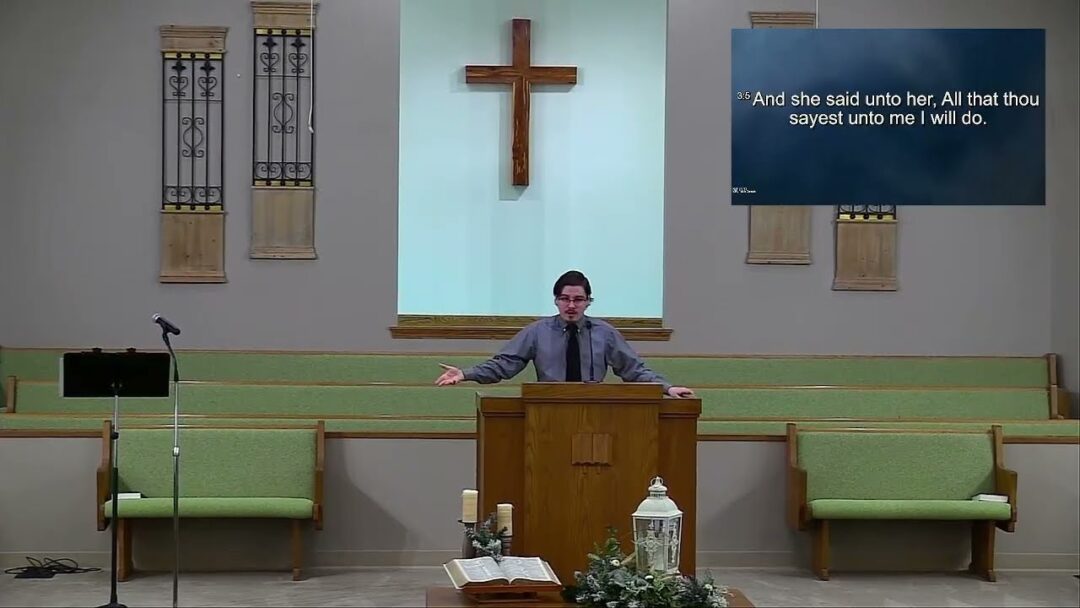
From our Sunday service on February 16, 2025, Ruth 3. This is part 3 of our Ruth series. Watch the full message: A Step Toward Redemption – Ruth Series #3 on YouTube.
Before we go verse by verse through Ruth 3, I’ll read my own translation of the chapter so that we all know the story before we get into it.
Story Time: Ruth 3
Then her mother-in-law Naomi said to her, “My daughter, should I not search out rest for you so that life can be good to you? And now, isn’t Boaz from our family, the one whose female servants you were with? Consider that he is winnowing barley tonight on the threshing floor. So wash yourself, anoint yourself, and put your cloak on you. Then go down to the threshing floor. However, do not be noticed by the men until he has finished eating and drinking. Then let it be known when he lies down that you will note the place he is lying. Go in, uncover his feet, and lie down there. Then he will explain to you what to do.” So she said to her, “I will do everything that you said to me.” And she went down to the floor and did everything that her mother-in-law instructed her. Then after Boaz ate and drank and his heart was glad, he went to lie down at the end of the grain piles. So she came softly, uncovered his feet, and laid down. And it so happened during the night that the man was startled and turned to look down, and consider this: a woman was lying at his feet. And he said, “Who are you?” And she answered, “I am Ruth, your female servant. Spread the edge of your robe over your handmaid, because you are a family redeemer.”
Ruth 3:1–9 (my translation)
And he said, “May you be blessed by Yahweh, my daughter. You have shown better kindness now than previously by not going after the young men, whether they be rich or poor. So now, my daughter, do not be afraid. I will do for you everything that you say, because all my people who enter the gate of the city know that you are a virtuous woman. And yes, it’s true that I am a family redeemer, but also there is a redeemer closer than me. Stay tonight, and let it be in the morning that if he will redeem you, then good, let him redeem you. However, if he will not redeem you, then as surely as Yahweh lives, I will redeem you. Lie down until morning.” So she lay at his feet until morning, and she got up before anyone could recognize another. And he said, “Do not allow it to be known that a woman came into the threshing floor.” He also said, “Bring the cloak that you have over you and hold it out.” And when she held it out, he measured six measures of barley and placed it on her. Then she went into the city. And when she went to her mother-in-law, she said, “How was it for you, my daughter?” And she told her everything that the man had done for her. And she said, “He gave me these six measures of barley because he said, ‘Do not go home empty to your mother-in-law.'” Then she said, “Sit here, my daughter, until you know how this will fall, because that man will not have peace until he has finished the process today.”
Ruth 3:10–18 (my translation)
The Context
At the beginning of Ruth 2 we said it was the beginning of the barley harvest. Since then three months have passed. Ruth entered Bethlehem in March, and now we’re in early June, when all the grain that’s been collected is being processed on the threshing floor. Ruth has been harvesting in Boaz’s field for a few months, pretty much every day, faithfully caring for her mother-in-law the whole time. That’s the context we’re entering in Ruth 3.
Ruth 3:1-4: Naomi’s Plan
Then Naomi her mother in law said unto her, My daughter, shall I not seek rest for thee, that it may be well with thee?
Ruth 3:1
Naomi is saying, “Ruth, you’ve spent these last few months taking care of me and feeding me. It’s time for you to think about yourself.” Here we have a first application: it’s okay once in a while to think about yourself. Sometimes we can be a little too strict about “Jesus, others, you.” But the truth is, it’s very hard to serve others when you yourself are suffering. There is a point where you have to say, “For me to serve others properly, I also need to look after myself.” That’s what Naomi is doing. “Ruth, it’s great that you’re taking care of me, and I recognize the work you’ve put in, but in the long term this isn’t going to work for you. You need to take care of yourself also.”
And now is not Boaz of our kindred, with whose maidens thou wast? Behold, he winnoweth barley to night in the threshingfloor. Wash thyself therefore, and anoint thee, and put thy raiment upon thee, and get thee down to the floor: but make not thyself known unto the man, until he shall have done eating and drinking.
Ruth 3:2–3
Naomi is telling her that Boaz, our family member, is working tonight on the threshing floor. In that day, when you harvested all your grain, you wouldn’t leave it alone. If you left it sitting in the barn, thieves would come in and steal it, so Boaz is there at night guarding his harvest.
Naomi knows that Boaz is a family redeemer, which means he’s viable for marriage. We’ll explain that more in a moment. “You don’t want to be a widow your whole life. You should go talk to him. He knows you, he’s a good man of character, and you’re a good woman of character. There’s a real benefit to this relationship. He’s going to be down there all night long, so you can get some private time to talk to him about this sensitive matter. You don’t have to ask him in front of his workers and you don’t have to embarrass him. He’s going to be sleeping there protecting his property. Go there and talk to him.”
She says, “Wash yourself.” That’s good advice. Young people, if you’re going on a date, Ruth and Boaz are getting ready for their first date: go take a shower first, bathe yourself first. This is not spiritual advice but life-living advice: wash yourself before a date and take care of yourself. “Anoint yourself” means put on some perfume and some good clothes. Then go down to the floor, but don’t let anybody else know you’re there. Don’t make a big deal out of this. It’s private, so go in secretly.
And it shall be, when he lieth down, that thou shalt mark the place where he shall lie, and thou shalt go in, and uncover his feet, and lay thee down; and he will tell thee what thou shalt do.
Ruth 3:4
This kind of implies that there are other people around. Once it gets dark you can’t see where people are sleeping, so she has to memorize where he sleeps. Don’t go to the wrong person in the middle of the night and ask them to marry you. Make sure you go to the right person.
Naomi is recognizing that Ruth is a Moabite and doesn’t know the traditions of Israel, so she says, “Your future husband will know. If you do exactly what I say, he’ll catch on to what’s going on and take care of the rest.” And Ruth, being the obedient woman she is, says she will do whatever Naomi tells her to do.
Here we get another application. Naomi tells Ruth it’s time to do something to help herself. Ruth’s situation wasn’t going to improve on its own. Naomi is saying, “You can sit back and wait for your problems to be solved, but it’s time to step up and do something.” A lot of times in life we think, “I’m a person of faith, I’m just going to pray and trust God to deal with the situation.” It’s good to pray and trust God, but it’s better to pray and trust God and also be active in trying to have your prayer answered. Naomi says, “It’s good that you have faith, but you need action too. Take the first step and let God do the rest.” As Christians we need to remember that praying is important, in fact necessary, but it also requires us to take that first step of faith so that God can do the rest.
What Is a Kinsman Redeemer?
Naomi knows that Boaz can act as a kinsman redeemer and marry Ruth, and that’s why she’s sending her his way. Another way to say it is “family redeemer.” The Hebrew word goel refers to a male relative who had the responsibility to act on behalf of a relative in need, particularly in matters of land redemption, debt repayment, and family lineage according to Old Testament law. These were pretty important people in the family, making sure the family’s property stayed in the family and that family members were taken care of. By default it would be the oldest son. What were a redeemer’s responsibilities?
First, he redeemed land. If a family member had to sell their land because of poverty, say they couldn’t afford to keep farming it and had to sell it to survive, it was the kinsman redeemer’s responsibility to buy that land back and keep it within the family. The oldest son would have the responsibility of saving enough money that if one of the younger children failed to be wise with his spending, he could buy his brother’s land and keep it in the family, so the family wouldn’t suffer from the foolishness of the younger son.
Second, he redeemed relatives from slavery. If a family member fell into debt with somebody, he would enter bond servitude, legally obligated to work for the person he owed. In ancient Israel they didn’t have a prison system. You wouldn’t go to jail to serve your sentence; you would work off whatever payment that sentence was. The family redeemer would literally buy back the captive from his debt and pay it off so that he would be free. The word “redeem” means to buy back.
Third, he was an avenger of blood. If a family member was killed unlawfully, it was the kinsman redeemer’s responsibility to bring the murderer to justice. He had every right to take him in and to kill him if it came to that.
Fourth, and most relevant for today, was levirate marriage. If a man died without an heir, the kinsman redeemer could marry the widow, and was very much supposed to, in order to produce an heir and preserve the family’s property.
Here with Naomi, her husband died and her sons died, and there was no one to inherit her land. While she owned the land and had the right to sell it or use it, she could not legally pass it on to Ruth. She can use it, rent it out to people, and make money off it, but when Naomi dies, Ruth will get nothing, because there’s no patriarch to inherit it. Without a kinsman redeemer there’d be no one to redeem Naomi’s land rights, and no husband legally responsible for taking care of Naomi and Ruth. If Naomi died and Ruth was unmarried, she would potentially lose the right to the land. So Naomi is saying, “Ruth, you need to get married, because I can’t pass my land on to you. If I die you’re alone in this country with no land, no money, and no caretaker.” Ruth needed to be legally married so Naomi could pass the inheritance on to her.
This is a picture of Christ, and that will be our focus next week: how Christ is our Redeemer, who buys us out of slavery, marries us, and passes on his inheritance to us. We are going to the marriage supper of the Lamb. We’ll talk about that more next week, but now we know what’s going on here and why it’s so important that Ruth get this marriage.
Ruth 3:5-7: At His Feet
And she said unto her, All that thou sayest unto me I will do. And she went down unto the floor, and did according to all that her mother in law bade her. And when Boaz had eaten and drunk, and his heart was merry, he went to lie down at the end of the heap of corn: and she came softly, and uncovered his feet, and laid her down.
Ruth 3:5–7
Sometimes this passage gets twisted. People try to make it something it’s not. They say Ruth was having an improper relationship with Boaz, an intimate relationship. That is not what’s happening, and you need to understand ancient Near Eastern culture. Boaz is not drunk. It says he was satisfied with his meal, not inebriated. He was full, and he was sleeping soundly on the floor not because he was drunk but because he was protecting his grain from thieves.
The phrase “uncovered his feet” is often called a euphemism for improper relations, but that’s not what happened. This was a cultural practice that signified a request for his protection. In the ancient Near East the outer cloak represented a man’s protection. Even in our culture today you watch a movie, and in your favorite Hallmark movie a guy takes off his jacket on a snowy day and puts it around the woman who’s out there in the cold. That picture is of his protection, his care, and his ability to provide for her. Young men who’ve dated know they’re going to miss a lot of hoodies in their lifetime, because women want to keep it as a symbol: “I’m protecting you, I’m identifying with you, I will take care of you.” This picture goes back not just in our society but way, way back, and it was used sort of like a proposal, the way you would give somebody a ring as a token. Instead, here you would cover them with your cloak. It’s part of their culture, and we’ll see this more clearly in a moment.
Ruth 3:8-9: “Spread Thy Skirt”
And it came to pass at midnight, that the man was afraid, and turned himself: and, behold, a woman lay at his feet. And he said, Who art thou? And she answered, I am Ruth thine handmaid: spread therefore thy skirt over thine handmaid; for thou art a near kinsman.
Ruth 3:8–9
“Midnight” doesn’t have to be literally 12:00; it just means the middle of the night. As anybody would be, he wakes up in the middle of the night noticing something at his feet, looks down, and there’s a person there. He’s naturally startled. Who wouldn’t be scared if you went to sleep alone and found somebody there? And of course it’s dark, because there were no lights back then. “Who are you? Why are you here? Why are you sleeping at my feet? This is weird.”
She answers, “I’m Ruth, your handmaid.” She doesn’t work for him, but she’s been in that role, working alongside his female servants. She’s saying, “I’m submissive to you, I’m indebted to you in a way.” Boaz has taken care of her for months, and she feels indebted to him, kind of like a bond servant. She puts herself in that role of humility. Then she gives him her request: “Spread your skirt over your handmaid.” Ruth is asking for his protection. Spreading your coat over your maid was a symbol of “I will redeem you.”
We see this illustrated in Ezekiel, where God speaks to Jerusalem.
Now when I passed by thee, and looked upon thee, behold, thy time was the time of love; and I spread my skirt over thee, and covered thy nakedness: yea, I sware unto thee, and entered into a covenant with thee, saith the Lord GOD, and thou becamest mine.
Ezekiel 16:8
God is saying to the nation of Israel, “I found you naked, with nothing, alone and destitute. I spread my cloak over you and made you mine. I put my protection over you.” You can think of this like the earlier passage in Ruth about seeking refuge under his wing, the idea of the hen putting her wings over her chicks. That extended into human life, where we put our cloak over the person in need to care for them. So Ruth clarifies: “You qualify as a kinsman redeemer. You can be my protector, and I am in need of that protection.”
Ruth 3:10-13: A Man of Character
And he said, Blessed be thou of the LORD, my daughter: for thou hast shewed more kindness in the latter end than at the beginning, inasmuch as thou followedst not young men, whether poor or rich. And now, my daughter, fear not; I will do to thee all that thou requirest: for all the city of my people doth know that thou art a virtuous woman. And now it is true that I am thy near kinsman: howbeit there is a kinsman nearer than I. Tarry this night, and it shall be in the morning, that if he will perform unto thee the part of a kinsman, well; let him do the kinsman’s part: but if he will not do the part of a kinsman to thee, then will I do the part of a kinsman to thee, as the LORD liveth: lie down until the morning.
Ruth 3:10–13
Boaz says, “Blessed be thou of the LORD, my daughter.” Why? Ruth is making somewhat of a sacrifice herself. Boaz realizes that Ruth is not just marrying him for money, attractiveness, or security. She chose him because of his character. Ruth could have married a young man, who could also have wealth in this society, since he would inherit from his father like everyone else, and a young man would also live longer. Ruth’s whole problem was that her husband died, so wouldn’t she want to marry a younger man who would protect her from widowhood even longer? But she doesn’t do that. She chooses an older man, and says that safety from widowhood is not as important to her as marrying a man of character. Ruth fell in love with Boaz not because of the goods he had or any personal gain, but because of the character he demonstrated in his life. Boaz didn’t know all the stuff about Ruth when he helped her. She was a foreigner in a foreign land with nothing to offer him, and he went out of his way time and time again to care for her.
Here’s the application for young people: what are you looking for in a spouse? One day you’re going to get married. Are you looking at what you can gain in comfort? What would have been easy for Ruth was to look for the richest man in Israel and marry him. Polygamy was pretty common at this time, so she didn’t have to go to a man who wasn’t married yet. She could have piggybacked off another marriage and enjoyed the comfort of his money for the rest of her life, never having to work or do anything. But that’s not what she did. She looked at his character. Are you looking for people for comfort in a relationship, asking, “How much can this person provide for me?” Or are you looking for character? Who you marry has a massive effect on your life, so do not take it lightly.
Ruth searched for a man who would do good to her no matter what, and we too should search for someone who will do good no matter what, not just someone who will do good for you but someone who will do good to everyone around them. If a person does good for you, that’s one thing. Someone can pretend to do good time and time again to win your heart and eventually win you. But if you marry someone who does good to everyone around them, you’ll never have to worry a day in your life about them loving you, because the way they love you is the way they treat everyone. That’s what Ruth realized: “I’m not going to go after the man who gives me the most money, or the youngest, or the most attractive. I’m going to go to the one who showed love to everyone around him, because if I marry that person, I’ll never have to worry a day in my life again.”
There is one problem. Boaz is not the nearest family member. There is someone on the redeemer list who has priority over him, and that person must be offered the marriage first. Only if he declines can Boaz marry Ruth. But Boaz promises to do his part if he is allowed to.
Ruth 3:14-18: Wait and Trust
And she lay at his feet until the morning: and she rose up before one could know another. And he said, Let it not be known that a woman came into the floor. Also he said, Bring the vail that thou hast upon thee, and hold it. And when she held it, he measured six measures of barley, and laid it on her: and she went into the city.
Ruth 3:14–15
Boaz doesn’t want any rumors started about what happened that night. He doesn’t want anybody to see it, and he wants to keep her reputation pure. He’s also such a caring person that he doesn’t let her go home with nothing. He takes the cloak off her and fills it with barley. One commentary says this is about 60 pounds of barley, which I think is pretty hard for her to carry all the way home. I don’t know how far away she lived, but carrying 60 pounds of barley in the morning is not my idea of a relaxing morning. But she has enough food for a good while, and she goes home to her mother-in-law.
And when she came to her mother in law, she said, Who art thou, my daughter? And she told her all that the man had done to her. And she said, These six measures of barley gave he me; for he said to me, Go not empty unto thy mother in law. Then said she, Sit still, my daughter, until thou know how the matter will fall: for the man will not be in rest, until he have finished the thing this day.
Ruth 3:16–18
Naomi gives some good advice here. Relationships can cause a lot of anxiety. You get butterflies in your stomach when you don’t know what’s going on, and you have all this worry. Naomi realizes, “I was young once, I was in a proposal once. I know how scary it can be to find out whether it’s a yes or a no.” So she says, “Instead of worrying, trust God. Sit still, take a deep breath, and wait.” Why? “I know Boaz’s character. I know he will do right.” Boaz isn’t even going to wait until tomorrow to get this resolved. He’s going to get it resolved today, and by the end of the day you’ll know what’s going to happen. Naomi is so confident in Boaz’s character that she tells Ruth she doesn’t have to worry: she is the number one priority in his life. That’s a beautiful example of marriage, of just how much Boaz cared about Ruth.
What We Take Away
We see a beautiful relationship built on mutual trust and good character. Both Ruth and Boaz have godly character. They both chose to love others more than themselves. Ruth prioritized her mother-in-law over her own good, even to a fault, and Boaz preferred to help those in need over his own profits. These are two people who love God and are passionate about God, and they come together and say, “Let’s see what we can do.”
Boaz could have been a little slick about this. He could have said, “Sure, I’ll marry you right now.” Once the marriage was done it couldn’t be undone. He could have just broken the rules and married her right there. He could have said, “My older brother or cousin, I’m not sure which one it was, wouldn’t want you to marry him anyway, so I’m not even going to ask.” But Boaz says, “No, we need to do this right. We need to go by the book. We need to honor the law God set for us, and if it’s God’s will, we will get married.” He says, “If it’s God’s will, then you better bet I’ll do whatever I can for you.”
This is also a picture of Christ. That’s what Christ did for us. He says, “I will do what I can for you,” and he died on a cross for us. We’ll talk next week about how Jesus is our Redeemer and how he bought us back. But today what I want us to take away is that we should emulate that kind of relationship in our lives, with our spouses and with the people we’re dating. Honor each other, have respect for each other, follow God together, and sacrifice for each other, and you will see a relationship that is truly blessed.

Recent Comments