
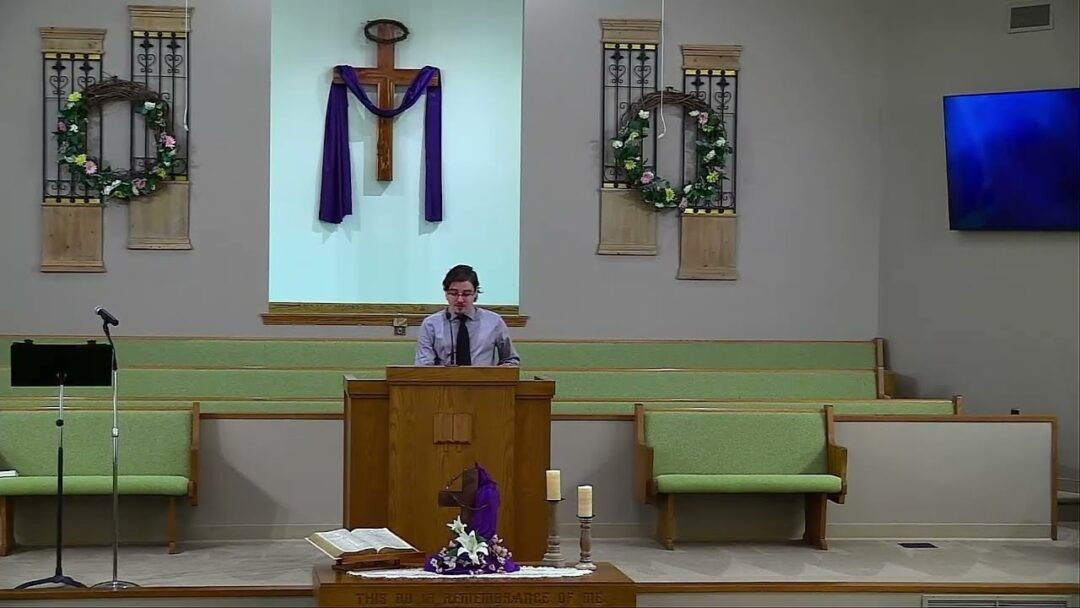
From our Palm Sunday service on April 13, 2025, Ephesians 5:21–6:20. This is part 6 of our Ephesians series, the final message in the series. Watch the full message: Submission & The Armor of God – Ephesians Series #6 on YouTube.
Today we conclude our series on Ephesians. Last week we talked about walking in love and light: God wants us to walk as the light of the world, and we need to walk in love in everything we do. Today Paul continues by focusing on two areas of our spiritual walk: first, our relationships with others, and second, our battles against spiritual forces.
Last week we left off with Paul telling us to redeem our time, to buy back the time we spent living in darkness as fools and invest it in walking in the light.
See then that ye walk circumspectly, not as fools, but as wise, Redeeming the time, because the days are evil.
Ephesians 5:15–16
Before we were saved, we lived in darkness. We did evil, and we were the darkness to those around us. Now, instead of undoing God’s will, we are to purposefully go out and do it. The last verse we looked at was Ephesians 5:21, and it is our first topic today:
Submitting yourselves one to another in the fear of God.
Ephesians 5:21
These passages are often misused and misrepresented to push agendas in the church, so we’re going to look at them as Paul intended them, from the Scriptures. Right in this verse, Paul sets the theme: this is not a one-sided submission. Both groups in the discussion need to submit to each other in different ways, and we’ll go one by one. Submission is one of the ways we redeem our time and bring unity to the body of Christ. God wants you to stand firm in your testimony through godly relationships and spiritual defense.
Ephesians 5:22-33: Husbands and Wives
First Paul talks to wives.
Wives, submit yourselves unto your own husbands, as unto the Lord. For the husband is the head of the wife, even as Christ is the head of the church: and he is the saviour of the body. Therefore as the church is subject unto Christ, so let the wives be to their own husbands in every thing.
Ephesians 5:22–24
Churches sometimes take this passage out of its context and misapply it, so I want to point out a few things.
The main gist is that wives are to place themselves under the authority of their own husbands. Notice it says their own husbands, not men in general. People will say, “This is a command that women are subservient to men in all cases.” That is not what the verse says. Wives submit to their own husbands. An unmarried woman does not need to submit to her boyfriend, her fiancé or a male best friend. This submission comes only after the covenant has been made, and only within the bounds of marriage.
The Greek word for submission is a military term, “to fall under rank.” It was used for falling under the authority of a commander in the Roman army. So the wife is to fall under the rank of her husband and submit to his leadership in the family. This is a two-way street, though, as we’ll see, because Paul says to submit to each other. The wife submits to the husband, and the husband has guidelines he must follow to hold this honor.
Some would say this refers to Roman law, under which a woman submitted absolutely to her husband in all areas of life, what was called a manus marriage. They say it’s old-fashioned and that Paul wrote it only for Romans, because Romans owned their wives. That isn’t true. While Romans did have manus marriages, that was the Roman Republic, not the Roman Empire. By the first century, they were almost nonexistent. In fact, Ephesus, where this was written, was the seat of Diana worship, in which women were all considered prophets and so had the say over their husbands in the marriage. It doesn’t fit culturally with the people Paul was addressing. None of them were in manus marriages. If anything, their wives were going crazy telling everybody what to do. Paul even writes to one of the churches that it’s good for women to keep silent, because the former Diana worshipers were yelling prophecy in the middle of the service while the minister was trying to speak.
What was more common in the first century was a sine manu marriage, in which authority over the wife sat in her father rather than her husband. A woman could go to her father and say, “I want to divorce my husband,” and the father could nullify the marriage. If the father didn’t like his daughter’s husband anymore, he could cancel the marriage or even put his daughter to death. So what Paul is doing is speaking against this cultural movement. He’ll bring up later that a husband and wife leave their father and mother and become one flesh. In that culture, the woman wasn’t leaving her father and mother. The father still had supreme authority in the marriage. Paul says, “No, this is not how it’s supposed to work. You leave your father and mother, and your husband is the authority, not your dad. Your marriage is between you and your husband, not you, your husband and your father.” The Bible calls for both husband and wife to leave father and mother and adhere to each other. Paul is encouraging believers to adhere to Scripture rather than the rule of their culture.
That doesn’t mean this isn’t real submission. It really does mean to fall under rank. In a relationship, someone needs to be able to have the final say in order to lessen conflict. With only two people in a marriage who can vote, there would never be a tiebreaker in an argument. Scripture gives the tiebreaking vote to the man, in order to honor the fact that marriage is meant to represent the love of Christ and his relationship with the church. John Chrysostom, a church father from around A.D. 400, only about 300 years after these writings, says: “When they are in harmony and their children are being reared well and their household is in good order, their neighbors will smell the sweet fragrance of harmony along with all their friends and relatives. But if the contrary is true, everything is overturned and thrown into confusion.” It’s done so that when we present ourselves to the world, they don’t see a marriage filled with bitter argument and resentment, fighting tooth and nail over who gets the final say. Submission is God’s solution.
This does not mean the wife cannot disagree. The word here is submit, whereas in other relationships the word is obey. This is not a supreme, absolute authority where you have no say. She submits to her husband as long as he is doing what aligns with the will of Christ. In return, the Bible commands the husband to follow some guidelines to hold this honor in the household.
Starting in verse 25, we see what the man has to do.
Husbands, love your wives, even as Christ also loved the church, and gave himself for it; That he might sanctify and cleanse it with the washing of water by the word, That he might present it to himself a glorious church, not having spot, or wrinkle, or any such thing; but that it should be holy and without blemish. So ought men to love their wives as their own bodies. He that loveth his wife loveth himself. For no man ever yet hated his own flesh; but nourisheth and cherisheth it, even as the Lord the church: For we are members of his body, of his flesh, and of his bones. For this cause shall a man leave his father and mother, and shall be joined unto his wife, and they two shall be one flesh. This is a great mystery: but I speak concerning Christ and the church. Nevertheless let every one of you in particular so love his wife even as himself; and the wife see that she reverence her husband.
Ephesians 5:25–33
“Husbands, love your wives.” That’s easy, right? If it were so easy to do right, the Bible wouldn’t have to encourage us to do it. At the end, the word “reverence” shows more of what submission looks like: respect, surrendering authority because you respect your husband.
“Gave himself for it” is a very important phrase. The Greek word means literally to hand yourself over. The husband is the head of the household, but he is to hand himself over to his wife as Christ handed himself over to us. Both husband and wife are called to surrender, just in slightly different ways. The wife is called to respect and submit, and the man is to give himself fully.
“So ought men to love their wives as their own bodies.” This is “do unto others as you would have them do unto you,” applied: love your wife as you would want to be loved. He can’t ignore his wife’s needs, wants and desires in order to grasp control over the household. He is to do for his wife what he wishes everyone would do for him. “For no man ever yet hated his own flesh, but nourisheth it and cherisheth it.” Nourish means to provide for her basic food and health needs. Men, if you’re not providing for the needs of your family, you need to man up. In a good Christian marriage the man provides for the financial needs and makes sure his wife is healthy and has everything she needs. Don’t ignore your wife’s health issues. Take care of her.
Cherish in the Greek is literally the word for “warm.” You need to feed and warm her. That carries the idea of providing for the needs of both intimacy and security. Men, your wives need to know they’re loved and to feel your warmth. You can’t say, “I’m in charge. I’m putting food on the table. What more do you need? You’ve got a car. You can go hang out with your friends.” No. You need intimacy in your marriage and a relationship in which she feels safe. For a wife to submit, her husband must care for not just her physical needs but her emotional needs. He can’t ignore her or put her aside. He needs an intimate relationship in which he is active in her life. In verse 31, “they two shall be one flesh”: you’re not two people, you’re one. If you’re caring for your wife, you’re caring for yourself, so everything you do should be for the benefit of your wife.
Verse 29 says he should love as the Lord loves the church. What did Christ do for us? First, Jesus literally died for us. We’re getting toward Easter, and this is Passion Week. If we are to have the relationship with our wives that Christ has with us, a man must be willing to die for his wife, to put aside all his pride and self-interest to protect her. What else did Jesus do? He humbled himself. As the master, the head and the one in charge, Jesus washed the disciples’ feet at the last supper, even the feet of Judas, who betrayed him. So the man, although he has the authority, humbly places himself below the wife who submits to him in order to serve her. Men, if you’re not serving your wife, you’re not setting an example of Christ in the church. If you want to lead the house, lead with service to your wife.
Chrysostom has a great passage on this: “Have you noted the measure of obedience? Pay attention to love’s high standard. If you take the premise that your wife should submit to you as the church submits to Christ, then you should also take the same kind of careful, sacrificial thought for her that Christ takes for the church. Yes, even if it is necessary for you to give your life for her, yes, and to be cut into pieces ten thousand times, yes, and to endure and undergo any suffering whatsoever, do not refuse it. Though you should undergo all this, not even then will you have done anything like Christ. For you truly are doing it for one to whom you are already knit, but he did it for the one who turned her back on him and hated him. In the same way then, as he laid at his feet her who turned her back on him, who hated and spurned and disdained him, not by menaces, not by violence, not by terror, but by his unwearied affection, so also do you behave yourself toward your wife. Yea, although you see her looking down on you, disdaining you and scorning you, yet by your great thoughtfulness for her, by affection and kindness, you will be able to lay her at your feet. For there is nothing more powerful to sway than these bonds, especially for a husband and wife.”
Men, does that put in perspective the kind of submission we are to have toward our wives? It’s wrong for the church to say it’s one way. The man submits to the wife as the wife submits to the husband. It’s a cycle: the wife submits to her husband, and the husband submits to Christ and imitates him. The wife surrenders her desire to command by trusting her husband for her needs, and the husband surrenders his desire to prioritize what he wants in order to cater to his wife’s needs. If this is done properly, conflict is done away with and the needs of both are met. Some of us are going to have to go home and think about this. The standard God has set for our marriages is very high, and if we want to reflect him well as we walk in love and light, we need to get our marriages in order.
Ephesians 6:1-4: Parents and Children
What does it say about parents and children?
Children, obey your parents in the Lord: for this is right. Honour thy father and mother; (which is the first commandment with promise;) That it may be well with thee, and thou mayest live long on the earth. And, ye fathers, provoke not your children to wrath: but bring them up in the nurture and admonition of the Lord.
Ephesians 6:1–4
Notice the word “obey” here. It doesn’t say wives, obey your husbands. It says submit. With children there is no room for discussion, personal opinion or argument. It’s obey. In the Hebrew concept, there’s no difference between the words for “hear” and “obey.” Your kid can’t say, “I heard what you said. I’m listening.” Merely hearing isn’t good enough. He needs to obey what the parent says. Obedience is a stronger commitment than submission, and it implies there’s no reasoning or open discussion involved like there is between husband and wife. And it’s done “in the Lord,” because we love the Lord and it’s the right thing to do.
“Honour” in the Greek is an economic word. You’d use it in a store when asking the price of an item: what is its honor, its value? Children are to value their parents and their input, and hold it as something priceless. Parents do a lot for their kids, and I don’t think kids ever realize it. You don’t know how valuable they are until they’re gone. Does that mean kids like everything their parents do? No. But regardless, they value their parents’ input and direction and submit to their leadership.
This is “the first commandment with promise.” Because children obey their parents, God says, “I will bless you.” Long days on the earth means you will prosper in the long run. It might be hard to listen to your parents some days, people watching online, but God says that in the long run it will do you much better than fighting and disagreeing with them.
What do parents need to do? “Fathers, provoke not your children to wrath.” “Fathers” in the Greek is meant to include both mothers and fathers. We see this in Hebrews 11:23:
By faith Moses, when he was born, was hid three months of his parents…
Hebrews 11:23
In the Greek, that says “dads.” We know Moses didn’t have two dads. He had a mother and a father, and the plural can designate a father and a mother. So here it means parents: parents, do not provoke your children to wrath. Don’t antagonize your children or purposefully upset them. That means no unreasonable instructions, no unrealistic expectations and no blame-shifting onto your children. Don’t come to your kids with a sinful attitude and excuse yourself because God gave you authority over them. You can’t sin against your children because you’re in charge. Sin is sin no matter who it’s done to. Have patience and grace when dealing with your children. They will never be perfect. They will always fall short of your expectations in some area, so prepare your hearts and come to terms with it ahead of time, so that when difficulty comes you respond the right way.
But “bring them up in the nurture and admonition of the Lord” means to discipline and correct them when they need it. Don’t just let them run wild. There needs to be correction when they step out of line. They won’t like it, but it needs to be done, and done in the Lord, in a way that God would approve of.
Ephesians 6:5-9: Employers and Employees
What about employers and employees? The words here literally mean slaves and bondmen, people contractually obligated by law to serve. Our relationships and jobs in the United States are a little different. We can quit whenever we want and be fired whenever we want. But these principles still generally apply to us.
Servants, be obedient to them that are your masters according to the flesh, with fear and trembling, in singleness of your heart, as unto Christ; Not with eyeservice, as menpleasers; but as the servants of Christ, doing the will of God from the heart; With good will doing service, as to the Lord, and not to men: Knowing that whatsoever good thing any man doeth, the same shall he receive of the Lord, whether he be bond or free. And, ye masters, do the same things unto them, forbearing threatening: knowing that your Master also is in heaven; neither is there respect of persons with him.
Ephesians 6:5–9
In Rome this was a legal reality. By Roman law you had to obey your master, and you could be severely punished if you disobeyed. Here Paul presents it as willful submission and changes the relationship between servant and master. We talked about that when we studied Philemon: masters are to see their slaves not as someone they own but as a brother in Christ. It applies to us today as employee and employer.
“Be obedient to them that are your masters according to the flesh.” Be obedient like a child to a parent. Listen to the instructions your boss gives you. Don’t argue, don’t be disagreeable, don’t cut corners. “As unto Christ”: follow your boss like you would follow Jesus. As long as your boss isn’t telling you to commit a sin, don’t fight with them. They’re your authority and responsible for you. “According to the flesh” means they’re your mortal masters. You have a master in heaven, but you also have bosses on earth with authority over you. When you took the job, you entered a contract and made a promise. The Bible says to let your yes be yes and your no be no, and if you signed the paper saying, “I accept the job,” you’ve said yes. If you start disregarding your boss and going against the contract you made, you’re ruining your testimony, because a Christian is supposed to be faithful to what they say they’ll do. If you’re constantly bucking heads with your boss at work, you’re hurting the testimony of Christ.
“With fear and trembling” isn’t terror. In the Bible, fear and trembling is more of a respect, and here it carries the idea of eagerness. The best way I can illustrate it is my little dog Finn. When I go to the furnace room where I store his food and grab it, he gets so excited. He spins around in circles. I say, “Okay, Finn, sit,” and he sits at my command and shakes with anticipation. He’s so ready and will do whatever I say, because he is excited. He’s trembling because the adrenaline is coursing through his body. That’s the picture. Be eagerly awaiting your boss’s orders. When your boss gives you an instruction, don’t say, “Okay, I’ll get on it.” Be excited, be present and be available.
Verse 6 continues: “Not with eyeservice, as menpleasers.” Don’t obey just to make yourself look good in front of your boss. Don’t work 100% all-in only while the boss is watching, and then go back to slacking off and wasting time the second he’s out of sight. Do it as unto the Lord, who is always watching. His eyes are on your work, on whether you’re putting in your all and on whether you’re respecting your authority. Act like you’re serving Christ, because in serving your boss, you are following God’s command to serve him.
Verse 7 says “with good will.” That means a positive attitude, with wishful thoughts that good things will happen for your boss. Not “I hope my boss trips and falls today. I am so sick of all this junk he’s making me work on. He gave me a pile of papers to file that’s this tall. I hope he goes home and his wife is mad at him.” Have good will toward your boss, and don’t wish evil on them. Why? “Whatsoever good thing any man doeth, the same shall he receive of the Lord, whether he be bond or free.” It doesn’t matter if you’re the boss or the employee. If you do your best as unto God, even if your boss doesn’t give you a promotion, even if you don’t get a raise, even if you don’t get noticed, your Father in heaven will notice, and he will reward you because you’re following his will and submitting to your boss. Work hard, work well, and be an example of Christ to your boss and the other employees. God will reward you even if your boss doesn’t.
It doesn’t go only one way. Verse 9 says masters do the same things to them. Everything for the slave applies to the master. Anything the employee needs to do, the boss needs to do too. Bosses, crew managers, work reviewers, whatever position of authority you have, this applies to you. “Forbearing threatening” means holding back the temptation to threaten the people who work for you with punishment: more or fewer hours, a pay cut or physical harm. Why? “Your Master also is in heaven; neither is there respect of persons with him.” You have a heavenly master who is watching, and he is not biased. He doesn’t care whether you’re the employee or the boss. If you abuse your power, you’ve got his wrath coming your way. He will correct you if you do wrong. So, business owner or manager, do you want your business to thrive? Treat your employees well, and be as patient with them as God is with you.
Ephesians 6:10-20: The Armor of God
That wraps up our section on submission. God has given us a big challenge already, but the good news is that he doesn’t leave us alone. Next we look at defending with the armor of God.
Finally, my brethren, be strong in the Lord, and in the power of his might. Put on the whole armour of God, that ye may be able to stand against the wiles of the devil. For we wrestle not against flesh and blood, but against principalities, against powers, against the rulers of the darkness of this world, against spiritual wickedness in high places.
Ephesians 6:10–12
If you pay attention to this passage, the key word is ability, and the ability does not come from us. Notice in verse 11 that it says “that ye may be able to stand against the wiles of the devil.” It’s “the whole armor of God.” He made it. We’re not doing this in our own ability. You didn’t forge this armor on your own, you didn’t buy it with your own money, and you didn’t even take the measurements to make sure it fit. It’s a gift from God.
“We wrestle not against flesh and blood.” If you’re fighting with people in this world, no matter who they are, you’re fighting the wrong battle. We’re fighting against spiritual rulers and authorities. “The rulers of the darkness of this world” is literally in the Greek the cosmic rulers of the darkness of this age. Paul piles it on so you understand that there is a real spiritual battle going on that we don’t see. If you’re wasting your time fighting your boss, your kids, your husband or your wife, you’re fighting the wrong battle. Equip yourself with God’s armor and fight the spiritual forces that want you to fail. There are fallen angels who want nothing more than to turn humanity against itself so that more of us burn in hell with them. Don’t fall into the temptation to fight your human siblings. If you fight the wrong battle, people will burn for all eternity.
Wherefore take unto you the whole armour of God, that ye may be able to withstand in the evil day, and having done all, to stand.
Ephesians 6:13
God gave us what we need to fight this battle. Paul refers here to Old Testament passages about the attributes of God and the Messiah. This is something about the armor of God I’ve never seen anybody mention: every single piece comes from an Old Testament passage about Jesus Christ or God the Father, in a prophecy about him. The armor is a picture of the whole theme of Ephesians, that we are to imitate Christ by taking pieces of him and putting them on ourselves. “Having done all, to stand” means that when everything is said and done, the dust settles and the battle is over, the demons will still find us standing strong in our faith.
Stand therefore, having your loins girt about with truth, and having on the breastplate of righteousness; And your feet shod with the preparation of the gospel of peace; Above all, taking the shield of faith, wherewith ye shall be able to quench all the fiery darts of the wicked. And take the helmet of salvation, and the sword of the Spirit, which is the word of God: Praying always with all prayer and supplication in the Spirit, and watching thereunto with all perseverance and supplication for all saints;
Ephesians 6:14–18
Let’s look at the attributes one by one.
The belt of truth. This comes from Jesus Christ in Isaiah 11:5:
And righteousness shall be the girdle of his loins, and faithfulness the girdle of his reins.
Isaiah 11:5
“Faithfulness” in the Hebrew could also be translated trustworthiness. What Christ says is true, faithful and going to happen. Your heavenly Father and your Messiah, the Lord Jesus Christ, are truthful, faithful and trustworthy, so put on his belt.
The breastplate of righteousness and the helmet of salvation. These come from Isaiah 59:
…his arm brought salvation unto him; and his righteousness, it sustained him. For he put on righteousness as a breastplate, and an helmet of salvation upon his head; and he put on the garments of vengeance for clothing, and was clad with zeal as a cloke.
Isaiah 59:16–17
This is a prophecy about the Messiah. His righteousness is his defense. He will not fall, because he has pure morality, and the arrows will not go through his head, because he is saved by God. Note that the helmet of salvation is something you are told to pick up, worded in the Greek as if it’s a gift, because salvation itself is a gift.
Feet shod with the preparation of the gospel of peace. This comes out of Isaiah 52:7:
How beautiful upon the mountains are the feet of him that bringeth good tidings, that publisheth peace; that bringeth good tidings of good, that publisheth salvation; that saith unto Zion, Thy God reigneth!
Isaiah 52:7
How beautiful are the feet of those who bring good news. The good news is the gospel. We are to put on shoes that allow us to go out into the world and tell people what Jesus Christ did for them on the cross.
The shield of faith. This comes from Psalm 18:30:
As for God, his way is perfect: the word of the LORD is tried: he is a buckler to all those that trust in him.
Psalm 18:30
The shield described here is the Roman centurion’s shield, about two feet by four feet, made so you can kneel, hold it in front of you, and have it cover your entire body. In ancient wars armies shot volleys of arrows all at once, and you couldn’t dodge them, because they came in one direction but everywhere at once. By putting up the shield, all the flaming darts would stick in it, and not one would hit you. It’s a picture of complete defense. The shield of faith defends against all attacks, which means nothing can defeat us unless we pull the shield to the side.
The sword of the Spirit, which is the word of God. This comes from Isaiah 49:2:
And he hath made my mouth like a sharp sword; in the shadow of his hand hath he hid me, and made me a polished shaft; in his quiver hath he hid me;
Isaiah 49:2
This is about the prophecies of Isaiah: “He hath made my mouth like a sharp sword.” The word of God is sharper than any two-edged sword, and you see this picture in the New Testament as well. The word of God helps us know how to defend ourselves, what to attack and what not to. It divides right from wrong in our minds, and the Spirit convicts us of right and wrong in our hearts.
Prayer. Verse 18 brings it all together: “praying always with all prayer and supplication in the Spirit, and watching thereunto with all perseverance and supplication for all saints.” Don’t just wear your armor. Pray consistently for everyone else that they put on the armor as well. You’re not the only one going through spiritual battles, so pray for the battles other people are going through, whether a time of difficulty or discouragement. Look for those in need and pray for them consistently.
And for me, that utterance may be given unto me, that I may open my mouth boldly, to make known the mystery of the gospel, For which I am an ambassador in bonds: that therein I may speak boldly, as I ought to speak.
Ephesians 6:19–20
Paul says, “Pray for me too.” We need people to pray for the gospel to be given. I have the armor of God, but you need to pray that when I go out with the preparation of the gospel of peace, I have the words to say. So don’t just pray for people’s needs. Pray for them to be spiritually enabled to spread the gospel.
Closing
We’ve gone through the whole book of Ephesians and learned what we need to do to equip ourselves to be light and love to the world. Walking in love and light is about actively pursuing God’s design for every part of our lives. Whatever the area, Paul calls us to a life of submission. Submission is not a sign of weakness but a declaration of our trust in the Lord. Wives are called to submit and trust. Husbands are to lead in sacrificial love. Children are to obey and honor, and parents are to raise them with patience and instruction. Workers are to serve sincerely, and leaders are to lead humbly. Every role is shaped by the example of Christ, our true head, shepherd and savior.
When opposition comes and the darkness of this world presses in on us, we are not left defenseless. We’re handed God’s armor: his truth, righteousness, peace, faith, salvation and word. With prayer as our lifeline and the Spirit as our empowerment, we can stand firm no matter what life brings, not by our own ability but by the ability and power God has given us. So let’s walk wisely. Let’s walk in love. Let’s walk in light. When all is said and done, may we still be standing, carrying the testimony of Jesus Christ with boldness, unity and grace.
God wants you to stand firm in your testimony through godly relationships and spiritual defense. Will you stand firm today?

Recent Comments