
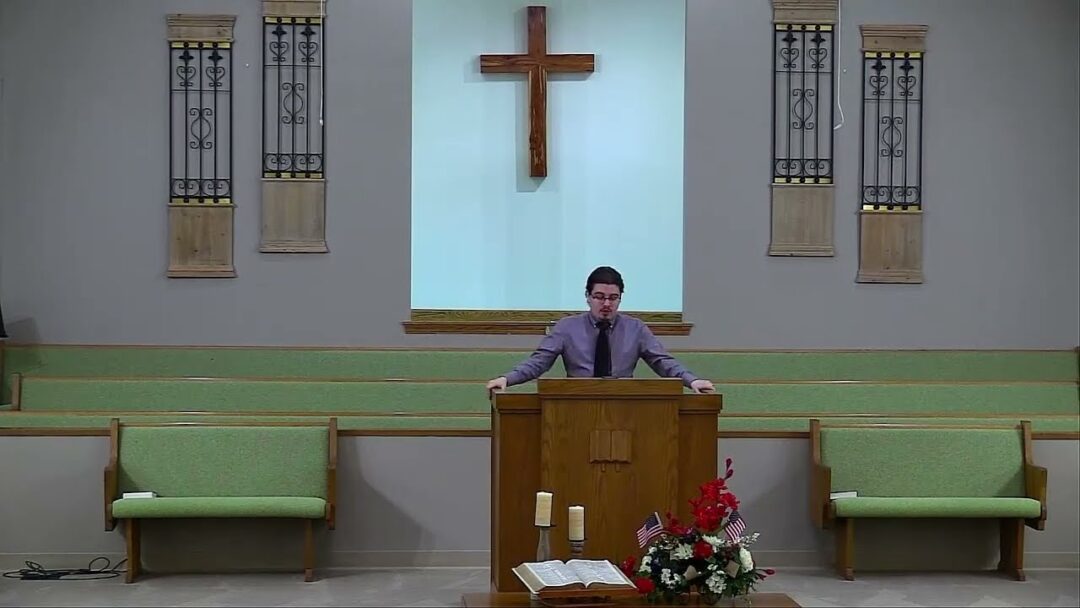
From our Sunday service on August 3, 2025, Psalm 42, Psalm 73, 2 Corinthians 12, Philippians 4, and Hebrews 4. Watch the full message: Finding Strength in Weakness on YouTube.
I didn’t really plan this, but the songs I picked actually went really well with the message: songs about broken vessels, about amazing grace that saved a wretch like me, about how Christ heals our brokenness, and one that ended with the phrase “help me know you are near.” That’s the topic we’re talking about today: finding strength in weakness.
Even the most faithful believers will experience seasons of sorrow, difficulty and inner turmoil. I think we can all agree that life on this earth is not always smooth and not always easy. Sometimes we ask God, “Why has this time of difficulty not ended?” Maybe it’s an extended time of financial difficulty. Maybe it’s a chronic health condition. Maybe it’s depression, anxiety or post-traumatic stress disorder. Maybe it’s difficulty in our marriage or in the relationship between parent and child. These things break our hearts. They make us groan and mourn, and we say, “Lord, please, can you do something about it?” And it seems like it never ends. There are weaknesses we wish would be removed, and we wonder in our hearts, “God, why is it still here?”
So today I’d like to take us on a journey through both the Old and New Testament to explore how Scripture addresses depression, emotional difficulty and weakness, and, more importantly, how God can use these difficulties to draw us closer to himself. From this lesson I want us to take away this: God wants you to rely on him for his strength.
The Depression Psalm
Psalm 42 is the opening of book two of the Psalms. If you don’t know the book of Psalms, there’s no visible division, but originally there were five sets of scrolls, five sections dealing with different issues. Book two, Psalms 42 through 72, focuses on one general theme: God is our deliverance. These psalms tell us how to hope in God during times of hardship. They were written during the time the Jews were in exile, as we saw in our Daniel series. Jerusalem was ransacked, the temple was looted, and Israel was under occupation by a foreign force. The Israelites felt like they had no hope.
And boy, does Psalm 42 start out that book with some of the most depressing writing in all of Scripture. Since Bible college I’ve called it the depression psalm. It uses a Hebrew word we could literally translate as “depressed.” Psalm 43 is basically the same thing in a very short, chorus-only form. I want us to look at this to put man’s inner struggle in perspective and to show you that a believer’s struggle through difficulty in faith is not rare. Many people in Scripture went through difficulties. David had times of great emotional distress in many different ways. Elijah struggled. Moses struggled.
The psalm begins “To the chief musician, Maschil, for the sons of Korah.” That gives us our timeline: the sons of Korah were temple ministers at the time. This psalm should be familiar.
As the hart panteth after the water brooks, so panteth my soul after thee, O God. My soul thirsteth for God, for the living God: when shall I come and appear before God? My tears have been my meat day and night, while they continually say unto me, Where is thy God? When I remember these things, I pour out my soul in me: for I had gone with the multitude, I went with them to the house of God, with the voice of joy and praise, with a multitude that kept holyday. Why art thou cast down, O my soul? and why art thou disquieted in me? hope thou in God: for I shall yet praise him for the help of his countenance.
Psalm 42:1–5
This is where we get the song “As the deer panteth for the water.” The psalm is a longing for the good old days before the exile. In verse 4 he remembers how not long ago he went to the temple with his friends and family, worshiped God, sang songs together and celebrated. But the Babylonians invaded, the land became desolate, Jerusalem was destroyed and the artifacts from the temple were stolen. There was no singing in their Sabbath service. The synagogues were dry and quiet as people lost faith in God because of the difficulty. He says, “I long for the days when I didn’t feel like this.”
The psalm uses two phrases to define his state: “cast down” and “disquieted.” In verse 5, “Why art thou cast down, O my soul?” is a word you could literally translate “depressed.” In Hebrew it means to be pushed downward, forcibly bowed to the ground. What does the word “depressed” mean? To be pushed down. Then “why art thou disquieted in me?” means grumbling or murmuring. Why is my heart mourning and complaining, with no peace? God hasn’t changed, so why am I struggling with this depression? And he says to his soul, “Hope in God.”
Haven’t we all been there? We don’t know which of the sons of Korah wrote it, but haven’t we been in the position this psalmist is in, praying, “Please help me put myself in the right place, because right now I can’t do it on my own”? “My tears have been my meat day and night.” All he has done is weep because of the difficulty. And everyone around him says, “Where is thy God?” I’m assuming these are the Babylonians going through Jerusalem: “Ha, Jews, where’s your God now? You’re under occupation and being oppressed. Who’s rescuing you?” Boy, have we been there as believers, struggling with difficulty while people ask, “How in the world can you keep faith when God allows this in your life?”
So the psalmist says, “I shall yet praise him for the help of his countenance.” He says, “My body, my spirit, my whole being doesn’t understand it. But I know in my mind the truth of Scripture, that God is my help, so I will still hope in God.”
O my God, my soul is cast down within me: therefore will I remember thee from the land of Jordan, and of the Hermonites, from the hill Mizar. Deep calleth unto deep at the noise of thy waterspouts: all thy waves and thy billows are gone over me. Yet the LORD will command his lovingkindness in the daytime, and in the night his song shall be with me, and my prayer unto the God of my life.
Psalm 42:6–8
Once again he says, “My soul is depressed inside me. I’m sinking because of the circumstances of my life. But because of this, I will remember you where I am in this moment. I will not allow it to separate me from you.” He doesn’t minimize his suffering. Look at verse 7: “Deep calleth unto deep at the noise of thy waterspouts: all thy waves and thy billows are gone over me.” The picture is that life has flooded over him. He’s standing on the ground as the waters of difficulty rise higher and higher. It’s up to his knees, and he’s uncomfortable. It’s up to his shoulders, and he’s desperate. And it keeps going until it’s above his head and far above, and all he sees is the depth of the ocean of difficulty he’s been placed in. It wasn’t peaceful. “The noise of thy waterspouts” was thunderous. Have you been to Niagara Falls? It’s really loud, the drone of the water falling over. He heard the drone of the water as it rose and rose, and he had faith: “God, it’s going to stop.” And now he’s underwater, feeling the pressure building all around him.
“Thy waves and thy billows.” He understands that God is sovereign, and that the water is there because God allowed it to be. “It’s your waves and your billows, and I’m desperately stuck at the bottom of them.” So what does he do? “Yet the Lord will command his lovingkindness in the daytime.” I know the depression is strong. I know the difficulty is overwhelming. I’m not going to deny how I feel or what I see. But I know the Lord will command his lovingkindness in the daytime. Lovingkindness means that God will be loving and God will be kind. God’s mercies are new every morning, which is what the psalmist is referencing: “Great is thy faithfulness.” I know that your mercy is here even when I can’t see it through the depths of despair.
Then, “and in the night his song shall be with me.” There’s a verse in the Bible that says God sings over his people, and that’s what this is referencing. I can’t hear his song because it’s muffled by the sound of the flood I’m under. But I know somewhere above all of this, my Lord is singing over me. I know he rejoices over me when I’m faithful to him. And so my prayer will be “unto the God of my life,” because no matter how desperate and lost I feel, I know the one who holds my life in his hands.
An Honest Prayer
I will say unto God my rock, Why hast thou forgotten me? why go I mourning because of the oppression of the enemy? As with a sword in my bones, mine enemies reproach me; while they say daily unto me, Where is thy God? Why art thou cast down, O my soul? and why art thou disquieted within me? hope thou in God: for I shall yet praise him, who is the health of my countenance, and my God.
Psalm 42:9–11
This prayer is not very positive. When we think of prayer, we think of the most spiritualized, uplifting, pastoral thing imaginable. This prayer is not like that. It’s an honest, grounded prayer. Before he prays, we see in the first half of the psalm his situation and how he feels about it. When he prays, he says exactly how he feels. “God, you’re my rock. You’re my foundation. You keep me fixed in life. But I feel like you’ve forgotten me.” He doesn’t pretend to have it all together. He says, “I’m struggling, and I feel like you don’t care. I’m drowning in despair.”
“Why go I mourning because of the oppression of the enemy?” He’s talking about Babylon. He may have had friends and family taken captive. His home may have been destroyed in the invasion. Food supply was scarce. Maybe a loved one was killed. We don’t know, but we know he had a lot of reasons to be depressed. It was one of the hardest times in Israel’s history. There was no comfort about tomorrow and no hope for the future, at least for seventy years, because that’s what Jeremiah prophesied. For the rest of this man’s life he probably had no hope of things getting better. It’s understandable why he would lose faith in God. The truth was that God had allowed Israel to go through this suffering because of their rejection of him. But not everyone in Israel was unfaithful. The man writing these songs wanted to be faithful to God despite everything going on, and yet he felt alone and forgotten.
“As with a sword in my bones.” It’s very uncomfortable. It’s not something you can ignore. You’re not going to look the other way and pretend it’s not there. We’ve been there, when something in our lives just sticks into our back, and with every step we take it fills our mind and makes us focus on it. And everybody around him doesn’t help. They’re saying, “Where is thy God?” And he doesn’t have an answer. God didn’t send an angel to him, as he later did with Daniel, to tell him how this would end. He’s just an average guy who writes songs for the temple. He’s supposed to be the spiritual one, to write a song for the temple that we sing to praise the Lord. And the only thing in his heart right now is “God, where are you?” And that was divinely inspired by the Holy Spirit. That’s a psalm.
How does it end? Verse 11, the last verse in the psalm, repeats the refrain: “Why art thou cast down, O my soul?” Aren’t psalms usually positive at the end? We just go back to where we started. The situation never gets resolved. It’s super unsatisfying. He doesn’t feel any better by the end of writing this psalm. He’s in the exact same spot. “I’m still depressed. I’m still grumbling. But I’m still going to hope in God, and hope that things get better. I will still praise him. My job is to write a song for God. Even if the best song I can give is ‘God, I don’t understand. God, please help me,’ I’m still going to do my part.” Even if his praise today isn’t as happy as usual, he says God is “the health of my countenance, and my God.” That word “health” means general welfare, not just your physical health but your safety and security. God is my welfare and what gives me blessing in life. “Countenance” is my appearance, my face. God is what makes me happy and gives me purpose. I will trust and praise him because he gives me my happiness, and he is my God. And that’s where it ends.
The truth of this psalm, and the truth for us as believers, is that not every difficulty wraps up so nicely that we can understand all we went through. Like this psalmist, we may never get the answer in our lifetime. Maybe when he got to heaven, he asked Jesus, “Why?” and Jesus told him, “That song you wrote for the temple was my Holy Spirit pouring out through you. That psalm is going to be used for thousands of years to encourage believers going through tough times. It wasn’t wasted.” He wouldn’t have known that in his lifetime. Thousands of years in the future, a pastor looks at that depressed time in your life when you wrote that song and could barely put anything positive together, and preaches about it, and other people going through the same thing are encouraged. He never got an answer in his lifetime.
Believer, you’re not always going to have every difficulty wrapped up in a box with a nice bow and put on your shelf as a trophy. Sometimes a difficulty is just going to be a difficulty. It’s going to be ugly. If it’s in a box, the box will be crumpled and have some holes in it. You put it on your shelf and say, “I got through it. I don’t find pleasure in it, and I don’t understand it, but it’s there on my shelf.”
So what do we do? We don’t always have the amount of faith we have at our high points. Surely some days this man went to the temple, worshiped, was excited and was 100% confident in God. But when difficulty came, his faith level dropped. We’re human, and that’s going to happen. We can’t hold ourselves down and feel terrible when our faith wavers a little. We have to have some grace with ourselves. God understands that we are dust. Sometimes our very being will give up hope, and we have to rely on the teachings we’ve learned from Scripture to keep pushing us in the right direction despite how we feel.
Another psalm, written by Asaph, says this in Psalm 73:26.
My flesh and my heart faileth: but God is the strength of my heart, and my portion for ever.
Psalm 73:26
He’s in the same position as everybody else during the exile. “My flesh and my heart faileth.” I acknowledge that when my flesh, my mind and my body don’t have the will to go on, I will push forward anyway, because God is my strength. That’s what we’re talking about today.
Paul’s Thorn in the Flesh
Let’s go into the New Testament to our main passage, 2 Corinthians 12, starting in verse 1. We’ll look at some of Paul’s struggles and see how he deals with strength in times of weakness. In 2 Corinthians, Paul is in the middle of giving a defense of his ministry. Some people had come forward and falsely accused him of something. We don’t know exactly what, because history didn’t record it, but there were accusations about Paul’s authority, probably stemming from the fact that he persecuted the church. If I had to guess, that would be the main issue people would have with Paul. In chapter 12 he talks about humility, suffering, difficulty, faith and strength and how they all go together.
It is not expedient for me doubtless to glory. I will come to visions and revelations of the Lord. I knew a man in Christ above fourteen years ago, (whether in the body, I cannot tell; or whether out of the body, I cannot tell: God knoweth;) such an one caught up to the third heaven. And I knew such a man, (whether in the body, or out of the body, I cannot tell: God knoweth;) How that he was caught up into paradise, and heard unspeakable words, which it is not lawful for a man to utter. Of such an one will I glory: yet of myself I will not glory, but in mine infirmities.
2 Corinthians 12:1–5
Paul is talking about a personal experience. He says, “I knew somebody,” but he’s talking about himself, trying to be humble. Remember, he’s defending his ministry. The man was himself, fourteen years ago, and he’s describing a miraculous experience in which he either had a vision or was literally caught up into heaven and God revealed to him things that would help him in his ministry. And Paul says, “That was fourteen years ago, and I haven’t told anybody until today. You accuse me of being proud of myself, but I don’t boast in these things. God revealed to me what I needed to do, and I just did it. I didn’t go around every city and talk about all the ways God directed me there, because I didn’t want my ministry to be about me. I wanted it to be about Jesus.” So he won’t glory in these things, or even in himself. What he will boast about is his infirmities, in other words his weaknesses. Instead of bragging about his achievements and high points, Paul would rather talk about his low points and weaknesses and about how God got him through them.
Let’s look at verses 6 through 8, where Paul talks about his thorn in the flesh.
For though I would desire to glory, I shall not be a fool; for I will say the truth: but now I forbear, lest any man should think of me above that which he seeth me to be, or that he heareth of me. And lest I should be exalted above measure through the abundance of the revelations, there was given to me a thorn in the flesh, the messenger of Satan to buffet me, lest I should be exalted above measure. For this thing I besought the Lord thrice, that it might depart from me.
2 Corinthians 12:6–8
Paul starts out by saying, “Though I would desire to glory, I shall not be a fool.” As a person, I would love to brag about all the good things God has done for me and revealed to me, but I don’t want my ministry to be about me. “I will say the truth, but I’ll hold back, lest any man think of me above what he seeth me to be.” In other words, I don’t want people to look at what God does and praise me for it. I want them to judge me by the actions I do and the words I say.
And Paul is being honest. “I really do want to brag about my life at a fleshly level in my inner man. I’m a proud person at heart. Remember, this man was a Pharisee to start with, and Pharisees are very full of themselves. In my heart I’m still one of those people. Even in this ministry, I’m tempted to brag and be full of myself, but I’m not going to do it.” And God knew this. “Lest I should be exalted above measure through the abundance of the revelations, there was given to me a thorn in the flesh.” God, knowing Paul’s attributes, said, “I need to put something in Paul’s life to hold him back. If Paul isn’t restrained in some way and his life is just perfect, he’s going to be proud, his ministry is going to fall apart, and he won’t be able to serve me to the best of his ability.”
Remember the psalmist said “a sword in my bones.” These are the same kind of idea: some kind of pain you can’t ignore, like a splinter in your finger. You try to pull it out and can’t, and it sticks there for days, maybe weeks. It drives you nuts. Paul’s thorn was like that. He couldn’t pull it out, and it agitated him, was uncomfortable and bothered him. He says it was a messenger of Satan. Here we’re told it was a demonic force that oppressed him no matter where he went. It buffeted him, and it bucked at him every time he tried to do something for God.
In verse 8 he says, “I besought the Lord thrice that it might depart from me.” I prayed, “God, remove this thorn in the flesh. This thing is so distracting to my ministry. Satan is beating me up. It’s annoying and hard, and it’s discouraging me. I want it gone.” But what he didn’t understand was that God was allowing the difficulty to keep him in check so that God could continue to use him. What was God’s response? Verses 9 and 10.
And he said unto me, My grace is sufficient for thee: for my strength is made perfect in weakness. Most gladly therefore will I rather glory in my infirmities, that the power of Christ may rest upon me. Therefore I take pleasure in infirmities, in reproaches, in necessities, in persecutions, in distresses for Christ’s sake: for when I am weak, then am I strong.
2 Corinthians 12:9–10
Paul prays, “Lord, remove this from me. It’s hindering my ministry. It’s making me doubt you.” No response. He goes again: “It’s ruining my testimony. It’s making it hard to follow you.” No response. A third time: “It’s distracting me from you.” And then God gives him a response: “My grace is enough for you, Paul. You don’t need it removed. My strength is perfected through your weakness.”
In other words, the reason for the difficulty in Paul’s life is that God can’t do everything he wants through Paul without it. In this case we know exactly why God allowed it. It kept Paul humble, because in his soul he wanted to boast and brag about who he was. He’d been doing it for years before he became a Christian, and he still struggled with it. God was saying, “Paul, this difficulty you say harms your ministry is the thing that’s preserving it. If I remove Satan’s ability to mess up your plans, you’ll go around Jerusalem, Judea, Greece and Rome bragging about all your plans and accomplishments, if Satan doesn’t knock down a few. You think you’re not doing enough for me because of this? You’re doing things for me because I’ve allowed this in your life. My grace is enough for you, because through this I have perfected you. Because it’s in your life, you’ll remember that you need me, and you’ll do what I say.”
Paul realizes this. “Most gladly therefore will I rather glory in my infirmities.” Instead of boasting about myself, I will boast about the low points in my life where my faith was weak and my difficulties were high, because I know God got me through them. It wasn’t me; it was him. I’ll admit that my faith was weak and that I struggled, because it’s going to help other people and my ministry. I would rather do more for God and go through difficulty than have a perfect life and accomplish nothing of meaning.
“I take pleasure in infirmities,” that’s weakness, “in reproaches,” that’s mocking, “in necessities,” that’s poverty, “in persecutions,” that’s conflict, “in distresses,” that’s anxiety, “for Christ’s sake.” Because what does Paul say? “When I am weak, then am I strong.” When I am the most broken, I am the most ready to be who God wants me to be. When my flesh runs out, my focus on God is at 100%. I’m not distracted by the things of this world anymore. I’m desperate for God to do something, and I’m ready to do whatever he says. Even though my flesh is struggling, even though it’s hard, Lord, I give it to you.
Paul’s Growth
Let’s look at Paul’s growth about five years later in Philippians 4. In 2 Corinthians this was a relatively new event in Paul’s life. This is about five to at most seven years later.
Not that I speak in respect of want: for I have learned, in whatsoever state I am, therewith to be content. I know both how to be abased, and I know how to abound: every where and in all things I am instructed both to be full and to be hungry, both to abound and to suffer need. I can do all things through Christ which strengtheneth me.
Philippians 4:11–13
Did Paul’s thorn in the flesh ever get removed? Reading Philippians, I don’t think so. I think he’s saying the exact same thing five to seven years later that he said in 2 Corinthians: “When I am weak, then am I strong. I can do all things through Christ which strengtheneth me.” Paul learns to accept life for what it is, hardship or not. There are times in life that are peaceful and enjoyable, and times that are difficult and unpleasant. But no matter what, Paul says, “I can face it because Christ is my strength.”
Come Boldly to the Throne of Grace
Let’s go to Hebrews 4 and wrap this up with an invitation. Hebrews 4:12-16 tells us that we should come to Christ for strength.
For the word of God is quick, and powerful, and sharper than any twoedged sword, piercing even to the dividing asunder of soul and spirit, and of the joints and marrow, and is a discerner of the thoughts and intents of the heart. Neither is there any creature that is not manifest in his sight: but all things are naked and opened unto the eyes of him with whom we have to do. Seeing then that we have a great high priest, that is passed into the heavens, Jesus the Son of God, let us hold fast our profession. For we have not an high priest which cannot be touched with the feeling of our infirmities; but was in all points tempted like as we are, yet without sin. Let us therefore come boldly unto the throne of grace, that we may obtain mercy, and find grace to help in time of need.
Hebrews 4:12–16
A lot of times when we preach this, we say the word of God is quick and powerful and sharper than any two-edged sword, and this Bible can cut through anything. But what is this verse talking about? Is it the Scriptures, or the Word, the person? “The Word became flesh, and dwelt among us, and we beheld his glory.” Who is that talking about? Jesus Christ. I’d say here the Word of God that’s quick and powerful is Jesus. “All things are naked and open unto the eyes of him with whom we have to do,” the one to whom we give an account. Jesus is quick and powerful and sharper than any two-edged sword. Jesus can divide soul and spirit, joints and marrow. Jesus can discern the thoughts and intents of the heart.
With all this knowledge, when we are weak, what do we do? We go to Jesus. He’s a great high priest who is touched with the feeling of our infirmities. What’s that word? Weaknesses. “My strength is made perfect in weakness,” and Jesus knows our weaknesses. He lived on this earth around AD 30, and before he died on a cross he lived for thirty years, dealing with all the hardships you and I will face: death, poverty and all kinds of difficulty. He knows the struggle and the sadness that come with it. He was in all points tempted as we are, yet he overcame. So when we are in our weakness, when we don’t know what to do, in the situation the psalmist was in and Paul was in, we “come boldly unto the throne of grace, that we may obtain mercy, and find grace to help in time of need.”
Believer, we have a great high priest, and he’s there to help us. But the truth is that God isn’t going to remove every difficulty from our lives every time. Sometimes he will leave us in an uncomfortable place so that we rely on him like we’re supposed to, and can do the most for him that we should.
What Do We Do?
How do we make this practical? First, identify your thorn in the flesh. What weakness or trial is pressing you down, depressing you and making you grumble? Here are some examples. It might be physical: a chronic illness, migraines, arthritis, autoimmune diseases, or constant pain and fatigue. It could be mental: anxiety, depression, panic attacks or PTSD. It could be your relationships: a conflict in the family, a betrayal by a friend or loved one, someone close to you who has walked away from the faith. Maybe it’s your confidence, and you always feel inadequate or unqualified. Maybe you face criticism or opposition, or a lack of success despite constant effort. Maybe it’s spiritual: a persistent temptation in your life, or opposition from spiritual forces like Paul had. Or maybe it’s life’s circumstances in general: financial issues, singleness, infertility or loss.
Once you’ve identified the thorn in the flesh, look at God’s promises. Weakness is the stage for God’s glory. We’re not alone in this struggle. Great heroes of the Bible also had a thorn in the flesh. Exodus 4:10 tells us Moses had a speech impediment. 1 Samuel 1 tells us Hannah was infertile and mistreated by her husband’s other wife. Job 1 and 2 tell us of the severe illness and loss Job went through. Jeremiah 20 tells us Jeremiah suffered rejection in his ministry. 1 Kings 19 tells us Elijah suffered from depression and hopelessness. And 1 Timothy 5 tells us Timothy suffered from frequent illnesses in his ministry.
Our weaknesses and hardships do not define us. But God does use them to do more with us than he could ever do without them. When we are weak, then we can be strong, and God can do great things through us.
Bring your limitations to God in prayer. Remember Hebrews 4:16: come boldly to the throne of grace to obtain mercy and find grace to help in time of need. When your strength is short, when that thorn in the flesh won’t be removed, when you see only the waters of despair above you, go to Jesus. Pray honestly: “Lord, I have no more strength. My faith is wearing thin. Lord, I need your strength to do what I need to do.” And let me tell you something: God will give you the strength to do it.
God wants you to rely on him for his strength. So the question today is, will you rely on God for your strength?

Recent Comments