
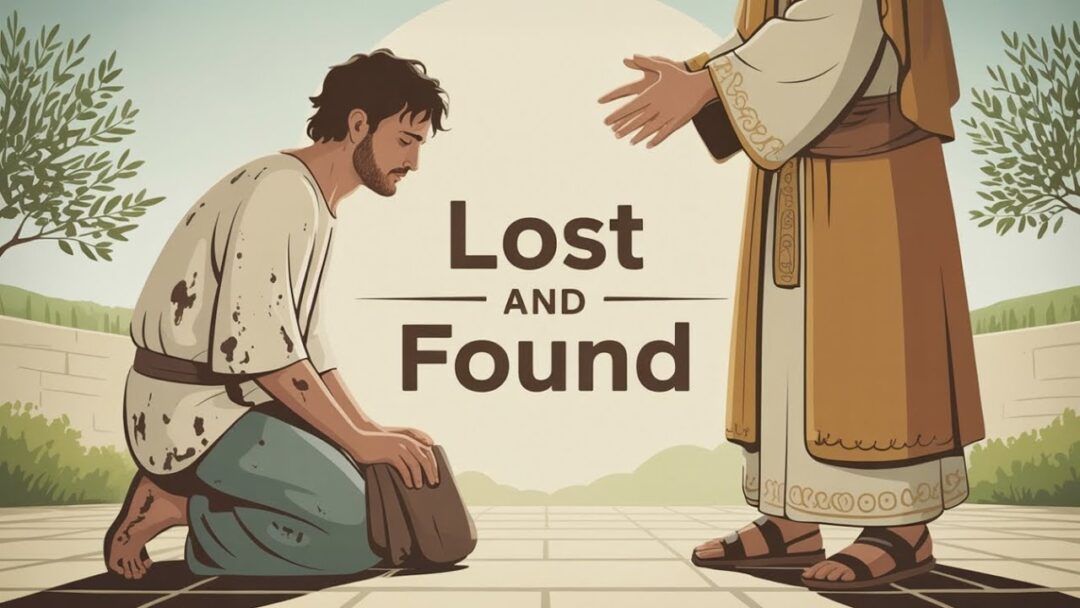
From our Sunday service on September 14, 2025, Luke 15 and Matthew 18. This is part 5 of our Parables of Christ series. Watch the full message: Lost & Found – The Parables of Christ #5 on YouTube.
Last week we talked about Jesus’s teaching on prayer and how we receive good gifts from God. For the next two weeks we turn in a slightly different direction, back to the topic of salvation and the emotional dynamics involved in it. This week we focus on God’s emotions, through the topic of God’s pursuit of the lost. Next week we’ll look at the human side, the jealousy that can arise because of grace. The parable of the prodigal son ties the two together, showing both God’s pursuit of the lost and the challenge of responding to his grace toward those we feel may not deserve it.
God wants you to know he relentlessly pursues the lost.
Why Jesus Told These Parables
We begin in Luke 15, which gives us the context.
Then drew near unto him all the publicans and sinners for to hear him. And the Pharisees and scribes murmured, saying, This man receiveth sinners, and eateth with them.
Luke 15:1–2
It’s great when Luke tells us exactly why a topic comes up. The three parables we’ll cover today come up specifically because the Pharisees said it was wrong for Jesus to welcome sinners and eat at his table. Through these parables Jesus teaches what it means to have a relationship with others and to reach the lost. They are a rebuke to the Pharisees. To them, Jesus’s relationship with sinners was a scandal to be avoided. To Jesus, it was the very ministry, the reason he walked this earth. If we want a Christlike attitude, we need to understand that the ministry of Jesus is the same ministry we’re called to today: to call sinners to eat at Jesus’s table.
These parables teach three things. First, all humans, saved or not, belong to God. As Paul tells us, all of humanity is God’s offspring, but not everybody is God’s son or daughter. Second, those who are unsaved are unsaved because they have been separated from God. They are God’s offspring, but through their sin they are separated and must be found again. Third, the unsaved becomes saved when he is reunited with God.
The Lost Sheep
Our first parable is the lost sheep, how God leaves the righteous to pursue the lost. Verses 3 to 7.
And he spake this parable unto them, saying, What man of you, having an hundred sheep, if he lose one of them, doth not leave the ninety and nine in the wilderness, and go after that which is lost, until he find it? And when he hath found it, he layeth it on his shoulders, rejoicing. And when he cometh home, he calleth together his friends and neighbours, saying unto them, Rejoice with me; for I have found my sheep which was lost. I say unto you, that likewise joy shall be in heaven over one sinner that repenteth, more than over ninety and nine just persons, which need no repentance.
Luke 15:3–7
This is one of the most famous parables we use to talk about God’s love for the lost. We talk about how he’s a good shepherd, and we go to Psalm 23. So let’s see what this parable teaches about God’s love for the lost.
First, consider the flock. We’re introduced to a shepherd with a flock of a hundred sheep. In Jesus’s day sheep were expensive livestock, and shepherds valued them. As a nomad, the shepherd didn’t have many possessions, so losing one sheep meant losing about one percent of his net worth. The sheep weren’t just food. They produced wool and milk that could be sold for a profit. Why are we talking about a shepherd and a sheep? Because we’re supposed to understand that we are valued by God. How many of us would be happy to lose one percent of our net worth and do nothing about it if it could be prevented?
Shepherding was also a communal effort. Shepherds traveled together with their flocks, which matters for the context later in the passage. The parable says the sheep were in the wilderness. There were places in Israel with plenty of wild grass for pasture, but getting to them meant going through rough terrain: rocky, semi-arid hills lacking vegetation, with dangers like cliffs, wolves, jackals and thorns. If you wanted your sheep to have all the nourishment they needed, you had to go through some dangerous areas first.
So the shepherd takes his flock through a treacherous mountain pass, and along the way one sheep falls to one of the dangers. When he gets back to the pastures where the other shepherds are tending their flocks, he counts his sheep and gets to ninety-nine. What does he do? Does he abandon his lost sheep, or write it off as a lost cause? No. He leaves the ninety-nine, who now have food and the protection of the other shepherds, and pursues the one who is in imminent danger from lack of food, water and shelter.
Jesus knows that the ninety-nine believers who have already come to faith in him don’t need his protection in the same way as the one who is in danger of hellfire. We know there are other shepherds with the flock, because when he gets back they rejoice together. I hope everybody in this church is saved, born again, and knows Christ as Savior. Each of us is in the pasture already, Lord willing, no longer in danger of imminent hellfire. So we ought not focus too much on ourselves. We are in a safe place. But there are people outside the doors of this church, probably just down the road, who haven’t made it to the pasture yet. They haven’t made it to the Savior yet, and they have no shelter for their souls. So this shepherd, caring so much for what he considers valuable and priceless, goes out alone into the dangerous wilderness where the wolves and jackals and thorns are. Remember that our Lord was pierced on a cross for us. He finds the lost sheep and carries it on his shoulders to make sure it doesn’t stray, and brings it home.
And then they rejoice. When the shepherd gets back to his community, he invites them to celebrate together. Jesus tells us this community represents heaven itself. Notice his community doesn’t come to him to celebrate. The shepherd is so excited about the redemption of his sheep that he invites them into his joy. God’s joy is so great that it can’t be contained within himself. Think of how you feel when you get something you wanted and have to tell your best friend about it. You finally get the motorcycle and show it to your wife, and then to your best friend: “Let’s go ride it.” Or you buy a house and post pictures of it. Or you graduate and show everybody your degree. That’s the way God feels when the unsaved comes to repentance and joins the flock. Do we understand how much God rejoices in our salvation? He says to us as a church, “Celebrate with me. What was lost is found and home again with me. This sheep was mine. I created each of these people. Rejoice with me.”
Take heed that ye despise not one of these little ones; for I say unto you, That in heaven their angels do always behold the face of my Father which is in heaven. For the Son of man is come to save that which was lost. How think ye? if a man have an hundred sheep, and one of them be gone astray, doth he not leave the ninety and nine, and goeth into the mountains, and seeketh that which is gone astray? And if so be that he find it, verily I say unto you, he rejoiceth more of that sheep, than of the ninety and nine which went not astray. Even so it is not the will of your Father which is in heaven, that one of these little ones should perish.
Matthew 18:10–14
God does not want anybody to be lost. Some people teach that God chooses who will and will not be saved, but that’s not what the Bible says. God doesn’t want to lose one sheep on the mountain pass, and he will do anything he can to bring it home. We sang “Reckless Love” today because from a human perspective it seems reckless to leave everything you own to pursue the one sheep, and to risk the ninety-nine. But Jesus says, “They’re safe in the pasture. I’m going to pursue the one and bring him home, because I love and value him.”
What’s the application? All of us belong to God, whether saved or not. We are all the offspring of his creation. We are of immense value to him, and he is doing everything he can to bring us home. For us, that means two things. First, don’t push away the lost whom God spends such an expense to rescue. What a shame it would be if we got to heaven and God said, “My child, why did you say that? Do you know how much I was pursuing that soul? He was ready to give his life to me, but you caused him to stumble and fall away.” God forbid that we do that. Realize how much God works to bring the lost to himself, and make sure we’re not in the way of their return home. Second, don’t spend so much time focusing on the saved flock that we forget those in imminent danger. We in the church love each other and care for each other, and we’re supposed to. But we need to be careful that we’re not so distracted with each other that we forget those in danger and delay rescuing them.
The Lost Coin
Next, Jesus gives a parable for those who may not be familiar with shepherding. It teaches the same lessons a different way, this time through the lens of a poor peasant woman. Verses 8 to 10.
Either what woman having ten pieces of silver, if she lose one piece, doth not light a candle, and sweep the house, and seek diligently till she find it? And when she hath found it, she calleth her friends and her neighbours together, saying, Rejoice with me; for I have found the piece which I had lost. Likewise, I say unto you, there is joy in the presence of the angels of God over one sinner that repenteth.
Luke 15:8–10
The lost coin would have been a silver coin called a drachma, worth roughly a day’s wage in Israel. So this woman has ten days’ worth of wages and loses one coin. In terms of buying power, it would be enough for about sixteen days’ worth of raw food, or six pre-made loaves of bread. It was a decent amount of money, but not a lot. She’s a poor peasant woman without regular income, trying to get by on ten days’ worth of income. Today it would be roughly like having a thousand dollars and losing a hundred-dollar bill somewhere in your house. She’s losing a tenth of everything she has, and she has no way to get more. She says, “I have to find this coin. It might be trampled down in the dirt, or covered up. I need to search diligently until I find it, because this is not just one percent of my wealth. This is ten percent, and I need to survive.”
This woman doesn’t have much money, but she lights a candle. Do you understand the expense of lighting a candle? You had to buy the oil for the lamp. It’s not like today, when you flip a switch and get light cheaply. She searches the house with a lantern, burning oil she can’t afford to replace. That’s what God is saying: “I am sparing no expense to find you.” And we know the expense is Jesus Christ, his Son. The light also often represents the Holy Spirit. God uses the Holy Spirit to reveal his truth to people so that they can be found. God values us, sends the Spirit to reveal us, and pays a great expense to draw men to himself.
The Lost Son
Lastly we have the parable of the prodigal son. We’ll talk about part of it today and part next week. More accurately you could call it the parable of the two sons, because there are two lessons in it. Today we’ll look at the first son’s lesson, and next week the second. First, the scandal, in verses 11 to 13.
And he said, A certain man had two sons: And the younger of them said to his father, Father, give me the portion of goods that falleth to me. And he divided unto them his living. And not many days after the younger son gathered all together, and took his journey into a far country, and there wasted his substance with riotous living.
Luke 15:11–13
We meet a son who doesn’t appreciate everything his father has done for him. Rather than staying with his family and working hard in the family business, he decides to take his inheritance early and tour the world. He says, “Father, give me my inheritance.” What does the father do? Does he argue? No. He says, “Okay, son. You take it and go.”
Would this be normal in the first century? Absolutely not. It would have been extremely dishonoring to your parents and disrespectful, and financially devastating to your family to have to split half of your estate before your father was dead. It was a very selfish decision to take half of the money your father lives on and walk away with it to another country. What this child asked for was awful, yet the father says, “It’s your choice. Take it.” The father doesn’t even argue.
This is the picture. All people are God’s offspring, but God does not make them follow him. The son says, “I want to live my life my way. I’m leaving.” And God says, “Go. It’s your choice.” So he goes far away, wastes his substance with riotous living, indulges himself, lives foolishly, and quickly his money is gone. Now let’s look at the son’s foolishness revealed, in verses 14 to 16.
And when he had spent all, there arose a mighty famine in that land; and he began to be in want. And he went and joined himself to a citizen of that country; and he sent him into his fields to feed swine. And he would fain have filled his belly with the husks that the swine did eat: and no man gave unto him.
Luke 15:14–16
The foolish son has quickly wasted everything his father gave him. Hardship comes to the country, famine, and food becomes very expensive, and he finds out he doesn’t have the money to buy it. He goes to one of the natives and asks for a job, and he doesn’t get a very good one. He gets a job feeding pigs. As he’s feeding them, he looks at the scraps being fed to the pigs and deeply longs to feed himself with the rotting trash they’re eating. It’s only at this low point that he realizes how far he has fallen and how much he has given up. And then suddenly it clicks and his mind clears. Next, the son’s regret, in verses 17 to 19.
And when he came to himself, he said, How many hired servants of my father’s have bread enough and to spare, and I perish with hunger! I will arise and go to my father, and will say unto him, Father, I have sinned against heaven, and before thee, And am no more worthy to be called thy son: make me as one of thy hired servants.
Luke 15:17–19
The son realizes that all this time he has been suffering with nobody to help him, while back at home, where he belonged, his father was willing to help him the whole time. He wasn’t starving because he had no options. He was starving because he was ashamed to humble himself, admit his mistake and go home to his father.
That’s how God works as well. Everybody’s a sinner. Everybody is guilty of death and guilty of hell. And nobody has to go there. Not one person in hell will be there because they didn’t know. Everyone who is there will be there because they chose to be. The only thing that stops you from getting into heaven is humbling yourself and saying, “Everything I need is back home. It’s with my Father. I’m his offspring, but I’m not acting as his son. I need to go home and be his son, and then I’ll have everything I need.” So the son finally says, “I need to go home. I need to apologize. I need to admit I’m wrong and ask for a job working for my father.” Now the son’s restoration, in verses 20 to 24.
And he arose, and came to his father. But when he was yet a great way off, his father saw him, and had compassion, and ran, and fell on his neck, and kissed him. And the son said unto him, Father, I have sinned against heaven, and in thy sight, and am no more worthy to be called thy son. But the father said to his servants, Bring forth the best robe, and put it on him; and put a ring on his hand, and shoes on his feet: And bring hither the fatted calf, and kill it; and let us eat, and be merry: For this my son was dead, and is alive again; he was lost, and is found. And they began to be merry.
Luke 15:20–24
The father’s response was so much greater than the son could have imagined. The son went home planning to say, “I’ll be like one of your servants. You won’t like me, but let me work.” But before he even has the chance to say, “Dad, please hire me,” the father restores him to his position of honor in the household. He puts on him his best robe and offers his best food, and he throws a party to celebrate. Why? For the same reason as in the other parables: he’s so excited about what he has that he has to tell everyone else. The rejoicing over his son is so great that he can’t contain it. The only thing the son had to do to have everything given back was to say, “Father, I was wrong, and I am unworthy.”
Come Home
What’s the application for us? This is all God requires of us: “God, I was wrong. I’m a sinner, and I am unworthy.” When we admit that, God says, “Come home. You are my son. You were dead and are alive again. You were lost and now are found.” Do we understand how much God pursues us, and how much he values us as his children?
The lost sheep, the lost coin and the prodigal son all remind us of a very powerful truth: God relentlessly pursues the lost because he values each of us more than we can imagine. To the Pharisees, Jesus’s fellowship with sinners was scandalous, but to God it was the very heart of his mission. Every soul matters. Every life is worth the cost. And heaven itself erupts in joy when even one sinner turns to God.
For us the challenge is twofold. First, we must remember God’s perspective. Every person we meet, saved or unsaved, belongs to God, is infinitely valuable to him, and is worth pursuing for his or her redemption. Second, we need to imitate God’s heart. We must guard against becoming like the Pharisees, who were more concerned with appearances than with God’s compassion for restoration. Remember that God pursued you when you were lost, and he is still pursuing others through his Spirit, through his church, and sometimes even through you.
Next week we’ll turn to the second half of the parable of the prodigal son and wrestle with the human response: the jealousy, pride and resentment that can arise when grace is poured out on others we don’t think deserve it. But before we go there, let’s rejoice that our God never stops searching, never stops loving, and never stops welcoming his children home. God wants you to know he relentlessly pursues the lost. So will you be a part of his mission and help pursue the lost today?

Recent Comments