
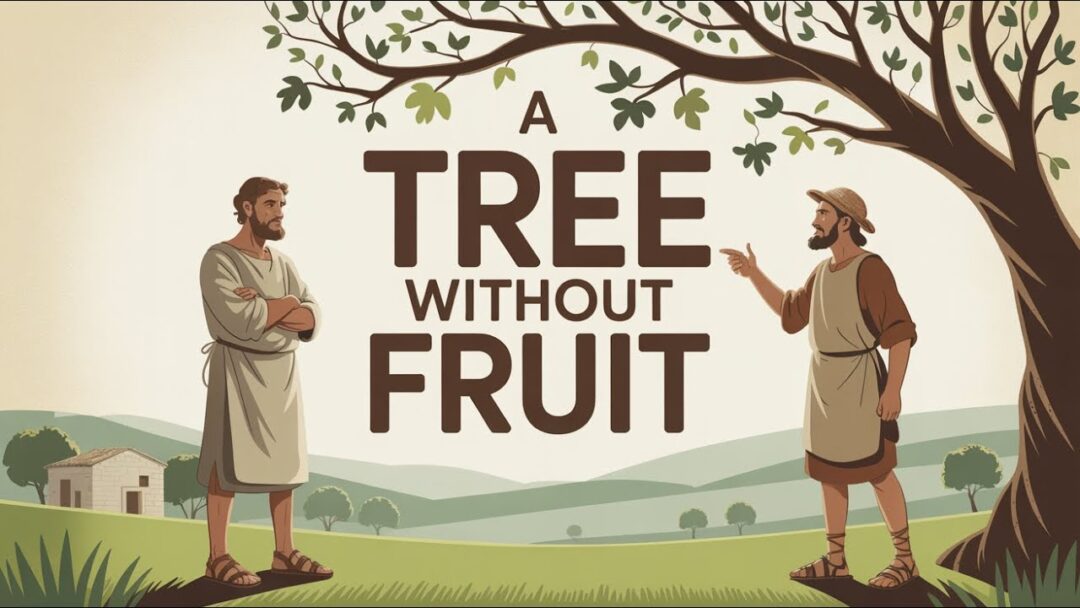
From our Sunday service on October 12, 2025, Luke 13, Matthew 18, Mark 11 and Luke 11. This is part 9 of our Parables of Christ series. Watch the full message: A Tree Without Fruit – The Parables of Christ #9 on YouTube.
Last week we talked about how God calls us to surrender to his service by doing good in this world in his name. We looked at the story of the good Samaritan to see what it looks like to love our neighbors and be like Christ. One of the most important attributes of a Christian is our love, and by our love we will be identified as true believers.
Today we start a new section that I’m going to call the parables of warning. They’re not completely different from what we’ve been talking about, but in these parables Jesus very clearly warns the unfaithful about the consequences of neglecting God’s call. A lot of the parables are positive and uplifting. The parable of the sower, where we started, is encouraging. Even though it talks about seed falling on bad ground and not everyone being saved, there is good ground, and the gospel is being spread one way or the other. These parables are a stern warning. Jesus isn’t messing around. He’s talking about very important topics that the religious leaders of his day had completely missed. Today we look at three parables about those who choose not to produce spiritual fruit in their lives.
God wants you to know that the gospel needs to change you.
The Fruitless Fig Tree
First we look at the parable of the fruitless fig tree and the necessity of change. Before the parable, let’s look at the context it was given in, Luke 13:1-3.
There were present at that season some that told him of the Galilaeans, whose blood Pilate had mingled with their sacrifices. And Jesus answering said unto them, Suppose ye that these Galilaeans were sinners above all the Galilaeans, because they suffered such things? I tell you, Nay: but, except ye repent, ye shall all likewise perish.
Luke 13:1–3
This passage is going to be obscure for most of us. A group comes to Jesus and asks him about something that happened to a group of Galileans. Galilee is Jesus’s home area, so this would have hit close to home. Most of us aren’t going to read this and say, “Yes, I know exactly what happened in Galilee in the first century.” So who are these Galileans? Most people think this refers to the followers of Judas of Galilee, who appears in Acts 5. Judas taught that no one should recognize any human as their master. In a sense that’s biblical, since we shouldn’t call anybody Lord but God. But he took it too far and rejected all authority across the board, because the only authority is God. Is that biblical? No. God says he ordains authority under him. Because of this belief, Judas and his followers refused to acknowledge Caesar’s authority, and if you know anything about history, that’s a very dangerous place to be. When the governor discovered that they refused to offer sacrifices or pay their taxes, Pilate had them publicly executed at the temple while they were worshiping God, and their blood was mixed with the blood of the sacrifices. It was a gruesome, horrific tragedy. These people weren’t following God correctly, but they had the right heart. They wanted to put God so high that they didn’t respect any other authority, though they had stepped out of line with what God said about authority.
Apparently this was a recent event, and the people are shaken. “Jesus, why was this allowed to happen? These Galileans were trying to be faithful to God. They were so careful in how they sacrificed, and yet their own blood defiled the temple. What do you have to say about this?” And Jesus asks, “Suppose ye that these Galilaeans were sinners above all the Galilaeans?” In other words, do you think they were worse sinners than everybody else in Galilee, than the people in the brothel or the people robbing at the tax booths? “I tell you, Nay: but, except ye repent, ye shall all likewise perish.” You’re shocked that the righteous die. Instead of being worried about them, pause for a second, because you really should be worrying about yourself. They didn’t die because they were worse sinners. They died because they’re human. Everyone is a sinner and everyone is in danger of death. He continues in verses 4 and 5.
Or those eighteen, upon whom the tower in Siloam fell, and slew them, think ye that they were sinners above all men that dwelt in Jerusalem? I tell you, Nay: but, except ye repent, ye shall all likewise perish.
Luke 13:4–5
Jesus brings up another recent tragedy. We don’t know a lot of details, but we know there was a tower in the Siloam region of Jerusalem, and as some random people were walking by, it collapsed and killed them. Jerusalem was a place you traveled to in order to worship, so maybe they were there to worship. Do you think these people were more wicked than everyone else because a tower fell on them? “No. Stop worrying about them for a second, because you are a sinner and you will die one day, too.” Then Jesus presents the parable of the fruitless fig tree, verses 6 to 9.
He spake also this parable; A certain man had a fig tree planted in his vineyard; and he came and sought fruit thereon, and found none. Then said he unto the dresser of his vineyard, Behold, these three years I come seeking fruit on this fig tree, and find none: cut it down; why cumbereth it the ground? And he answering said unto him, Lord, let it alone this year also, till I shall dig about it, and dung it: And if it bear fruit, well: and if not, then after that thou shalt cut it down.
Luke 13:6–9
A vineyard owner plants a fig tree in his vineyard, and within three years he expects fruit. He goes on year three, expecting figs, and finds not one piece of fruit on it. What does fruit represent? In the parables, fruit almost always represents the Christian walk. The first fruit produced is salvation, and the fruit after that is what we do for God through good works and actions. So God goes to the person he has invested in to call to salvation, and says, “They haven’t accepted my salvation yet. In three years I’ve given you all the time you should need.” Usually if a fig tree hasn’t produced fruit by the third year, it’s a dud, and you cut it down and start over. So the owner says it’s a lost cause.
But the gardener says, “Give it one more year. We’ll dig a trench around it, put water in it, put some manure in there, and give it every opportunity for success. Then, after we’ve done everything we can, if it still doesn’t produce fruit, we’ll cut it down.”
Jesus is speaking a hard truth about salvation. The truth is that God is patient with us. He gives us every opportunity for salvation and everything we need to produce the fruit of salvation. Maybe three years should be enough. God could say, “I’ve given you enough evidence that I’m real, enough opportunity to respond to my call. I’ve had a number of Christians tell you the gospel and you haven’t responded.” But is that where God ends it? No. He says, “I’m going to extend my mercy. I’m going to invest in this person. I’m going to set up things in their life that point them to me. I’m going to give them water,” and water always represents the Holy Spirit, “and convict them, and give them more time.”
The sad truth is that although God is patient and tends us so we can produce the fruit of salvation, it’s not unlimited. God’s time isn’t unlimited. Eventually there’s a time in life when someone has to decide whether they’re going to follow God, whether they’re going to be a tree that produces fruit or not. God gives tender care to each and every person to ensure they have the best chance to produce the fruit of salvation. But if he has done all he can and they still do not repent, they will die in their sins.
But we’re Christians. We’ve already been saved. We’ve already produced a fruit. What should we take away? It should remind us that the reason we are still on earth is to serve God and produce fruit beyond salvation. What would that farmer say if he came the next year and found one fruit, and the next year no more fruit than that? Would he still want to keep the tree in the field? God doesn’t keep us on this earth for us to go live life to the fullest. He leaves us here so that we can serve him. He leaves us in the garden to continue producing fruit after the first one. If we do not continue to produce fruit and point others to Christ, then we too are at risk of being pruned from this earth when we end up hindering the work of the Lord with our lives. In the coming weeks we’ll see more of what God says to those who have salvation but do not continue to produce good fruit.
The Unmerciful Servant
Our next parable is in Matthew 18, the parable of the unmerciful servant. Here Jesus tells us the important truth that those of us who have received forgiveness must be those who forgive. Forgiveness is part of the fruit God wants us to produce. If we want to produce spiritual fruit, we’re going to have to have forgiveness. First the context, verses 21 and 22.
Then came Peter to him, and said, Lord, how oft shall my brother sin against me, and I forgive him? till seven times? Jesus saith unto him, I say not unto thee, Until seven times: but, Until seventy times seven.
Matthew 18:21–22
If you remember our Daniel series, I brought up something I’d never noticed before: seventy times seven is the amount of time God gave Israel to repent, in the seventy weeks of Daniel. The seventy weeks were seventy sets of seven years. So I think what Jesus is saying is not that seventy times seven is a big number. He’s saying that seventy times seven is how much God delays and forgives. God gave Israel 490 years of forgiveness, and if they weren’t ready to accept the Messiah, he would go to the Gentiles and do something new. By saying seventy times seven, Jesus isn’t saying we should forgive a lot of times. He’s saying we should forgive as much as God has forgiven us. Not 490, because it’s a number we’ll never reach, but because we will never have the opportunity to forgive someone else more than God has already forgiven us. No matter how long you live, you will never have to forgive someone more than God has forgiven you. So Jesus says, “Peter, you think seven times is enough? Remember how many times God forgave Israel. Do you think you can surpass that in your lifetime?” And he gives a parable to drive the point home. Verses 23 to 25.
Therefore is the kingdom of heaven likened unto a certain king, which would take account of his servants. And when he had begun to reckon, one was brought unto him, which owed him ten thousand talents. But forasmuch as he had not to pay, his lord commanded him to be sold, and his wife, and children, and all that he had, and payment to be made.
Matthew 18:23–25
These parables are very intense, and so is this situation. A king is going over his accounts and sees that one of his servants owes ten thousand talents. What’s a talent? Ten thousand talents is the equivalent of about 150,000 years of wages. This man earns a year’s wage every year, and he owes 150,000 years’ worth of his pay. That’s a problem. The king says, “That’s not coming back. He’s not going to live that long. I have to do something to recoup my loss.” So he orders the man sold into bond servitude to work for free, and his wife and his children as well. The king won’t make back all of that in any of their lifetimes, but at least he’ll make back more than if the man just started paying now. Bond servitude was the prison system of the day. The king knew the man could never pay the debt in his lifetime, so he does the dramatic thing and sells him and his family into debt slavery. Man, that’s intense. Please tell me it gets better. Let’s look at the servant’s request, verses 26 and 27.
The servant therefore fell down, and worshipped him, saying, Lord, have patience with me, and I will pay thee all. Then the lord of that servant was moved with compassion, and loosed him, and forgave him the debt.
Matthew 18:26–27
The word “worship” in Greek literally just means to bend the knee to. He isn’t worshiping the king like he’s God. Think of how people in Asian cultures bow in respect. The servant falls on his knees and bows before the king. If I were the king, the first thing I’d think is, “Yeah, right. You’re going to pay me 150,000 years of wages?” He’s making an empty promise he can never fulfill. But he begs and he cries and he bows, and the king is moved with compassion. “This guy’s a mess. He didn’t really think about the cost of what he was doing. I feel bad. I’ll cut you some slack. I’ll release you and your wife and your family. I’ll write it off.” What a relief that must have been, that you and your wife and your kids aren’t going to be sold into slavery for the rest of your life. You would think he’d go home and celebrate. But what does he do? Verses 28 to 30.
But the same servant went out, and found one of his fellowservants, which owed him an hundred pence: and he laid hands on him, and took him by the throat, saying, Pay me that thou owest. And his fellowservant fell down at his feet, and besought him, saying, Have patience with me, and I will pay thee all. And he would not: but went and cast him into prison, till he should pay the debt.
Matthew 18:28–30
After being forgiven an astronomical amount, that same servant went to another servant who owed him a hundred days’ worth of wages. After having his own debt cleared, he thought, “Wouldn’t it be nice to have another third of a year’s wages in my pocket? That guy owes me.” He takes the man by the throat and threatens him. “Give me what you owe me or I’ll ruin your life.” The one who was just pardoned of something enormously greater than this man owed. And the fellow servant says exactly what he had just said to the king: “Have patience with me, and I will pay thee all.” This man might have been telling the truth. It was a debt he could perhaps work off. But even though that was a reasonable thing to say, the servant has no mercy. He throws him into debtor’s prison as a debt slave until he can pay it back. That is a messed up parable, and Jesus is going to teach us that some of us are messed up and don’t know it. Verses 31 to 35.
So when his fellowservants saw what was done, they were very sorry, and came and told unto their lord all that was done. Then his lord, after that he had called him, said unto him, O thou wicked servant, I forgave thee all that debt, because thou desiredst me: Shouldest not thou also have had compassion on thy fellowservant, even as I had pity on thee? And his lord was wroth, and delivered him to the tormentors, till he should pay all that was due unto him. So likewise shall my heavenly Father do also unto you, if ye from your hearts forgive not every one his brother their trespasses.
Matthew 18:31–35
When the king finds out that the man he had just forgiven had thrown his fellow servant into debt slavery, a judgment he himself had just been spared, he is furious. He had written off a huge debt, and this man was petty with somebody else. He calls him forward and chastises him for his evil character. If you do not give mercy to other people, you don’t deserve mercy yourself. So instead of writing off the debt, the king puts it back on him and throws him into debt slavery for the rest of his life.
And what does Jesus say this parable is about? “So likewise shall my heavenly Father do also unto you, if ye from your hearts forgive not every one his brother their trespasses.” Here is the hard truth. There are some people who follow Jesus and have been forgiven. They’ve produced the fruit of salvation, and they’ve decided that one fruit was enough. “God has forgiven me for all my sins, but my coworker, my family member, the person who cut me off in traffic, I’m not going to forgive them. They don’t deserve it. My coworker drove me crazy and made me do two extra days of work. My family member drives me crazy with their online posts. That person who cut me off, I hope they get pulled over.” One by one they decide that although they were forgiven so great a debt by God, they will not extend forgiveness to others. Maybe they’ll forgive friends, or family who do good to them. But those who owe them, those who have inconvenienced them, that’s on them. And Jesus says that if you have that attitude and harbor resentment against people who have wronged you, he will not forgive you. What does that mean? We don’t need to turn there, but Jesus talks about this in Mark 11:25-26.
And when ye stand praying, forgive, if ye have ought against any: that your Father also which is in heaven may forgive you your trespasses. But if ye do not forgive, neither will your Father which is in heaven forgive your trespasses.
Mark 11:25–26
Is this saying you’ll go to hell if you don’t forgive people? No. It’s talking about prayer. If you’re still talking badly about something that happened last week, if you’re still mad at the coworker who wronged you two years ago, if you’ve decided you hate a family member, cut off all contact and will talk badly about them for the rest of your life, don’t expect your prayers to be answered. If you can’t forgive, God isn’t going to forgive you, and the Bible says that if God hasn’t forgiven you, he’s not going to answer your prayers. Don’t expect your life to be blessed if your life is a curse to other people. If you want God to do something great in your life, you cannot be unforgiving.
Jesus died on a cross for your sins. You were his enemy when he died for you. It wasn’t convenient for him to have nails driven through his hands and feet. You’re mad at your coworker because they made you do a few extra hours of work this week. How big of an inconvenience was it for him to die on the cross for your sins? If we as Christians want God to bless our lives, we have to be people who forgive others. You can never be a good Christian if you’re not also a good forgiver. The two cannot be separated. Being a person who forgives and is free of grudges is a very powerful way for people to see Christ in you.
The Strong Man Bound
Our last parable today is in Luke 11, the strong man bound. Here God shows us that either you are with him and drawing people to him, or you are against him and pushing people away. If we are people who do not forgive, we are not drawing people to Christ but pushing them away. First the context, verses 14 to 16.
And he was casting out a devil, and it was dumb. And it came to pass, when the devil was gone out, the dumb spake; and the people wondered. But some of them said, He casteth out devils through Beelzebub the chief of the devils. And others, tempting him, sought of him a sign from heaven.
Luke 11:14–16
Jesus casts out a demon from a man who was mute (Matthew tells us he was also blind), and everyone is amazed when he suddenly speaks. But some of them, the Pharisees, were very unhappy. They claimed that Jesus was putting on a show, using Satan to cast out Satan to trick the people into following his false teachings. So what does Jesus say in response? Verses 17 to 20.
But he, knowing their thoughts, said unto them, Every kingdom divided against itself is brought to desolation; and a house divided against a house falleth. If Satan also be divided against himself, how shall his kingdom stand? because ye say that I cast out devils through Beelzebub. And if I by Beelzebub cast out devils, by whom do your sons cast them out? therefore shall they be your judges. But if I with the finger of God cast out devils, no doubt the kingdom of God is come upon you.
Luke 11:17–20
Jesus says it’s impossible for a nation or household that is divided to keep itself together. I think this is a very important truth that a lot of us forget: division does nothing but harm us. Whether it’s your nation or your home, if it is divided, desolation and ruin are sure to follow. Satan can’t run his kingdom by fighting against himself.
Then Jesus asks an interesting question: “If I’m casting out demons through the power of Satan, how are your sons casting them out?” He’s talking about the students of the Pharisees and scribes, who did exorcisms in the community during this time. “Why is it okay for your students to cast out demons, but not for me? Were they doing it through witchcraft? If not, why is it strange for me?” If Jesus is the Messiah and God does allow him to cast out demons, the only conclusion the Pharisees can reach is that what Jesus says is true and the kingdom of God has arrived. So they had to come up with an excuse. If you saw someone claiming to be the Son of God, healing the sick and casting out demons, you might take him seriously. But the Pharisees say, “He’s on the other side. He’s satanic. This is a big conspiracy.” And Jesus says, in effect, “I don’t think people are dumb enough to buy this. A house divided can’t stand.” Then he gives the parable of the strong man bound, verses 21 to 23.
When a strong man armed keepeth his palace, his goods are in peace: But when a stronger than he shall come upon him, and overcome him, he taketh from him all his armour wherein he trusted, and divideth his spoils. He that is not with me is against me: and he that gathereth not with me scattereth.
Luke 11:21–23
Jesus compares Satan to a strong man, a warrior with weapons and armor who owns riches in a large home. The Greek word for the home describes one with outer walls and the house built in the middle. The King James translates it as a palace, but it’s a walled home with a courtyard. He’s wealthy, and he has protection not just in his sword and armor but in the walls around his house. Jesus says that if you want to steal from this strong man, you first have to disarm him, take off his armor and get into his territory so you can restrain him. Then and only then can you rob him. You can’t rob him unless you can get through the gate of his wall, and you can’t carry his stuff out of the house unless you can stop him from coming at you with a sword. If you want to rob the strong man, you’ve got to be more powerful than the strong man. Who is more powerful than Satan? Jesus Christ. If you want to disarm Satan, you can only do it through his power. Only God can cast out demons. Jesus came to this earth to disarm Satan and steal back his people from his household.
But in verse 23 Jesus says a very hard truth: “He that is not with me is against me.” There are only two sides in this battle, Jesus and Satan, and everyone must pick a side. A lot of times in life we make a false dichotomy that there are only two options. In this case there really are only two. Either you’re on the side of Jesus and actively trying to bring people to him, or you’re pushing others away from him. Either you gather or you scatter.
Think of the passage in Revelation about lukewarm water: “I would thou wert cold or hot. So then because thou art lukewarm, I will spue thee out of my mouth.” A lot of times we misunderstand that to mean, “I’d rather you be totally for me or totally against me than apathetic.” That’s not what it’s saying. Cold water is refreshing and hot water soothes, but lukewarm water isn’t useful for anything. Jesus says there is no middle ground. Either you’re disgusting and pushing people away, or you’re serving him, refreshing or soothing and working for him.
Either you’re with Jesus and you help him gather people back from Satan through your life. You show forgiveness. You show love. You tell people what Jesus has done for you. You praise Jesus for every miracle in your life. You have faith in difficulties, and people look at you and know you’re a Christian and know something’s different. Or you’re ashamed of your Christianity and don’t want to make a stand for Christ. You’re afraid to speak for him. You don’t forgive your enemy. You don’t love your neighbor. And rather than drawing people in, you push them away.
This passage leads into the parable of the sower, where we started our series. Are you going to be someone who gets the field ready for Jesus, or someone who ruins the field, tramples the dirt and makes it hard, leaves the stones in the soil that choke the wheat? “Well, pastor, I’m stepping out of the way. I’m not doing anything, but I’m not in the way either.” That’s not how it works. The Bible doesn’t say there’s an apathetic middle ground. There is either for me or against me. Either you are active or you are hindering. The apathetic Christian isn’t neutral. The apathetic Christian is harmful in the way he lives his life. A Christian who steps out of the way is a hindrance to the gospel of Jesus Christ.
Change, Forgive, Stand With Christ
Each of these passages reveals a vital truth about life in the kingdom of God. Change is not optional. Forgiveness is not negotiable. And loyalty to Christ is undivided.
The fruitless tree reminds us that God is patient and merciful, but his patience is not endless. He nurtures us and gives us grace and opportunity to produce fruit, but there comes a time when we must respond with genuine repentance and spiritual growth. The absence of fruit is not just unproductive. It is a danger to us and to those around us. To choose to remain unchanged by the gospel is to choose to live in death rather than life.
The unforgiving servant shows that repentance must be accompanied by transformation in how we treat other people. God’s forgiveness should produce a heart that freely forgives. To receive grace and refuse to extend it to others reveals that we have not truly understood the purpose of God’s grace. A fruitless tree and an unforgiving servant share the same heart condition: a refusal to let God’s mercy change them from the inside.
And in Jesus’s teaching about the strong man, he makes the choice clear. There is no neutral ground in the kingdom of heaven. Either we are standing with Christ, sharing in his mission to reclaim souls from darkness, or we are resisting his work and pushing people away from him. The one who repents, forgives and bears fruit proves by his actions that he belongs to the stronger one who has overcome our enemy, Satan.
So let’s take these three truths to heart. Repent quickly when God convicts you. Forgive freely as you have been forgiven. Stand firmly with Christ, producing spiritual fruit that will last forever. The time of God’s mercy is now, and he’s calling us to forgive others and to stand beside him as a light to our world. Let’s not waste this season hoping that maybe we’ll change next year, maybe we’ll make fruit next year. Choose today to live changed, forgiving and faithful, showing the world the power of the gospel. God wants you to know that the gospel needs to change you. So will you allow the gospel to change you today?

Recent Comments