
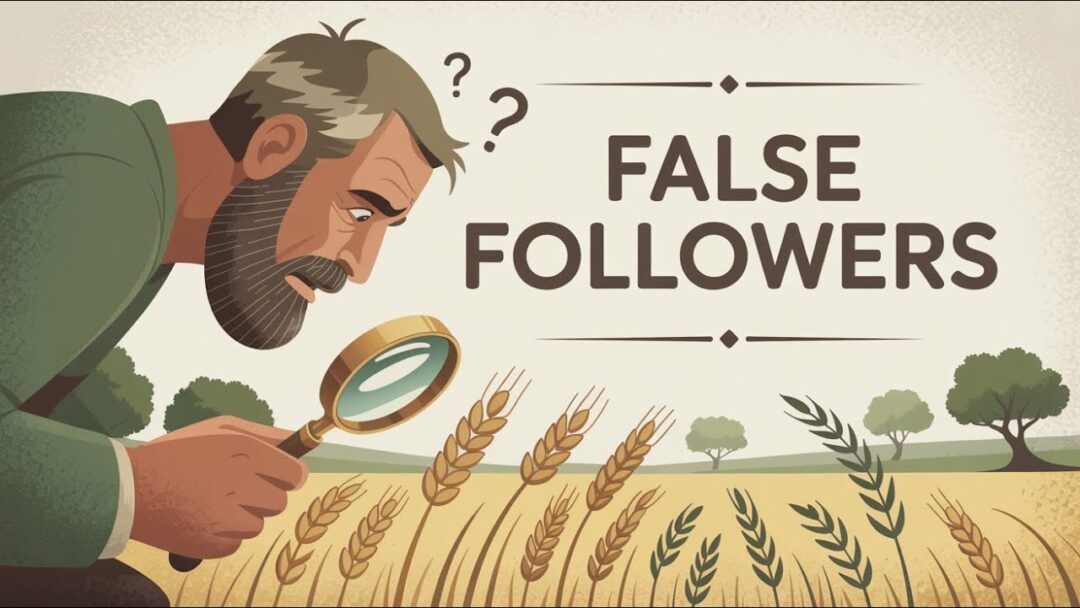
From our Sunday service on November 2, 2025, Matthew 13, Luke 9 and Matthew 25. This is part 12 of our Parables of Christ series. Watch the full message: False Followers – The Parables of Christ #12 on YouTube.
Last week we talked about serving the Lord as he awaits his return, and how we need to be watching and working in anticipation of it. This week we continue in what we’ve called the parables of warning, parables with severe warnings about things we need to pay attention to if we want to live for Christ effectively. Last week the warning was to be working and not lazy. This week we look at what Jesus teaches about so-called false followers, specifically how we should respond to people who profess Christ but don’t actually follow him in their lives.
God wants you to know that the kingdom of God belongs only to those who are his true followers.
Today we have only two sections. Part one is the breadth of the kingdom. Part two is the separation at Christ’s return and the identification of the righteous.
Wheat and Tares
The context is that this comes right after the parable of the sower. Jesus said the parable of the sower is the foundation for understanding all of his parables. The sower is about how people grow into salvation. Now he talks about people who appear to grow into salvation but truly aren’t part of the same group. Matthew 13:24-25:
Another parable put he forth unto them, saying, The kingdom of heaven is likened unto a man which sowed good seed in his field: But while men slept, his enemy came and sowed tares among the wheat, and went his way.
Matthew 13:24–25
Right off the bat you should see similarities with the parable of the sower. Both are about planting seed in a field and waiting for it to grow. But in the first parable only good seed was planted. In this one the farmer plants good seed, and the farmer’s enemy comes and sows bad seed in the field. The bad seed is called tares. Tares are a type of weed that, when young, appears almost indistinguishable from wheat. Sowing the two together would cause great disorder, because as they grow they look identical and you can’t tell what is a weed and what is wheat. Weeds in your garden steal nutrients from the plants you want to grow.
The enemy, hating this farmer, decides to sabotage his field. Rather than doing something super obvious like burning down his fields, he scatters tares among the wheat. The farmer won’t know it, but his crops will be slowly killed off by this invasive species, and he can’t do anything about it, because to remove the evil would also mean removing the good.
God, in his wisdom, sows the good news of the gospel into the world. The good seed is the gospel, the news that Jesus Christ, God himself, loves you, died for you and paid for your sins on the cross, and that if you humble yourself before him and say, “God, I’m a sinner, I need you, I surrender to you, you’re the only way I can have any righteousness in my life, save me,” and allow Jesus to come into your life, you can be saved. But then there’s the bad seed. The enemy, Satan, plants false believers in the field: people who profess Christ but don’t actually follow him, who want the benefit of the kingdom but not the surrender the kingdom calls them to. Maybe they want the social comfort of being in the church. Maybe the church offers community activities and they want to build friendships and relationships. Maybe they’re interested in the philanthropy opportunities the church provides. So they come in among the church and pretend to be Christians, pretend to profess Christ, but in their hearts they know they’re not surrendered to Jesus. They’re there for the external comforts the church can provide, not the change Jesus wants from them. Verses 26 to 30:
But when the blade was sprung up, and brought forth fruit, then appeared the tares also. So the servants of the householder came and said unto him, Sir, didst not thou sow good seed in thy field? from whence then hath it tares? He said unto them, An enemy hath done this. The servants said unto him, Wilt thou then that we go and gather them up? But he said, Nay; lest while ye gather up the tares, ye root up also the wheat with them. Let both grow together until the harvest: and in the time of harvest I will say to the reapers, Gather ye together first the tares, and bind them in bundles to burn them: but gather the wheat into my barn.
Matthew 13:26–30
Quite a conflict arises from just a little scattered seed. The seed didn’t immediately reveal itself. Everything seemed fine, but when things started to grow, the servant noticed something wasn’t quite right. He goes to investigate and realizes not all the seed in the field is wheat. He goes to the landowner and says, “Didn’t you plant the good seed? Did you plant the wrong seed this season? Where did the tares come from?” And the farmer says, “I know what happened. I’m not taken by surprise. I planted good seed, but my enemy also planted in my field.”
Who are the servants in this parable? The servants represent anybody who serves God. It represents you and me, those who are working for the kingdom. Remember that the parable of the sower is about people growing toward the fruit of salvation. The wheat growing in the field represents a person on the path to saving faith. Some of them don’t make it to salvation. Some wither before they make the choice to give their life to Christ. So the field is those new potential believers growing, and the servants are tending the garden, trying to bring people to Christ. And the servants notice that while we are trying to bring people to Christ, there are people in the field trying to do the opposite. They’re growing among us in the kingdom of God, but they’re not part of the group we’re trying to reach, and they’re trying to steal from that group and lead them away.
The servant panics. In parable form he says, “God, do you want me to kick them out? These false followers who are mooching the resources of the church, mooching the benefits of the kingdom, do you want me to expel them?” What does the farmer say in verse 29? “Nay; lest while ye gather up the tares, ye root up also the wheat with them.” What’s Jesus saying? “No servant of mine, this job is not for you.” Why? Because if you try to rip the weeds out of the wheat, you’ll accidentally rip up some wheat while you’re at it.
We Are Not as Good at Detecting False Christians as We Think
This is a very important part of our lesson today: God does not call us to rip the tares out of the kingdom of God. In his infinite wisdom Jesus sets forth a parable that tells us we’re not as good at detecting false Christians as we think we are. The servant is excited. He has zeal for his master and says, “Do you want me to go do the work? I’m ready.” I’m sure the farmer is like, “I love the enthusiasm, but this is not what I want you to do.” Since the young tares and young wheat are almost indistinguishable, we have to wait and see at the time of harvest what they produce. Remember, the time of harvest is salvation. We need to wait and see whether they prove to be saved, and once they are fully matured and have fully revealed what they are, then we will separate them out and take the evil and wicked and throw them for fuel in the fire.
Why shouldn’t we sort the saved from the unsaved ourselves? Because we might harm those who are on a path to salvation. Let’s be honest: a lot of people don’t get saved the first time they hear the gospel. If you learn anything from these parables, it should be that the path to salvation is a time of growth. The main lesson of all the parables of the sower is that salvation doesn’t just come like that. It has to be nurtured and grown, and it takes time. Jesus is saying, don’t try to cast out the false believer, because you don’t know who is a false believer and who is just having a mild trip-up. They might look very similar.
Think of someone who is severely addicted to drugs or alcohol, someone chemically dependent on a vice, who has lived in moral depravity at the lowest of the low, hooked on heroin and really wanting to get off. God has a hold of their heart. They’ve heard the gospel and know there’s hope, but at the same time they’re addicted. If you want to be the person who sorts the true Christian from the false, it’s going to be hard to tell the difference with someone trying to recover from heroin. It’s not going to be easy for that true believer to give up the vice, and it won’t happen overnight. Some people see that person struggling and say, “They don’t care about God. They keep going back to it, they keep falling into sin. If they really loved God they’d be over that by now.” That’s not always how it works. Maybe you gave up alcohol cold turkey when you got saved, but not everybody can do that. Someone over there says they’re a Christian but they’re still struggling with alcohol, still stumbling home at three in the morning to their family. “They must not be saved. We ought to cast them out of the church, shun them, rip them out of the field because they’re toxic to our walk with God.” Or: “They don’t have a job. It’s been a year and they still don’t have a job. Kick them out, they’re mooching off the church.”
It’s hard to tell a true walk from a false walk when there are serious things at stake. Not everybody starts from the same position, and not everybody’s walk looks the same. If we begin to decide for ourselves that this person is sincere and that person is not, we’ll go to the person in recovery who is doing the hardest thing they’ve ever done, putting in more effort than they ever have on anything, and tell them, “Get out of here, you think you have me fooled?” And that plant, which was going to produce salvation, whose heart the Spirit of God had touched and was drawing near, we rip out before salvation ever comes into their life. Rather than being filled with Christ and finding abundant life and eventually victory over that vice, they give up and fall, and their life is destroyed.
It is not our position to judge the validity of someone’s walk toward faith. But it is also true that there are false followers among us. We must remember that the time of harvest represents the moment of salvation. We can never know for sure ourselves whether someone will be saved until their salvation is fully realized. Jesus knows, God knows, the farmer knows, but we do not. Some people may seem insincere or hopeless in their walk with Christ and then, years later, repent and be saved.
James and John in Samaria
Turn to Luke 9:52-56. This is an example in the Bible of this exact situation. The context is that Jesus is training his disciples and followers to do his work and proclaim that the kingdom of heaven is at hand. James and John are true followers. I think we can all agree they were true Christians. I would sure hope so, they’re in Scripture. They get really excited about the mission to spread the gospel, but in Samaria they see that they’re rejected. A year or so before, Jesus was accepted in Samaria and everybody was excited. This time, not so much. So James and John say, “In the Old Testament the prophets called down fire on their enemies. These people rejected us. They’re not true followers. Should we call down fire and have them killed now and send them straight to hell?” And Jesus rebukes them: “Ye know not what manner of spirit ye are of.” They aren’t following the Spirit of God. This is the spirit of Satan. With their zeal for the kingdom they had mistaken their role. Their role was to tell people about the kingdom, not to kick them out. And Jesus says, “The Son of man is not come to destroy men’s lives, but to save them.”
Christian, your job is not to destroy lives. Your job is to save lives. If at any point you’re thinking about doing something destructive to another person, you don’t know what kind of spirit you are of. The kingdom of God is never about destroying lives, but always about saving them. The kingdom does not exist to wage war against the people of the world, but to save converts before the coming war begins. We’re not in the war already. We’re in the time of mercy and grace. The day of wrath is coming. Don’t start fighting before the war has started, and don’t start something God hasn’t called you to. “We wrestle not against flesh and blood, but against principalities, against powers, against the rulers of the darkness of this world, against spiritual wickedness in high places.” We’re not here to root out the evil in each person’s life. We’re here to get the evil out of our own lives and reach others with the gospel so they can deal with theirs. If someone ever preaches to you to war against the unsaved, they are not speaking from Scripture but from a sinful and prideful heart. The Bible says we’re preparing for the war against this world, building up soldiers for the coming war. We’re going to meet the Lord in the air, and then the war begins. Don’t start the war before the first shot has been fired. Satan is building his army and God is building his. Don’t help Satan get more on his side.
What’s our application? It’s not the role of the churchgoer to divide the believer from the non-believer, because God will take care of that in his time, not ours. We must make sure we don’t snuff out the plant before it has grown into salvation, that we don’t snuff out the convert before he’s converted, and that we show grace and mercy like Jesus did to those people in Samaria.
The Net
Let’s skip down to Matthew 13:47, the parable of the net. It says a similar thing in slightly different words:
Again, the kingdom of heaven is like unto a net, that was cast into the sea, and gathered of every kind: Which, when it was full, they drew to shore, and sat down, and gathered the good into vessels, but cast the bad away. So shall it be at the end of the world: the angels shall come forth, and sever the wicked from among the just, And shall cast them into the furnace of fire: there shall be wailing and gnashing of teeth.
Matthew 13:47–50
Jesus compares the kingdom to a wide net dropped into the sea and dragged behind a moving boat. This method of fishing isn’t leaving a net out and letting fish swim into it. You drag it across the bottom. It would be either the Mediterranean or the Sea of Galilee, we’re not sure which, but they drag the net across the floor of the sea and it picks up everything. It could pick up fish, but also crabs, snakes, coral. Whatever gets caught in the net stays in the net. The net has no intelligence. It doesn’t think, “I’ll catch that, I’ll catch this.” The person driving the boat doesn’t choose either. They just drag the net.
The kingdom of heaven is like that net. God threw out the net, and the kingdom is going to attract things God wants but also things God doesn’t want. The “bad” that they cast away is, in the Greek, rotten or decaying: foul, dead, rotten fish. If you picture salvation as life, a dead fish is never going to come back to life. These people caught in the net come to be around the kingdom but aren’t part of the kingdom. The dead fish are with the good fish, but not part of the same group. Because the kingdom is so open, not everything caught up in it is what God is looking for. Often there are bad actors caught inside the net with the true fish.
We’ll see in the church, more often than we would like, different kinds of scandals. Sometimes it’s false teachers. Sometimes it’s abusers and manipulators who make sinful moves to use the kingdom to build wealth, fame or political movements, or, God forbid, to indulge their sinful desires. When this happens, we shouldn’t be shocked. Jesus told us before he ushered in the kingdom age exactly what would happen: when you bring in converts, you bring in bad actors as well as believers. We ought not pick and choose who’s who, but we ought to be aware that not everyone in the church is of the church. If you are a pastor or teacher and you don’t keep this in mind, you’re setting yourself up for scandals and trouble. That’s why, as pastors, it’s so important that we do things to protect children and those who can’t protect themselves. People will come and use the church for their sinful desires and also for their agendas, and if you begin to follow them, you’re not following Christ. That’s why it’s so important that we get our doctrine from the Bible and not from popular speakers who are using the kingdom to make wealth, fame, fortune and power for themselves.
So what do we do? Oh no, there are dangers in the church. There’s not much we can individually do about it. Not all the invaders will be as blatantly obvious as the ones I listed. Some will be subtle, and not all Christians will even be alarmed by their presence. Not all false followers are horrible people. Some are just lonely and want friendship and fellowship in the church. You’ll see a lot of people, not to pick on Catholics, who go to church simply because they’re culturally Catholic. It’s not always extreme, and not everything needs an extreme reaction. If you come to church just to talk to people, we’re not going to say, “I think you should leave.” That’s not what God calls us to do.
So what do we do? We rely on Christ to separate the good from the bad, and we focus more on our own Christian walk. Am I loving God? Am I loving my neighbor as myself? Am I reaching these false followers in the same way I reach people outside the church? Am I setting an example they can look at and say, “Why is my experience not the same as theirs? I’m going to church every Sunday, I’m going through all the motions. Why isn’t it the same?” We need to trust Christ, because at the end of the world the problem will sort itself out, and we must focus instead on being faithful ourselves.
Separation at Christ’s Return
If it’s going to be taken care of at the end of the world, what will that look like? Let’s go to Matthew 25:31 for our last parable and part two, the separation at Christ’s return and the identification of the righteous. Verses 31 and 32:
When the Son of man shall come in his glory, and all the holy angels with him, then shall he sit upon the throne of his glory: And before him shall be gathered all nations: and he shall separate them one from another, as a shepherd divideth his sheep from the goats:
Matthew 25:31–32
This should seem familiar. It’s the same description with different imagery. First it was separating the wheat from the tares, then the good fish from the rotten fish, and now the sheep from the goats. Different words, same picture. We now see the issue of false followers through the illustration of a good shepherd instead of the parable of the sower. Jesus draws on these different pictures: the sower, fishers of men, the good shepherd. Verses 33 to 36 show, for the first time in our lesson, what identifies the righteous from the unrighteous, what shows the true fruit of salvation from the false fruit of the weed of the false follower:
And he shall set the sheep on his right hand, but the goats on the left. Then shall the King say unto them on his right hand, Come, ye blessed of my Father, inherit the kingdom prepared for you from the foundation of the world: For I was an hungred, and ye gave me meat: I was thirsty, and ye gave me drink: I was a stranger, and ye took me in: Naked, and ye clothed me: I was sick, and ye visited me: I was in prison, and ye came unto me.
Matthew 25:33–36
When the final day of judgment comes, what will be distinguishable is whether the person produced fruit. Don’t get me wrong. I’m not saying salvation depends on good works, but I am one hundred percent saying that all salvation produces good works. You don’t work for salvation, but salvation makes you work. There is no seed in the parable of the sower that is saved and doesn’t produce fruit. Some produce a hundredfold, some sixtyfold, some thirtyfold. Not everybody produces the same amount, but every true believer produces fruit. So when we’re looking to separate the false follower from the true follower, what we’re really looking for is fruit in the person’s life. Not everybody’s journey is the same, and not everyone produces fruit at the same time. We can’t write someone off because they haven’t produced fruit in the first few years of their walk with God. We do not get to judge, but it’s important for us to watch so that we can protect ourselves from false followers.
Fed the hungry. “I was an hungred, and ye gave me meat.” That work grew from their salvation. They saw the person and said, “God loves that person. God was merciful to me when he saved me. I have to be merciful to you. Here, have some food.” It doesn’t have to be a starving person in the typical sense. Maybe someone is having trouble with their card and you can say, “Let me get that for you.” Maybe you just do something kind for no reason at all, “Let me be a blessing to someone today.”
Gave drink to the thirsty. “I was thirsty, and ye gave me drink.” A cup of water in Jesus’s name has its reward. How easy is it to give somebody a cup of water? False followers won’t. “That’s my water, you’re not getting any of it. You could get your own.” A true follower says, “You’re thirsty? Let me solve that problem for you.” It’s something small, but it means something in the kingdom. Give the little things as much as you give the big things. All of us can be givers. All of us can give a cup of water in Jesus’s name.
Took in the stranger. “I was a stranger, and ye took me in.” In King James language that means a foreigner. In those days there were no borders as we think of them. People came from one country to another with no plan for where they were going, no Google Maps. You went to Israel from another country, and where was the hotel? You relied on the kindness of strangers. Jesus is saying that when someone needs a place to stay, you don’t say, “You’re in danger, good luck, I can’t risk myself for you.” You say, “I can trust God to take care of me. Let me bring you into my home and give you a safe place for the night. You need directions? Come to my place, be refreshed, and I’ll send you on your way blessed and full.”
Clothed the naked. That’s easy, right? If somebody doesn’t have good clothes, give them some. If it’s winter and somebody can’t afford a coat, go buy them one. If it’s summer and all they have are winter coats, buy them something better suited for the weather.
Visited the sick. “Visited” doesn’t just mean going to see someone in the hospital. It means to care for them and provide for them. Maybe that looks like giving a gift basket to someone who’s sick, something to encourage them on their path to recovery.
Came to the prisoner. “I was in prison, and ye came unto me.” That means not being nice only to the people who are nice. If you’re in prison, you usually did something wrong, though in those days that wasn’t always the case, since the Romans were known for arresting people for spurious reasons. But it’s having mercy on those who don’t necessarily deserve it. If we only have mercy on those who deserve it, we are no better than the wicked. So not only do we provide food, water, clothing, shelter, directions and refuge, we also give it to those who can’t reward us and don’t deserve it but need it regardless. Verses 37 to 40:
Then shall the righteous answer him, saying, Lord, when saw we thee an hungred, and fed thee? or thirsty, and gave thee drink? When saw we thee a stranger, and took thee in? or naked, and clothed thee? Or when saw we thee sick, or in prison, and came unto thee? And the King shall answer and say unto them, Verily I say unto you, Inasmuch as ye have done it unto one of the least of these my brethren, ye have done it unto me.
Matthew 25:37–40
The faithful are confused. They ask God at the day of judgment, “How did I ever have an opportunity to serve you? I just got into heaven. I’ve just met you for the first time. When in the world did I serve you?” And God says, “When you did it to my brethren.” As Paul says, everyone is the offspring of God. Not all are his children, but all are his offspring, and Jesus is our brother. So Jesus says you served me when you took care of those among you whom everybody else overlooked, who needed help, and you didn’t even think about me when you did it. You just had my Spirit in your heart and my Spirit convicted you to do it. You may not have thought you were doing it for me. You were just doing it out of the Holy Spirit. But when you served my brother, you served me. When we serve others’ needs, we are actually serving God, and anything we do unto others we do unto God, which should also be a little concerning, as we see in the next verses. Verses 41 to 45, the negative side:
Then shall he say also unto them on the left hand, Depart from me, ye cursed, into everlasting fire, prepared for the devil and his angels: For I was an hungred, and ye gave me no meat: I was thirsty, and ye gave me no drink: I was a stranger, and ye took me not in: naked, and ye clothed me not: sick, and in prison, and ye visited me not. Then shall they also answer him, saying, Lord, when saw we thee an hungred, or athirst, or a stranger, or naked, or sick, or in prison, and did not minister unto thee? Then shall he answer them, saying, Verily I say unto you, Inasmuch as ye did it not to one of the least of these, ye did it not to me.
Matthew 25:41–45
Here the false followers say, “God, when did we ignore you? When did we do nothing for you?” Scripture says, “Therefore to him that knoweth to do good, and doeth it not, to him it is sin.” When we see an opportunity to care for one of the offspring of God and pass it by, we choose not to serve our God. What sets the false follower apart from the true follower is the ability to serve when given the opportunity. The true follower will lay himself down to serve the brother. The false follower will keep to himself and ignore the needs of the brother.
Once again, good works aren’t required for salvation, but true salvation is always followed with good works. Every single person who enters heaven will have fruit, plenty of it, recognizable not just by themselves but by those who lived around them. If you walked the streets of gold asking people what good work they did, not one would say, “Nothing.” I believe that if we are truly doing good works, it won’t just be something we notice but something others notice in us. When you go into the field to pick the good from the bad, how do you discern it? By the fruit on the plant. So from the parable we must assume that true good works are noticed by others. If no one in your community notices any good works in you, maybe you should see whether those works are really good. When we get to heaven, we will know the good works of those up there with us.
Light in a Dark Field
As we’ve seen through these parables, the kingdom of God has a broad draw. It attracts all kinds of people, both good and bad. But Jesus never told us to pull up the weeds, cast out the bad fish, or judge the hearts of men. He called us to personal faithfulness, to patience and to love, even when surrounded by those who are false or hypocritical. It’s easy to become frustrated when we see hypocrisy, corruption or false teaching in the world or even in the church, but Christ reminds us that judgment is his responsibility alone, not ours. Our task is not to separate or discern the good from the bad but to serve, to care and to disciple others. When Jesus returns, he will make the final distinction between those who truly belong to him and those who only claimed to. Until that day we live as wheat among tares, shining like a light in a dark field, showing through our actions that we belong to God.
So today let’s ask ourselves three questions. One, are we living as wheat, producing fruit in faith and love, or are we just blending in with the church like the weeds? Two, are we serving Christ by serving the least of these? In doing so we actually serve him. Three, are we trusting the Lord to bring justice in his time, or are we trying to bring our own corrupt form of judgment before the time?
May God say to each of us, “Come, ye blessed of my Father, inherit the kingdom prepared for you from the foundation of the world.” God wants you to know that the kingdom of God belongs only to those who are his true followers. So will you choose to be a true follower today?

Recent Comments