
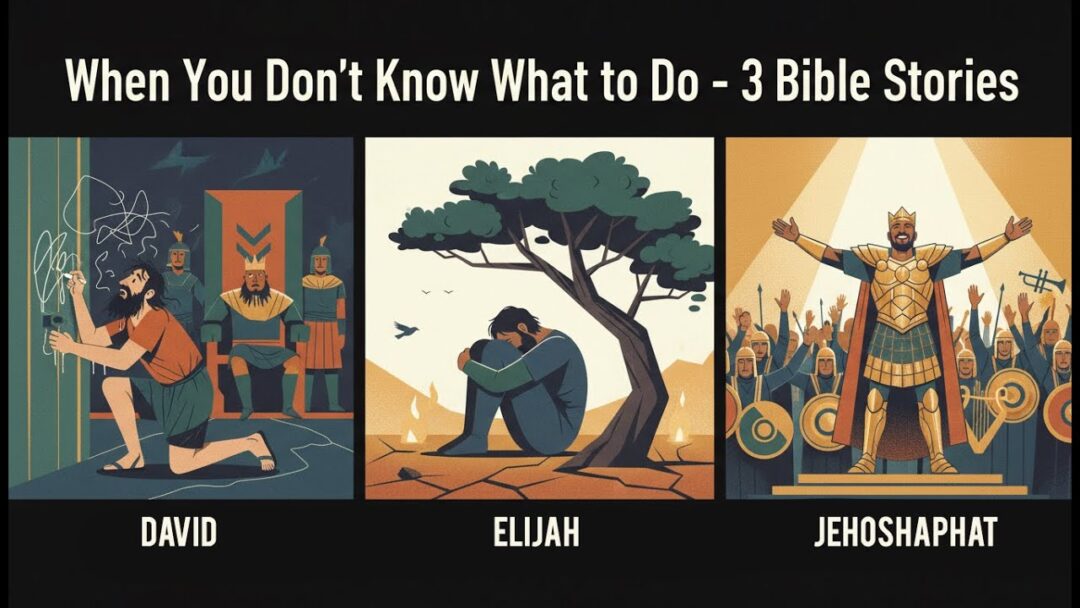
From our Sunday service on January 4, 2026, three Bible stories from 1 Samuel 21, 1 Kings 19 and 2 Chronicles 20. Watch the full message: When You Don’t Know What to Do on YouTube.
Recently our church had quite a surprise, and for the first time in my life I genuinely thought, “I am having a nightmare, and I’m going to wake up any moment.” It wasn’t a bad dream. It was real, and I didn’t know what to do. I had church the next morning, and as I made it back into the church, the first thing I thought was, “Oh boy, this is going to be my next message.” Sometimes, as a pastor, the best way to preach to your congregation is to preach to yourself. If I’m having a struggle, it’s likely I’m not the only one.
There are going to be moments in your life when you don’t know what to do. In fact, there will be many moments when you’re stuck like a deer in headlights and just overwhelmed. How you choose to respond in those moments can have a big effect on the results. Today we’ll look at three examples in the Bible of people who found themselves completely lost for direction, and learn from what they did how and how not to respond in moments of desperation. We have a lot of reading, but don’t think of it as a lot of reading. Think of it as story time.
God wants you to rely on him.
Response One: Fear-Driven Desperation
Our first response is David’s. The context is that David has just discovered from his friend Jonathan that King Saul wants him dead. The king of all Israel is coming for his life because he knows David wants to take his position as king, and the prophet has anointed David as the next king of Israel. Feeling threatened, Saul pursues David for his life. David becomes desperate. He flees from Saul alone, with no help, and decides the best course of action is to run straight into the enemy territory of the Philistines in Gath, Goliath’s hometown. 1 Samuel 21:8-10:
And David said unto Ahimelech, And is there not here under thine hand spear or sword? for I have neither brought my sword nor my weapons with me, because the king’s business required haste. And the priest said, The sword of Goliath the Philistine, whom thou slewest in the valley of Elah, behold, it is here wrapped in a cloth behind the ephod: if thou wilt take that, take it: for there is no other save that here. And David said, There is none like that; give it me. And David arose, and fled that day for fear of Saul, and went to Achish the king of Gath.
1 Samuel 21:8–10
David is completely overwhelmed. The news that the king is coming for his life sends him into a chaos of desperation. He didn’t have time to go home and grab clothes, food or weapons. He just runs. He doesn’t stop and pray. He doesn’t ask God for direction. He panics: “I don’t know what to do. The king of Israel is coming after me with the entire army on his side. I’m one guy alone with no clothes, no food and no weapons. The first thing I need is a weapon to defend myself.”
And here is the irony, the poetic contrast: he grabs the sword of the giant he slew in the power of God. Goliath’s sword is obviously going to be way too big for him, knowing the size of David compared to Goliath. It’s a sword he can’t use well, and a sword he himself proved God is stronger than. Killing Goliath is what David is famous for, and when he loses faith for a moment and lets desperation take over, he grabs the sword of the man he defeated in the power of God. Rather than turning to God for help, David goes to man’s defense, which has been proven to be weaker than God.
Then he flees to Achish, the king of Gath. Instead of going to God’s people, he flees into Philistine territory and seeks help from the very people God told him to kill, the wicked people Israel would one day drive from the land. In his desperation he runs to Israel’s enemies for protection, the very people he’s supposed to be fighting. Let’s see how it goes for him. Verses 11-12:
And the servants of Achish said unto him, Is not this David the king of the land? did they not sing one to another of him in dances, saying, Saul hath slain his thousands, and David his ten thousands? And David laid up these words in his heart, and was sore afraid of Achish the king of Gath.
1 Samuel 21:11–12
David thinks, “Nobody knows me there. The people of Israel know me. I’m famous. I’ll lay low among God’s enemies and everything will be fine.” Lo and behold, the second he gets there, the king’s servants say, “Isn’t that David, the one who killed Goliath, the one who killed ten thousand of our people? I saw him on the battlefield. I’d recognize that guy anywhere.” Suddenly David’s situation has gone from bad to worse. Israel is after his life, and now he’s among enemies and immediately identified as the one who killed so many of their people. And David was “sore afraid.”
David left because of his fear of Saul. He didn’t know what to do. He tried to conquer the problem in his own power, with a sword he held in his own hand, and came up with his own plan. Now he’s driven by fear again to make a foolish decision. He wanted to blend in and disappear, but he was immediately identified as the rightful king of Israel. So what does David do? Does he turn to God for help or ask for direction? No. He humiliates himself in front of all the people. Verses 13-15:
And he changed his behaviour before them, and feigned himself mad in their hands, and scrabbled on the doors of the gate, and let his spittle fall down upon his beard. Then said Achish unto his servants, Lo, ye see the man is mad: wherefore then have ye brought him to me? Have I need of mad men, that ye have brought this fellow to play the mad man in my presence? shall this fellow come into my house?
1 Samuel 21:13–15
“Feigned” means he pretended to be mad, or insane. David ended up in a situation he should never have been in, in a place he never should have gone, and he panics: “The only way I’m getting out of this is if I make myself look crazy when they bring me to the king.” So he scratches at the doors of the gate, drools all over himself, and makes himself look disgusting and dirty. David, the anointed king of Israel, anointed by God to lead and be strong in faith, pretends to be a mad lunatic. And the king says, “Look at this man. He’s crazy. Why did you bring him to me? Get him out of here. He doesn’t belong in my house.”
What went wrong? David didn’t know what to do, and he allowed his reaction to be fear rather than taking time to reflect and wait on God’s direction. He allowed his fear to replace his prayers. Rather than praying for direction and looking for hope, he tried to control the situation in the only ways he knew how. He ran to places he never should have been, went to Israel’s enemies for protection rather than to God, and humiliated himself, pretending to be insane just to survive.
The application: sometimes not knowing what to do will make us do just about anything to escape the feeling of being out of control. When we get that deer-in-the-headlights feeling, we’ll do anything to get away from it, even if it’s foolish, even if it causes more problems than we have right now. Instead of pausing and anchoring ourselves in God, we’ll do anything and everything to make the situation go away. I saw this many times at a previous job. Someone made a mistake at work, and instead of confessing it, they panicked, doubled down and tried to cover it up, and in the process made the situation a hundred times worse than if they had come clean at the beginning. We say, “I hate this feeling of being out of control. I need to do anything in my power to get that control back.” That’s what David did: “I’m not going to give the control to God. I’m not going to trust that he’s sovereign. I’m going to take control back for myself.”
Does David’s plan work? He escapes, but nothing about his actions reveals trust or wisdom. Later, in Psalm 34, David reflects on this event:
I sought the LORD, and he heard me, and delivered me from all my fears. … O taste and see that the LORD is good: blessed is the man that trusteth in him. … Many are the afflictions of the righteous: but the LORD delivereth him out of them all.
Psalm 34:4, 8, 19
It was only after David humiliated himself and ran off into the cave of Adullam that he realized just how foolish he had been. After he stopped and sat down in that cave and thought for a moment, he wrote down the words of Psalm 34: “I made the mistake of trying to take control myself. I’m not the one who’s supposed to have the control. I’m going to search out what the Lord wants for me.” “I sought the LORD, and he heard me.” When he stopped trying to do things in his own power and went to the Lord, God answered him right away. “And delivered me from all my fears,” the fears that drove him to make those foolish decisions. The second he turned to God, God turned that fear into comfort.
Then he says, in effect, to the person reading this in the future, “O taste and see that the LORD is good: blessed is the man that trusteth in him. Don’t make the same mistake as me. When you’re stuck in a situation where you don’t know what to do, don’t panic. Center yourself on God. Put God as your foundation and taste and see his goodness.” And he concludes, “Many are the afflictions of the righteous: but the LORD delivereth him out of them all.” We will have times of affliction, trial and difficulty, but if we turn to God, God will deliver us from them. Had David waited on God rather than trying to take control himself, God would have sent him the protection he needed, and his dignity would not have been taken away from him.
Response Two: Despair-Driven Withdrawal
Our second response is Elijah’s. This passage comes right after Elijah confronts the worshippers of Baal on top of Mount Carmel, one of his most famous accounts. He says, “We’ll see who answers: Yahweh, the God of Israel, or Baal. Let’s call down fire from heaven.” The Baal worshippers try all day to get Baal to answer, and nothing happens. Then Elijah covers his sacrifice in water so it’s even harder for God to light it. He prays, and God strikes it and consumes even the water. It is proven that God is truly the God of Israel, and the prophets of Baal are slain as false prophets. You would think this is a high moment for Elijah: “I just saw God call fire down from heaven. I saw the prophets of Baal overthrown and the people recognize God as who he says he is.” That’s not what happens. 1 Kings 19:1-4:
And Ahab told Jezebel all that Elijah had done, and withal how he had slain all the prophets with the sword. Then Jezebel sent a messenger unto Elijah, saying, So let the gods do to me, and more also, if I make not thy life as the life of one of them by to morrow about this time. And when he saw that, he arose, and went for his life, and came to Beer-sheba, which belongeth to Judah, and left his servant there. But he himself went a day’s journey into the wilderness, and came and sat down under a juniper tree: and he requested for himself that he might die; and said, It is enough; now, O LORD, take away my life; for I am not better than my fathers.
1 Kings 19:1–4
At what we would consider the high point of Elijah’s career, we see him at the lowest he ever goes. When Jezebel hears that the prophets of Baal were slain, she swears by all the gods she believes in that Elijah will be dead by tomorrow, and she sends the people of her court to search for him and put him to death. Not unlike David, Elijah gets that deer-in-the-headlights moment: “I’m toast. It’s just me and my servant. I can’t fight off all these people. I need to get out of here.” And like David, he doesn’t go to God for help or comfort. He goes to Beersheba, in Judah, outside Jezebel’s jurisdiction, and leaves his servant there: “I don’t want my servant to get caught up in this. If they come after me, it’s just me who dies.”
So he flees into the wilderness, and there he freezes in depression and shock. He sits under a tree and says, “God, just kill me. It’s enough. I am under more stress than I can handle. I don’t know what to do or where to go. Why don’t you take my life so that no one else can take it from me, so I don’t have to wonder anymore what’s going to happen next?” “I am not better than my fathers,” in other words: “The prophets before me tried to get Israel to repent. I just killed all the prophets of Baal, and we’re no closer than when we started. I’m the last prophet doing anything around here. I’ve failed just like them. I’ve done everything I know to do, so just take me away.” Elijah doesn’t know what to do. He panics, flees, leaves the country, and sits there sulking. But he isn’t left alone. God helps Elijah. Verses 5-8:
And as he lay and slept under a juniper tree, behold, then an angel touched him, and said unto him, Arise and eat. And he looked, and, behold, there was a cake baken on the coals, and a cruse of water at his head. And he did eat and drink, and laid him down again. And the angel of the LORD came again the second time, and touched him, and said, Arise and eat; because the journey is too great for thee. And he arose, and did eat and drink, and went in the strength of that meat forty days and forty nights unto Horeb the mount of God.
1 Kings 19:5–8
Elijah is so depressed and discouraged that he doesn’t even have the energy to take care of himself. Where David tried to do anything to get control of the situation, Elijah does the opposite. He does absolutely nothing: “If I don’t know what to do, I’ll do nothing. I’m not going to ask God for help. I’m just going to ask God to kill me.” He’s like the guy who’s so depressed he can’t get out of bed in the morning. He sits sleeping under the tree, wasting away. He doesn’t eat. He doesn’t have the motivation to get food or water. So God says, in effect, “Elijah isn’t going to take care of himself. I’m going to send an angel to feed him.” God lifts him up when he doesn’t have the strength to take care of himself. The angel literally says, “The journey is too great for thee.” Your strength is not enough. You’ve frozen in fear and given up. So the angel tends to him and gives him just enough strength to keep going.
Elijah goes forty days and forty nights to Horeb, the mount of God. That is another name for Mount Sinai, where the law was given, a place where he should be really encouraged and reminded of the goodness of God. Then God comes and asks him a very important question. Verses 9-10:
And he came thither unto a cave, and lodged there; and, behold, the word of the LORD came to him, and he said unto him, What doest thou here, Elijah? And he said, I have been very jealous for the LORD God of hosts: for the children of Israel have forsaken thy covenant, thrown down thine altars, and slain thy prophets with the sword; and I, even I only, am left; and they seek my life, to take it away.
1 Kings 19:9–10
“Elijah, what are you doing here? You’re frozen from fear and you’re not doing anything.” Elijah says, “What’s the point? I’m overwhelmed. I don’t see a way out. It’s just me. Your people aren’t going to help me. I’ve been trying to get them to change their hearts forever. It’s just me and you, and that’s not enough. I’m just going to die.” Then God makes a statement. Verses 11-14:
And he said, Go forth, and stand upon the mount before the LORD. And, behold, the LORD passed by, and a great and strong wind rent the mountains, and brake in pieces the rocks before the LORD; but the LORD was not in the wind: and after the wind an earthquake; but the LORD was not in the earthquake: And after the earthquake a fire; but the LORD was not in the fire: and after the fire a still small voice. And it was so, when Elijah heard it, that he wrapped his face in his mantle, and went out, and stood in the entering in of the cave. And, behold, there came a voice unto him, and said, What doest thou here, Elijah? And he said, I have been very jealous for the LORD God of hosts: because the children of Israel have forsaken thy covenant, thrown down thine altars, and slain thy prophets with the sword; and I, even I only, am left; and they seek my life, to take it away.
1 Kings 19:11–14
God says, in effect, “I’ve got to do something for this guy. He’s not going to make the right decision and come see me. He’s wasted forty days.” So God shows up and makes a grand show of his power. There’s chaos and destruction on the mountain: strong winds, the mountain shattering and crumbling under a massive earthquake, and fire, an all-consuming force. In all the chaos and destruction, Elijah realizes God isn’t in it. But after it goes away and all the noise disappears, all that is left is a still small voice. Another way to translate that is a gentle whisper, or a gentle sound. God was not in the chaos and destruction. God was in the little silent moments in between.
When Elijah hears it, he realizes God’s presence is there. He wraps his mantle around his face, because the Bible says that if you see God’s glory you’ll die. That’s ironic. Elijah, weren’t you trying to end your life just a few moments ago? But when the rubber meets the road and God shows up, he covers his face so that God’s presence doesn’t kill him. And God asks again, “What are you doing, Elijah?” Elijah gives the same response: “Israel hasn’t repented. They’ve killed the prophets. I’m the only one left, and they’re coming after me.” What does God say? Verses 15-18:
And the LORD said unto him, Go, return on thy way to the wilderness of Damascus: and when thou comest, anoint Hazael to be king over Syria: And Jehu the son of Nimshi shalt thou anoint to be king over Israel: and Elisha the son of Shaphat of Abel-meholah shalt thou anoint to be prophet in thy room. And it shall come to pass, that him that escapeth the sword of Hazael shall Jehu slay: and him that escapeth from the sword of Jehu shall Elisha slay. Yet I have left me seven thousand in Israel, all the knees which have not bowed unto Baal, and every mouth which hath not kissed him.
1 Kings 19:15–18
Boy, has he missed a lot of jobs while he’s been idle. God shakes Elijah up. He threatens him with the loss of his life, and Elijah realizes, “Maybe I don’t want to die. Maybe I do want to live.” This time God says, “I’m not going to let you sulk around anymore. I’m going to tell you what you should have asked to begin with. There are a lot of jobs you needed to do to solve this situation, but because you froze in your fear and sulked in your depression, nothing has changed. I need you to anoint these people. Ahab and Jezebel aren’t going to be a problem for long. Israel is going to have a revival. There’s someone after you named Elisha who is going to complete the mission you started. It’s not all on you. I have a plan, but I need you to work on it, ask where to go and follow my directions.”
Elijah thought he was alone, and God says, “No, I have left seven thousand in Israel, followers just like you, ready to step up when you go and tell them. I’ve already laid down all the pieces, and just because you don’t know what they are doesn’t mean they’re not there. Get up and go do something.” Elijah realized that God was not in the chaos around him, not in the chaos of Ahab and Jezebel or of the priests of Baal. God was in the still small voice moving in the background. Because all Elijah could hear was the chaos, he couldn’t listen to God’s voice. When he stopped and listened, he found the truth he should have had all along: he wasn’t alone, and God had a plan.
What went wrong for Elijah? He was emotionally exhausted and depressed. He isolated himself and became stagnant in the purpose God called him to, and he let the chaos overwhelm him rather than letting God’s peace and quiet calm and sustain him. The application: sometimes not knowing what to do makes us want to do nothing. David’s problem was that he wanted to do anything to get control. Sometimes we make the opposite mistake. Elijah doesn’t sin loudly by blaspheming God. He just quietly quits his role as a prophet and goes into self-exile. When he doesn’t know what to do next, he disconnects from his purpose and sits idle in his depression. And God’s question, “What doest thou here, Elijah?” implies, “Why aren’t you where I want you to be? There’s a purpose for you. I know you don’t feel it or see it, but there’s a place for you to be and something for you to do.”
Response Three: Faith-Driven Dependence
Now let’s look at a good example, King Jehoshaphat, in 2 Chronicles 20. Jehoshaphat is king of Judah, and he finds himself in a very sticky situation. Three kingdoms, and some more which aren’t listed, are coming to war against Judah to take Jehoshaphat’s life and overthrow the country. Because of the massive number of soldiers coming, there is no military solution to this problem. Verses 1-4:
It came to pass after this also, that the children of Moab, and the children of Ammon, and with them other beside the Ammonites, came against Jehoshaphat to battle. Then there came some that told Jehoshaphat, saying, There cometh a great multitude against thee from beyond the sea on this side Syria; and, behold, they be Hazazon-tamar, which is En-gedi. And Jehoshaphat feared, and set himself to seek the LORD, and proclaimed a fast throughout all Judah. And Judah gathered themselves together, to ask help of the LORD: even out of all the cities of Judah they came to seek the LORD.
2 Chronicles 20:1–4
Same situation as the other two. David feared. Elijah feared. Jehoshaphat feared. But instead of doing anything or doing nothing, Jehoshaphat sought the Lord. Multiple invading armies are approaching Jerusalem, out for blood and complete destruction, and Jehoshaphat knows his people are outnumbered and there’s nothing they can do to fight them off. Rather than run, rather than freeze, he tells all the people to seek God and fast throughout the nation, and the people do as they are told. Verses 5-7 and 12:
And Jehoshaphat stood in the congregation of Judah and Jerusalem, in the house of the LORD, before the new court, And said, O LORD God of our fathers, art not thou God in heaven? and rulest not thou over all the kingdoms of the heathen? and in thine hand is there not power and might, so that none is able to withstand thee? Art not thou our God, who didst drive out the inhabitants of this land before thy people Israel, and gavest it to the seed of Abraham thy friend for ever? … O our God, wilt thou not judge them? for we have no might against this great company that cometh against us; neither know we what to do: but our eyes are upon thee.
2 Chronicles 20:5–7, 12
Look at the difference in Jehoshaphat’s response. He remembers the things God had done for Israel and the truths Scripture taught: “These invading armies are Gentiles, but isn’t God also sovereign over the Gentiles? Couldn’t God wipe them out on their way here if he wanted to? As we left Egypt and as we conquered the promised land, hasn’t God kept his promises? Let’s go to prayer, remind God who he is, and admit where we are.” He admits, “We don’t know what to do,” but he doesn’t leave it there: “But our eyes are upon thee.” We don’t know what to do, but we know who to look to. When Jehoshaphat found himself without direction, he did the one thing David and Elijah forgot. He went to God for help, because he knew God had been faithful before and kept his promises. How does God respond? Verses 14-15:
Then upon Jahaziel the son of Zechariah, the son of Benaiah, the son of Jeiel, the son of Mattaniah, a Levite of the sons of Asaph, came the Spirit of the LORD in the midst of the congregation; And he said, Hearken ye, all Judah, and ye inhabitants of Jerusalem, and thou king Jehoshaphat, Thus saith the LORD unto you, Be not afraid nor dismayed by reason of this great multitude; for the battle is not yours, but God’s.
2 Chronicles 20:14–15
When Jehoshaphat seeks the answer from God, God gives him comfort: “I know you don’t know what to do, but this isn’t your battle to fight. This is God’s battle to fight for you. Don’t rely on your own strength. You’re not the one who needs the power. I have the power.” Verses 20-21:
And they rose early in the morning, and went forth into the wilderness of Tekoa: and as they went forth, Jehoshaphat stood and said, Hear me, O Judah, and ye inhabitants of Jerusalem; Believe in the LORD your God, so shall ye be established; believe his prophets, so shall ye prosper. And when he had consulted with the people, he appointed singers unto the LORD, and that should praise the beauty of holiness, as they went out before the army, and to say, Praise the LORD; for his mercy endureth for ever.
2 Chronicles 20:20–21
Jehoshaphat knows the army isn’t what will get him where he needs to go. Rather than putting his best men or sacrificial soldiers on the front lines, he says, “I’m going to put my worship team on the front line, the people who have faith in God, and they’re going to sing, ‘Praise the LORD; for his mercy endureth for ever.’ If I can’t win this fight, I’m going to put all my bets on the one who can. God says it’s not our fight, so I’m not even going to plan to fight.” Verses 22-24:
And when they began to sing and to praise, the LORD set ambushments against the children of Ammon, Moab, and mount Seir, which were come against Judah; and they were smitten. For the children of Ammon and Moab stood up against the inhabitants of mount Seir, utterly to slay and destroy them: and when they had made an end of the inhabitants of Seir, every one helped to destroy another. And when Judah came toward the watch tower in the wilderness, they looked unto the multitude, and, behold, they were dead bodies fallen to the earth, and none escaped.
2 Chronicles 20:22–24
They marched toward the battlefield singing praises to God, and as they sang, the invading armies betrayed one another. It doesn’t tell us why, but for some reason they didn’t believe the others had good intentions. They became paranoid. The first two armies turned against Seir, and when Seir was eliminated, they looked at each other and said, “Oh no, we’re next,” and went to war with each other, until all the armies that came to destroy the nation had been completely eliminated before Judah arrived at the scene of the battle.
The application: when we don’t know what to do, we need to rely on God to lead us through our difficulties. Jehoshaphat didn’t pretend to be strong. He anchored himself in God rather than in his ability to gain control. When God told him he would win this battle for them, he invested 100 percent in that truth. He went to the battle knowing God was going to do something, and he put his singers on the front lines to prove it. As they worshiped God, facing something they’d never faced before, God took care of the entire situation, so that when they arrived there was nothing left for them to do. Sure, they had to go through the stress and the feeling of being hopeless and not knowing what to do, but when it came time to face it, God walked them straight through. Jehoshaphat didn’t make the same mistakes as David and Elijah. He didn’t rely on his own ability and humiliate himself in front of his enemies like David. He relied on God’s promises. And unlike Elijah, he didn’t sit idle, sulking, depressed and frozen in fear. He made an intentional effort to go to God and worship him.
Eyes on the Lord
Each of us will face moments when we don’t know what to do, and we have a choice in how we respond. David showed us what happens when fear takes control. When he didn’t know what to do, he ran ahead of God, ended up in the wrong places and lost his dignity. He let fear make the decisions instead of faith. Elijah shows us another danger. When he didn’t know what to do, he shut down, isolated himself, withdrew from his calling and sat under the weight of despair. He didn’t rebel. He didn’t even act. He just quietly gave up. He let his fear prevent him from moving instead of letting God move him.
Jehoshaphat shows us the right response. When he didn’t know what to do, he admitted it honestly before God. He didn’t pretend to be strong. He didn’t run away, freeze or isolate himself. He said, “We don’t know what to do, but God, our eyes are on you,” and that admission made a world of difference. Not knowing what to do is not a failure of faith, but refusing to look to God in that moment is.
So when you don’t know what to do, don’t let fear push you into places God never called you. Don’t let despair convince you that you’re alone or finished. Turn your eyes to the Lord. Seek him first, and worship before you see the outcome. Sometimes the most faithful thing you can say is, “I don’t know what to do, but God, I know you do.” When your eyes are on God, uncertainty becomes the doorway to seeing God’s power, peace and deliverance in our lives. God wants you to rely on him. Will you choose to rely on him today?

Recent Comments