
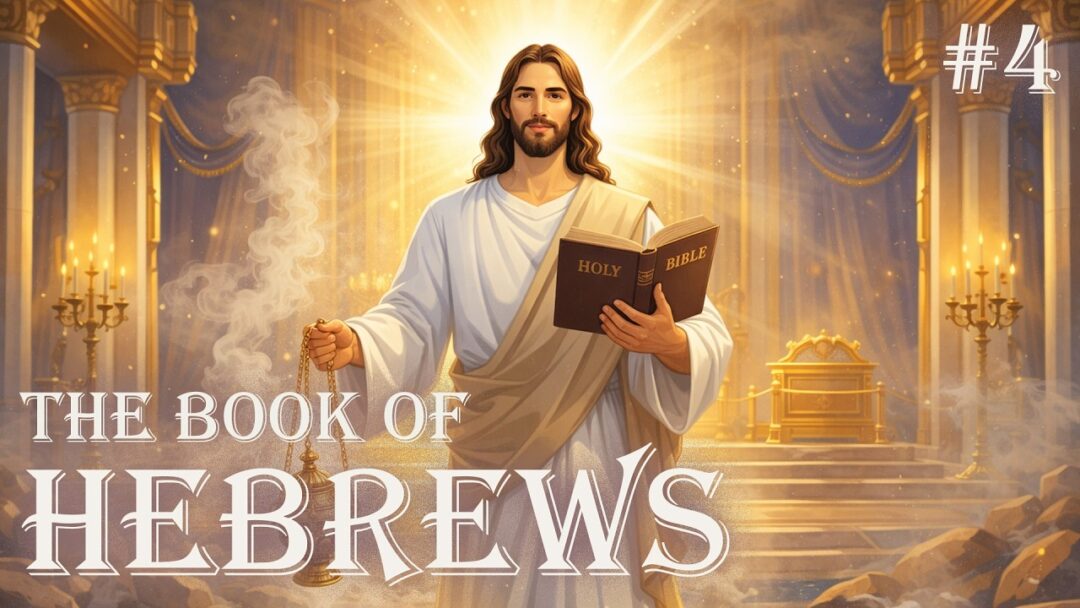
From our Sunday service on February 22, 2026, Hebrews 4:14-6:20. This is part 4 of our Hebrews series. Watch the full message: Our Great High Priest – Hebrews Series #4 on YouTube.
Today’s lesson is about a topic I really enjoy: Jesus being our great High Priest. I think it’s a very encouraging message about how God relates to us and how Jesus Christ is our advocate to the Father.
We’re getting pretty deep into our study of Hebrews, into the deeper things. Today we start talking about the concept of Jesus as our great High Priest. We’ll cover it a couple of other times as it comes up in Hebrews, but today is our introduction. Last week we talked about God’s rest, and how Jesus has given us the opportunity to stop trying to work our way into heaven and instead rest in the finished work he did for us on the cross. Today we build on the closing section of last week’s passage, where Jesus was introduced to us not just as our Savior, our Brother or our source of rest, but as our great High Priest, our representative with God the Father.
God wants you to know that having Jesus as an advocate should be an anchor for your faith.
A High Priest Who Understands
Let’s start by reading the last three verses we looked at last week.
Seeing then that we have a great high priest, that is passed into the heavens, Jesus the Son of God, let us hold fast our profession. For we have not an high priest which cannot be touched with the feeling of our infirmities; but was in all points tempted like as we are, yet without sin. Let us therefore come boldly unto the throne of grace, that we may obtain mercy, and find grace to help in time of need.
Hebrews 4:14–16
“Hold fast” means hold firmly to our profession. We left off with the encouragement that we have a representative with God who is not far removed from the difficulties we face. We’ve talked about this a few times: one of the reasons Jesus came to earth as a man was not just so he could die for our sins, but also so he could live life on earth like we do, and be better able to help us because of that. Not only did he live alongside us and deal with the difficulties we face, but now, after the resurrection, he sits on the right hand of God as our advocate, our representative to the Father.
Today the author of Hebrews tells us how that should be an encouragement to us. He compares it with the Old Testament priesthood, so if you’re not very familiar with the priesthood of the Old Testament, hopefully today will give you some insight and help you understand how Jesus is foreshadowed in the role of priest.
Jesus lived on this earth for over 30 years. I meant to say this last week, but I overlooked it: based on my studies of the timeline, it may have been almost 40 years. He may have been around 40 when he died, if he was born in 6 BC and died in AD 33. That’s a long time that Jesus lived on this earth, and during that time he faced all the hardships. He fought sickness. He had to work a physical job. He had to care for his family. He lost friends. He experienced everything this earth has to offer except one thing, and that is sin. Though there were temptations all around him every day, he never gave in to them. He knows what it feels like to be tempted, but he also knows how to overcome temptation.
Because of that, Jesus himself is the best representative we could ever ask for. He doesn’t just know how to overcome sin. He knows how to help us overcome it as well. Because Jesus has finished the work of salvation, because we can rest in his finished work, we can come boldly before the throne of grace. In other words, we can go into God’s presence asking for grace and help in our times of need. When we struggle with temptation or difficulty, we’re not alone. Jesus has dealt with difficulty and temptation, and he knows how to overcome them. So when we find ourselves in that situation, the author of Hebrews encourages us to go to Jesus as our advocate and pray for his help.
The Human Priest
In Hebrews 5:1-4 the author reminds us of the role of human priests.
For every high priest taken from among men is ordained for men in things pertaining to God, that he may offer both gifts and sacrifices for sins: Who can have compassion on the ignorant, and on them that are out of the way; for that he himself also is compassed with infirmity. And by reason hereof he ought, as for the people, so also for himself, to offer for sins. And no man taketh this honour unto himself, but he that is called of God, as was Aaron.
Hebrews 5:1–4
There’s a lot said here about priests. Let’s take the concepts one by one.
Taken from Among Men
Verse 1 tells us that every human priest is taken from humanity as its representative to God. In the Old Testament days, before Jesus came and paid for our sins, there was a temporary system in place to deal with the sin problem. God set up a temple and said, “When you sin, go to the temple and offer a sacrifice,” a goat or doves or whatever was equivalent to your wealth level. You offered it in the temple as a gift to God, and it temporarily covered your sins and allowed you to have communion, a relationship, with God. That was the system they used, and the person responsible for killing the animal was the priest. He was the representative who worked on behalf of God to accept the sacrifice. That priest was the Old Testament example of what Christ would eventually do.
But every high priest of the Old Testament, it says, was “taken from among men” and “ordained for men.” Every priest was human. Sure, they served in a role for God. They did “things pertaining to God,” sort of like how a pastor does things associated with God. A pastor can give you advice on what the Bible says. He can direct you in wisdom. He can give you encouragement in a time of difficulty. But a pastor is also just a human. I didn’t come from God. I’m not a miraculous spawn from heaven. I’m just another person.
Compassed with Infirmity
What does that mean? If a priest or a pastor is human, verse 2 says he “can have compassion on the ignorant, and on them that are out of the way; for that he himself also is compassed with infirmity.” In other words, a priest or a pastor can have compassion on those who are struggling, because we as humans also have struggles and temptations. Throughout our lives we have fallen and tripped up.
“Them that are out of the way” could also be translated “those who wander.” Everybody has had times of wandering, times when they tripped up and fell. Because the priest is human, he can understand the difficulties that come with it, and because of that he’s able to help. Why? Because he himself is also compassed with infirmity, surrounded by it.
The author of Hebrews doesn’t want us to fixate on the priest. He’s writing to new believers, or people on the edge of believing in Jesus, who are tempted to go back to the Old Testament system because of the difficulty in the Roman Empire at this time. They’re being persecuted not just by Rome, but also by their Jewish brothers and sisters. So he says, “Remember, the priests are just people. They’re like you and me. They struggle with sins. They have times of wandering. They’re not perfect.” There is some benefit to that: when you’re having difficulties, they know what it’s like, and they’re able to encourage you with what they know from the Scriptures.
He Must Offer for Himself
Verse 3 continues: “And by reason hereof he ought, as for the people, so also for himself, to offer for sins.” Though there’s a benefit in his being able to relate to you, there’s also a problem. Because he is flawed, he’s under the same condemnation as you. He needs to offer a sacrifice for his sins just like you. Working in the temple didn’t mean a priest got off on his sins. Every time he sinned, just like everybody else, he had to offer a sacrifice in the temple and rededicate himself to God so he could do God’s work.
That means he can’t be a savior for you, because the priest can’t even save himself. No human can be your advocate, because he needs an advocate himself. So this Old Testament system, while it worked to temporarily cover sins, could never really solve the root issue of needing someone to pay for sins.
Called of God
Verse 4 says, “And no man taketh this honour unto himself, but he that is called of God, as was Aaron.” The priest is no better than other sinners because of his position. He was appointed to it. If you know anything about Old Testament priests, they had to come from the line of Levi. If you came from the line of Levi, you could be a priest. On top of that, if you came from the line of Aaron, you could be an Aaronic priest and have even higher responsibilities.
But nobody was better than anybody else, and nobody was just able to become a priest. They weren’t more holy than the rest of Israel. If you look at the book of Judges, you’ll see corruption in the priesthood just as much as outside it. The priests weren’t any better than the other people. They were just born into it, called into it.
So the author of Hebrews is saying, “You need to understand this Old Testament system. You’re holding these priests to a high standard, but they’re just people like you. You’re acting like they’re high and lofty, but they’re no different from you. It’s just a job they were born into, to serve God.” They had no more choice about being born into Levi than you had about not being born into Levi. No one could choose to be a priest. God’s ordaining it through their birth was all there was to it. That’s the human priest, and it leaves a lot to be desired.
The Divine Priest
In verses 5-10 the author moves on to our divine Priest, Jesus Christ.
So also Christ glorified not himself to be made an high priest; but he that said unto him, Thou art my Son, to day have I begotten thee. As he saith also in another place, Thou art a priest for ever after the order of Melchisedec. Who in the days of his flesh, when he had offered up prayers and supplications with strong crying and tears unto him that was able to save him from death, and was heard in that he feared; Though he were a Son, yet learned he obedience by the things which he suffered; And being made perfect, he became the author of eternal salvation unto all them that obey him; Called of God an high priest after the order of Melchisedec.
Hebrews 5:5–10
Here the author draws out a few comparisons between the human priest and the God-man, the divine Priest. One thing they have in common is that neither the human priest nor Jesus chose his role as a representative. He draws out a few examples from the Old Testament. Verse 5 draws on Psalm 2:6-7, a prophetic psalm.
Yet have I set my king upon my holy hill of Zion. I will declare the decree: the LORD hath said unto me, Thou art my Son; this day have I begotten thee.
Psalm 2:6–7
This Old Testament psalm points forward to the divine King who would come from the line of David, and says of him, “Thou art my Son; this day have I begotten thee.” So the author of Hebrews says Jesus wasn’t just a man who made himself our High Priest. Look at the Old Testament prophecies about the Messiah. Who made Jesus High Priest? God the Father. As part of the incarnation, Jesus was born into flesh by God’s divine decree, and in that decree to be made flesh he was also appointed to be a priest, not from the line of Aaron or Levi, but after the order of Melchizedek.
He also references Psalm 110. Here is verse 1, which introduces the psalm, and then verse 4.
The LORD said unto my Lord, Sit thou at my right hand, until I make thine enemies thy footstool. … The LORD hath sworn, and will not repent, Thou art a priest for ever after the order of Melchizedek.
Psalm 110:1, 4
So he’s designed to be a priest and a Son. Jesus didn’t choose this. It’s something he has by nature, just like those born from Levi and Aaron. God determined before Christ was born that he, as the Messiah, would be both his Son and a priest, a representative between God and man.
Dull of Hearing
But it says something a little unusual: “after the order of Melchisedec.” Who is Melchizedek? Hold that thought. We’ll have to save it for another day, because of verse 11.
Of whom we have many things to say, and hard to be uttered, seeing ye are dull of hearing.
Hebrews 5:11
Even the author of Hebrews says what I’m going to say today: Melchizedek is important, but we’re not quite there yet. There’s a lot that could be said about Melchizedek, but it’s deep, and most people don’t yet have the spiritual understanding of Scripture to dive into it. So I’m going to follow the author of Hebrews and agree that we don’t have the time to deal with Melchizedek today.
Just to give a short summary: Melchizedek appears in Genesis 14. He was the king of Salem, a city that may be more familiar to you as Jerusalem. Jerusalem is also Salem. He was a priest outside the line of Abraham who worshiped the true God. He met Abraham after the war of the nine kings, before Abraham had any children, and Abraham paid him a tithe, 10% of all the goods recovered from that battle. The basic concept is that if Melchizedek’s priesthood existed before Abraham, and Abraham gave tithes to Melchizedek, then the priesthood of Melchizedek must be superior to the priesthood of Abraham. That’s the general idea we’ll talk about down the road.
That’s why Melchizedek is important: his priesthood was superior to Abraham’s. The Jews were tempted to turn back to Abraham’s priesthood and reject Christ. But the author of Hebrews says Christ’s priesthood is bigger, better and more important than Abraham’s priesthood, so don’t neglect it.
He says it’s “hard to be uttered,” hard to explain, because “ye are dull of hearing.” You don’t understand your Scriptures. You don’t understand what the Bible said about the Messiah. Remember, when Jesus was teaching, his disciples were lost nine times out of ten on what he was saying about the Messiah. He said he had to die, and Peter said, “Be it far from thee, Lord.” “No, you can’t die. You’re the Messiah.” And Jesus said, “Did you read the Scriptures? It says I have to die. Did you read Isaiah? Did you read the Psalms? It’s all over there.” Because the Jews had the wrong concept of the Messiah, these things went straight over their heads. So the author of Hebrews says, “We can deal with Melchizedek later, but I need to get you to understand where you are now.”
From Learners to Teachers
He continues in verses 12-14, explaining that people who are still students should already be teachers, but they’ve fallen short.
For when for the time ye ought to be teachers, ye have need that one teach you again which be the first principles of the oracles of God; and are become such as have need of milk, and not of strong meat. For every one that useth milk is unskilful in the word of righteousness: for he is a babe. But strong meat belongeth to them that are of full age, even those who by reason of use have their senses exercised to discern both good and evil.
Hebrews 5:12–14
Verse 12 tells us that all believers are supposed to move from a learning phase of Christianity to a teaching phase. How do we know? Because it says, “when for the time ye ought to be teachers, ye have need that one teach you again.” That means all Christians at some point in their walk with God should stop being only learners and start being teachers.
Does that mean you know everything there is to know about the Bible? No. What I mean is that there should come a point when you’re teaching the Bible and telling people about it more than you’re learning about it. You should understand the basic fundamentals of the gospel well enough to tell people about them more than you’re learning new things every day. You should know what God says well enough that you aren’t tricked by every false doctrine.
Discerning Good and Evil
In verse 14 he says you have to have your “senses exercised to discern both good and evil.” So he says, “Not only do you not understand the Messiah, but you’re so unskillful in what God taught about morals that you can’t tell what is good and what is evil. I’m not going to talk to you about Melchizedek.” You can’t understand the theology of Melchizedek if you can go down the street, see someone committing a sin, and say, “Praise the Lord.” Christians, you’ve got to know what the Bible says about good and evil. You can’t learn anything else if you can’t get the fundamental concept of what is morally right and what is morally wrong.
The Christians of AD 64 had this problem. They couldn’t understand their Bibles because they couldn’t understand the morals of God. Unfortunately, many Christians in the 21st century have the same problem, as they’re moved around by the people of their day and what those people teach. In AD 64 they were being persuaded by the rabbis, the Jewish leaders and the Greek culture, each telling them what was right. Some of them were compromising on the Word of God to take in some of the culture of the Romans. Some were divorcing their wives for any cause, because the rabbis told them it was okay. They had these moral failings, and they didn’t understand what God said about marriage or about being set apart from the world.
Today Christians in the 21st century make the same mistakes. They don’t value marriage like the Bible says. The statistics on divorce among Christians are so extremely high that they’re almost no different from those of the unsaved. The author was saying, “We can’t even teach you, because you haven’t learned what God said about the foundational moral principles,” and today we have that same problem.
Not only is divorce a problem, but we see people swayed by the society of the day, by the moral standards that people in the government or the school system, or even other pastors and teachers, say the Bible teaches when it doesn’t. People begin to say, “The Bible said this, but this teacher says that’s not really what it means, so that’s not the standard we need to follow.” When that begins to happen, how can you grow as a Christian? You can’t. You end up stuck forever in the learning phase and never move forward to the phase where you become a teacher.
Practice Your Faith
So what are you to do, if those who lack experience are like babies who have to be spoon-fed the same thing over and over? Let’s read verse 14 again: “But strong meat belongeth to them that are of full age,” that is, mature, “even those who by reason of use have their senses exercised to discern both good and evil.”
How do you increase your understanding of God’s moral standard? The only way to mature in your faith is to practice it. You practice doing good, and good becomes second nature. It’s important to practice your faith, because if you don’t do the things your faith calls you to do, you will never mature. You’ll never move past the ABCs of the things of God. You’ll always be immature and unlearned, and you’ll never fulfill the calling to teach others the standards of God, because you won’t be able to discern good from evil.
The Foundation Every Christian Should Know
What are the fundamental teachings? He tells us in Hebrews 6:1-3.
Therefore leaving the principles of the doctrine of Christ, let us go on unto perfection; not laying again the foundation of repentance from dead works, and of faith toward God, Of the doctrine of baptisms, and of laying on of hands, and of resurrection of the dead, and of eternal judgment. And this will we do, if God permit.
Hebrews 6:1–3
Here the author of Hebrews names a few of the foundational doctrines every Christian should know and understand.
The doctrine of Christ. Doctrine literally just means teaching. This is the teaching of Christ, the words Jesus himself taught: namely, that you should love God, love others and believe on Jesus as the Son of God.
Repentance from dead works. This is the teaching that our works are worthless for salvation and that we are unable to save ourselves.
Faith toward God. These are the teachings that tell us salvation is based on faith and that we should have reverence for God.
The doctrine of baptisms. These are the teachings about baptism and what it represents. If you don’t know what baptism represents, how are you going to tell people the gospel? Baptism represents your being immersed in the Holy Spirit. It represents Christ’s burial and resurrection, and how you die to your old self and become new. If you don’t understand the doctrine of baptism, how will you understand what God has called you to do after you’re saved?
The laying on of hands. These are the teachings about prayer and healing. You should know that “the effectual fervent prayer of a righteous man availeth much.” You should know that when people are sick and weak, God calls you to pray for them, so that he can heal them and do miracles in their lives.
The resurrection of the dead. You should know about heaven and the return of Christ. You should know that those who put their faith in Christ will go to heaven one day, and that one day Christ will return for his people, and that day will come suddenly to those who don’t know about it.
Eternal judgment. These are the teachings about hell and the lake of fire, knowing that a day is coming when those who don’t have their faith in Christ will face judgment.
If you don’t know these things, if you’re a baby in Christ, how are you going to serve Christ effectively? If you’re not reminded that time is running out to tell people about Christ, how will you have the energy you need to share the gospel? If you don’t know that there’s a day when you’ll stand before Christ and give an account of what you did, how will you have the push to do what God has called you to do? Every Christian should know these teachings. They’re not all the teachings you need to know, but they’re the foundation. And he says, “You don’t understand this. You need to understand it.”
A Warning
In verses 4-6 he gives a warning.
For it is impossible for those who were once enlightened, and have tasted of the heavenly gift, and were made partakers of the Holy Ghost, And have tasted the good word of God, and the powers of the world to come, If they shall fall away, to renew them again unto repentance; seeing they crucify to themselves the Son of God afresh, and put him to an open shame.
Hebrews 6:4–6
Here he talks about people who do understand all the teachings of Christ, and he warns that you can understand all the teachings of Christ and still reject them. Some people worry, “Is this me? Am I one of these people who have tasted salvation and then lost it?” That’s not what this is talking about. It’s not talking about losing salvation. It’s talking about rejecting salvation. Let me explain.
He’s talking about people who have fully understood the truth of the gospel. They understand all the foundational principles: heaven, hell, death, burial, baptism, salvation, faith, works and so on. They “were once enlightened” to the news of the gospel, which means they have fully understood it. They “have tasted of the heavenly gift.” They have seen that Jesus is good: “O taste and see that the LORD is good.” They “were made partakers of the Holy Ghost.” In other words, the Holy Spirit has brought them conviction. They have felt the draw of the Holy Spirit calling them to salvation. And after they “have tasted the good word of God, and the powers of the world to come,” the things that come with the promise of God, if they then reject it, it’s “impossible… to renew them again unto repentance.”
The truth is, when you fully understand the gospel, that is the moment you make a decision in your life whether or not to follow Christ. If you understand the entirety of the gospel and still walk away, he says there’s not another chance for salvation. Why? Because it will be impossible to renew them again unto repentance. In other words, if they fully understand the gospel and still reject it, it will be impossible for them to change their minds again. If they’ve understood everything there is to know, there’s nothing new that will change their minds. If they understand that God is good and gracious and that they are sinful, and they still disagree, their hope of salvation is lost. They’ve seen Christ. They’ve seen the power he has. They’ve experienced the truth and still chosen to walk away.
What is this? These people are committing the same sin Jesus warned about when he walked the earth, the sin of blasphemy against the Holy Spirit: to know God, to understand God, and still to say that he is evil and unworthy of worship. If you understand everything there is to understand about the gospel and still reject it, what conclusion have you made? “I understand who God is, but I want nothing to do with him.” That’s why the author of Hebrews says that after you’ve made that decision, there is no turning back. You have already decided in your heart that you want nothing to do with this God or this salvation, and you choose hell over him.
Crucifying the Son of God Afresh
He says, “they crucify to themselves the Son of God afresh, and put him to an open shame.” In other words, these people are like those who crucified Christ because he said he was the Messiah. What did the Romans put on the cross above Jesus’s head? “King of the Jews.” They knew who Jesus was. They knew who he claimed to be. And what did they do? They crucified him for it. Those who reject Christ in this way are just like the Romans and the Jews who nailed Jesus to the cross. Given the choice, they too would have put Jesus on that cross, written that title, Son of God, above his head, and still put him to death. If that is your belief, what does the author of Hebrews say? Nothing awaits you but judgment, because if you’ve come to that conclusion, you will never change your mind.
He’s warning the Jews not to make this mistake, because the rabbis were teaching that Jesus was this way. The Talmud says that Jesus, after he died on that cross, went to hell and was boiling in a pot of feces. That’s what the rabbis of that day wanted people to think about Jesus. He says, “If you come to that conclusion about Jesus, your hope for heaven is gone. Your works of the law aren’t going to save you. Your good works aren’t going to save you. Thinking you’re better than Christ isn’t going to save you. You are destined for hell. So don’t make that mistake. Do not recrucify the Lord in your heart.”
Fruit or Thorns
Verses 7 and 8 give the other side.
For the earth which drinketh in the rain that cometh oft upon it, and bringeth forth herbs meet for them by whom it is dressed, receiveth blessing from God: But that which beareth thorns and briers is rejected, and is nigh unto cursing; whose end is to be burned.
Hebrews 6:7–8
In other words, those who do not reject the truth but absorb it into themselves, who take the truth of God, learn it and embrace it, will eventually produce fruit unto salvation, because their hearts are receptive to the Word of God. As their hearts are open and they learn more about Christ, one day they will choose to follow him. They will produce fruit, and they will do great things for God.
But those who do not absorb the truth of God, who reject it, who harden their hearts and say, “I want nothing to do with Christ,” are “nigh unto cursing.” In other words, they are approaching their own day of destruction. Their “end is to be burned.” One day they will go to the lake of fire.
Persuaded of Better Things
That sounds very discouraging. So what do we do? The author of Hebrews says not to be discouraged, in verses 9-12.
But, beloved, we are persuaded better things of you, and things that accompany salvation, though we thus speak. For God is not unrighteous to forget your work and labour of love, which ye have shewed toward his name, in that ye have ministered to the saints, and do minister. And we desire that every one of you do shew the same diligence to the full assurance of hope unto the end: That ye be not slothful, but followers of them who through faith and patience inherit the promises.
Hebrews 6:9–12
What the author of Hebrews just said was intense. I think we can all agree that all that about eternal damnation and rejecting Christ was intense. He says, “I know what I just said was intense, but I don’t want you to be discouraged. I don’t think you’re part of the group of people who would recrucify Christ. I have seen your works. I have seen your labour of love. But you’re still immature, and I still think God can get more out of you than what you’re giving him.”
In verse 12 he says, “be not slothful, but followers of them who through faith and patience inherit the promises.” He’s convinced that those reading this aren’t the people condemned, but people who want to do the right thing and produce fruit. So he says, “Don’t be lazy. Follow the examples of those in Scripture.”
An Anchor of the Soul
He gives us one example to close: Abraham.
For when God made promise to Abraham, because he could swear by no greater, he sware by himself, Saying, Surely blessing I will bless thee, and multiplying I will multiply thee. And so, after he had patiently endured, he obtained the promise. For men verily swear by the greater: and an oath for confirmation is to them an end of all strife. Wherein God, willing more abundantly to shew unto the heirs of promise the immutability of his counsel, confirmed it by an oath: That by two immutable things, in which it was impossible for God to lie, we might have a strong consolation, who have fled for refuge to lay hold upon the hope set before us: Which hope we have as an anchor of the soul, both sure and stedfast, and which entereth into that within the veil; Whither the forerunner is for us entered, even Jesus, made an high priest for ever after the order of Melchisedec.
Hebrews 6:13–20
Abraham by faith received the promise God made to him. What was that promise? One of its major parts was the seed: Jesus Christ, the Messiah, the Son of God, coming through his line. And God made that promise on what? On his own name. Because there was nothing higher than God, he promised on his own character, doubly affirming that what he said was true. First, God cannot lie. Second, he confirmed it with an oath on the highest authority that exists in the universe. He double-confirmed that his promises would be true.
Just as Abraham had that promise, we have the same promise. I just talked about hell, and about how people can reject Christ and go to hell, even knowing and understanding everything there is about Christ, believing it’s true, and still rejecting it. But I want you to know that if you are the opposite, you have an anchor for your soul. You don’t have to wonder whether you’re going to heaven when you die. There is an anchor in Christ, a doubly immutable promise, a promise that cannot be changed or ever taken away. If you put your hope in Christ, you don’t have to worry anymore. Your soul is fixed in Jesus, and he will carry you the rest of the way.
Just as Abraham had to wait for the promise, we as believers wait for the promise of heaven one day, where we will receive glorified bodies and become like Christ. We too can hope in the unchanging nature of God. We don’t have to be discouraged, because God always keeps his promises. The same Jesus who is the anchor of our souls is the same Jesus who entered into the Holy of Holies, sits at the right hand of the throne of God, and is our representative to the Father, there when we need him. That should be an encouragement for us today.
Conclusion
To wrap it all up, today we’ve been reminded of three powerful truths that must shape our lives.
First, we have a High Priest, a divine representative, unlike any other. Human priests were weak, temporal and sinful. They could sympathize with people because they shared the same broken condition, but they were also flawed themselves. Jesus, however, is both compassionate and perfect. He knows our weaknesses because he lived among us, suffered and was tempted, but he never failed. Because of that, his priesthood is not temporary or flawed, but eternal and sufficient. He does not stand beside us as another sinner. He stands beside the Father as our Savior, the sinless Son who secures mercy and grace for all who come to him.
Second, this truth invites us to grow. We are not meant to remain spiritual infants, content with only the basic truths of the faith. God has given us his Word, his Spirit and the example of faithful believers so that we can mature, discern truth from error, and live lives that reflect Christ. The warnings in this passage are not meant to paralyze us with fear, but to shake us out of complacency and urge us toward perseverance and a higher standard.
Lastly, we are given hope, a hope not rooted in our own strength, but in God’s unchanging character. Just as Abraham trusted God’s promises and endured, we too can hold tightly to Christ, knowing that God cannot lie and will not fail. Jesus himself is the fulfillment of God’s promise. He is the anchor of our souls, steady in every storm. He has already entered into God’s presence on our behalf, and nothing in this world can remove us from the security we find in him.
God wants you to know that having Jesus as an advocate should be an anchor for your faith. So remember the challenge today: hold tightly to your faith, press on toward maturity, and live with confident hope. Our salvation does not rest on shifting circumstances or human effort, but on the finished work of Christ, our eternal High Priest, our Advocate and our eternal anchor.

Recent Comments