
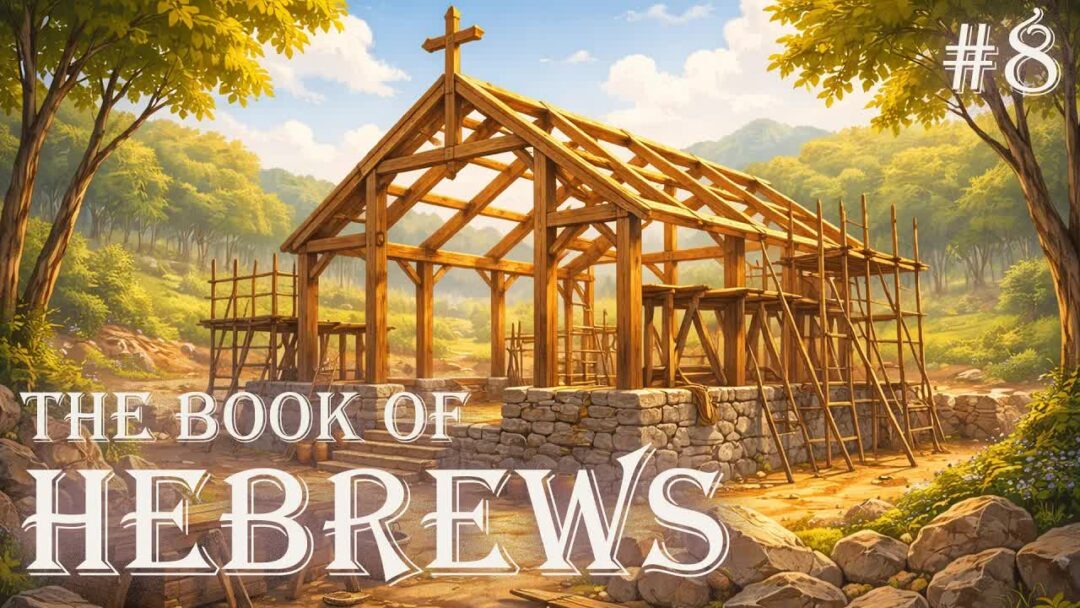
From our Sunday service on March 22, 2026, Hebrews 11:1-12:4. This is part 8 of our Hebrews series. Watch the full message: A Foundation of Faith – Hebrews Series #8 on YouTube.
We are now reaching the end of our Hebrews series. Today we’re in Hebrews chapter 11. We are in the final section of the book of Hebrews, and we’re talking about faith. The whole book of Hebrews talks about faith, but here we’re talking about the application of everything that’s been said: how Jesus is our great High Priest, how Jesus paid the price for our sins, how he has transformed us, and how he enables us. Now the author of Hebrews is taking all of the thoughts he has shared and tying them together into a super-focused practical application. If you want to pay attention to any part of this series, maybe you’ve fallen asleep for a couple of messages, now’s the time to wake up, because we’re getting to the practical application section that can transform your life like never before.
Today we’re in the passage that’s often referred to as the Hall of Faith. We have a lot of individuals to talk about, but they’re all for the same application. The author is going to continue talking about encouragement. Remember, this entire book was written to encourage believers who were under persecution in Rome and in Jerusalem, by both the Romans and the unbelieving Jews who lived in their area. They were being shunned. They were being persecuted. Life was getting difficult. And some of them said, “Is it worth fighting for? Is it worth persevering in our faith?” Today the author of Hebrews is going to lay down a great foundation for why we should always persevere in our faith.
God wants you to know that he has laid down a foundation of faith throughout all of the Scriptures to encourage us.
Faith Is a Foundation
We’ll be starting in verses 1 and 2.
Now faith is the substance of things hoped for, the evidence of things not seen. For by it the elders obtained a good report.
Hebrews 11:1–2
This is our thesis statement for this section. This is what the author of Hebrews wants us to think about the entire time.
The word “substance” is interesting. My Greek studies on this passage drew out a lot of things I didn’t know before I studied for this message. The word “substance” in the Greek is hypostasis. It literally means what is placed under, or what supports. Another way you could translate it is: “Now faith is the foundation of things hoped for, the evidence of unseen things.”
You may wonder how I got to the word “foundation.” Throughout this entire passage, the author of Hebrews uses construction terminology. In one part, where he’s talking about pregnancy, he says a baby was founded rather than conceived, because he’s using this construction terminology. I’ll point those spots out as we get to them.
The main idea of this passage is that we have a foundation we can build our faith on. Our faith isn’t based on no evidence. The Bible is full of stories that give evidence that faith works. When we want to persevere in our faith, we aren’t left without a foundation. There is a foundation of testimonies before us that prove that what God said is true.
The Binding of the Bible
Faith is the substance, or foundation, of things hoped for, the evidence of things not seen. Why? “For,” or because, “by it the elders obtained a good report.” Another way you could translate that is that they obtained a good testimony, or witness.
The people of faith are what bind the story of Scripture together. There are two things that bind the Bible. The first is Jesus Christ. The Old Testament looks forward to him, and the New Testament talks about what he taught and how to go forward from him. Jesus is throughout the whole Bible. But also running through the whole Bible is the story of faith: a story of people who had faith in God despite horrible circumstances, insurmountable odds and unbelievable difficulty. That ties all these pages together. You could say the binding of the Bible is faith.
Either people saw God’s promises and believed them through faith, and God rewarded them for it, or people doubted God’s promises, and it led to their downfall. Those are the two types of faith stories you have. Through these stories, the author wants to teach us that the elders and forefathers received a good testimony because of their faith. It is their faith that tells us today how clearly God is good.
Creation
The first testimony we see is in verse 3.
Through faith we understand that the worlds were framed by the word of God, so that things which are seen were not made of things which do appear.
Hebrews 11:3
The author of Hebrews wants to point out that the beginning of the Bible is based on faith. The Bible starts with a story that nobody was there to witness. No one was there at the creation of the world. Man wasn’t created until day six. So the creation itself must be taken by faith. The first line of the first book of the Bible says, “In the beginning God.” That is a statement of faith, because in the beginning there was only God. There was no man to give witness. So the first words of the Bible begin with faith, and the last words of the Bible end with faith as well.
No matter how much we study creation, no matter how deeply we look at the fundamental structure of the universe, we cannot grasp how it works. We will never understand how God in all his power created the universe, so it must be taken by faith.
Abel
Verse 4 teaches us about the first family and how it demonstrates faith.
By faith Abel offered unto God a more excellent sacrifice than Cain, by which he obtained witness that he was righteous, God testifying of his gifts: and by it he being dead yet speaketh.
Hebrews 11:4
How many of you are familiar with the story of Cain and Abel? It’s very early in your Bible. If you’ve ever started reading through the Bible, you probably made it to Cain and Abel. Cain and Abel were brothers, and they both went to offer a sacrifice to God. Abel was a shepherd, and he offered the best of his flock. Cain offered just some of the yield from his farming.
Here the author tells us that Abel’s offering was better. It was more pleasing to God. Why? Because Abel offered the best he had, while Cain offered menial things and didn’t give God the best. God respected Abel’s offering because he gave the best to God, but he didn’t respect Cain’s, because Cain was just going through the motions of worship.
We all know what happens. Cain killed Abel in jealousy. But despite this, Abel’s faith in offering the best to God is a testimony that has endured through literally all generations. They were the first generation. The testimony of Abel, offering the best to God and trusting that God would take care of the rest, is a lesson that has existed from the first generation to where we are now. That is a foundation of faith on which we can build. The righteousness of Abel teaches us today what it means to give the best to God. Abel’s faith is a testimony that when you give to God, God is pleased by it, and God will bless those who give to him first.
Enoch
After that, in verses 5 and 6, we see Enoch.
By faith Enoch was translated that he should not see death; and was not found, because God had translated him: for before his translation he had this testimony, that he pleased God. But without faith it is impossible to please him: for he that cometh to God must believe that he is, and that he is a rewarder of them that diligently seek him.
Hebrews 11:5–6
We don’t know a lot about Enoch. He shows up in a genealogy with a short sentence about his life. But we do know one thing: he pleased God. Why? Because Genesis tells us he walked with God, and that phrase implies he had a relationship with God that was healthy and blessed. Because Enoch walked with God, because he was faithful, because his faith was strong and he walked in it, God gave him an immediate transfer to heaven so that he didn’t experience death. One moment he was on the earth walking with man; the next he was in glory with God.
Enoch wasn’t translated because of some bloodline, or because he was innately better than everybody else. He was translated because he walked in faith with God. It was his faith that pleased God so much that God took him to heaven.
Two Things About Faith
This teaches us two things about faith. Verse 6 says, “without faith it is impossible to please him: for he that cometh to God must believe that he is, and that he is a rewarder of them that diligently seek him.”
First, you must believe that God is. That is, you must believe God truly exists. To have faith in God, you have to believe he exists. That’s the easy part. Second, you must believe that he rewards those who diligently seek him. That’s the harder part to believe. Another way you could say it is that we need to follow after what God calls good and maintain a relationship with him, because when we do that, God blesses us.
What’s the testimony of Enoch? That when you walk faithfully with God, he rewards you. Enoch’s reward was that he didn’t have to go through a painful, agonizing, drawn-out death. He pleased God so much that God was merciful to him and translated him. So we learn from Enoch’s testimony that those who have faith and please God receive a blessing. That is a foundation we can build on in our own lives.
Noah
Let’s move to verse 7 and see Noah.
By faith Noah, being warned of God of things not seen as yet, moved with fear, prepared an ark to the saving of his house; by the which he condemned the world, and became heir of the righteousness which is by faith.
Hebrews 11:7
We all know the story of Noah. We learn it in Sunday school. Sometimes we have it painted on the walls of our nurseries. Noah had never seen a flood before. When somebody said a flood was coming, he would have said, “What’s a flood?” “It’s a lot of water.” “I don’t know. A lot of water is usually good. We have a lake and we fish from it. That’s good, right?” “No, Noah. This water is going to be water you’ve never seen, never imagined, and everyone is going to die.”
The easy thing would have been to say, “I’ve lived a long time.” You know how long Noah was alive? Hundreds of years. “I’ve lived a long time, and I’ve never seen a flood. I don’t believe in a flood.” That’s the natural thing to say. But he said, “If God says there’s going to be a flood, and there’s going to be a lot of water, and I’m in danger, then I’d better have faith that what God is saying is true.” Because of his faith, he spent over 100 years building the ark, never seeing any sign that a flood was going to come. He didn’t need evidence. Faith was enough for him to work and plan for his survival for over a hundred years.
Righteousness by Faith
At the end of verse 7, it says he “became heir of the righteousness which is by faith.” Noah’s testimony is that righteousness is ascribed by one’s faith, not perfection. Noah never lived a sinless life. Everybody in the world died except Noah and his family. Why was no one else on the ark? Not because they weren’t allowed. Noah went around inviting people for years. Salvation didn’t come through righteousness. It came through faith in God that what he said was true. Had anybody else believed that a flood was coming, they would have been saved along with Noah. But they rejected faith and so condemned themselves. Noah’s testimony is that righteousness is ascribed by one’s faith and not perfection. That is a foundation of faith we can build on today.
Abraham
What about Abraham? Verses 8-10:
By faith Abraham, when he was called to go out into a place which he should after receive for an inheritance, obeyed; and he went out, not knowing whither he went. By faith he sojourned in the land of promise, as in a strange country, dwelling in tabernacles with Isaac and Jacob, the heirs with him of the same promise: For he looked for a city which hath foundations, whose builder and maker is God.
Hebrews 11:8–10
Notice the key word there, “foundations.” Notice the theme of foundations in this passage.
Who is Abraham? I’m sure most of you have heard of him. Abraham lived in a city called Ur of the Chaldees. It was a massive Mesopotamian city that existed around 2000 BC. What you probably don’t know is exactly what Abraham was giving up. We’ve excavated it. We know exactly what was there. Let me tell you what was there, and you tell me if you would have given it up.
What Abraham Left Behind
Ur was a capital city of the Mesopotamian Empire, and it was highly advanced for its time. It had running water that flowed through clay water pipes into homes. It had public bathrooms with water that flushed away when they were used. It had schools that taught cuneiform writing and mathematics. People played popular board games like the Royal Game of Ur and knucklebones to pass the time. Doesn’t that sound like a great place to live?
You know how rare it was to have running-water toilets in that day and age? Ur was one of the biggest, richest cities in the entire world. If you were wealthy enough, you could have running water in your home, running through clay pipes from the aqueducts. In 2000 BC, you could wash your hands in your own house. Almost every family owned the Royal Game of Ur. When they excavated the houses, they found this board game in every home. People had time to play games and have fun.
And what does Abraham do? He leaves. Why? Though Ur had all that comfort, it was a pagan city that worshiped idols, and idolatry was rampant. God called Abraham to leave the comfort of the modern city and become a nomad in an unknown location, to get away from idolatry and get alone with God. Instead of living in a home with running water, board games and leisure, he was asked to live in the wilderness and scrape by.
Did this stop Abraham? No. His faith was so great that he left everything behind, all the comforts the city offered, for the promise of something better. It says he didn’t even know where he was going. But he said, “If God wants me to go there, that’s enough for me. That’s enough for me to know it’s the place God wants me to be, and to leave all my comforts behind. Sure, I’ll give up the running water. I’ll live in the desert with sand in my eyes and in my teeth. I’ll work day and night under the heat of the sun, if that means I can be closer to God and do what he wants me to do.”
That’s a foundation of faith that was laid. Abraham’s testimony is proof that God blesses those who abandon everything to seek him. That’s a foundation we can build on today.
Sarah
What about his wife, Sarah?
Through faith also Sara herself received strength to conceive seed, and was delivered of a child when she was past age, because she judged him faithful who had promised. Therefore sprang there even of one, and him as good as dead, so many as the stars of the sky in multitude, and as the sand which is by the sea shore innumerable.
Hebrews 11:11–12
Once again, the word “conceive” in the Greek literally means “to found.” It says she received strength to found a seed. The author is playing with that idea of foundations again. Because Sarah had faith, she received a miraculous child, and the promise of that child was fulfilled. It says “she judged him faithful who had promised,” because she believed in the impossible.
It says Abraham was “as good as dead.” In other words, the only thing awaiting Abraham in his life was the cold embrace of death. Pretty dark. But God says, “I’m not done with you. I’ve got bigger plans for you. You may think your life is over, but I’m telling you it’s just begun. I’ve got bigger promises. You may have left everything behind, but there is a lot before you.” Sarah believed the promise, and because of it she was able to found a child.
I like this because it works two ways. She founded a child in the sense that she was able to conceive. But it was also the founding of the future nation of Israel, the nation God would use to give his word. So what is Sarah’s testimony? Her testimony is proof that relying on God’s faithfulness can do the impossible. That’s a foundation we can build on today.
Seeing the Promises Afar Off
Now the author of Hebrews takes a pause to remind us of a truth: not all promises were realized in people’s lifetimes. Let’s read verses 13-16.
These all died in faith, not having received the promises, but having seen them afar off, and were persuaded of them, and embraced them, and confessed that they were strangers and pilgrims on the earth. For they that say such things declare plainly that they seek a country. And truly, if they had been mindful of that country from whence they came out, they might have had opportunity to have returned. But now they desire a better country, that is, an heavenly: wherefore God is not ashamed to be called their God: for he hath prepared for them a city.
Hebrews 11:13–16
Another word you could use for “country” in verse 14 is “homeland.”
In Genesis chapter 3, Eve was told that there would be a promised child, a seed who would defeat Satan. All the people we’ve seen in this Hall of Faith knew about that promise: Abel, Enoch, Noah, Abraham and Sarah. They all knew the promise of Genesis 3, and yet none of them saw it fulfilled. But what does it say? “These all died in faith, not having received the promises, but having seen them afar off, and were persuaded of them, and embraced them, and confessed that they were strangers and pilgrims on the earth.”
Greeting Jesus from a Distance
The picture here is that they looked at the promise in the distance. It’s a metaphorical picture. Imagine a big white space. On the left side you have Abraham and Sarah standing there with baby Isaac. On the right side, picture Jesus Christ: the promise, the redemption. Between them is a great distance. They see Jesus standing there, but they’re not going to make it that far. They know they’re going to die before Jesus comes. But they see the promise.
It says they “embraced” the promises. That word is “to greet” in the Greek. That’s how they would greet people, with a hug or a grasp of the hand. A modern equivalent would be waving to Jesus across the distance of time: “Jesus, I see you. I know I won’t reach you, but I see you. I know we’re going to get there. Isaac, my little one, is here. He might not get there, but eventually we’re going to reach you.” They greeted the promises from a distance, knowing they wouldn’t see them fulfilled in their lifetime.
That’s the faith we need, the foundation to be built on. Why? Because not everybody would get to see the promise fulfilled. Many of their lives would end before the promises came. They embraced them. They greeted them from a distance, even though they had not reached them yet.
A Better Country
The author says that when you see something like this, you know for a fact that these people are searching for a spiritual homeland more than an earthly one. Why? Because they don’t worry about the temporal things of this world; they care about the long-term longevity of the kingdom. Abraham and Sarah didn’t follow God because everything would be fulfilled in their lifetime. They said, “I want a future for the people of God, and I will have a testimony of faith for future generations to follow.”
They say plainly that they don’t seek comfort here in this world. Abraham left all the comforts of Ur to go out into the wilderness for a hard life, so that he could demonstrate faith for his own son. If they had remembered the comfort of their earthly country, they might have returned to it. But we’re told they never thought about going back, because their faith was that strong.
Because of this, verse 16 says, “But now they desire a better country, that is, an heavenly: wherefore,” or this is why, “God is not ashamed to be called their God: for he hath prepared for them a city.” God has no shame in being called the God of Abraham, Isaac and Jacob. Why? Because they pleased him. God is pleased with what they have done in his name.
They called themselves the people of God. The modern equivalent today is “Christian.” When you call yourself a Christian, is God pleased that you bear that title because of your faith? Or does he say, “I wish you wouldn’t call yourself a Christian. Your testimony doesn’t live up to it”? Abraham wasn’t like that. When someone says “the God of Abraham,” God says, “That’s me. The God of Abraham. He has faith. The God of Isaac. He has faith. The God of Enoch. He has faith.” What does God say when you say he is your God?
The Patriarchs
Let’s continue and look at the patriarchs in verses 17-19.
By faith Abraham, when he was tried, offered up Isaac: and he that had received the promises offered up his only begotten son, Of whom it was said, That in Isaac shall thy seed be called: Accounting that God was able to raise him up, even from the dead; from whence also he received him in a figure.
Hebrews 11:17–19
Here we have all the patriarchs, the forefathers of the people of Israel, grouped together. We see Abraham’s faith, and Isaac’s faith is included too, because Isaac went along with the plan. He knew something was up. Halfway up the mountain he asked, “Where’s the sacrifice? What’s going on here, Dad? Something’s wrong.” Isaac is included in this faith segment.
Abraham’s faith was so great that he didn’t even question God when God asked him to do something that seemed contradictory. Isaac was the promised child, the seed through whom the promise would be fulfilled. But God asked Abraham to give Isaac back. In his faith, Abraham just assumed that God knew better, and that somehow God would bring Isaac back and keep his promises, no matter what God asked him to do. So he went up there fully willing to sacrifice Isaac, saying, “If God wants me to do it, he’s going to raise my son back from the dead.” And Isaac, following his father’s lead, also demonstrated faith.
But that’s not all the patriarchs. We see more in verses 20-22.
By faith Isaac blessed Jacob and Esau concerning things to come. By faith Jacob, when he was a dying, blessed both the sons of Joseph; and worshipped, leaning upon the top of his staff. By faith Joseph, when he died, made mention of the departing of the children of Israel; and gave commandment concerning his bones.
Hebrews 11:20–22
Once again we see the patriarchs trusting in promises that were not yet fulfilled. Isaac, on his deathbed, blesses Jacob and Esau about the promises that await them. Jacob, on his deathbed, tells his son Joseph about the promises awaiting their people, the tribes of Israel. Joseph, when he dies, tells his brethren about the return to the promised land that awaits them. They all died in faith, not receiving the promise, but they laid a foundation of faith for their children to follow. All the patriarchs demonstrated faith, and the patriarchs’ testimony reminds us that even when we don’t see God’s promises yet, they are still reliable.
Moses
What about Moses? Verse 23 says:
By faith Moses, when he was born, was hid three months of his parents, because they saw he was a proper child; and they were not afraid of the king’s commandment.
Hebrews 11:23
Before we even get to Moses, we get to see Moses’s parents, Amram and Jochebed, who had faith that God would protect their son, so they acted against Pharaoh’s command. What’s our foundation there? The testimony of Moses’s parents is proof that God is pleased with those who do right, even when it’s punishable to do so. God protected them when they stood against the king and his unrighteous command. That’s a foundation we can build on today.
Continuing with Moses in verses 24-26:
By faith Moses, when he was come to years, refused to be called the son of Pharaoh’s daughter; Choosing rather to suffer affliction with the people of God, than to enjoy the pleasures of sin for a season; Esteeming the reproach of Christ greater riches than the treasures in Egypt: for he had respect unto the recompence of the reward.
Hebrews 11:24–26
Because Moses believed the promises to the Israelites, he refused to identify with his adoptive family.
Pharaoh’s Daughter
I’ve been doing some study in Exodus, and I was trying to figure out who this daughter of Pharaoh was. Based on the timeline I came to, it really could only be one person: Hatshepsut. She was the queen of Egypt right before the Exodus. That means that at some point in his life, Moses was almost definitely next in line to be Pharaoh, because she had only a daughter and not a son. It seems like she’s the only one possible, because she was the only daughter of a Pharaoh alive around the time of the Exodus, around 1447, and while Moses would have been growing up before then. She was the only daughter of Pharaoh, and she had no heir, which means Moses would have been the heir to be Pharaoh.
But it says he forsook the treasures of Egypt to fulfill the promise to the Israelites. Instead of enjoying the role of a leader in Egypt, he decided to suffer with his people in the wilderness.
Notice in verse 26, it says he esteemed “the reproach of Christ greater riches than the treasures in Egypt.” He is identified with having faith in Christ, even though Christ hadn’t come yet. Why? Because Christ is the ultimate fulfillment of all of God’s promises. It started in Genesis chapter 3, with the promise that he would crush Satan’s head. So faith in the promises of God was always faith in Jesus, because Christ is the ultimate fulfillment of all of God’s promises.
Moses’s Faith Led the People
It continues in verses 27-29.
By faith he forsook Egypt, not fearing the wrath of the king: for he endured, as seeing him who is invisible. Through faith he kept the passover, and the sprinkling of blood, lest he that destroyed the firstborn should touch them. By faith they passed through the Red sea as by dry land: which the Egyptians assaying to do were drowned.
Hebrews 11:27–29
It was Moses’s faith that brought the people out of Egypt. Remember the story: how strong was the faith of the Israelites? It wasn’t very good. They constantly complained, gave up and wanted to go back to Egypt. Before they even got to the Red Sea, they were already having problems with their motivation. It wasn’t the faith of the Israelites that fulfilled the promise. It was Moses’s faith that saw the promise revealed.
There was a point in the wilderness when God said, in effect, “Let me kill off these people and keep the promise through you, Moses. You’re the only one who’s really invested in it.” But Moses’s faith was so strong that he led the people, the mixed multitude, out of Egypt toward the promises. He too didn’t see the promise fulfilled. He died overlooking the promised land and didn’t see them go into it. He had given up all those things in Egypt to wander in the wilderness by faith with a wicked, stubborn people.
What do we learn from that? If we have faith, God can use us to inspire faith in others, and we can have a part in his plan.
We don’t know a lot about the pharaohs who were in Egypt during that time. There’s very little information available. We say Hatshepsut had only one daughter, but we can’t confirm it, because there’s so little information about them. But you know where we can find a lot of information about a certain individual named Moses? In the word of God. The legacy of the pharaoh in Egypt may have come with riches, but it didn’t come with a foundation of faith laid for future generations. How many of you have been inspired by the story of Moses? I think most of us would say we are. Moses laid a foundation of faith we can build upon. Though it didn’t benefit him on earth, it benefited him greatly in the kingdom of heaven.
The Conquest
What about the conquest? Verses 30 and 31:
By faith the walls of Jericho fell down, after they were compassed about seven days. By faith the harlot Rahab perished not with them that believed not, when she had received the spies with peace.
Hebrews 11:30–31
Here we see Moses, Joshua and Rahab wrapped together into one group of faith. These three testimonies are proof that God protects those who have faith in him. Moses was protected by faith. Joshua was protected by faith. And Rahab, who was not even a part of the children of Israel, was saved because of her faith in the God of Israel. She had no part in the promises, yet she was grafted in through faith, as we talk about in the New Testament, with the people of promise, and she even came into the line of Jesus himself. These testimonies lay a foundation we can build on: God protects those who have faith in him, and he will not reject anyone who believes in him.
Time Would Fail Me
There are so many more we could look at, but the author of Hebrews says the same thing I have to say. We could spend all day talking about the foundations that have been laid, but there’s not enough time to talk about them all. Starting in verse 32:
And what shall I more say? for the time would fail me to tell of Gedeon, and of Barak, and of Samson, and of Jephthae; of David also, and Samuel, and of the prophets: Who through faith subdued kingdoms, wrought righteousness, obtained promises, stopped the mouths of lions, Quenched the violence of fire, escaped the edge of the sword, out of weakness were made strong, waxed valiant in fight, turned to flight the armies of the aliens. Women received their dead raised to life again: and others were tortured, not accepting deliverance; that they might obtain a better resurrection:
Hebrews 11:32–35
Notice there’s a change. In the first half, with Gideon and Barak and David, we see all these great things happen: great victories, and they prospered in their lives. But in verse 35 we get to a turn. It says “women received their dead raised to life again.” I really wanted to go through and mention who each of these people was today, but the author of Hebrews was right: there’s not enough time. Women received their dead raised to life. Their children were raised from the dead. They received a blessing that is unimaginable.
Others Were Tortured
But the unfortunate truth is that this is not how everyone’s story of faith goes. Just as everybody before hadn’t received the fulfillment of all the promises, not everybody who laid down a foundation of faith inherited what we would consider a good blessing for it. Another way you could translate it is, “Women received their dead raised to life, but others were tortured, not accepting deliverance.”
Just because you have faith doesn’t automatically mean you’re going to get the outcome you want, or that your will is going to line up with God’s will. While there were many who received victory in battle, many who received their dead back to life, and many who did amazing things that we write about and celebrate how good God was to them, there were others who had to suffer for their faith.
And others had trial of cruel mockings and scourgings, yea, moreover of bonds and imprisonment: They were stoned, they were sawn asunder, were tempted, were slain with the sword: they wandered about in sheepskins and goatskins; being destitute, afflicted, tormented; (Of whom the world was not worthy:) they wandered in deserts, and in mountains, and in dens and caves of the earth. And these all, having obtained a good report through faith, received not the promise: God having provided some better thing for us, that they without us should not be made perfect.
Hebrews 11:36–40
I was so excited looking at Moses and Abraham and Joshua and how all these things were great, how they lived nice long lives and prospered. But the story of faith isn’t always clean-cut and enjoyable. There were prophets who were put to death for preaching the truth. The Talmud says Isaiah was sawn asunder. He was cut in half for preaching. Jeremiah, the weeping prophet, preached and preached and preached and saw nothing come of it. But God still called him to preach, and he had faith that he was doing what God called him to do. With nobody repenting, at the end of his life he probably felt like a failure, even though he did everything God called him to do.
People were stoned. People were so destitute because they served the Lord that they spent the rest of their days living in the rocks of the mountains, scraping by for food. But it says the world wasn’t worthy of these people. Though they suffered, though they had difficulty, the world didn’t deserve them, because they were so valuable to God. They pleased God like Enoch had. Though they didn’t see the blessings on the earth, they realized they had something better waiting for them. So they took the hardship and the difficulty, and they persevered.
Persevere Like These People
That’s the point the author is trying to make in this book. Persevere like these people. Even when it’s difficult, even when you have nothing, even when hope seems lost, keep walking in the deserts, the mountains and the dens, because they received a good testimony through their faith and laid down a foundation for us. They provided something better for us than they were given.
Being sawn in half is not a good thing to receive. But being able to give the testimony of a martyr is going to found somebody’s faith more than anything else. How many people have believed because of the testimony of the early church, who died for their faith in the persecution of the Roman Empire? When this was written, Nero was just about to come and start killing off the Christians. How many people believed because they watched Christians thrown into the Colosseum to fight lions without any weapons? How many watched as they burned at the stake declaring that Jesus is Lord? What a foundation of faith was laid. Did it benefit them? Not on this side of heaven. Not at all. But on the other side, it brought an eternal reward, and in our lives, a foundation on which we can have confidence in what God taught.
That They Without Us Should Not Be Made Perfect
Verse 40 says, “God having provided some better thing for us, that they without us should not be made perfect.” These believers were ready to give up. The author says, “Don’t give up, because this foundation is pointless if you give up now.” They laid down their lives to lay down a foundation of faith for you to persevere on. Their work isn’t complete unless you persevere in your faith as well. Don’t waste the sacrifice these people made.
We live after the Messiah. We have seen the promises and experienced them. They only hoped for the Messiah, but we participate in the completion and perfection of the promise as the body of Christ. We have to finish what they started. They looked forward to Christ. Christ came. He established us as the body of Christ, a kingdom of priests to live for him. We get to complete the work they were waiting for, because the promise came, and now we’re the ones who keep pushing it forward. We’re the ones who keep being Christ’s hands and feet on the earth. Some of these people received miracles for their faith. But the vast majority of believers suffered so that we would have the opportunity to carry the faith forward.
A Great Cloud of Witnesses
At the beginning of Hebrews 12, the author gives his final charge.
Wherefore seeing we also are compassed about with so great a cloud of witnesses, let us lay aside every weight, and the sin which doth so easily beset us, and let us run with patience the race that is set before us, Looking unto Jesus the author and finisher of our faith; who for the joy that was set before him endured the cross, despising the shame, and is set down at the right hand of the throne of God. For consider him that endured such contradiction of sinners against himself, lest ye be wearied and faint in your minds. Ye have not yet resisted unto blood, striving against sin.
Hebrews 12:1–4
“Compassed about” means surrounded. The author of Hebrews says that because we have all these testimonies surrounding us and supporting our faith as a foundation, we should be more inspired than ever to persevere in our faith, even when there’s difficulty. We should be moved and encouraged to abandon the things that drag us down and the sins that easily entangle us and trip us up, so that we can run the race of faith ahead of us and lay down a foundation for those who come after.
The Author and Finisher of Our Faith
Verse 2 says we look “unto Jesus the author and finisher of our faith.” Remember that image of Abraham and Sarah on the left and Jesus on the right. They’re running toward him. We are in the same position. We don’t see Jesus; he’s in heaven now. But we’re running toward him, and at the end of our race we will meet him there. We need to embrace him from a distance and go toward him.
He’s not just the destination. It also says he’s the author and finisher. What does “author” mean? You’ll never believe it, but it says it’s Jesus who is the founder of our faith. The founder is the first piece of the foundation ever laid down. What was it? Verse 3 told us the worlds were framed by the word of God. Who is the Word of God?
In the beginning was the Word, and the Word was with God, and the Word was God. The same was in the beginning with God. All things were made by him; and without him was not any thing made that was made.
John 1:1–3
The first foundation we saw today was Jesus Christ, and all the faith of all the Christians who came before us was built on that foundation. The truth is that Jesus isn’t just the founder of our faith; he’s also the one who completes our faith. He is not just the start; he is the one who brings it to the end. And if Jesus is the finisher, then we should have the confidence to persevere.
Verse 3 tells us he’s done all the hard work for us. He’s the one who picked up his own cross. He’s the one who thought little of the shame of hanging on it. And he is the one sitting at God’s right hand as our great High Priest. When you think about the opposition the prophets faced, also think of the opposition Jesus faced, and you’ll no longer be discouraged. Instead, you’ll be encouraged, so that you don’t become spiritually exhausted and faint in your faith.
Resisting unto Blood
We’ve never suffered like Jesus has. It’s rare that someone fights the fight of faith against sin to the point of shedding their own blood, as Jesus did. These people were ready to give up the faith, and the author says, “You haven’t even come near where Jesus was in his sacrifice for you. Jesus was willing to shed his blood to save you, and you haven’t shed any blood for your faith. You’re giving up your faith over the draw of sin. You’re giving up faith because you live a sinful life. Why don’t you resist unto blood, fighting against those sins that entangle you, that trip you up, that ruin the foundation God wants to lay with your life? Don’t give up.”
Build on the Foundation
From the very beginning of Scripture, God has been laying down a foundation of faith: a series of testimonies that are evidence of God’s promises. Every story, every testimony, every life we saw today, and countless others, did not live perfect lives, but each was a layer in that foundation. Abel, Enoch, Noah, Abraham, Sarah, Moses and countless others lived faithfully for God. Through their faith, God revealed his character, his promises and his goodness to us.
Now we stand, thousands of years later, on that same foundation, but with one difference. While they looked forward to the promises, we look back on their fulfillment in Jesus Christ. What they hoped for, we know personally. Because of that, we are not running this race alone. We are surrounded by a great cloud of witnesses, all pointing us to the same truth: God is always faithful.
So the question is not whether God has proven himself. Scripture has given us more than enough evidence. The question is whether we will build on the foundation he has already laid.
Will we set aside everything that slows us down? Will we stay away from the sins that so easily drag us down? Will we trust in what we cannot see? And will we endure, just as those before us did?
God wants you to know that he has laid a foundation of faith throughout all of Scripture to encourage us. So the question today is: will your life build on the foundation of those who came before? And will your life leave a new testimony of faith for others to build on?

Recent Comments