
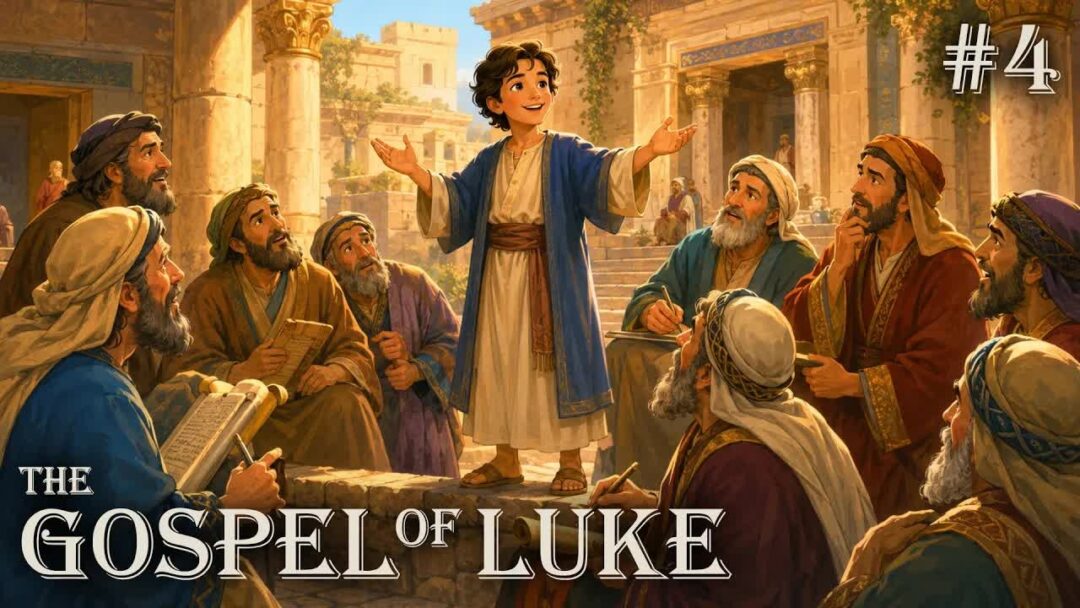
From our Sunday service on June 14, 2026, Luke 2:21-52 and Matthew 2. This is part 4 of our Gospel of Luke series. Watch the full message: A Kid Called Christ – The Gospel of Luke #4 on YouTube.
I’ve entitled this message “A Kid Called Christ,” because today we’re looking at the stories of Jesus when he was a child. Last time, we left off with the birth of John the Baptist and the birth of Jesus, and we saw how God moved the world to fulfill his prophecies and ultimately fulfill his promise of the Messiah. Today we’ll continue and see the early days of Jesus’s life, and how God rewards those who are faithful to him with blessings. Through our time in Scripture today, the key idea we want to take away is that God wants you to know he blesses those who serve him.
Jesus Presented at the Temple
Last time, we saw John the Baptist dedicated. Now we’ll see Jesus.
And when eight days were accomplished for the circumcising of the child, his name was called JESUS, which was so named of the angel before he was conceived in the womb. And when the days of her purification according to the law of Moses were accomplished, they brought him to Jerusalem, to present him to the Lord; (As it is written in the law of the Lord, Every male that openeth the womb shall be called holy to the Lord;) And to offer a sacrifice according to that which is said in the law of the Lord, A pair of turtledoves, or two young pigeons.
Luke 2:21–24
As we saw with John the Baptist, on the eighth day it was part of the Jewish law to officially circumcise the child and give the sign of the covenant, and then he would be officially seen as a Jew and part of God’s chosen people. This ritual was required by law for Jesus to be considered Jewish.
Part of this process was dedicating the child to God. Here in Baptist churches we have baby dedications, where you can dedicate your child to God. It’s not unlike that. First came circumcision, then dedication. The last part we deal with is Mary’s ritual purification. After giving birth to a son, a woman was ritually unclean for seven days, and then she continued in the blood of her purifying for thirty-three more days. When the days of her purifying were fulfilled, she would need to go to the temple and offer a sacrifice for her purification.
The Offering of the Poor
We’re told a detail about Mary and Joseph here that’s easy to overlook. I’ve mentioned a few times in our studies how poor Mary was, how the swaddling clothes were torn pieces of fabric from something else. Here we’re told again just how poor she was. She was supposed to offer a sacrifice that’s usually a lamb. Usually, for the ritual purification, you’d sacrifice a small lamb. But we’re told that’s not what she sacrificed. In Leviticus 12:8, if you could not afford to offer a lamb, you could bring a cheaper alternative: a pair of turtledoves or two young pigeons.
So we’re told here that Mary was in the lowest economic class. Of all the sacrifices you could give, this was the lowest. Mary and Joseph had no money to their name, because they did not offer a lamb for purification. Jesus started off his life in the most humble of circumstances, his parents not even able to afford the lamb for the sacrifice, but having to offer something else instead.
Simeon
In this humble situation, we’re introduced to a man called Simeon.
And, behold, there was a man in Jerusalem, whose name was Simeon; and the same man was just and devout, waiting for the consolation of Israel: and the Holy Ghost was upon him. And it was revealed unto him by the Holy Ghost, that he should not see death, before he had seen the Lord’s Christ.
Luke 2:25–26
We’re told a few things about him. First, he is just and devout. That means he was very good in his moral character, and in his life he prioritized following God. That’s the main idea we have about Simeon; not much else is said about him. All we know is that he was faithful, and because of his faith, the Holy Spirit revealed to him that he would not die until he saw the Messiah with his own eyes.
This man was very old, and he had done everything he wanted to do in life. The Holy Spirit says, “You’ve been faithful to me, Simeon. I want to give you a gift. I’m going to allow you to survive until the day that you see the Messiah appear.” And so Simeon was counting out his days: “Soon the Messiah is going to come. The Holy Spirit has revealed it to me. I get a gift for my faithfulness.”
And he came by the Spirit into the temple: and when the parents brought in the child Jesus, to do for him after the custom of the law, Then took he him up in his arms, and blessed God, and said, Lord, now lettest thou thy servant depart in peace, according to thy word: For mine eyes have seen thy salvation, Which thou hast prepared before the face of all people; A light to lighten the Gentiles, and the glory of thy people Israel. And Joseph and his mother marvelled at those things which were spoken of him.
Luke 2:27–33
The Holy Spirit told Simeon, “I have a gift for you. Before you die and meet me, you’re going to see the Messiah on earth. Go to the temple. He will be coming soon.” So Simeon goes, led by the Holy Spirit, and waits at the temple as people walk by. A normal person might think the Messiah is going to be an adult, but Simeon sees baby Jesus being carried by Mary and says, “That’s the Messiah. The Holy Spirit told me.” He runs to Mary and Joseph as fast as an old man can, takes the Messiah in his arms, and praises God: “I can finally go in peace, Lord. My time has come. I’ve seen your salvation with my own eyes.”
A Light to Lighten the Gentiles
Then he says something interesting in verse 32: “A light to lighten the Gentiles, and the glory of thy people Israel.” Here he brings the Gentiles, these non-Jews, into the blessing of the Messiah, which, if he weren’t full of the Holy Spirit, is not something he would do, because the Jewish people of this day did not understand that the Messiah was for the Gentiles as well. This was not public discourse in the synagogues. They believed the Messiah was for the Jews and only the Jews. And here Simeon chimes in and says, “He’s a light to the Gentiles.”
It says that Joseph and his mother marveled at those things spoken of him. We have to remember how far out in the middle of nowhere Mary and Joseph lived. They didn’t have synagogues to get this biblical training. They didn’t really know most of what the Messiah was all about. Mary and Joseph were probably learning things as we’re learning them going through the Gospel. They were poor; they couldn’t even afford a regular sacrifice. How could they afford to get Torah teaching in school and learn all these things? So here, for the first time, they’re hearing about what this baby is going to do, and they see other people excited about it. Maybe Mary and Joseph don’t really know all that’s going on in their child’s future. They’re amazed at the things that are going to happen with their son, and that the Holy Spirit is revealing these things one after another through all these faithful followers.
And Simeon says, “I can die in peace. I’ve seen God’s salvation.” That must have been amusing to Mary, because Jesus’s name literally means God is salvation. When he says, “I’ve seen God’s salvation,” she’d think, “I didn’t tell him his name was Jesus. That’s so cool.” Imagine being Mary and seeing that. It’s like he called him by his name. God is salvation. “He’s going to be a light to the Gentiles.” This is the Holy Spirit. So the man has this amazing gift for his faithfulness. And it’s not just a gift to him, but also a gift to Mary and Joseph, who have been faithful in raising Jesus up to this point.
A Sword Shall Pierce Thy Soul
And Simeon gives a blessing to the family.
And Simeon blessed them, and said unto Mary his mother, Behold, this child is set for the fall and rising again of many in Israel; and for a sign which shall be spoken against; (Yea, a sword shall pierce through thy own soul also,) that the thoughts of many hearts may be revealed.
Luke 2:34–35
Isaiah 8:14-15 tells us how the Messiah would be a stumbling block to Israel. Simeon refers to this passage: “Many are going to rise and fall on your son. He’s going to cause a lot of Israelites to reject him by the things he asks them to do, but because they fall, many people will stand up again through his salvation.” He says, “He’ll be a stumbling block for them. But Mary, be aware: there’s going to be a stumbling block for you as well. A sword will pierce through your own soul. You’re going to be pierced in your heart over what’s going to happen to your son.”
This is probably the first Mary had heard of it, because what he’s talking about is the crucifixion. He knows the suffering servant of Isaiah. This man’s been faithful his whole life. He’s studied the Scriptures. He knows the Messiah is going to suffer. And he says, “Mary, I want you to know it’s not just going to be hard for other people; you’re going to have struggles as well. Your heart’s going to break when you see your son in his thirties on a cross, bleeding out and dying under the Roman Empire. Mary, it’s not going to be easy for you. But the thoughts of many will be revealed through this. God’s going to make salvation clear for them. He’s going to purify their hearts through the brokenness that you go through.” So here we see this miraculous blessing for the faithful, but we also see Mary’s scary future.
Anna the Prophetess
And there was one Anna, a prophetess, the daughter of Phanuel, of the tribe of Aser: she was of a great age, and had lived with an husband seven years from her virginity; And she was a widow of about fourscore and four years, which departed not from the temple, but served God with fastings and prayers night and day. And she coming in that instant gave thanks likewise unto the Lord, and spake of him to all them that looked for redemption in Jerusalem.
Luke 2:36–38
It appears that after the arrival of John as the first prophet after the 400 years, there were a few other prophets who arrived shortly thereafter. One of these is Anna, or as her name would have been in Hebrew, Hannah. Hannah had a rough life. We’re told she was married young, but after only seven years of marriage her husband passed away, and she remained unmarried as a widow for 84 long years. Instead of remarrying, she chose to dedicate herself to serving in the temple as a prophetess, praying for others’ needs and giving them advice.
What’s interesting is that the wording used for her ministry is actually the exact words that 1 Timothy 5:5 tells us is the proper role of widowed women in the church, what we call the widow indeed.
What Is Prophecy?
This is what it’s talking about when it speaks of the gift of prophecy. A lot of times, we over-spiritualize or over-supernaturalize the ministry of prophecy. We like to think that prophecy is only those huge prophecies where God sent an angel to a prophet and told him to warn people about coming judgment. Most times, that’s not how prophecy worked. Those are the exceptions to the rule, not the general way it works.
It’s just like today: there are miraculous healings. You can see them. I saw one online. Michael Jones of InspiringPhilosophy was posting about a baptism that happened during my lifetime. A man had MS and he was blind, and he went into the water of baptism, came out, suddenly had a pain in his eyes, and could see again. Miracles still happen. But when I was baptized, I had diabetes, and my diabetes didn’t get cured. We don’t use the exception to the rule to define the rule. Prophecy did involve miraculous things, but not always.
Prophecy is also going into God’s Word and saying, “God says if you’re greedy and selfish, he’ll bring judgment.” Hannah could sit there in the temple and people could come to her for advice: “I’ve been trying to grow my business, and I’ve been doing this and that, and I did wrong here.” And Hannah could say, “You know what God’s Word says? If greed controls your life, then destruction will follow. More sin will follow. I warn you what will come in the future if you continue down that path.” You don’t have to have miraculous, divine, angelic knowledge to give a gift of prophecy. If someone’s living in sin, the Bible tells you what the outcome is going to be.
When God called Jonah to Nineveh, he didn’t tell Jonah all the things to say. Jonah’s message was simply, “Yet forty days, and Nineveh shall be overthrown”: repent, or judgment will come. Jonah didn’t need to know magical details to know that if you sin, judgment will come. So you can go to any place where there’s sinful activity, stand up with God’s Word, and say, “If you continue down this path, judgment will come.” That’s prophecy. What is prophecy by definition? It’s telling ahead of time what will happen. You don’t need an angel to come tell you that if a drug addict continues to use drugs, destruction is going to come into their life. You know that.
So that was Hannah’s ministry, this gift of prophecy. She sat in the temple, like the widows in the church are to do, and when people had a problem, they came and sat with her, talked, and asked for advice. She took what the Scripture said and taught them the end result of their actions. And she prayed with them: “Let me pray for you. How can I pray for you? How can I pray that God does something in your life? How are you struggling right now?” That was her ministry, and that’s a ministry we can still do today.
And when she sees Jesus, having the Holy Spirit in her, she also recognizes the Messiah and has a similar experience to Simeon. For her faithfulness, choosing to serve God and help others rather than remarry and seek comfort, she is blessed by God.
The Wise Men
Now we skip ahead a few months. Mary and Joseph are still in Bethlehem, which is about six miles from Jerusalem, and we’re going to go over to Matthew chapter 2 as we see the wise men arrive.
Now when Jesus was born in Bethlehem of Judaea in the days of Herod the king, behold, there came wise men from the east to Jerusalem, Saying, Where is he that is born King of the Jews? for we have seen his star in the east, and are come to worship him.
Matthew 2:1–2
I’ve been waiting to tell you about the wise men, or as it is in the Greek, the magi. Last time, I told you that Jesus was likely born in April, and today I get to tell you why I believe we have very specific timing for the birth of Christ.
Who Were the Magi?
Here we’re told that wise men, the Greek word there is magi, came from the east because of a star in the sky that they followed. How can a person follow a star to find the Messiah? Magi is a Greek word often used for a Zoroastrian priest in ancient Persia. These were people who studied astronomy, astrology, dreams, and other mystic things.
If you remember, the Jews spent a long time in exile within the kingdom of Persia, so they interacted with Persian society because they were captives there. One of the processes of being a captive was diaspora: they would take people and spread them out over the empire. So Jews with their Scriptures had gone through all the empire of Persia and been dispersed among the people. Those who knew the prophecies about the Messiah spread their knowledge among the Zoroastrian priests, and so these magi knew about the prophecies of the Messiah.
What’s interesting about Zoroastrianism is that some secular theologians say Judaism took lessons from Zoroastrianism, and that Judaism is just an extension of Zoroastrianism. That’s not true. But they have a lot of common beliefs, probably because they interacted with each other quite a bit. Zoroastrians also believed in one invisible God. They also believed it was sinful to represent that invisible God with an idol. They also believed that God should be worshiped through good thoughts, good words, and good actions, not through sacrifice. And they had a prophecy from their own prophets that one day there would be a prophet born of a virgin, called the Saoshyant, who would bring a final restoration of the world and victory over evil. He would embody righteousness and be called truth in the flesh, and one day he would resurrect all souls and bring a final judgment.
So when the Zoroastrians were told about the Messiah of the Jewish people, they said, “That sounds a lot like what our prophet said would come, that the salvation of the world would come through the Saoshyant. It must be our Messiah too.” And so they were watching for the Jewish Messiah, because those Jews in exile had told them about him. And these wise men were looking for a sign, because they were astrologers. They studied the mystic horoscopes and such, so they were looking for a sign in the heavens. They looked for this star.
The Star
On April 17, 6 BC, the year Jesus was born, there would have been a rare planetary alignment with Jupiter, Saturn, the sun, and the moon, where they would all cross over the constellation Aries. This would have been extremely significant to the Zoroastrian astrologers. Aries was the constellation associated with the region of Judea, and specifically the region around Jerusalem. If you know anything about constellations, what is Aries? It’s a ram, or a lamb. Jupiter was considered the regal planet, which symbolized a newborn king entering the world. The alignment also happened with a heliacal rising on that day, visible at dawn, meaning the star would have risen in the east. The astrologers believed that when these specific circumstances occurred, it quite literally meant by definition that a great king would be born in the region of Judea.
So when the magi saw this event coming on the horizon, they began to travel straight toward where Jesus was, in search of this great king who would be born in Judea. Of course, the first thing they do is travel to Herod, because they assume the great king will come from the line of the current king. But when they get there, they’re disappointed.
Herod Is Troubled
When Herod the king had heard these things, he was troubled, and all Jerusalem with him. And when he had gathered all the chief priests and scribes of the people together, he demanded of them where Christ should be born. And they said unto him, In Bethlehem of Judaea: for thus it is written by the prophet, And thou Bethlehem, in the land of Juda, art not the least among the princes of Juda: for out of thee shall come a Governor, that shall rule my people Israel.
Matthew 2:3–6
Herod sees these magi from Persia and says, “What’s going on? They believe there’s a king coming. There’s a prophecy in our Scriptures about a king. This could be a problem. Rome is knocking on our doors. I’m barely keeping power as it is. I don’t need somebody else trying to usurp my throne, making Rome uncomfortable, and taking my power away. Figure it out. Go ask the scribes where this Messiah is going to be born, because they know something I don’t know.” And the scribes say, “Well, it’s Bethlehem, because Micah 5:2 tells us it would be in Bethlehem, in the land of Judah.” And Herod says, “We’ve got to nip this in the bud before it becomes a problem. I’m going to send those magi there and have them report back.”
Then Herod, when he had privily called the wise men, enquired of them diligently what time the star appeared. And he sent them to Bethlehem, and said, Go and search diligently for the young child; and when ye have found him, bring me word again, that I may come and worship him also.
Matthew 2:7–8
“Privily” means privately. Herod lies. He says, “Tell me where he is. I want to worship him.” But what he really wants to do is kill Jesus before he has the power to overthrow him.
Gold, Frankincense, and Myrrh
So the wise men follow the star to where Jesus is.
When they had heard the king, they departed; and, lo, the star, which they saw in the east, went before them, till it came and stood over where the young child was. When they saw the star, they rejoiced with exceeding great joy. And when they were come into the house, they saw the young child with Mary his mother, and fell down, and worshipped him: and when they had opened their treasures, they presented unto him gifts; gold, and frankincense, and myrrh.
Matthew 2:9–11
Finally, this star they predicted would arrive appears in the sky, and it leads them directly to where Jesus is. When they arrive, they find him with Mary in a house. So some time has passed. Everybody who was in Bethlehem for the census is gone. This probably wasn’t the exact same day Jesus was born, but it was somewhere around April 17, probably. That’s the only time this really lines up. They find Jesus there with Mary in the house, and the family has now upgraded to living indoors.
Then they give him gifts, and these gifts are all prophetic. They give him gold, frankincense, and myrrh. Gold was given as a sign of his kingship: he was the rightful King of the Jews, royalty. Frankincense was an aromatic used in religious sacrifices at the temple. It was given in recognition of his divinity, as you would offer it as a sweet-smelling savor in your sacrifice. And myrrh was a perfume used to prepare dead bodies for burial, given to Jesus as a sign of his coming suffering. All the gifts the magi brought were exactly the things the Messiah would need.
Flight into Egypt
They come, they find him, and it’s time to go home. And this is where the supernatural begins.
And being warned of God in a dream that they should not return to Herod, they departed into their own country another way. And when they were departed, behold, the angel of the Lord appeareth to Joseph in a dream, saying, Arise, and take the young child and his mother, and flee into Egypt, and be thou there until I bring thee word: for Herod will seek the young child to destroy him.
Matthew 2:12–13
God knows that Herod has bad intentions toward baby Jesus, so God supernaturally warns everyone of Herod’s threat. The wise men decide to go a different, less-traveled route back to Persia. And Mary and Joseph are told to take refuge in Egypt, which was also under Roman occupation at the time.
This also is slightly prophetic, because the Bible said God would raise up a prophet like unto Moses. What did Moses do? He was in Egypt, he fled Egypt, and he came back to be the savior, so to speak. Here, Jesus does something similar. He’s in Bethlehem. He flees to Egypt, and he will return to be the Savior. So we have a prophet like unto Moses in this exodus to Egypt.
When he arose, he took the young child and his mother by night, and departed into Egypt: And was there until the death of Herod: that it might be fulfilled which was spoken of the Lord by the prophet, saying, Out of Egypt have I called my son. Then Herod, when he saw that he was mocked of the wise men, was exceeding wroth, and sent forth, and slew all the children that were in Bethlehem, and in all the coasts thereof, from two years old and under, according to the time which he had diligently enquired of the wise men. Then was fulfilled that which was spoken by Jeremy the prophet, saying, In Rama was there a voice heard, lamentation, and weeping, and great mourning, Rachel weeping for her children, and would not be comforted, because they are not.
Matthew 2:14–18
The Slaughter in Bethlehem
Herod quickly realizes, after nobody comes back to talk to him, that those wise men had no intention of returning. Herod the Great, being the angry, dramatic, and desperate man that he was to keep power, orders all young children in Bethlehem two years old and under to be put to death.
There were probably around 300 to 500 people in Bethlehem at this time. This is after the census, so most of the people had already left the area. Around 3% of people on the planet are under the age of two. So if we use that statistic, it was probably about 9 to 15 children who were killed. I’ve seen secular historians say there’s no evidence for the massacre of the innocents. Well, it would have been about nine to 15 children, because it’s a small town. It’s not going to be a huge event in the history books, because Herod the Great killed people all the time. This was just a weekend hobby of his. He killed his own children. It’s not going to be a big recorded thing that he killed a couple of children in Bethlehem. But it shows how desperate Herod was to remove Jesus. And this also fulfilled the prophecy of Jeremiah 31:15, that there would be weeping and mourning. Unfortunately, that was fulfilled.
Out of Egypt
So Mary, Joseph, and Jesus end up staying in Egypt to avoid Herod’s fury until he dies, which according to archaeology is sometime around 4 BC. So they stayed in Egypt at least until 4 BC. This fulfills the prophecy of Hosea 11:1, which says, “Out of Egypt have I called my son.”
Jesus’s time in Egypt is also why some people in history accused Jesus of practicing Egyptian sorcery. Specifically, Celsus was one of the people who accused Jesus of being an Egyptian magician. And the Jewish Talmud also records that Jesus practiced Egyptian magic. So it seems that maybe they didn’t come back exactly in 4 BC, because Jesus lived there long enough that it was an accusation they could make, that he had learned witchcraft while he was there. He may have stayed a couple more years than that. Maybe when he was five or six, they came back into the nation of Israel.
Return to Nazareth
But when Herod was dead, behold, an angel of the Lord appeareth in a dream to Joseph in Egypt, Saying, Arise, and take the young child and his mother, and go into the land of Israel: for they are dead which sought the young child’s life. And he arose, and took the young child and his mother, and came into the land of Israel. But when he heard that Archelaus did reign in Judaea in the room of his father Herod, he was afraid to go thither: notwithstanding, being warned of God in a dream, he turned aside into the parts of Galilee: And he came and dwelt in a city called Nazareth: that it might be fulfilled which was spoken by the prophets, He shall be called a Nazarene.
Matthew 2:19–23
When Herod is dead, the angel tells Joseph, “Herod’s gone. No one’s going to come after you. It’s safe to return to Israel.” So Joseph and Mary eventually make their way back to Israel. But they find out that not all of Herod’s line is gone. His son Archelaus is now reigning in his place. Joseph is a little wary of this. “It’s Herod’s son. Herod was crazy. Maybe his son’s not too different from his dad.” He’s uncomfortable, and an angel also confirms to him that it’s not a good idea to be under that jurisdiction.
It seems that what Joseph wanted to do initially was to raise Jesus in Bethlehem. But because Herod’s son took his place, that made him uncomfortable, because Bethlehem fell under Herod’s son’s jurisdiction. It was dangerous. So he was warned in a dream: “You need to go elsewhere. You can still return to Israel, but don’t return to Judea, where Herod’s son reigns. Instead, go to Nazareth in Galilee, which is ruled directly under the Roman authority of Caesar Augustus.” That would leave him out of Herod’s jurisdiction and his family line, but he would still be in Israel, and Christ could lay low in Nazareth until it was time for his ministry to begin.
He Shall Be Called a Nazarene
Because the wise men gave gold, frankincense, and myrrh, Mary and Joseph’s situation had greatly changed. They were not nearly as poor as they were before. The myrrh on its own would have been multiple years’ worth of wages. Mary and Joseph went from having nothing at all to having a lot of money, so Joseph could go pretty much wherever he wanted. He thought, “I’ll upgrade my kid’s life from Nazareth in the middle of nowhere and put him in Bethlehem.” But then he found out he couldn’t do that, because it was dangerous. So he ends up going back to Nazareth.
He thinks he’s making that decision because it makes sense to him. What he doesn’t know is that God had a prophecy about Jesus being a Nazarene. This comes from Isaiah 11:1:
And there shall come forth a rod out of the stem of Jesse, and a Branch shall grow out of his roots:
Isaiah 11:1
That word Branch in Hebrew is netzer. He is the Branch. He is a Nazarene, a little branch that grew out of Jesse.
Jesus at Twelve
Now we jump forward a few years, and Jesus is 12 years old.
And the child grew, and waxed strong in spirit, filled with wisdom: and the grace of God was upon him. Now his parents went to Jerusalem every year at the feast of the passover. And when he was twelve years old, they went up to Jerusalem after the custom of the feast.
Luke 2:40–42
What’s really interesting about this story is that Jesus had to grow up like all the other kids. Jesus “grew, and waxed strong in spirit, filled with wisdom: and the grace of God was upon him.” Jesus wasn’t born into the world as a fully grown man with full capabilities and skill sets. As his body grew stronger, his spiritual knowledge and abilities expanded to fill that body.
We’re told in verses 41 and 42 that every year his parents traveled to Jerusalem to celebrate Passover together. This was a sweet little gift, because only the men were required to go to Jerusalem for the Passover. But Joseph, loving his wife so much, brought her along to share in that precious time.
It seems that Jesus didn’t go until he was 12 years old. You might be familiar with the bar mitzvah the Jews do today. Bar mitzvah didn’t exist at this time, but the concept was that there was an age at which you became an adult. It wasn’t set in stone, but it was around 12 or 13 years old. So Mary and Joseph said, “You’re old enough. You’re now considered a young man. It’s time for you to go with us to worship in Jerusalem for the first time.” Until then, while Mary and Joseph had gone, Jesus had stayed back in Nazareth with the family that didn’t go. Now Jesus goes along with his parents for the first time.
Left Behind in Jerusalem
And we see in verses 43-45 that a little issue arises on that trip.
And when they had fulfilled the days, as they returned, the child Jesus tarried behind in Jerusalem; and Joseph and his mother knew not of it. But they, supposing him to have been in the company, went a day’s journey; and they sought him among their kinsfolk and acquaintance. And when they found him not, they turned back again to Jerusalem, seeking him.
Luke 2:43–45
Mary and Joseph are the parents of the Messiah, which comes with the nice convenience that they’ve never had any problems with Jesus. He’s not a sinful child. So they just assume, “We don’t need to lead Jesus in everything he needs to do. He’s God in the flesh. He’ll just naturally do everything he needs to do.” Somehow, we’re not told exactly how, they managed to leave Jesus behind. I don’t know if Jesus physically wasn’t able to keep up with them before they left, but somehow Jesus was unable to leave with them. And they just assumed, because he’s Jesus, he’ll figure it out and he’s with us.
They leave and go a whole day’s journey. Then, in their camp for the night, they look around: “Where’s Jesus? Has anybody seen Jesus? Surely he’s here. He’s a good boy. He always does what he’s told.” But they never considered that, because he’s human, he has limitations. And in this case, that limitation stopped him from being able to catch up with them before they left. So they panic and look everywhere: “Is he with you? Have you seen him?” “No, I haven’t seen him the whole way.” “Oh no, we left Jesus behind.”
How many of you have left Jesus behind somewhere, except it was your own kids? I think every parent’s done it. You can relate to this. “Oh my goodness, we left Jesus in Jerusalem, one of the biggest cities in the entire nation, during a holiday when thousands of people are there. What are we going to do? We’ve got to turn this car right around and go back to Jerusalem.” Except you have to walk a whole day to get there. Nobody was happy about this. So they go back and look for him.
Among the Doctors
And it came to pass, that after three days they found him in the temple, sitting in the midst of the doctors, both hearing them, and asking them questions. And all that heard him were astonished at his understanding and answers.
Luke 2:46–47
They get to Jerusalem, and they don’t find him right away. They took one day to travel back and three more days to find him in the temple. They’re looking everywhere in the city, and they just don’t find him. So for four days, Jesus is missing. Can you imagine losing your own kid? “I lost the Messiah. I can’t find him.” Mary and Joseph are panicking and getting more and more frustrated, until eventually they look in the temple. And when they go in, they see Jesus sitting there with the doctors of the law, those who studied the law and taught what the Bible says, and he’s just talking with them.
It would be like your 12-year-old son sitting at Harvard University with the professors of law, and they’re asking him about the law of the United States, and this kid says, “Oh, yeah, article D says this, this, and this.” Except it’s the law of Moses, and it’s Jesus. So they ask, “What about this case of divorce? Is it lawful?” And Jesus says, “Well, according to this verse, no, it’s not lawful.” And they say, “That’s a really deep insight from a 12-year-old boy. I’ve never seen anything like this.” Then they start escalating the questions, and time after time Jesus is able to answer them. I’m sure in this conversation he gave insight they had never had before: “I’ve never thought of it that way. This boy is making me rethink how I look at the Scriptures.” So these doctors are amazed, and they begin to ask Jesus questions and get answers back. “And all that heard him were astonished at his understanding and answers.” So clearly there was a group of people surrounding Jesus as he began to speak about the things of his own Word.
“Why Hast Thou Thus Dealt with Us?”
What do Mary and Joseph do? Let’s see their response.
And when they saw him, they were amazed: and his mother said unto him, Son, why hast thou thus dealt with us? behold, thy father and I have sought thee sorrowing.
Luke 2:48
Mary says, “Oh my goodness, do you see our son there? He’s teaching the doctors of the law. This is crazy.” And then, “Wait, I’m mad at you. Why have you done this to us, Jesus? Why did you leave us? We’ve been looking for you. We were sorrowing. We were grieving. We haven’t seen you for four days.” While they were impressed, they were still upset.
And he said unto them, How is it that ye sought me? wist ye not that I must be about my Father’s business? And they understood not the saying which he spake unto them.
Luke 2:49–50
Jesus is genuinely confused by this response. “How in the world did you need to look for me? Don’t you know I need to be involved in my Father’s affairs? Why wouldn’t you look for me first in the temple? This is my home. I’m God in the flesh. Why wouldn’t I be at home? Why did it take you four days to get to the temple? Yes, you left me behind, but why didn’t you come to the temple first? Didn’t you know that this is my ministry: to teach the law, to teach grace, to teach the people the ways of peace? Don’t you know what the Bible says about my role? Mom, Dad, why didn’t you come here on day one, walk into the temple, and find me? I’ve been waiting for you in the place I’m supposed to be.”
But his mother and father just didn’t understand it. They didn’t understand the scope of what Jesus was meant to do. They grew up in Nazareth. They didn’t know the Scriptures like everybody else. They didn’t think to look in the temple. “Why would the boy be at the temple? Surely he’s like the other boys, doing what the other boys do.” But Jesus wasn’t like the other kids. He had a purpose and a mission to fulfill.
Increasing in Wisdom and Stature
And he went down with them, and came to Nazareth, and was subject unto them: but his mother kept all these sayings in her heart. And Jesus increased in wisdom and stature, and in favour with God and man.
Luke 2:51–52
Once again, we’re reminded of Mary’s humility in all this. She doesn’t brag that Jesus could impress all the doctors of the law. She doesn’t brag that her son is the Messiah. She takes in all these sayings, these little things she’s learning from all these people who serve God and were blessed to see the Messiah, and she holds them closely in her heart for the future.
And we see that Jesus continues to grow, and as his body grows and his mind grows, the divine power fills him more and more, as he can take on more and more of his ability. I think one of the funniest things is that Jesus probably had to learn how to play catch. He probably wasn’t good at it the first time he played ball with Joseph. There were limitations on him because he was in a human body. As his body grew, his mind grew, and he was able to explain and expound and do more. Our great Messiah, our God who came down, was limited in his human body in a very unique way.
Conclusion
To conclude, as we look at the early days of Jesus’s life, we see a repeated truth in this narrative: God blesses those who faithfully serve him. Mary and Joseph were not wealthy, powerful, or influential, but they obeyed God with what they had. Simeon was not a priest or a ruler, but he was a devout man waiting faithfully for God’s promises. Hannah had known sorrow and loneliness for many years, but instead of becoming bitter, she gave her life to fasting, prayer, and the service of others. The wise men traveled a great distance to worship a king they barely understood. And Joseph obeyed God’s warnings, even when it meant uprooting his family and fleeing into Egypt. In each case, God saw the faithfulness of these individuals, guided their steps, allowed them to be a part of his greater plan, and blessed them all in unique ways.
The blessing of serving God does not always mean an easy life. Mary would still have a sword pierce through her own soul. Joseph would still have to run from Herod. Hannah still spent many years as a widow. But God’s blessing is greater than comfort. He blesses his servants with his presence, his guidance, his protection, and the joy of being used in his service.
The greatest blessing in this passage was not the gold, the safety, or the recognition. It was simply seeing Jesus. Simeon saw him and could die in peace. Hannah saw him and could not stop speaking about him. The wise men saw him and worshiped him. And Mary and Joseph saw him grow in wisdom, stature, and favor with God and man. So may we also be found faithful, serving God where he has placed us, trusting that he sees, guides, and blesses those who serve him.
God blesses those who serve him. So will you serve him today?

Recent Comments