
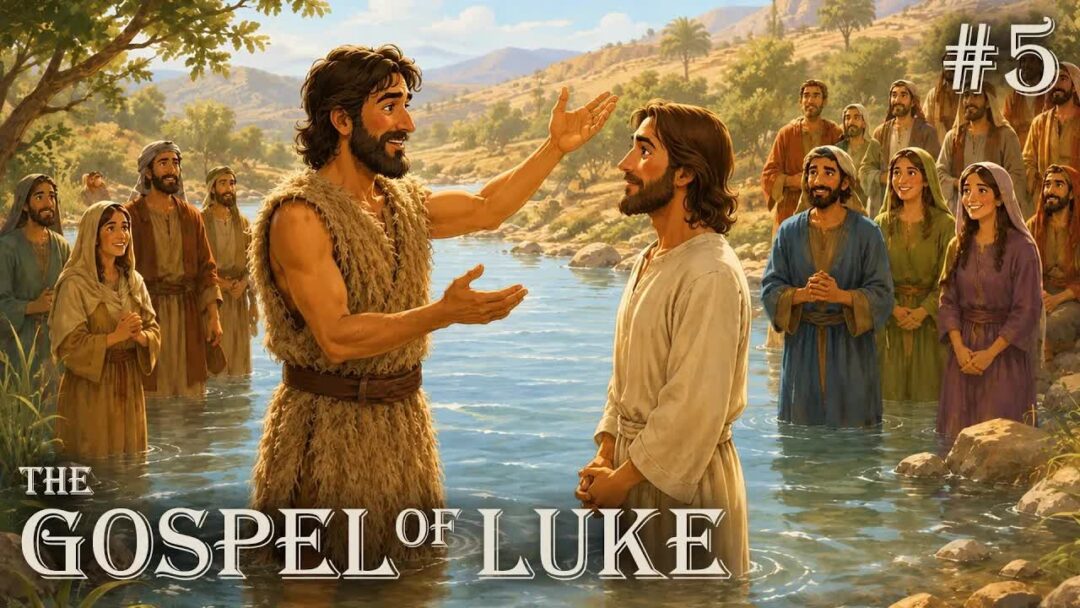
From our Sunday service on June 21, 2026, Luke 3:1-22. This is part 5 of our Gospel of Luke series. Watch the full message: The Revealing – The Gospel of Luke #5 on YouTube.
Last time, we covered the early life of Jesus in a message entitled A Kid Called Christ. We saw Jesus’ early years, from a baby to a toddler to a young boy in the temple at the age of 12. Now he’s grown up. We’re jumping forward 22 years to view John the Baptist’s ministry, as John passes the torch from his ministry over to Jesus, the Messiah.
God wants you to change your mind about sin.
A Real Time, a Real Place
Now in the fifteenth year of the reign of Tiberius Caesar, Pontius Pilate being governor of Judaea, and Herod being tetrarch of Galilee, and his brother Philip tetrarch of Ituraea and of the region of Trachonitis, and Lysanias the tetrarch of Abilene, Annas and Caiaphas being the high priests, the word of God came unto John the son of Zacharias in the wilderness.
Luke 3:1–2
What was the purpose of the book of Luke? The early church was passing around Matthew and Mark, and they knew a lot about the ministry of Jesus, but the Greeks didn’t understand the context because they didn’t grow up in Israel. So Luke’s goal was to put the gospel in its historic setting. He gives us the political positions of seven specific people just to set the context of when the ministry of Jesus started.
Luke wants everyone to understand that the story of Jesus Christ is not a fairy tale. It’s not a made-up mythology. It’s a historic event. Luke wanted you to be able to look in your Bible, then look at the historical documents of the day and confirm that all these people were ruling. When Herod interacts with John the Baptist, that is historical fact. It’s not allegory or metaphor. Of course there can be allegory and metaphor in God’s sovereign providence, but these are not just stories. Jesus is not just a story that makes us sleep well at night. He is the Son of God come in the flesh to change the world.
Dating the Ministry of Jesus
Luke doesn’t give specific dates because in Jesus’ time there were multiple competing calendars. If he put a date in one calendar, chances are you didn’t use that calendar. So he dates everything by the political leaders of the time. That places us in AD 28 or 29. Late 28, early 29, a very specific period of about one year.
From this date we can begin to date the entire ministry of Jesus. The only historical dates available for the crucifixion, based on the gospel accounts, are the 7th of April AD 30 or the 3rd of April AD 33. Which one is it? When Jesus was crucified, there was darkness over the earth. Is there anything in the sky that lines up with that? If you go to April 3, AD 33, you will find that around the region of Israel there was a lunar eclipse. That puts the ministry of Jesus beginning in late 28 or early 29 and ending April 3, AD 33, with the cross.
Luke 3:23 tells us that Jesus was about 30 when he began his ministry. Based on this timeline, Jesus was either 34 or 35 when he began his ministry and 39 or 40 when he died on the cross.
Many pastors will say that Jesus’ ministry lasted only 3 years. They get this from the fact that the book of John records three separate Passovers. But just because only three Passovers were recorded doesn’t mean only three Passovers occurred. Maybe nothing significant in Jesus’ ministry happened on the others. According to the chronology of Luke, we can know the age of Jesus during his ministry. This is a factual story about a factual person who had a factual birth date and a factual death.
Dressed Like Elijah
Matthew tells us a few things about John that Luke doesn’t. When John begins his ministry, he wears clothing of camel’s hair and a leather belt around his waist, and he eats locusts and wild honey. Is that significant? In 2 Kings 1:8 that description appears for another prophet: Elijah. Elijah was identifiable by clothing made of hair and a leather belt around his waist.
Remember who John the Baptist was. He was the one who was to come in the spirit of Elijah. God promised that when you see Elijah, you will know the day of the Lord is coming. In 2 Kings, the king asks about the man who gave a prophecy. What was he wearing? A hairy coat and a leather belt. And the king says, “That’s Elijah.” So John wore the same clothing Elijah wore.
The King James says Elijah was “an hairy man.” It’s translated that way because the Hebrew is written with a pun. It has a double meaning: he was both a hairy man and a man wearing hairy clothes. Since it’s a pun, you can only translate it one of two ways, and the King James chooses “hairy man.” But both meanings are in the original Hebrew. That’s probably not comfortable clothing, but that’s what John wore, and that’s why he wore it.
Repent for the Remission of Sins
And he came into all the country about Jordan, preaching the baptism of repentance for the remission of sins; As it is written in the book of the words of Esaias the prophet, saying, The voice of one crying in the wilderness, Prepare ye the way of the Lord, make his paths straight. Every valley shall be filled, and every mountain and hill shall be brought low; and the crooked shall be made straight, and the rough ways shall be made smooth; And all flesh shall see the salvation of God.
Luke 3:3–6
Here we have the summary of John’s ministry. His job was to go through all the country about Jordan and announce that the Messiah was coming and that Isaiah’s prophecy was being fulfilled. They needed to prepare the way. The mountains would be laid low and the valleys brought up to build a road for the Messiah. “The Messiah is coming. Prepare your hearts.”
You must repent for your sins to be remitted. Remitted means forgiven. The word repent in the original language literally means to change your mind about something, and by extension to change your perspective in a way that leads to a change of action. When God calls us to repent, he’s telling us to change our minds about something sinful by viewing sin the way he views it, and then to live in light of that knowledge by avoiding that sin going forward.
What Baptism Is
As a sign, John calls for baptism. We’re Baptist, so we should probably know what baptism is. Baptism in the Greek literally means to dip something in water. This word was used in the translation of the Old Testament for when the priest would dip an item into water to ritually purify it. That’s all the word means: to dip. We just don’t say “dip” because that’s boring. “Are you going to get dipped at church this week?” It sounds weird. So we use the Greek word transliterated: baptize.
There was nothing spiritually significant about baptism. Baptism was an outward reflection of a change of perspective. As a confession that I have changed my mind about sin, that what I’m doing is wrong and what God says is right, I’m going to be dipped in water. Just as the priest dipped artifacts in water to dedicate them to God, I dip myself in water to dedicate myself to Christ, to be usable for his purposes. John’s ministry was to get people to renounce their evil actions, confess that they had changed their minds, and then baptize them to walk in newness of life. By changing people’s hearts toward their sin, he was preparing them to follow Jesus.
O Generation of Vipers
Then said he to the multitude that came forth to be baptized of him, O generation of vipers, who hath warned you to flee from the wrath to come? Bring forth therefore fruits worthy of repentance, and begin not to say within yourselves, We have Abraham to our father: for I say unto you, That God is able of these stones to raise up children unto Abraham. And now also the axe is laid unto the root of the trees: every tree therefore which bringeth not forth good fruit is hewn down, and cast into the fire.
Luke 3:7–9
This is probably not the message you want to hear when you come to church on a Sunday morning. “You generation of snakes, who warned you to come here?” But this was the message. Matthew tells us this correction was directed at the Pharisees and the Sadducees, spiritual leaders who put on an aura of godliness but at the core were hypocrites and liars. They were prideful, arrogant people who thought their lineage through Abraham was good enough to save them.
You think because you go to the synagogue (our equivalent today would be the church), because you’re a cultural believer, because your parents followed God, that automatically makes you a follower too? You don’t understand the purpose of God’s redemption. You don’t understand remission because you are unrepentant. He says, “You guys were destined to hell. You think because you followed someone else in their belief that somehow you’ll be saved too?” That’s not how it works.
He says God could take a bunch of rocks and replace you with them, and they’d be more profitable for ministry than you. John tells the Jews, “You don’t deserve salvation just because of your ethnicity. You need to change your mind about what it means to follow God, because God could replace Israel with a bunch of rocks if he really wanted to.” God has his axe ready. When the Messiah comes, you’ll have a choice to accept him or reject him. If you reject the Messiah, God has his axe ready to cut you out of the promise because you rejected him to his face.
What Shall We Do?
And the people asked him, saying, What shall we do then? He answereth and saith unto them, He that hath two coats, let him impart to him that hath none; and he that hath meat, let him do likewise.
Luke 3:10–11
The people ask, “If I can’t be saved by my parents, if it doesn’t mean anything to follow God culturally and just say I’m a Christian, what am I supposed to do?” John’s answer should have been obvious: if you have two coats, give one to somebody who doesn’t have one. Stop being a hypocrite. Stop saying you want to be like God if you won’t do the things God does. God cares about the poor. He lifts up the humble. You say you follow God, but you’ve got a bunch of stuff you’re keeping for yourself while other people suffer and die. There are people out in the cold wearing tattered robes, and you’ve got a coat just sitting in your closet. The law had told them to be kind to their neighbor, to love those who have nothing, and not to hoard up treasures for themselves. And yet they continued to do so.
As Americans, we really struggle with this, and we think we don’t. We don’t see ourselves as rich. We judge ourselves by America as a whole and forget about the rest of the world. When the World Cup was here, you probably saw videos on social media of people from other countries reacting to how much blessing America has. They walk into a Costco and think they’ve entered the land flowing with milk and honey. “You mean this hot dog’s a dollar fifty? Look at all the things I can buy. We don’t have this elsewhere.” We’re so used to it that we don’t realize how much we have. Our closets are full of extra clothes while even in America there are neighbors who don’t have any.
We think, “I’m in the lower tax brackets of America, so I’m struggling just as much as them. That gives me the right to keep my closet full of coats. Maybe I don’t need them, but they’re mine.” We pat ourselves on the back while people around us struggle, because our culture teaches us that’s how you do it in America. But if we stood in front of John the Baptist in his camel shirt and leather belt, he would say, “Who are you to hoard for yourself? If you say you follow God, why don’t you give like God gives? Be God’s hands and feet. Take what’s rotting in your closet and give it to those who need it more.” If you have excess, use that excess to help those in need.
The Publicans
Then came also publicans to be baptized, and said unto him, Master, what shall we do? And he said unto them, Exact no more than that which is appointed you.
Luke 3:12–13
This would have been really unexpected to any Jew. The tax collectors who work for the Romans showed up to John and wanted to repent? Those tax collectors were lying thieves. In that day there were two classes of tax collectors. The chief publicans worked directly for the Roman Empire and supervised districts collecting taxes to pay Rome. The ordinary publicans worked under them, collecting taxes from individual people. The ones who came to John were the common publicans.
You might think, “That’s not so bad. We don’t like paying taxes either. We hate April.” But Rome was an occupying force in Israel. The people didn’t want to pay taxes to Rome. Rome didn’t represent them. Most of them weren’t even citizens. In the Bible, the only person we know who was a citizen really is Paul. Most were never granted citizenship, but they still had to pay these taxes. So everyone hated the publicans, because they were exploiting their own people for a foreign occupying government.
On top of that, it was very common for the regular publicans to overcharge and collect extra for themselves. The pay wasn’t great, so they would threaten to put false charges against people unless they tipped them. Maybe you feel like this at Starbucks when they turn the screen around and ask how much you’d like to tip. In the Roman Empire your tax collector would say, “Do you want to tip me? 10, 15, 20%? If you tip 10%, I’ll say you underpaid this year and cook the books a little. If you tip 5%, I might say you hit me. And if you don’t tip me anything, I’m going to say you’re committing sedition against Rome, and they’ll crucify you.” People hated them because they would extort them, and there was nothing they could do to stop it. And the chief publicans, because they still got their payday, just overlooked the extortion that happened under their watch.
The Jews listening probably thought, “John’s going to tell them to quit their jobs and stop supporting Rome.” But John says, “Exact no more than that which is appointed you.” Now John makes both sides furious. The faithful Jews are mad because he told them it’s okay to work for the Roman Empire. The tax collectors are mad because he says, “Don’t take good pay by extorting the people you collect from.” The Jews would much rather the publicans quit their job than just tax them what they were supposed to. John wasn’t preaching what sounded good to his audience. He was preaching the truth.
The Soldiers
And the soldiers likewise demanded of him, saying, And what shall we do? And he said unto them, Do violence to no man, neither accuse any falsely; and be content with your wages.
Luke 3:14
What are Roman soldiers doing here? They’re the occupying force. But they said, “This Messiah is coming. I want to get my heart right. What do I need to change my mind about?” John tells them three things. First, “Do violence to no man.” That word violence doesn’t mean what we would think. It literally means to shake, like if you took somebody and shook them. It’s not about punching someone. It’s intimidation. Don’t threaten someone to make them scared of you. Second, don’t falsely accuse. Don’t make up charges against people to get money from them. Third, be content with your wages.
The soldiers were doing basically the same thing as the tax collectors. They had a big sword at their side and the power of the world’s largest empire behind them. If they wanted extra pocket change, they could shake someone up: “Give me the money. Do you want me to call the Roman Empire on you? They’ll take my side, not yours, because I’m a citizen and you’re not. You don’t have rights.”
Again this was unpopular with both sides. John’s audience wanted them to quit, since they were working for the enemy. But John says, “No. Stop sinning. Do what’s expected of you. Defend the people. God has put Rome in charge for this time because he needs the power of Rome to spread the gospel. God has allowed them to occupy. Serve in that job, but do what is right, and don’t use that power to take advantage of someone who has less power than you.”
One Mightier Than I
And as the people were in expectation, and all men mused in their hearts of John, whether he were the Christ, or not;
Luke 3:15
Rather than rebuking John for his teachings, the crowd is receptive. They begin to wonder, “This John is really different from the other rabbis and teachers. We haven’t had a prophet in a long time. Might John be the Messiah? He speaks in a way our religious leaders don’t. Religious leaders condemn the Romans. Religious leaders condemn the tax collector and the soldier. Why is he so different?”
John answered, saying unto them all, I indeed baptize you with water; but one mightier than I cometh, the latchet of whose shoes I am not worthy to unloose: he shall baptize you with the Holy Ghost and with fire: Whose fan is in his hand, and he will throughly purge his floor, and will gather the wheat into his garner; but the chaff he will burn with fire unquenchable.
Luke 3:16–17
John immediately shuts this down. His entire job is to point people to the Messiah, so their thinking he’s the Messiah would undermine his entire ministry. “Compared to the Messiah, my ministry and my teaching are nothing. I’m not even worthy to tie his shoes, to strap up his sandals. I baptize you on the outside. I give a sign of a change of mind. The Messiah will baptize you with the power of the Holy Spirit. What I do on the outside is just a symbol of his ministry. He will transform you, and his holy fire will purify you from within.” The Messiah won’t just warn people like John did. He will bring judgment and separate the true followers from the fake.
The Revealing of the Messiah
Now when all the people were baptized, it came to pass, that Jesus also being baptized, and praying, the heaven was opened, And the Holy Ghost descended in a bodily shape like a dove upon him, and a voice came from heaven, which said, Thou art my beloved Son; in thee I am well pleased.
Luke 3:21–22
Luke summarizes this very quickly because it had already been told from multiple perspectives before he wrote. So you won’t get as much from the story unless you read all four Gospels together. I’ve been working on a harmonized Gospel book. When you put the verses in chronological order, this is the whole detail of Jesus’ baptism:
Then cometh Jesus from Galilee to Jordan unto John, to be baptized of him. But John forbad him, saying, I have need to be baptized of thee, and comest thou to me? And Jesus answering said unto him, Suffer it to be so now: for thus it becometh us to fulfil all righteousness. Then he suffered him. And Jesus, when he was baptized, went up straightway out of the water: and, lo, the heavens were opened unto him, and he saw the Spirit of God descending like a dove, and lighting upon him: And lo a voice from heaven, saying, This is my beloved Son, in whom I am well pleased. … And John bare record, saying, I saw the Spirit descending from heaven like a dove, and it abode upon him. And I knew him not: but he that sent me to baptize with water, the same said unto me, Upon whom thou shalt see the Spirit descending, and remaining on him, the same is he which baptizeth with the Holy Ghost. And I saw, and bare record that this is the Son of God.
Matthew 3:13–17; John 1:32–34
When Jesus is revealed as the Messiah, it seems like any other day. John was telling people to repent and be baptized, just like always. On this day his cousin Jesus comes to the Jordan and asks John to baptize him. John refuses, because he knew Jesus didn’t need to repent. “No, Jesus. You’re already following God. I should be baptized by you. I’m more of a sinner than you are.” Jesus says, “No, John. I need this to happen. Allow it for this moment, because it’s suitable for us to fulfill righteousness this way.” That word “suffer” means allow.
To Fulfil All Righteousness
If you look at the phrase “to fulfil all righteousness” throughout the Bible, it’s almost always tied to Jesus’ work of redemption. It’s often identified with God saving his people. Jesus is saying this needs to be done for the process of the world’s salvation. Through his baptism, Jesus demonstrates that water baptism is not about salvation. He never sinned, so he didn’t need to be baptized to be saved. Baptism wasn’t about salvation; it was about identity.
Baptism is not part of the law of Moses. There was no law that the Jews needed to be baptized. But baptism connected you with John’s ministry, and by extension the ministry of the Messiah. Jesus was always meant to be revealed through John’s ministry. Through baptism, Jesus identifies himself with humanity’s sin so that he could carry our sins on the cross. We aren’t baptized to remove our sins. We’re baptized to show others who we belong to. This baptism is also the sign of Jesus’ anointing as the Messiah, which literally means the anointed one. The prophecy said there would be one who prepared the way, and there needed to be a clear line between John’s ministry and Jesus’.
What John Saw
John tells us John the Baptist was told ahead of time that the Spirit of God would descend on the Messiah while he was baptizing. John didn’t know who the Messiah was going to be. He never thought for a second that his cousin was the Messiah. He grew up with him and just thought he was a righteous man. That’s why John doesn’t understand when Jesus asks to be baptized. But the Messiah would be identified through baptism.
As John baptizes Jesus, he has a divine sight. A lot of times we misread this and think everybody there saw the Spirit of God descending on Jesus. But when you read the text, it’s only John who sees this. John alone sees this vision of the Spirit descending on Jesus, and he hears God speak to him alone: “This is my beloved Son, in whom I am well pleased.” This fulfills the prophecy of Isaiah 42:1.
Behold my servant, whom I uphold; mine elect, in whom my soul delighteth; I have put my spirit upon him: he shall bring forth judgment to the Gentiles.
Isaiah 42:1
When John saw this vision and prophecy fulfilled, God told him, “Your cousin Jesus is the Messiah,” and by extension, “It’s time to pass on your ministry and declare the Messiah.” Up to this point John thought Jesus was just his cousin, but now he knew as a fact that Jesus is the Messiah. He didn’t delay. Immediately after the baptism he declares that Jesus is the Son of God, passes his ministry to Jesus, and tells his followers, “You’ve had a chance to repent. You’ve had a chance to change your mind. Today’s the day to follow.”
John and Herod
And many other things in his exhortation preached he unto the people. But Herod the tetrarch, being reproved by him for Herodias his brother Philip’s wife, and for all the evils which Herod had done, Added yet this above all, that he shut up John in prison.
Luke 3:18–20
John’s teachings were extremely controversial. When Jesus began his ministry, John still preached, but he didn’t say, “Follow me.” He said, “Follow Christ. Go follow Jesus. He’s the Messiah. Repent and follow Jesus.” Eventually he came into conflict with Herod Antipas. Herod was really interested in John. He was amused by him. But Herod found out John had said some not-so-nice things about him.
Herod Antipas had sinfully married his brother’s wife, Herodias. Both Herod and Herodias were already married, so they divorced, and it was adultery. Above all, Herodias was also his own niece. Herod became furious with John. He thought John was a threat to his power and his reputation. So John was thrown into prison in an attempt to shut him up for speaking out against Herod’s adulterous and incestuous marriage to his own niece. And John’s ministry concludes with him in prison.
Have I Changed My Mind About My Sin?
John preached a message that is still relevant today: it’s time to change your mind about sin. The message is simple, but it’s not easy to hear. It’s tempting to hide behind your family, your position, your religion, your job, or your reputation, but none of these things save you. If a person has truly repented of their sin, there should be fruit that gives evidence of that repentance. For John’s audience, the common people needed to become more generous, the tax collectors needed to stop stealing, the soldiers needed to stop intimidating and falsely accusing, and Herod needed to repent of his wicked immorality.
Each group had different sins, but they were all condemned by the same basic truth: you cannot prepare your heart for Christ while still defending the sin he came to save you from.
John’s ministry occupies only a short part of the gospel account, but his message was never meant to end with him. John pointed beyond himself to the one who was mightier than he was, Jesus, the beloved Son of God. After Jesus came, the message of repentance didn’t disappear. It became even more urgent. John could baptize with water, but Jesus came to cleanse us from within. John could warn of judgment, but Jesus is the one who separates the wheat from the chaff.
So the question for us today is, have I changed my mind about my sin? If we belong to Christ, we must stop excusing what God condemns, turn from it, and identify ourselves with the Savior who came to make us new.
God wants you to change your mind about sin. So, will you be honest about your sins, turn from them, and follow Jesus today?

Recent Comments