
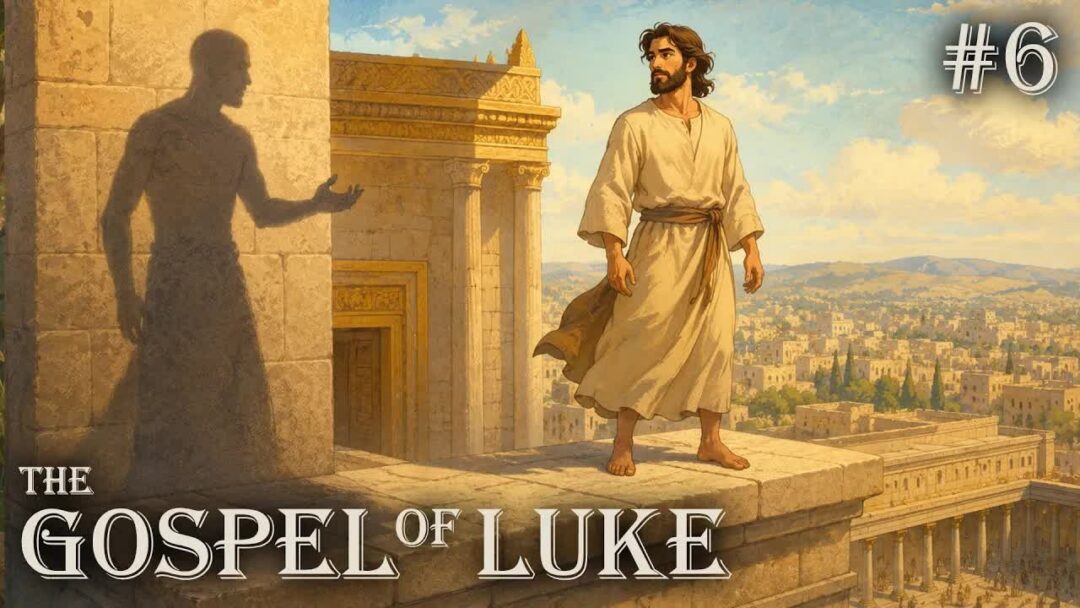
From our Sunday service on June 28, 2026, Luke 4:1-15. This is part 6 of our Gospel of Luke series. Watch the full message: The Temptation – The Gospel of Luke #6 on YouTube.
Last time, we saw Jesus’ baptism, as John declared Jesus to be the Messiah and ushered in Jesus’ ministry. Now we see the first steps of that ministry. Before he had the disciples, before he had the teaching, Jesus went into the wilderness to be tempted by Satan. He is tempted in three broad categories: the lust of the flesh, the lust of the eyes, and the pride of life. For those of you who enjoy the traditional three-point message, I’ve got good news: this passage falls naturally into three points. We’re going to learn from Jesus’ example what Satan’s temptations look like and how we can overcome them.
God wants you to beware of those who twist Scripture for their agenda, and he wants you to be able to overcome Satan’s attacks.
Led by the Spirit into the Wilderness
And Jesus being full of the Holy Ghost returned from Jordan, and was led by the Spirit into the wilderness, Being forty days tempted of the devil. And in those days he did eat nothing: and when they were ended, he afterward hungered.
Luke 4:1–2
This happens immediately after John baptized Jesus. There are no events in between. Jesus is baptized in the Jordan River, John declares him the Son of God, and rather than stick around to talk, Jesus walks out of the water. He literally ascends. Some of the other Gospels say he was led up, quite literally going up the bank of the Jordan and into the wilderness. That would have been a confusing sight for those who were there: “Behold the Lamb of God, which taketh away the sin of the world.” The Son of God. And then he just walks away. But it wasn’t time yet for Jesus’ ministry of teaching. First came the temptation. He goes from the valley up to a higher elevation, into the wilderness.
John saw the Spirit descending on Jesus like a dove, and here that same Spirit leads Jesus into his first steps of ministry. We see the Trinity working together: God the Father sends God the Holy Spirit to lead God the Son. We can get lost in the weeds with that, and we don’t need to today. But God placed limitations on himself in his incarnation. Though Jesus was fully God and fully man, there were limitations. So the Holy Spirit was needed for this work, because it was through the Holy Spirit that Jesus was shown what to do for the Father.
Forty Days
The Holy Ghost says, “Jesus, before we start this ministry, you need to go into the wilderness and fast for 40 days.” How many of you have fasted for 40 days? I would not recommend it. If you get to 40 days of fasting, it’s almost supernatural that you survive. Not very many people in the Bible fasted 40 days, because it’s a highly dangerous thing to do. Jesus’ life so far has been a lot of hard things, and now he’s asked to do another: don’t eat for 40 days. Not just don’t eat, but go into the middle of the desert, where it’s dusty and dry, and live out those 40 days there. And while you’re there, Satan is going to tempt you for 40 days straight. Not a moment of peace, not a moment of comfort, just temptation.
Why? Because Jesus needed to set an example for us to follow. He wanted to prove to us that it’s possible for us to overcome sin. Just as Adam was our representative in the beginning, Christ is called the second Adam. He is our representative who lived a sinless life, and because of his sinless life, his death on the cross covers our sins. Part of his being that sacrifice is that he needed to be tempted in all the ways we are. For those 40 days Satan was let loose on Jesus and tempted him in every way, shape, and form you could imagine.
Yet we’re told about only three temptations, which happened at the very end of the 40 days. This was Satan’s last-ditch effort to get Jesus to sin. After this, we don’t see Satan himself until around the time of the crucifixion. Maybe some demons, but Satan himself doesn’t show up until way later. This was Satan’s last attempt, for a time, to undermine the mission of the gospel.
Why the Wilderness?
The word “wilderness” in the original language means an undeveloped section of the land of Israel. It’s not necessarily the Negev desert to the south, as we might expect. It was likely the Judean desert, around the area of Judea.
Why did Jesus spend 40 days in the wilderness? The Bible doesn’t clearly tell us, but there are a couple of theories. Israel spent 40 years in the wilderness. Maybe Jesus’ 40 days represent Israel wandering 40 years because they didn’t obey, and Jesus wanders 40 days in order to obey. We also see Elijah and Moses spent 40 days fasting in the wilderness before they met with God. If Jesus is the prophet like unto Moses, it would make sense that he has 40 days of fasting like Moses did. Or maybe it’s like Elijah too, because Jesus fulfills the law (Moses) and the prophets (Elijah).
What we know for sure is that Jesus needed to be an example for us. He had to be tempted like we are to demonstrate that we can truly overcome temptation. And when you haven’t eaten for 40 days, you’re at your most vulnerable. I think Snickers says it best: you’re not you when you’re hungry. He’s not feeling his best. He’s hungry, and with hunger comes the natural temptation to be cranky and to indulge. Satan is going to try to take advantage of that to ruin Jesus’ ministry.
Temptation One: The Lust of the Flesh
And the devil said unto him, If thou be the Son of God, command this stone that it be made bread.
Luke 4:3
We don’t think about these temptations as deeply as we should, but I’m going to make you stop and think about them in context. You’re going to see just how diabolical Satan is. The first temptation is the lust of the flesh. “Pastor Zach, what does that mean?” It means simply the desire to enjoy. All of us like enjoying things. The lust of the flesh is the desire to sin for the sake of enjoyment. Satan’s temptation deals specifically with Jesus’ current weakness. He’s extremely hungry. His flesh deeply desires to eat, but God through the Holy Spirit led him not to eat for 40 days.
Sins of the lust of the flesh are good things that are part of your natural desires. Food is a good thing. If you don’t eat food, you die. But good things can be made sin by wanting or claiming them outside the context in which God designed us to enjoy them. Sins of the lust of the flesh include gluttony, drunkenness, adultery, fornication, and so on. The things in marriage are good inside the bounds of marriage, but when you take them outside, now you’ve got a problem. The lust of the flesh says, “I want to take something that’s good outside of where God put it for me.”
It was fine for Jesus to eat food every other day except these 40 days, because the Holy Spirit told him not to. For him to eat bread now would be a sin, and Satan knows this. He knows Jesus wants the bread, so he just nudges him a little more. “If I can get you to sin, you wouldn’t be the Messiah. You couldn’t die on the cross, because you’d be guilty like the rest of them.” So he nudges him about something that sounds so good, something he has enjoyed a hundred times: a nice fresh loaf of bread. How much better does food taste after you haven’t had it for a long time? You haven’t eaten for 40 days and you’re driving past Nichols Bakery and you smell it. That’s what Satan’s doing here. He’s getting you to drive past Nichols Bakery on a fast.
“If Thou Be the Son of God”
But he’s really sneaky. He doesn’t just test him on the food. “If thou be the Son of God, command this stone that it be made bread.” He’s tempting Jesus on his immediate desire, but also on pride: “If you really are who you say you are, if John the Baptist was right in declaring you the Son of God, then surely…”
Jesus is the divine Word. John tells us, “In the beginning was the Word, and the Word was with God, and the Word was God.” That Greek word is logos. God created the world through Jesus the Son, the divine Logos, the spoken word. God spoke and it came to be, and that Word was Jesus, the creating force behind creation. So Satan is saying, “Surely the divine Logos who created the world through a word could speak once more, and reality itself would reshape to obey its master. If you really spoke the world into existence, couldn’t you just say one word and make this stone into bread? Prove that the ministry you claim is real.”
We need to realize the context. We read this knowing the Gospels as a whole. We know Jesus turned water into wine at the wedding at Cana, cast out demons, and raised the dead. But none of that has happened yet. This is day one of his ministry. So far, all that being the Messiah has brought him is suffering. His family fled to Egypt just to keep him alive. He was forced to live in the middle of nowhere in Nazareth his whole life, because the Herodians would kill him if they ever found out he existed. His father died when he was young. The Gospels don’t tell us, but the context does: Joseph is already dead, which means Jesus, as the carpenter’s son, was forced to work a hard physical labor job to provide for his mother in a town with nothing.
On top of all that, his brothers don’t believe he’s the Messiah. They don’t believe until after the resurrection. Judas and James hate their brother, because they think he’s the favorite and that he was born outside of a marriage. He works a hard job for 30-some years. He lives in the middle of nowhere because the king wanted to kill him. He has no positive association with being the Messiah. Think of Isaiah’s suffering servant. That’s all Jesus knew.
So Satan says, “Jesus, if you really are the Son of God, wouldn’t it be good to get something out of it for once? You suffered. The king wanted you dead. You lived as a refugee in Egypt, a foreign country that didn’t speak your language or share your culture. You came back an outsider. You live in the middle of nowhere. Your dad died. You’re responsible for your mom, and the family you’ve helped your whole life doesn’t even like you. Wouldn’t it be nice to get a win for once?” How many of us have been there? If you really are a faithful Christian, Satan has whispered this in your ear: “Shouldn’t you get something good out of it for once? You’re pretty hungry. Don’t you think you deserve that bread?”
“It Is Written”
And Jesus answered him, saying, It is written, That man shall not live by bread alone, but by every word of God.
Luke 4:4
We know Jesus combats these temptations with Scripture, but I don’t think we’ve ever stopped to think about what those scriptures are. Turn to Deuteronomy 8, the passage Jesus is quoting, and you’ll see just how much it relates to what he’s going through.
All the commandments which I command thee this day shall ye observe to do, that ye may live, and multiply, and go in and possess the land which the LORD sware unto your fathers. And thou shalt remember all the way which the LORD thy God led thee these forty years in the wilderness, to humble thee, and to prove thee, to know what was in thine heart, whether thou wouldest keep his commandments, or no. And he humbled thee, and suffered thee to hunger, and fed thee with manna, which thou knewest not, neither did thy fathers know; that he might make thee know that man doth not live by bread only, but by every word that proceedeth out of the mouth of the LORD doth man live.
Deuteronomy 8:1–3
“All the commandments”: once again, Jesus had been given a command by God. “To prove thee” means to test thee. How much does that passage deal with what Jesus is dealing with? Israel wandered 40 years in the wilderness and suffered hunger so that they would learn to live by the word of God and not by bread alone. Satan is being rebuked by a passage about the exact situation Jesus is in. Jesus is hungry. Jesus is being tested. Jesus has the same lesson as Israel: man cannot live by bread alone.
The verse Jesus quoted gives us the conclusion: it is more beneficial to live in obedience to God than to live by what makes us feel good in the moment. That was the point of Israel’s suffering. Jesus is saying, “Satan, did you not read the Torah? Did you not read Deuteronomy? This is how God works. He tests his people, he improves them, and he makes them realize there’s more to life than what satisfies the flesh.” Jesus passes the first test and proves that we too can have victory over this temptation if we value the words of God over the desires we feel in our bodies.
Temptation Two: The Lust of the Eyes
And the devil, taking him up into an high mountain, shewed unto him all the kingdoms of the world in a moment of time. And the devil said unto him, All this power will I give thee, and the glory of them: for that is delivered unto me; and to whomsoever I will I give it. If thou therefore wilt worship me, all shall be thine.
Luke 4:5–7
Satan has been defeated, so he changes strategies. Jesus is taken up to a high mountain. Traditionally this location is believed to be Jebel Quruntul, a mountain 450 feet tall overlooking the city of Jericho. This is probably not physical travel around the world. It’s probably a vision. Satan is allowed to flash before Jesus every kingdom that exists, from Persia to the Roman Empire, the British up north and the Egyptian kingdoms down south.
“Don’t you know I’m the prince of this world? God lets me run through and mess with these nations as much as I want. The ministry of the Messiah is full of suffering. You know the end of this game: you’re going to have to die on a cross to get power over these kingdoms. If you just worship me, you can skip the cross. You can skip the suffering. You think these 40 days have been hard? Wait till you get to Passion Week. Worship me instead, and I’ll give you all the kingdoms of the world.”
Another way to say the lust of the eyes is the desire to possess. This temptation deals with materialism. The lust of the eyes is when we see things and, through greed or envy, desire them for ourselves even though God hasn’t given them to us. Satan shows Jesus everything this world has to offer: “Eventually you’re going to inherit the earth and redeem it as the kingdom of God. But right now you don’t have that. I can give you everything, not just the spiritual but the physical. You see Rome? They own everything. As king of the empire, you can have whatever you want. Somebody’s plot of land, somebody’s beautiful painting, it’s yours. Just bow down to me and I’ll move the world. I’ll have my demons work things out so you get whatever you want.”
How Satan Still Works
Satan still does this today. Satan will give you anything you want if it ultimately allows him to destroy your life and enjoy sin’s misery. He wants nothing more than bodies to suffer with him in hell for eternal misery. He knows he’s going to lose. He’s playing a losing game, so he might as well take as many people with him as he can. His goal isn’t to get you to curse God to his face. It’s not to make you an angry atheist. His goal is to distract you long enough that you never find salvation, to make you think you’re good enough to get to heaven without fully surrendering to God and fully accepting the gift of salvation. That can look like a million different things. Satan doesn’t care, so long as he keeps you from heaven.
The media shows Satan as the one torturing people in hell. That’s not what happens. Satan is not the torturer of hell. He is tortured in hell, and he wants people to be tortured and miserable with him. So he’ll whisper, “If you just give that up, I’ll stop bothering you.” If you get involved in ministry, you’ll learn very quickly that Satan sets up dominoes just to knock them all down at once. And he promises, “If you just stop serving, your life will be a lot easier. I’ll stop setting up these dominoes to crash your life.”
The occult and witchcraft are just one step further: making deals with Satan through rituals to make your life a little easier. “If you get into the occult, you can use me as a tool any way you want, so long as you don’t go to heaven. Enjoy life for a little while now, but I will eternally watch you suffer beside me, and I’ll pay any price for that.” That’s how Satan works. “Worship me and all will be thine. Worship me and I’ll leave you alone.”
“Him Only Shalt Thou Serve”
And Jesus answered and said unto him, Get thee behind me, Satan: for it is written, Thou shalt worship the Lord thy God, and him only shalt thou serve.
Luke 4:8
Jesus first replies with a rebuke: “Get thee behind me, Satan. Get out of here. Leave me alone.” And once again he replies with Scripture, this time Deuteronomy 6:13.
Thou shalt fear the LORD thy God, and serve him, and shalt swear by his name.
Deuteronomy 6:13
Jesus doesn’t quote this verbatim. He adds the word “only,” because he understands that’s what the passage means even though it’s not what it literally says. Sometimes the Jews would manipulate the Old Testament: “It says you must fear the Lord, but it doesn’t say you can only fear the Lord, so I can fear the Lord and fear somebody else.” Jesus doesn’t do that. He knows what it means. “The Bible says you should worship only God, and him only should you serve. Every aspect of your life should be in service to God. You can’t serve God and something else. Satan, get out of here. I can only serve God, and that leaves no room for you.”
The Order of the Temptations
Matthew records that this was actually the last temptation in the wilderness. In his account, Satan leaves after being told to get behind him, in obedience to Jesus’ command. Luke lists it second, and he subtly tells us in verse 13 that the order has been changed for his Greek audience.
Why did Luke change it? He wanted an escalation of intensity for his Greek audience. In Greek thought, becoming a god would be considered a much greater temptation than ruling the world, and blasphemy was a foreign concept to them. For the Jews, blasphemy by worshiping the devil would easily be recognized as a more severe sin than the pride associated with being the Messiah. In Greek culture there was no real concept of blasphemy. You could worship all the gods, and worshiping another god wasn’t a big deal. So Luke put this one second and the temple last, because for Greek thought that would have been the greatest temptation. And that works out well, because it matches 1 John: the lust of the flesh, the lust of the eyes, and the pride of life.
Temptation Three: The Pride of Life
And he brought him to Jerusalem, and set him on a pinnacle of the temple, and said unto him, If thou be the Son of God, cast thyself down from hence: For it is written, He shall give his angels charge over thee, to keep thee: And in their hands they shall bear thee up, lest at any time thou dash thy foot against a stone.
Luke 4:9–11
Another way to say the pride of life is the desire to be acknowledged. In Matthew’s order this is the second temptation, and that gives us insight into how Satan is working. The first one has “If thou be the Son of God,” and this one also has “If thou be the Son of God.” Satan tried that one twice, because being the Messiah had been nothing but pain for Jesus, and he thought there might be another angle. He saw that Jesus quoted Scripture back to him the first time, so he says, “Maybe if I quote Scripture to him out of context, I can trick him into doing something against God’s will.”
Here Satan is extremely sneaky. He’s not just tempting; he’s twisting God’s words to teach something they do not teach. This is one of Satan’s biggest strategies, and you’d better bet he still does it today. He quotes Psalm 91.
There shall no evil befall thee, neither shall any plague come nigh thy dwelling. For he shall give his angels charge over thee, to keep thee in all thy ways. They shall bear thee up in their hands, lest thou dash thy foot against a stone.
Psalm 91:10–12
What Satan didn’t tell Jesus was that this is a conditional promise. It is conditional on the person following the Lord. We get that in the first verse of the psalm. Does Satan quote the first verse? No, because it undermines his point. He takes a verse out of context to fit his agenda.
Satan’s Ministers
If Satan did it then, he’s still doing it now. Second Corinthians 11 tells us so.
And no marvel; for Satan himself is transformed into an angel of light. Therefore it is no great thing if his ministers also be transformed as the ministers of righteousness; whose end shall be according to their works.
2 Corinthians 11:14–15
Paul tells us a secret we need to know. God has his pastors, bishops, elders, and teachers, but Satan has his own pastors, bishops, elders, and teachers. Anything God does, Satan has a twisted version of it. You can pray to God and he’ll give you what’s good for you, or you can pray to Satan and he’ll give you what’s bad for you, what feels good in the moment. You can have the church experience and the social benefit of being in a church, but if you go to one of Satan’s churches, he won’t have you follow God’s standards. He’ll pat you on the back for your sin. He’ll make evil good and good evil.
His ministers will tell you, “The Bible says God will protect you if you jump off the building. If you put yourself at risk through sin, God’s grace is bigger than your sin, so it’s not a big deal.” And they ignore all the verses that say sin is a big deal. Homosexuality is a big one. There are many churches in America that have switched over to saying it’s not wrong. They ignore the five verses in the New Testament that specifically deal with that issue. They skip over them and talk only about the verses on love. “God is love. God is love in any shape or form.” No, God is not love in any form. There are wrong types of love. Satan will call something love that is not love at all. Using someone for your own pleasure is not love. Doing something that is damaging to your mental health is not love.
You’re not supposed to stay the way you were born. Otherwise there’d be no point to redemption. Go to Satan’s church and they’ll say, “You were born this way. You should embrace it. God made you that way.” Go to God’s church and you’ll hear that you were born in sin, your desires are evil, and you have to work at being like God. It’s not going to come naturally. Yes, you were made in your mother’s womb, but the second sin entered the world, everything started falling apart. I was born wanting every toy around me. If there was food in front of me, I wanted to eat it. Those are natural desires, but they’re not good ones. If you steal everything around you, you have anarchy. If you eat every food in front of you, you live in a world of gluttony, obesity, and misery. That’s the way we were born. That’s not the way we should live.
Satan’s ministers will teach you whatever you want to hear. “It’s okay. Look at this verse: God is love. So why don’t you just love the way you want to? God can be anything you need him to be.” That is blasphemy and slander. And Satan uses that same strategy on Jesus: “There’s a promise that if you’re going to dash your foot against a stone, God’s angels will protect you, because he loves you so much. He’ll never let anything happen to you.” That’s the prosperity gospel, by the way: “If you love God and just feel this way, you’ll have everything you ever need.” That’s the promise Satan is giving here.
Comparing Scripture with Scripture
And Jesus answering said unto him, It is said, Thou shalt not tempt the Lord thy God.
Luke 4:12
Jesus compares Scripture with Scripture. “Tempt” there means to test. Satan says, “If thou be the Son of God, test God and see if he loves you. If you’re the Son of God, he’ll keep his promises, won’t he?” Jesus says, “You’re ignoring other scriptures. There’s another verse that tells us not to test God. We walk by faith, not by tests. If I tested the Lord my God, I would be breaking an instruction from God, and I’d be out of his will. And that promise only applies when I’m in the will of God.”
If I’m following God faithfully, he will give his angels charge over me so I don’t dash my foot against a stone. In other words, if I’m following God faithfully, he will protect me and send his angels to guide and protect me to do what he’s called me to do. But if I’m not doing what God called me to do, he’s not going to protect me. That promise is conditional. You have to compare Scripture with Scripture. You can’t take half a verse out of the Old Testament and say that’s what the Bible says. You’ve got to look at one verse alongside all the others and make sure what you’re doing doesn’t contradict what God has promised.
With the pride of life, the desire to be acknowledged, Satan was trying to get Jesus to have his head in the clouds: if he jumped off the temple and the angels saved him, all the worshipers at the temple waiting for the Messiah would immediately recognize him, instead of his having to do years and years of ministry. Everybody would see him and worship him, and everything would be great. But is that what would have happened? No. Could Jesus sin? No. But if he had, he wouldn’t have been saved, because he would have been disobedient. He wouldn’t have been alive, because he would have been out of God’s will. It would have killed him. Satan made it sound so good, until you stop, look at your Bible, and think about it. He still uses that temptation today. He makes sin sound good. He makes sin seem like no big deal. He makes the easy way sound like the way we should go, but it’s not the path you want to walk.
For a Season
And when the devil had ended all the temptation, he departed from him for a season.
Luke 4:13
Luke gives us his hint that he reordered the temptations by saying, “when the devil had ended all the temptation,” rather than saying Satan left right after this, like Matthew does. Matthew says, “Then the devil leaveth him,” right after temptation number two in Luke’s order. That’s how we know the true order. After Jesus says, “Get thee behind me, Satan,” Satan leaves. He’s rebuked. He’s tried all three angles of attack, the lust of the flesh, the lust of the eyes, and the pride of life. “I failed. I’ve been tempting him for 40 days straight. I’m going to take a break.”
Does he leave forever? No, he leaves for a season. That’s how it is now. Satan will send his demons to tempt you. If you overcome it, he’ll leave, but you’d better bet he’ll come back. Jesus says “Get thee behind me, Satan” again later in his ministry, this time to Peter, through whom Satan was tempting him again. When Jesus says he has to die, Peter says, “Be it far from thee, Lord: this shall not be unto thee.” And Jesus says, “Get thee behind me, Satan.”
Satan spoke through Peter, doing the same thing he did before. Peter had just been saying, “You’re the Son of God.” Be it far from the Son of God to die on the cross. And Jesus says, “Satan, get out of here. This is the same thing you tried all those years ago in the wilderness.” Just because you overcome a temptation once doesn’t mean Satan won’t try it again. We can have victory over Satan, but we need to be vigilant and know that it’s only a matter of time until he comes back and reworks the deals he wants to make.
The Ministry Begins
And Jesus returned in the power of the Spirit into Galilee: and there went out a fame of him through all the region round about. And he taught in their synagogues, being glorified of all.
Luke 4:14–15
Jesus’ ministry begins in a natural way. He didn’t cut corners. He put in the work. We don’t know exactly how, but Jesus was at least educated enough to be allowed to teach in the synagogues, so he had some sort of rabbinical training. He was allowed to teach during their Sabbath day services. So Jesus begins his ministry by going into the synagogues on the Sabbath, reading the Old Testament, and teaching on it. As people hear him, their hearts are pricked by the power of the Holy Spirit preaching through him, and they begin to talk. “Did you hear about that Jesus guy? He taught in my synagogue last Saturday and spoke about the law in a way I’ve never heard before. It touched my heart. You’ve got to hear him if he’s ever teaching in your synagogue.” He went around every Saturday preaching in these Jewish churches, and people sought out this traveling teacher. Jesus is blessed for his faithfulness.
Will You Follow Him?
In each of these temptations, Satan offered Jesus something desirable: satisfaction for his hunger, power over the world’s kingdoms, and public recognition as the Son of God. Yet each offer required Jesus to step outside his Father’s will. Jesus refused to let the desires of his flesh, the attractions of the world, or the promise of recognition become more important than obedience to God. He demonstrated that victory over temptation comes from trusting God and submitting ourselves to his word.
This passage also gives us a serious warning. Not everyone who quotes the Bible at us is teaching the truth, and we should not be surprised when someone misquotes Scripture at us for their own benefit. Satan knew the words of Scripture well, but he removed them from their proper meaning and tried to use them for his own agenda. Jesus corrected him by presenting Scripture in its proper context and by comparing Scripture with Scripture. We must do the same. We can’t build our beliefs on someone’s title, confidence, personality, or ability to quote a verse at us. We must know the word of God well enough to recognize when it’s being used to twist and manipulate us.
Satan will still tempt us the same ways he tempted Jesus, using the lust of the flesh, the lust of the eyes, and the pride of life to lead us astray, and he may even use Scripture to make disobedience look spiritual. So we must remain full of the Spirit, grounded in the word, and committed to obeying God, just as Jesus was. Jesus entered the wilderness full of the Holy Ghost, defeated every temptation through the truth of God’s word, and returned in the power of the Spirit to prove to us that we too can have victory by choosing righteousness. We should all choose to follow Christ’s example.
God wants you to beware of those who twist Scripture for their agenda, and he wants you to be able to overcome Satan’s attacks. So the question today is, will you follow him?

Recent Comments