
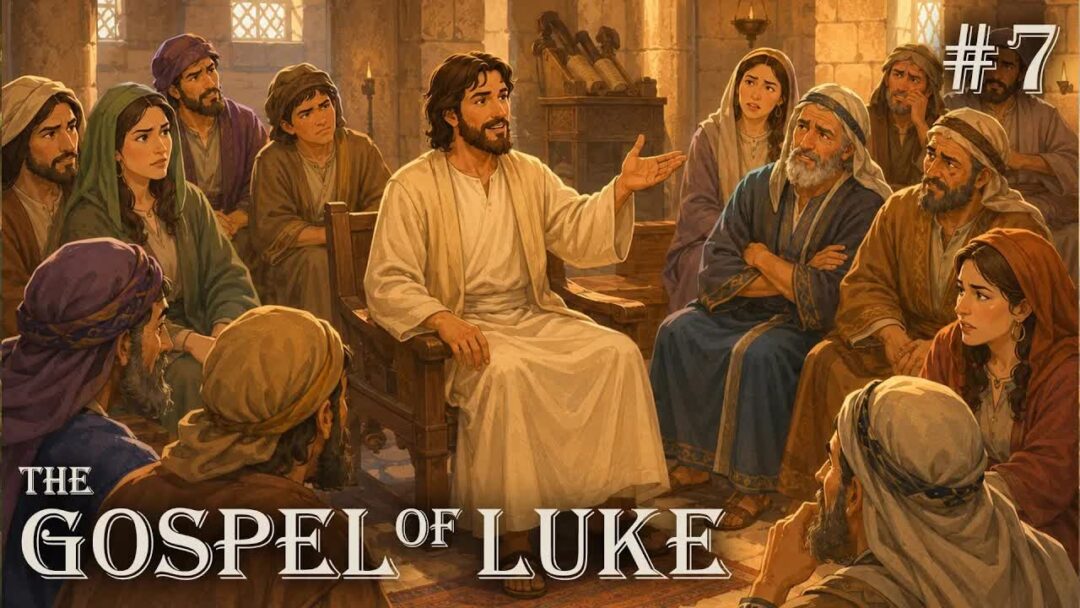
From our Sunday service on July 5, 2026, Luke 4:16-30. This is part 7 of our Gospel of Luke series. Watch the full message: A Prophet in His Country – The Gospel of Luke #7 on YouTube.
Last time, we saw Jesus tempted in the wilderness as Satan attacked him from multiple directions, targeting the lust of the flesh, the lust of the eyes, and the pride of life. Now we come to the passage where Jesus says, “No prophet is accepted in his own country.” We’re going to see Jesus reveal himself, not to crowds who have never heard of him, but to his friends and family, for the first time as the Messiah.
What Happened in Between
Luke and the other synoptic Gospels skip over a lot that the Gospel of John records between the temptation and this passage, so let me tell you what has transpired. John’s ministry didn’t end when Jesus was anointed, but it changed. Instead of getting followers to follow him, John baptized people and said, “Go follow Christ.” For the weeks, possibly months, in between, John has continued to baptize, and Jesus’ disciples are now baptizing alongside him, baptizing people into following Jesus.
During this time John says, “Behold the Lamb of God,” and two of John’s disciples leave to follow Jesus. One is Andrew. The other is left unnamed, which means it’s likely John, because John, who wrote the book, never refers to himself by name. Andrew, after leaving John to follow Jesus under John’s command, goes and tells his brother Peter that he has found the Messiah. Peter meets Jesus for the first time, but he doesn’t yet choose to follow him. Then Jesus calls Philip, who was likely also a disciple of John. Philip, so excited that the Messiah is here, tells Nathanael, and Nathanael becomes a disciple as well.
Jesus takes these four disciples, Andrew, John, Philip, and Nathanael, to the marriage at Cana, a family wedding of someone likely in his family. At that wedding we see the water turned into wine, the first miracle Jesus does. Then Jesus comes to the temple to worship and throws out the money changers for turning the temple into a place of profit, and he did miracles there. Nicodemus, hearing about Jesus and seeing him throw out the money changers, comes to Jesus by night: “What is this ministry you’re doing? How can I know the way? How can I be saved?” And Nicodemus learns about Jesus’ teaching and purpose.
At this time it is Jesus’ four disciples who are baptizing, for “Jesus himself baptized not, but his disciples.” Jesus becomes more popular than John the Baptist and is said to have baptized more converts than John. Jesus travels to Samaria, where he reveals he is the Messiah for the first time, to the woman at the well. And John the Baptist is thrown into prison for speaking out against King Herod Antipas. After all this travel, the miracles and the teaching, including miracles in Capernaum, the buzz was starting to go around about who this Jesus is. That’s the context. Jesus returns to his hometown for the first time since his ministry began, and boy is that going to be an interesting interaction.
God wants you to understand that he requires faith before he reveals his power.
As His Custom Was
And he came to Nazareth, where he had been brought up: and, as his custom was, he went into the synagogue on the sabbath day, and stood up for to read.
Luke 4:16
We aren’t told why Jesus goes to Nazareth, so it’s pretty safe to assume he’s just visiting, the way people go back to their hometown once in a while to catch up with friends and family. There’s no reason to think otherwise. But we are told something about his habit: “as his custom was.” It was Jesus’ habit to teach in the Nazareth synagogue when he was in Nazareth. So he was probably there often, and he often taught there.
An Unordained Rabbi
This tells us about Jesus’ public perception in his region. Jesus was formally recognized as a Jewish rabbi by quite a few people in the Gospel accounts. A rabbi is a formal title for a religious teacher. It quite literally means, in the Hebrew and Aramaic, “my master.” You’d call a professor “professor,” or a pastor “pastor,” because he’s a teacher of the Bible. You’d call the rabbi “my master” because he is the one who teaches about the law and the prophets and the Torah. Jesus was well recognized as someone with this title.
But we also know from the book of John that Jesus was not a legally recognized rabbi. In the first century, the temple had officially recognized rabbis. The Pharisees and the Sadducees were officially recognized teachers who had gone through the Torah school and learned from the great teachers. Paul was a Pharisee. He was taught by Gamaliel, an officially recognized rabbi of the Pharisees, and because Gamaliel was his rabbi, Paul could go into any synagogue and start teaching. He had an ordination, so to speak.
Jesus did not have an ordination from the Pharisees or the Sadducees. “Well, Zach, how do you know?” Because in John we’re told he had never been trained in biblical law. When he teaches in Jerusalem, people are amazed specifically because they know he wasn’t taught by the Jerusalem ordination council, so to speak. No religious sect had trained Jesus. He learned all this on his own, growing up in Nazareth, which barely had a synagogue. You could say Jesus was a rabbi without a degree to back it up. There was no institution behind his teaching. He was recognized locally, so he could teach in some synagogues, but he couldn’t be recognized and allowed to teach in the big synagogues of Jerusalem, because he wasn’t associated with a sect of Judaism.
The Synagogue at Nazareth
What do we know about the synagogue at Nazareth? We have allegedly excavated it, but this was hundreds of years ago, so not much is known about it. It would likely have been a very humble synagogue, which, if you don’t know, is a Jewish church. Nazareth was a city of probably 300 people at the most. It was so small that the synagogue was likely a building shared with some other purpose. They probably didn’t have the funds to build their own. If you had a big enough population, Jerusalem and the temple might help pay to build your synagogue, but not Nazareth. They wouldn’t have had official Pharisees sent to teach. This was a locally run, locally funded synagogue, and the rabbi in charge wouldn’t have been ordained at all. So Jesus teaching there wouldn’t have been a big deal. It was like your independent fundamental Baptist church versus a Catholic church that has everyone paying into it.
They would have a rectangular room with benches around the edges, and in the middle a chair with a podium in front of it. Every service started the same way, with the reading of a specific section of Scripture. Pretty much all the synagogues at this time had a very strict schedule: you went through the whole Old Testament in three years. Every time you went, there was a specific passage to read. Everyone would stand for the reading. When the reading was done, everybody sat down, including the rabbi, and he would expound and explain the Scriptures. At the end, people could chime in and ask questions. It was more of a dialogue.
Here at church you don’t just interrupt. As Paul said, you’re supposed to keep silent, because people asking questions in the middle of the service became disruptive. But in the synagogues, if somebody was stumped, they could raise their hand or interject: “Rabbi, you said that, but what about this?” We get this from the book of Ezra. That was Ezra’s teaching style, and because Ezra was so used by God, they kept that tradition in the synagogues for hundreds and hundreds of years. That’s the setting Jesus is teaching in. He can go in as an unordained but recognized rabbi and teach from that day’s selection of Scripture.
The Acceptable Year of the Lord
And there was delivered unto him the book of the prophet Esaias. And when he had opened the book, he found the place where it was written, The Spirit of the Lord is upon me, because he hath anointed me to preach the gospel to the poor; he hath sent me to heal the brokenhearted, to preach deliverance to the captives, and recovering of sight to the blind, to set at liberty them that are bruised, To preach the acceptable year of the Lord.
Luke 4:17–19
Notice the book was given to him. He did not select this reading. It was already decided before Jesus got there. As I said, the first-century synagogue had a scheduled reading. So by chance? No, by divine providence, Jesus comes to preach on the day they’re dealing with a very specific passage: Isaiah 61, a prophetic passage about the liberation of Israel from its oppressors.
This was written during the time Israel was in exile. Remember the book of Daniel? It was written around the time the people were in exile for 70 years, and there were promises about the works God would do to restore Israel. We were told by Daniel that there would be 70 weeks, 490 years after the Babylonian exile ended, before the Messiah was to appear. And then Israel would be restored after the 400 years of silence. So people were waiting for this full restoration of Israel, and when they read Isaiah 61 and heard about the acceptable year of the Lord, they had preconceived notions about it. The common interpretation at the time was that the passage referred to a soon-coming restoration in which Israel would be physically and materially given power over their enemies.
A Year of Jubilee
The “acceptable year” would clearly have been understood by the Israelites as a year of jubilee, which the law of Moses says was to be a release from all slavery and all debts. Say you went into debt for a house, or you planted a field and promised a certain share of the grain back and didn’t quite make it. You’d go into debt, and as part of that you’d become a bond servant to the person you owed. But if you hadn’t paid your way out by the year of jubilee, under the law of Moses everybody’s debts were struck clean, and they started with a clean slate. You could think of it as filing for bankruptcy. So God prophesied through Isaiah that one day the Messiah would come and liberate people from their debts and their slavery.
The people of Israel were very much anticipating this. Why? They were enslaved to Rome. They were paying crushing taxes under the Roman Empire. So they saw the year of jubilee as liberation from the Roman occupation: “This slavery to Rome will be broken, and we’ll all prosper. Those Romans who charged us money will be our slaves, and we’ll rule over them.” They celebrated the acceptable year of the Lord as a material victory.
But I’ve got bad news for the people in that synagogue. That wasn’t what Jesus was about to say. The passage wasn’t talking about an acceptable year of the Lord for physical renewal. It was about a renewal of the spirit: freedom from slavery to sin and the removal of the debt of sin through forgiveness by the blood of Jesus Christ. This passage was about the Messiah and his work, not about liberation from Rome.
This Day Is This Scripture Fulfilled
And he closed the book, and he gave it again to the minister, and sat down. And the eyes of all them that were in the synagogue were fastened on him. And he began to say unto them, This day is this scripture fulfilled in your ears. And all bare him witness, and wondered at the gracious words which proceeded out of his mouth. And they said, Is not this Joseph’s son?
Luke 4:20–22
Jesus gives the application: today this scripture is fulfilled. “Wait, hold on, Jesus. The rabbis in Jerusalem told me this is about freedom from Rome, freedom from the Greek influence on our nation. This isn’t spiritual renewal. This is physical. Our country is going to be great again. Our country is going to be powerful again. We will rule over our enemies again. But you’re telling me this passage is fulfilled? Hey, Jebodiah, do you still pay taxes to Rome? Yeah. Hey, Mary, did the Roman soldier make you carry his stuff? Yeah. Jesus, I don’t think this passage is fulfilled. I’m still forced into labor. I’m still paying taxes. My business is dying. Everything’s falling apart. This is about our nation becoming powerful again.” So the people begin to be upset.
The Words of the Messiah
But Jesus says it has been fulfilled. Why? Because Isaiah 61 is written as the literal words of the Messiah. “The Spirit of the Lord is upon me, because he hath anointed me.” The Hebrew word for anointed is the same word we use for Messiah, the anointed one. You could translate it, “The Spirit of the Lord is upon me, because he hath made me the Messiah.” This is a prophetic passage about something the Messiah is going to say. So get this, this is wild: when Jesus reads the prophetic words the Messiah is going to say, in this synagogue, he fulfills the prophecy by saying them. It’s a self-referential situation. Jesus says, “This prophecy is fulfilled in your ears because I, the Messiah, just read it.”
Now the people are getting a whole different perspective. “I’m not free. But you’re saying the Messiah just said those words? There’s been rumbling that John the Baptist said, ‘Behold the Lamb of God,’ and that you didn’t correct John when he said you were the Messiah. Jesus, are you saying what I think you’re saying? That the Spirit of the Lord is upon you? You, who grew up here, who came to our activities and hung out with us? That little boy I saw at age five trip and give himself a bloody nose? You are the Messiah? That’s blasphemy. That’s slander. And you’re telling us the rabbis in Jerusalem are wrong about what this passage means? That we’re not going to get freedom, that our nation isn’t going to be restored? You’re making this passage all about you.” That’s why they say, “Is not this Joseph’s son? Who do you think you are?”
In Mark 6:3 we’re given more of what they said.
Is not this the carpenter, the son of Mary, the brother of James, and Joses, and of Juda, and Simon? and are not his sisters here with us? And they were offended at him.
Mark 6:3
“I know your mom. I know your dad. I know your brothers and sisters. Judas and James are in the room right now. Who do you think you are to claim the title of Messiah? Who do you think you are to challenge the authorities on what our Bible says?”
What’s interesting is that, as we saw last time, the Spirit of the Lord truly was upon him. At John’s baptism the Spirit of the Lord descended on him, and the Spirit led him into the wilderness to be tested. That had already been fulfilled. And since then he had already gone and done miracles. So when Jesus says the scripture is fulfilled today, it was the truth, but the people’s hearts were not ready to hear it. Everybody there knew Jesus extremely well. He grew up there. Jesus, the Son of God, was born with human limitations, and everyone there knew those limitations very well. How could they imagine that the normal boy they had known all these years, in a community of 200 to 300 people where everybody knew everybody’s business, was the Messiah?
Physician, Heal Thyself
And he said unto them, Ye will surely say unto me this proverb, Physician, heal thyself: whatsoever we have heard done in Capernaum, do also here in thy country.
Luke 4:23
Jesus confronts them with a proverb: “Physician, heal thyself.” In other words, you shouldn’t trust a doctor who can’t heal his own sickness. If you were truly a doctor, surely you would heal yourself first to prove you’re a good doctor. Nobody wants to be a doctor’s first patient. “If you really are the Messiah, if what John said is true, if the miracles in Capernaum really happened, then surely you can do a miracle for us and prove who you are.”
Jesus adds, “whatsoever we have heard done in Capernaum, do also here in thy country.” We’ll soon realize the reason he did miracles in Capernaum is that Capernaum had faith in Jesus first, and after they had faith, he could do miracles. These people wanted it the other way around. The people who grew up with Jesus didn’t have any faith. They wanted to have faith because of what Jesus could do for them. “Prove yourself to me first, then I’ll believe. Do what I want first, God, and then I’ll trust you.” Anybody who knows God knows he does not work that way. You can’t tell Jesus, “Meet my demands and then I’ll believe in you.” You can’t speak to God that way. So Jesus’ hands are tied.
No Prophet Is Accepted in His Own Country
And he said, Verily I say unto you, No prophet is accepted in his own country. But I tell you of a truth, many widows were in Israel in the days of Elias, when the heaven was shut up three years and six months, when great famine was throughout all the land; But unto none of them was Elias sent, save unto Sarepta, a city of Sidon, unto a woman that was a widow. And many lepers were in Israel in the time of Eliseus the prophet; and none of them was cleansed, saving Naaman the Syrian.
Luke 4:24–27
Jesus rebukes them. “You don’t understand what it means to be an Israelite, what it means to be the people of God. You think ‘people of God’ is a title you’re given at birth. But the people of God are people driven by faith. Haven’t you read your Scriptures and seen how God worked outside of Israel? You think the whole Bible is just the story of Israel? You forget all the Gentiles God went out of his way to do miraculous things for.” He gives two examples from the lives of Elijah and Elisha, evidence from Scripture that they’ve missed the point. God doesn’t do miracles to build up people’s belief. He does miracles for those who already believe.
The Widow of Sarepta
In the time of Elijah, Elijah prophesied there would be no rain in Israel until God spoke again. Queen Jezebel was furious, and Ahab her husband was furious because his wife was upset, so they wanted to kill Elijah. God said, “Flee, because it’s not safe,” and Elijah fled. He was in Israel for a time, right on the border. But God says, “It’s time to move,” and he calls Elijah to a place no one would expect. We’ve talked about this before. He’s sent to Sarepta in Sidon, which is crazy, because Jezebel was from Sidon. It was only four hours from where her dad lived. Why, while he’s in hiding, is he sent to a pagan land, to enemy territory, to serve God there? That would seem insane.
The Israelites think God only cares about them. Yet Jesus says, “Look at the story of Elijah.” This is the first story that’s ever told about him, and the first thing he does is go to someone from among Israel’s enemies, God’s enemies. The Sidonians were against the worship of Yahweh. The reason there was paganism in Israel was because of Sidon. And yet God says, “I don’t care about Sidon as a country. I care that there’s a widow woman there who’s struggling and has faith in me. It’s not her nationality I care about. It’s her heart. She’s ready to see me move in her life because she has the faith. So, Elijah, leave behind all of Israel and travel days and days to Sidon, the city of your enemies. Take a turn to the west and go help this woman.” There were many in Israel struggling with the famine, but God didn’t send Elijah to any of them, because it wasn’t the nation of Israel that made them important. It was faith that touched God.
Naaman the Syrian
We see the same thing a couple of decades later in the time of Elisha. There were hundreds and hundreds of people with leprosy in Israel, but none of them was healed. Only one was: Naaman the Syrian, an Aramean military commander of a nation that was often Israel’s enemy. They had been Israel’s enemies not 10 years before, and about 5 years later they’d be Israel’s enemies again. But Naaman had a change of heart. He traveled all the way to Israel, not this time to conquer it, but to humble himself before God: “God, I need a miracle in my life. Nothing can be done if you don’t act.” He humbled himself, came to Elisha, and said, “I need healing, and I know God can do it.”
God didn’t care that he was from Aram or that he was a Syrian commander. God cared about his heart. Because Naaman’s heart had faith, he was the only one in Israel healed, despite not being an Israelite himself. He sought divine healing in faith, and he found it. What Jesus is saying to these people is, “You’ve got faith wrong. You’ve got the idea of being God’s people wrong. It’s not about being an Israelite by nationality. It’s about being a person who has faith in their God.”
Through the Midst of Them
And all they in the synagogue, when they heard these things, were filled with wrath, And rose up, and thrust him out of the city, and led him unto the brow of the hill whereon their city was built, that they might cast him down headlong. But he passing through the midst of them went his way…
Luke 4:28–30
That’s a hard thing to hear. “All they in the synagogue… were filled with wrath.” Everybody there had a bad response. I don’t think this is meant to include Mary, his mother. I think it means pretty much anybody who could have a problem with it had a problem with it. I think that includes Jesus’ brothers, because his brothers didn’t believe he was the Messiah until after the resurrection. Everyone who had known Jesus, who had grown up as his friends, family, loved ones, people he trusted and had known for decades since he was a child, suddenly turned on him.
We talk about how Jesus knows what it’s like to be human. He knows what it’s like for family and friends to betray you. In this moment those closest to Jesus decided, “Jesus, we can’t associate with you anymore. What you’ve claimed today is blasphemy. You claim to be the Messiah, the Son of God, but you won’t meet us where we are and prove it to us.” At first they were amused by his teaching. Now they’re not, because it challenged their belief and their understanding of who they were as Jews. He invoked this passage as his own words. He said God loved the Gentiles like he loved the Jews. He said faith was more important than heritage. So they rejected him because it didn’t fit what they wanted to hear.
They forced Jesus to the edge of a cliff, a cliff he had no doubt been to many times before, probably as a kid throwing rocks off it. But this time he wasn’t there to hang out with his friends. The friends he had tossed rocks off that cliff with are now standing at his side, talking about who’s going to be the one to throw Jesus over and end his life. They went there with full intention of executing Jesus, but God through his Spirit restrained them so they could not go through with it. In verse 30, “he passing through the midst of them went his way.” Though they intended to kill him, none of them could find the strength to push him over the edge, and Jesus walks straight through the middle of the crowd and away.
Can you imagine how painful that would have been, to have a crowd of loved ones calling for your death? Had God not miraculously stepped in, surely Jesus would have been thrown headfirst over the cliff. But it was not yet Christ’s time to die for our sins. He had more work to do and more people of faith to meet. But imagine the deep personal hurt that came with this.
Will You Walk First in Faith?
The people of Nazareth wanted Jesus to prove himself through tests before they would believe what he said. “Surely, Jesus, you did these miracles in Capernaum. Do them here.” Jesus says, “I did miracles in Capernaum because people already believed. They were ready to repent and believe in me, but you’re not. I can’t do anything in your life unless you first give your life to me.” They wouldn’t believe until they saw it. They had heard about the miracles and what Jesus had allegedly done in the towns nearby, but instead of receiving his words with faith, they demanded a performance before they would believe.
They wrongly thought their relationship with Jesus gave them the right to question God with demands. But their stubbornness and unbelief blinded them to the truth in front of them. They had preconceived notions about what God should do for them, and how God would bless their lives no matter what they did. The Messiah they had waited for so long was finally there, teaching in the synagogue of little old Nazareth, reading the prophetic words written about him, fulfilling the prophecy right in front of them and declaring that the promise had been fulfilled. And with something so miraculous in front of them, they still rejected him, because he did not meet their expectations in that moment. He didn’t say what they wanted to hear, and he wasn’t willing to bend to their will to get them to follow him.
Through the stories of the widow of Sarepta and Naaman the Syrian, Jesus reminded them that God’s power is reserved for those with faith, not for personal or religious heritage. Faith takes God at his word and acts on what he has said. God is revealed only to those who are willing to trust him in their moment of need. The people of Nazareth wanted a miracle before they believed, so Jesus taught them that God requires faith before he reveals his power.
So the question today is not whether Jesus has given us enough evidence to trust him. The question is whether we will believe what he has already said and done for us. We can respond like the people of Nazareth, resisting his truth because it challenges our expectations or doesn’t line up with our desires. Or we can respond like the widow and Naaman, humbly trusting him, obeying his word, and receiving the blessings that come with it.
God wants you to understand that he requires faith before he reveals his power. So will you walk first in faith today?

Recent Comments