
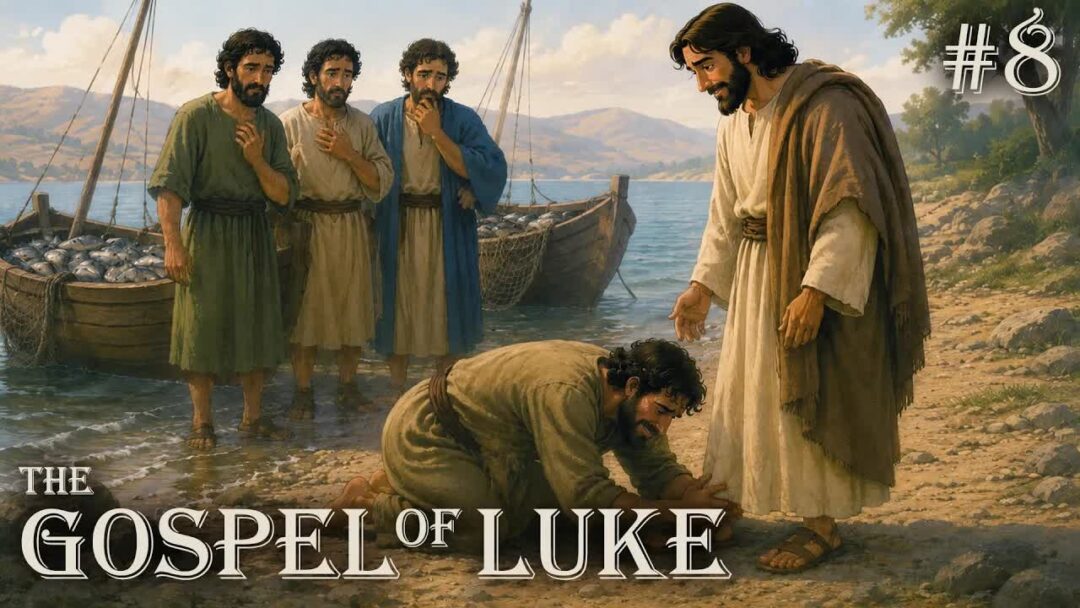
From our Sunday service on July 19, 2026, Luke 4:31-5:11. This is part 8 of our Gospel of Luke series. Watch the full message: Delayed Devotion – The Gospel of Luke #8 on YouTube.
Last time, Jesus had returned to his hometown of Nazareth, and there he revealed that he was the Messiah to those in the synagogue listening to his teaching. The reception was not very positive. They took Jesus by force, led him to a cliff, and were going to throw him over headfirst for blasphemy. From that time forward Jesus probably never set foot in his hometown again. His family and friends demanded signs from him. They demanded evidence that he was the Messiah. They didn’t take him on faith, so he could not do any works there. Now we see Jesus return to Capernaum to continue his ministry for those who would believe him without all these signs and wonders.
God wants you to know he wants you to follow his calling for your life. We don’t need to be a fan of Jesus. We need to be a follower. There is more to the Christian walk than saying, “I like Jesus.” It means everything to say, “Lord, I will follow you.”
A Word with Power
And came down to Capernaum, a city of Galilee, and taught them on the sabbath days. And they were astonished at his doctrine: for his word was with power.
Luke 4:31–32
Right off the bat we see quite a difference between his preaching in the synagogue in Nazareth and his preaching in the synagogue in Capernaum. It’s not “Who do you think you are? Why don’t you do a miracle?” Immediately the people in Capernaum are more receptive. They’re amazed, impressed, shocked: “This man speaks with power. He has authority. He seems like someone we should respect.” In Nazareth they said, “We can’t respect you. You’re that little boy who grew up in our town. We’ve known you since you were a little kid.” Here we see a juxtaposition: Jesus is a man of authority, and because people respond in faith, Jesus can do a lot more with them.
Capernaum is a city on the edge of the Sea of Galilee. It’s where Peter, Andrew, James, and John all worked as fishermen in a business they had together under Zebedee. We haven’t met Matthew yet, but he worked as the town tax collector there, and he would have collected the taxes on Peter, Andrew, James, and John’s fishing work. Wouldn’t that have been an interesting relationship between the disciples? Your former taxman is now going to hang out with you every day for the rest of your life. Jesus teaches there on the Sabbath exactly as he did in his hometown, and unlike Nazareth, the people respond positively, because he teaches with authority and they respond in faith. And we see Jesus do great things because of it.
Hold Thy Peace
And in the synagogue there was a man, which had a spirit of an unclean devil, and cried out with a loud voice, Saying, Let us alone; what have we to do with thee, thou Jesus of Nazareth? art thou come to destroy us? I know thee who thou art; the Holy One of God. And Jesus rebuked him, saying, Hold thy peace, and come out of him. And when the devil had thrown him in the midst, he came out of him, and hurt him not. And they were all amazed, and spake among themselves, saying, What a word is this! for with authority and power he commandeth the unclean spirits, and they come out.
Luke 4:33–36
In the synagogue there’s a demon-possessed man in the audience. This isn’t where you’d expect to see a demon-possessed person. This is the equivalent of church in Jewish culture. You go to church on Sunday; that’s not where you expect to see the demon-possessed man. But sure enough, there was one this Sabbath, this Saturday. When Jesus begins teaching, the demon knows exactly who Jesus is, and he’s upset about it. He doesn’t want to sit in the audience and hear what Jesus has to say. “What have we to do with thee, thou Jesus of Nazareth? Why are you here?” The demon thinks everything’s about him. “Art thou come to destroy us?” God has a time set when he will deal with the evil spirits, the demons, the fallen angels, and cast them into hell. The demon is saying, “Have you come to send us to hell? Don’t you know that time is in the future? It’s not time yet, Jesus. I know who you are.” And the demon blurts it out: you’re the Holy One of God, the Messiah, God the Son. Jesus wasn’t revealing this information yet.
So Jesus says, “Hold thy peace, and come out of him.” That is a King James-ism that literally means “Shut up and get out of him.” It’s the Greek word for close or shut. Shut it and get out of him. No wonder they think he speaks as someone with authority. This man is having a demon-possessed manic attack, panicking, acting strange, and Jesus says, “Shut it and get out of him.”
Then immediately, “when the devil had thrown him in the midst, he came out of him, and hurt him not.” The demon wants to make as big a show of it as possible, but he also knows who he’s talking to. If you know anything about how demons work, when God tells them they can or can’t do something, they have to listen. The whole reason they’re not in hell already is that they’re only allowed to do what God lets them do. The Bible speaks of angels in “everlasting chains under darkness.” Those are the ones who didn’t listen when God said, “You can’t step over this line. If you step over it, you go to hell early.” So this demon knows, “If I don’t obey when he says get out, he’ll put me in chains under darkness forever.” So he makes a big show. He makes the man fall on the floor and thrash around. But “he hurt him not.” It was scary, and it looked painful, but it was all an act, a power trip to make the demon look more powerful than he was. The demon has no power at the word of Jesus.
And the people say, “What a word is this!” “In the beginning was the Word, and the Word was with God, and the Word was God.” Jesus is the Word of God, in the Greek the divine Logos, the Word which spoke the universe into existence. If they had known what Word it was, it would have completely changed their perspective. It was the very Word that started the universe and the very Word that upholds it. When they saw the authority of God, they couldn’t help but be amazed. And yet they missed who he was.
Healing in Peter’s House
After this, Simon’s mother-in-law is sick. We know from archaeology how this would have gone. We’ve excavated Capernaum over the last 100 years. We have found the synagogue Jesus taught in, and we found Peter’s house, because they built a church on it. So we know Peter’s house was right next to the synagogue. If you remember, the book of John records that Peter met Jesus, and Jesus said, “Thou shalt be called Cephas, which is by interpretation, A stone.” He names him the rock, but Peter does not yet follow Jesus. So they have a relationship. Peter knows about Jesus and has associated with him, and he now lives in the same town as Jesus. Capernaum would be Jesus’ home base for his ministry. Peter is not just a fan who knows Jesus from a distance; he knows him personally.
And the fame of him went out into every place of the country round about. And he arose out of the synagogue, and entered into Simon’s house. And Simon’s wife’s mother was taken with a great fever; and they besought him for her.
Luke 4:37–38
Mark’s account tells us Peter, Andrew, James, and John were all there during this event, so it was likely something they had all discussed together. Peter’s house is right next to the synagogue. It’s the Sabbath day, and according to Jewish law you’re only allowed to walk so far on the Sabbath. Andrew already followed Jesus at this point. So it would have been natural for Peter and Andrew to go up to Jesus after the synagogue: “Why don’t you stay at our house for the Sabbath? It’s just two buildings down. We can spend the Sabbath together for dinner, as you do with family and friends.” What Jesus hasn’t been told yet is that in the back room of their house, Peter’s mother-in-law is very sick. She has a very high fever, and there’s a very high chance she’ll die from it. Jesus has already healed people at this point, so naturally it comes up in conversation between the four of them: “Should we ask Jesus to heal my mother-in-law? Would that be appropriate?” And when Jesus is there, “they besought him for her.” Mark also tells us that Peter and Andrew both owned this house. This is the second time in the gospel chronology of the four Gospels that we’re introduced to Peter, and boy, does he get a show.
And he stood over her, and rebuked the fever; and it left her: and immediately she arose and ministered unto them.
Luke 4:39
Here we see the authority and power of Jesus’ word. Just as Jesus told the demon, “Shut it and get out of him,” he rebukes the fever: “Shut it and get out of her.” He commands the fever to leave, and immediately it’s gone. When Jesus says the word, the problem is solved.
Exceeding Abundantly
The text wants us to realize something here. Jesus’ word doesn’t just do the bare minimum. He could have said, “Let the fever be gone,” and she could have stayed in bed a few days and recovered. That’s not what happened. “It left her.” Is that the end? No: “and immediately she arose and ministered unto them.” Jesus doesn’t just restore to normality. The Bible says he “is able to do exceeding abundantly above all that we ask or think.” They asked, “Can you heal my mother-in-law?” Jesus didn’t just heal her. He gave her energy and enthusiasm. She hops out of bed: “Guests in my home! Let me take care of you. Let me make you a meal. Let me wash your feet. Let me do anything and everything for you.” A lot of times we ask God to do the bare minimum, but God can do exceeding abundantly above that. Christ says, “I am come that they might have life, and that they might have it more abundantly.”
Peter sees this miracle. The first time Peter met Jesus, Andrew decided to follow and was officially a disciple, but Peter was not convinced. Peter doesn’t follow, but he sees the miracles. And now the miracle isn’t a distant thing. It’s in Peter’s personal life. He’s seen Jesus heal lepers and the sick, but they were strangers. Now Jesus has done something in his very home, with his very family. You’d think Peter would stop being on the edge and become a follower, a disciple, devoted to him. But Peter doesn’t. Once again, he takes the blessing and does nothing with it.
Fans but Few Followers
Now when the sun was setting, all they that had any sick with divers diseases brought them unto him; and he laid his hands on every one of them, and healed them. And devils also came out of many, crying out, and saying, Thou art Christ the Son of God. And he rebuking them suffered them not to speak: for they knew that he was Christ.
Luke 4:40–41
Notice in verse 40, “when the sun was setting.” Clearly the Sabbath wasn’t as relaxing a dinner as Peter was anticipating. When his mother-in-law was healed, word spread very quickly, and by the time the Sabbath day was coming to an end at sunset, there was a whole group of people outside the building. They brought their sick, their diseased, and their possessed: “Heal, heal, heal, just like you did for Peter’s mother-in-law.” Everybody is excited about Jesus, except Peter. He’s still not devoted. These people came on their day of rest to seek restoration from Jesus, and Jesus casts out the demons, who cry, “Thou art Christ the Son of God.” Peter sees all of this in his home, and yet he hasn’t devoted himself to Christ. But Jesus’ power is still revealed.
And when it was day, he departed and went into a desert place: and the people sought him, and came unto him, and stayed him, that he should not depart from them. And he said unto them, I must preach the kingdom of God to other cities also: for therefore am I sent. And he preached in the synagogues of Galilee.
Luke 4:42–44
It gets to be too much commotion in Peter’s house. “Andrew, Peter, James, John, I’m sorry, but I’ve got to go. My ministry isn’t just for Capernaum, where I live. I’ve got to go through all the regions and tell everybody the kingdom of God is at hand.” Remember, at this point he doesn’t have all the disciples. He’s only got four that we know for sure are following, and he can’t send them out to teach yet. So Jesus says, “I’m the only one. I’ve got to teach in other cities.” So he leaves. Peter stays home and keeps doing his job. Jesus has quite the fan base at this point. People want to see him and hear his teaching. They’re big fans, yet there are very few followers. We’re not told how long he’s gone, but he makes his circuit through the synagogues for a couple of Sabbath days, and eventually he ends up back where Peter, Andrew, James, and John are working.
At Thy Word
And it came to pass, that, as the people pressed upon him to hear the word of God, he stood by the lake of Gennesaret, And saw two ships standing by the lake: but the fishermen were gone out of them, and were washing their nets. And he entered into one of the ships, which was Simon’s, and prayed him that he would thrust out a little from the land. And he sat down, and taught the people out of the ship.
Luke 5:1–3
As I said, Capernaum became the command center of Jesus’ ministry. He didn’t have a place to lay his head, but he would probably often stay at Andrew and Peter’s house. One day, as he’s returning, the crowds follow him back to Capernaum. When you’re a public speaker with a crowd and no microphones, you need a good way to talk to the whole audience. So he walks by the sea and sees familiar faces: Simon Peter, Andrew, James, and his brother John. “I know them. They’re friends. I’ve been to their house. I’ll ask to use their boat, so I can pull out on the water, and my voice can carry over the water to this large audience spread across the shoreline.”
All four of them have this business together. They’re all fishermen by trade, they all work with Zebedee, and they’re all here at this moment. When we meet them, the work had already been done. The boat was docked, and the nets were already being washed. This was not a convenient time to stop. They had already fished a full day’s work, which means the sun was probably already beginning to set. They’d worked their eight hours, so to speak, and probably more. They’re tired and exhausted, probably cleaning those nets thinking about what’s waiting at home. We know Peter was married. His wife was probably at home preparing a nice warm meal. I’m sure Andrew, who lived with Peter, was excited to see what she had cooked. They didn’t want to delay going home. How many of you wives like it when your husband is late coming home after you’ve prepared a meal? People today are the same as they were 2,000 years ago when it comes to that kind of thing.
Simon, knowing Jesus, goes along with it. That’s not too much: “I can take my boat out. I can finish cleaning my nets later. I’ll be late home to my wife for dinner, but she’ll get over it when she knows it’s about Jesus. Everybody in Capernaum knows you. Not a big deal.” So Jesus sits down, as was the tradition of their day, and teaches while sitting in the boat, speaking over the water. But then Jesus doesn’t just ask for a little thing. He asks for a big thing.
Now when he had left speaking, he said unto Simon, Launch out into the deep, and let down your nets for a draught. And Simon answering said unto him, Master, we have toiled all the night, and have taken nothing: nevertheless at thy word I will let down the net.
Luke 5:4–5
Here Jesus is going to do something not for the crowds, but for Andrew, Peter, James, and John. They call themselves followers or fans of Jesus, but up to this point they haven’t really followed him. Every day they weren’t with Jesus. They were in that boat trying to make a day’s wage. They considered their jobs more important than following the Messiah. Jesus knows exactly the lesson he wants to teach these four young men about what it means to be his follower.
So he stops speaking and looks at Simon: “Launch out into the deep, and let down your nets.” Peter had to be furious at this point, because the way he reacts shows his attitude. He calls him master, but he doesn’t treat him like a master. “Master, we have toiled all the night! We stayed late for however long this sermon went.” We don’t know; I’d expect it was probably an hour. “We’ve already half washed the nets. We caught nothing, Jesus, nothing. I just want to wash my nets and go home.” But he says, “Nevertheless,” ignoring all this, “at thy word,” because it’s you, Jesus, “I will let down the net.” Jesus wasn’t just asking him to wait. He was asking him to do another chore. That mending and washing of the nets took a lot of time. When you drag a net, it catches on branches in the water and rips and tears. It’s tedious to re-tie all the torn ropes, and tedious to wash and dry them properly so they don’t mold and decay. “Oh my goodness, this is so much work, but whatever, Jesus. I’ll do it anyway.”
The Catch of a Lifetime
And when they had this done, they inclosed a great multitude of fishes: and their net brake. And they beckoned unto their partners, which were in the other ship, that they should come and help them. And they came, and filled both the ships, so that they began to sink.
Luke 5:6–7
What seemed pointless and impossible to Peter a couple of seconds ago became the catch of a lifetime. Andrew and Peter catch so many fish they literally cannot pull the net out of the water themselves. Since they have a business with James and John, they gesture to James and John, who are mending their nets further up, to grab their boat and come over. James and John hadn’t caught anything that day either. None of them had made a cent on all their hard work. James and John come over, struggling to get all the fish in, and the fish are so heavy that they’re borderline sinking their boats. These boats weren’t huge, but they were big enough that sinking them with fish was quite an impressive thing to do.
Jesus performs this miracle in front of and for those who would probably be considered his closest friends at the time: Peter, Andrew, James, and John. They’re all associated with Jesus, but not yet devoted to him. They were still fishermen by trade, not disciples. In this one miracle Jesus shows them the futility of their commitment to their vocation. God had called them to follow, and they stayed back: “I need to trust in my job, Jesus. I can’t follow you. I need to take care of myself.” But that whole time, Jesus had made it so their efforts brought them nothing. Their efforts were fruitless and futile.
Now Jesus wants to show them a truth. “What you think you need to rely on is not what you need to rely on. In a second I can give you everything you need if you commit to me. That job you think is going to provide for you, the job you’re using as an excuse not to follow me, I can fix that in a second. The problems you think you’d have if you committed to what I’ve called you to do, I can wave them away.” In so many unspoken words, Jesus says, “All the effort you put in is pointless without me. The excuses you make don’t matter when I’m involved. ‘The LORD gave, and the LORD hath taken away; blessed be the name of the LORD.’ Have you not read the words of Job? Do you think staying in your comfort zone will bring you more blessings than being with me? Do you realize that in a moment I can take away all the blessings you think you need to stay for? And if you leave, I can give you all the blessings I want to? These excuses are nothing compared to my word.” The lesson was clear: stop waiting on the edge of faith and obedience. Trust me, forsake it, and follow me.
They Forsook All
When Simon Peter saw it, he fell down at Jesus’ knees, saying, Depart from me; for I am a sinful man, O Lord. For he was astonished, and all that were with him, at the draught of the fishes which they had taken: And so was also James, and John, the sons of Zebedee, which were partners with Simon. And Jesus said unto Simon, Fear not; from henceforth thou shalt catch men. And when they had brought their ships to land, they forsook all, and followed him.
Luke 5:8–11
This miracle was not for the audience at the sermon. It was for Peter, Andrew, James, and John, because though they said they followed Jesus, they really didn’t. They hadn’t let go of the things holding them down. If you put the Gospel accounts in chronological order, he says to all of them, “Follow me,” and they all follow. But another Gospel records that afterward someone else came to Jesus. Jesus said, “Follow me,” too, but he said, “I can’t leave these things behind.” In a little while Jesus is going to get on that boat and go to the other side of the sea, and those disciples are going to take the same boat they had just filled with fish and go with Jesus, leaving everything behind, and follow him all the way to the cross and beyond.
The way it’s worded, it’s not even clear whether they took the fish and sold them. If you put it in chronological order, right after this they go on the sea in the storm, Jesus is asleep, and they wake him up: “Don’t you care that we perish?” That story involves a boat. Where did the boat come from? It’s probably the same boat that was just full of fish. They probably dumped the boat and went with Jesus, because they realized the fish don’t matter anymore. The job doesn’t matter anymore. “If I do what Jesus wants me to do, all those things will be taken care of. I don’t need to worry about money, because if I follow Jesus, he can just say, ‘Cast here,’ and I have all the fish I need for all the money I need.” God owns “the cattle upon a thousand hills,” and if he wants to, he can sell off a few to take care of my needs.
But that one man on the shoreline saw these four disciples forsake all and follow Jesus. He said, “I want to.” Jesus said, “Then leave everything behind.” He said, “I can’t.” So when they go across the sea, he’s left alone on the shore. The question for us today is, which are we going to be? Are we going to be the four who got slapped in the face by Jesus, “Wake up. You call yourself devoted to me, but you’re not,” and who wake up and say, “I’m going to leave all that behind and follow you”? Or are we going to be the one who says, “I can’t. I’ve got stuff to do back home”?
Who You Were Doesn’t Matter
When Peter sees this miracle, he is the first to admit his sin. He’s immediately filled with regret. He reluctantly agreed to follow Jesus’ instructions and cast the nets, and he may have put a little attitude in the way he said it. He was no stranger to Jesus. He’d met Jesus the day after John the Baptist declared, “Behold the Lamb of God.” Jesus had a conversation with him and gave him a new name, Cephas, a stone. He had seen Jesus heal and do miracles. Jesus had been in his home just a few weeks before and healed his mother-in-law. He called Jesus master, but he didn’t treat him as one or follow him as one. Knowing all the wrong he had done to Jesus, Peter admits his sin: “Leave me, because my sin makes me unworthy of your use.”
And Jesus says, “Fear not,” because who Peter was before is about to become irrelevant. From this time forward Peter would follow Jesus and bring people to the kingdom of heaven. “From henceforth thou shalt catch men.” From now on your purpose is changed. Who you were before doesn’t matter, because when you decide to go all out for Jesus, what matters isn’t your past. What matters is your future and what he’s going to be able to do with you. “Leave it behind. Your old job’s gone. Follow me.” And they forsook everything and followed him. Andrew, James, and John also, for the first time, abandon everything they held onto in their family business and fully pursue following Christ.
Don’t Live on the Edge of Devotion
Jesus shows us the example of who we are to be like. Jesus never allowed the rejection of his family, his popularity, his inconveniences, or the demands of others to distract him from the work the Father had sent him to do. He preached with authority, healed the sick, delivered those in bondage, and then moved on to other cities, because he understood his calling and would not allow anyone to delay it.
On the other hand, we see regular people more like us. Peter, Andrew, James, and John struggled to accept their calling. They’d already heard Jesus teach and seen his miraculous power. They had all the evidence that Jesus was who he said he was and that he could take care of their problems. But their lack of faith kept them anchored to their comfortable lives. Andrew and John had already received specific calls to follow, recorded in the book of John. Although they followed from a distance as fans of the Messiah, they were far from a full commitment to their invitation to follow. Peter was even less convinced. He stayed at arm’s length from Jesus the whole time. Although Jesus spoke to him one-on-one and healed his mother-in-law, Peter still questioned Christ and his ability.
However, Jesus showed all of them at once that everything they were trusting in could fail at any moment. Through the miraculous catch, he showed that he could provide more for them than they could ever accomplish on their own. Their consciences immediately connected the dots. The lesson was clear: don’t live on the edge of devotion. Commit to me fully and trust me to do the rest. So when they brought their ships to shore, they left everything behind and immediately followed him. In the same way, God has given each of us a purpose, and we cannot allow fear, comfort, disappointment, or the expectations of others to keep us from obeying what God has called us to do.
God wants you to follow his calling for your life. So stop waiting on the edge of obedience. Trust in Christ, let go of whatever is holding you back, and follow him wherever he leads.

Recent Comments