
From our Sunday service on July 26, 2026, Luke 5:12-39. This is part 9 of our Gospel of Luke series. Watch the full message: A New Thing – The Gospel of Luke #9 on YouTube.
I love it when these happy, super clear, practical lessons just pop out of the pages of Scripture. Last time, we left off where Jesus called Peter, Andrew, James, and John to forsake everything and follow after him. All of them knew Jesus. All of them were in Capernaum, where Jesus was doing his ministry. All of them heard him preach, and all of them were fans. But they hadn’t yet forsaken everything they were holding on to in pursuit of Christ. Then we saw them abandon their fishing career and the comfort of all those things that provided for them, as Jesus showed the miraculous catch of fish.
Remember Peter, who had met Christ not once, not twice, but three times already, and who doubted that Jesus could provide. He toiled all the night trying to catch fish and caught nothing, and he got nippy with Jesus when Jesus asked him to go back out in his boat and cast his nets after he’d already mended and washed them. When he pulls out the net, it’s full of fishes, and he realizes, “I didn’t follow Jesus because I thought I needed to provide for myself, but if I’m with Jesus and where he wants me to be, I will have everything I need.” He falls down and says, “Depart from me; for I am a sinful man, O Lord.” But Jesus doesn’t say, “Get out of here, Peter.” He says, “Get up and follow me.” And that’s what the four of them do.
Luke records it later, in chapter 8, but after that they take Peter’s fishing boat, and now it’s a missions vessel. They go across the Sea of Galilee, and as they pass over, a storm comes up while Jesus is asleep in the boat. The boat begins to sink, they panic, and they wake Jesus: “Jesus, don’t you care about us?” Jesus probably says something along the lines of, “Were you not just there a few minutes ago with the miraculous catch of fish?” He stands up and says, “Peace, be still,” and the storm stops, showing once again that he can provide for those who follow him and trust in him. Today Jesus continues his travels as he gets to the other side of the sea and keeps preaching to the cities in the region around Galilee.
God wants you to know he wants to do a new thing in your life. Today we’ll look at four new things Jesus does in this passage.
A New Hope
First of all, we see a new hope, as Jesus gives hope to a man who had none.
And it came to pass, when he was in a certain city, behold a man full of leprosy: who seeing Jesus fell on his face, and besought him, saying, Lord, if thou wilt, thou canst make me clean.
Luke 5:12
Here we’re introduced to the first of our four situations, a leprous man who approaches Jesus. What is leprosy? In the Bible, leprosy refers to any kind of serious skin disease that leaves a person permanently disfigured. Those diagnosed with it were often separated from their normal communities and religious life to prevent contamination, because they were considered unclean under the law, and some of the diseases they had could in fact be spread. There are multiple forms of leprosy, but probably the most famous form we know today is Hansen’s disease, where the fingers would eventually shrivel up and fall off. Any form of leprosy was horrible, mostly because in Jewish culture, with the purity laws, anybody who had a skin disease had to be taken out of the camp so as not to spread it to everybody else. They were put in their own communities with all the sick and diseased, and that was their life.
Surely this man had no hope. His community had shunned him. His disease limited him, and he only knew a life with no cure, no future, and no hope. But somehow, some way, during his time in exile from his city, he heard that Jesus had healed others who were sick, and they were miraculously cured. So he begins to search out Jesus. He knew that if he met Jesus, Jesus could take that hopeless situation and turn it into one with hope once more. He comes to Jesus with his last hope: “All I can do is present my faith to him and hope he will do the rest.”
“Lord, if thou wilt, thou canst make me clean.” Another way you could translate that is, “Lord, I know that if you want to, you can cleanse me from my leprosy.” The first thing he does is demonstrate his faith. So the question isn’t whether Jesus can heal him. His question is, “Jesus, do you want to heal me? Do you care about my situation? Do you care about the difficulty and the hopelessness I face?”
And he put forth his hand, and touched him, saying, I will: be thou clean. And immediately the leprosy departed from him.
Luke 5:13
Jesus simply responds, “I will: be thou clean.” The leprous man’s question wasn’t, “Lord, can you do something in my life?” but, “Lord, do you want to?” And Jesus says, “I do. I do want to.” Let me tell you, in your life today, God does want to give you hope. God does want to get you out of your hopeless situations and give you a new hope. Immediately, when Jesus says, “I will,” the leprosy went away. In those two sentences Jesus transformed that man’s entire life, and from that point forward he had a hope for the future like no one else had.
And he charged him to tell no man: but go, and shew thyself to the priest, and offer for thy cleansing, according as Moses commanded, for a testimony unto them.
Luke 5:14
Jesus tells him to do two things. One, keep what was done a secret, so Jesus could continue his ministry unrestrained and uninterrupted. Two, show that he was healed and go through the law’s purification rituals, to show the religious leaders what the Messiah was here to do. “Don’t start spreading this around. I need to preach. I need to teach. I need to go to all the cities. If everybody comes to me, I’ll have to leave the city, because I won’t be able to teach anymore. It’ll be too disruptive. What I do want is for you to go into Jerusalem, show yourself to the priest, show him that the Messiah has healed you, and let it be a testimony of who I am.”
There’s something for us today. God wants to give you a new hope, and for what purpose? As a testimony of his goodness. If you allow Christ to give you a new hope, he will allow you to be used for his glory.
But so much the more went there a fame abroad of him: and great multitudes came together to hear, and to be healed by him of their infirmities. And he withdrew himself into the wilderness, and prayed.
Luke 5:15–16
Unfortunately, we’re told by the other Gospels that the man didn’t keep it a secret like he was supposed to. He didn’t obey. God didn’t punish him for it. God didn’t bring back his leprosy. He understood that man makes mistakes. The man was so excited that he told more people than he was supposed to, and so Jesus has to withdraw from that community and can no longer serve there. But if Jesus can give hope to a hopeless leper, then he definitely can give you hope today.
A New Forgiveness
Next we see a new forgiveness, as Jesus provides forgiveness not long after that.
And it came to pass on a certain day, as he was teaching, that there were Pharisees and doctors of the law sitting by, which were come out of every town of Galilee, and Judaea, and Jerusalem: and the power of the Lord was present to heal them.
Luke 5:17
The fame of Jesus from healing this leprous man starts to spread. We’re told in Mark that already at this point the scribes did show up, the very people the leper was supposed to tell about Jesus. So although the leper failed to keep it a secret, he did accomplish his mission of getting the religious leaders to take notice. Clearly the man went to them and told them what happened, because the next time we see Jesus teaching, the scribes, the Pharisees, and the teachers of the law all show up to hear him, because they want to know what this miracle worker is saying. This country preacher has now gotten the notice of the city teachers. And “the power of the Lord was present to heal them.” It was once again time for Jesus to do a miracle.
And, behold, men brought in a bed a man which was taken with a palsy: and they sought means to bring him in, and to lay him before him. And when they could not find by what way they might bring him in because of the multitude, they went upon the housetop, and let him down through the tiling with his couch into the midst before Jesus.
Luke 5:18–19
“Taken with a palsy”: that’s paralysis. This paralyzed man was a loved man. He had four friends who saw him in his condition, and when they heard Jesus could provide healing, they said, “Our paralyzed friend is never going to get there on his own. He wants to be healed by Jesus. Let’s pick up his bed and carry him all those miles to find Jesus.” Carrying a paralyzed man that far is not an easy task. But these people loved their friend so deeply they didn’t care how much effort it took. They’d carry this man miles and miles to meet Jesus.
But when they get there, they’re a little disappointed. Carrying a man is not a very fast thing. By the time they arrive, the crowds have already surrounded the building, and there’s no way to carry a man on a mat through the crowd. So they come up with another plan. They look at how the buildings are lined up: “That building connects there and there, and Jesus is in that building, and it has a clay tile roof. If we can carry him up on top, hop over a few buildings, and tear off the terracotta tiles, we can lower him in through the ceiling.” I don’t know what the paralyzed man thought about this. He might have been a little nervous: “What if you drop me? Will Jesus be mad? What about the person who owns the house? Are they going to like that we’re dismantling their roof?” But his friends didn’t care. “Our friend needs Jesus. We’re going to get him there.” Somehow, some way, they pull it off. As Jesus is preaching, right down the middle comes a paralyzed man.
And when he saw their faith, he said unto him, Man, thy sins are forgiven thee.
Luke 5:20
Hold up. What were we expecting Jesus to do? “Jesus, the man’s paralyzed. We brought him here to be cured of his paralysis, not to have his sins forgiven.” But that’s what this section is about. Jesus provides a new kind of forgiveness that you can’t get anywhere else. He doesn’t say, “I heal your paralysis.” He says, “Your sins are forgiven.” As Ephesians 2:8 tells us, “For by grace are ye saved through faith.” He saw the man’s faith, and since faith is saving, he told the man, “Your sins are forgiven,” because he believed in Jesus and believed Jesus was who he said he was. The man didn’t even have to ask Jesus to forgive his sins. Jesus knew his heart. It’s not the words we say that make us saved; it’s the faith we have inside of us. The second part of Ephesians 2:8 says, “and that not of yourselves: it is the gift of God.” So the man didn’t have to ask. Jesus saw his faith, handed him the gift, and said, “Your sins are forgiven.” The man receives it as an unrequested gift, giving us an early example of how salvation works today.
And the scribes and the Pharisees began to reason, saying, Who is this which speaketh blasphemies? Who can forgive sins, but God alone?
Luke 5:21
Naturally, the religious leaders are furious. This man is offensive to them. He claims to be able to forgive sins, but according to their teachings it’s pretty clear only God can forgive sins. A man can’t do that. So they recognize that this preacher claims to be God. He claims to be able to do the works of God, so this must be blasphemy. They came to the conclusion, “This man must be claiming to be God.” And guess what? Jesus was.
But when Jesus perceived their thoughts, he answering said unto them, What reason ye in your hearts? Whether is easier, to say, Thy sins be forgiven thee; or to say, Rise up and walk? But that ye may know that the Son of man hath power upon earth to forgive sins, (he said unto the sick of the palsy,) I say unto thee, Arise, and take up thy couch, and go into thine house. And immediately he rose up before them, and took up that whereon he lay, and departed to his own house, glorifying God. And they were all amazed, and they glorified God, and were filled with fear, saying, We have seen strange things to day.
Luke 5:22–26
Jesus knows the Pharisees’ hearts. He knows the hardness of their hearts, and he knows they’re not going to listen to him: “Anybody can say sins are forgiven, but can you prove it?” Before they have a chance to confront him, he says, “What are you thinking? It’s really easy for me to just say your sins are forgiven. It’s easy to claim it. But what’s not easy is to tell this paralyzed man to get up, pick up his bed, and go home. Because you doubt me, because you don’t have faith and this man does, I’ve already forgiven his sins. But for your faith, I’m going to prove to you that I do have the power to forgive sins.” So he looks at the man and says, “Arise, and take up thy couch, and go into thine house.” Instantly, just like the leper, the man is healed. He gets up and walks out, and the people are amazed. If he says he can forgive sins, he’s now backed it up. This is not a normal person. “We have seen strange things to day.” Another way you could translate that is extraordinary things. This preacher is not your ordinary preacher. None of the prophets could forgive sins. None of the teachers of the law could forgive sins. But this one, the Messiah, could. And if Jesus could forgive a paralyzed man’s sins, he can forgive yours too.
A New Calling
Next we see a new calling, as Jesus gives a new purpose to one who follows him.
And after these things he went forth, and saw a publican, named Levi, sitting at the receipt of custom: and he said unto him, Follow me. And he left all, rose up, and followed him.
Luke 5:27–28
We know that Levi lived in Capernaum, where Jesus did his ministry, so this tax collector was no stranger to Jesus. In fact, it’s almost 100% likely that this was Peter, Andrew, James, and John’s personal tax collector, probably their least favorite person in all of Capernaum, because he took a huge chunk of their profits and gave it to the oppressive Roman Empire. I’m sure, as with most publicans of the day, he took money for himself over and above the tax rate, because in this day and age tax corruption was so widespread that pretty much everyone did it.
Jesus walks by this tax booth, sees Matthew, also known as Levi (he goes by two names), and says, “Follow me.” What’s crazy is that, unlike Andrew, Peter, James, and John, there’s no long dialogue between them. They haven’t really talked. It’s just the tax man. But the tax man knows about Jesus and has heard what’s going on, and when he hears “Follow me,” he abandons his post for the Roman Empire and follows Jesus. You don’t abandon your post for the Roman Empire. That’s a really bad idea. But Matthew didn’t worry about that: “If I follow Jesus, everything else will be taken care of.” And sure enough, it was. How do we know? He wrote the book of Matthew. It must have worked out, because he lived long enough to write an entire book of the Bible. He forsakes everything and follows Jesus just like the others, and I’m sure the other disciples weren’t too enthusiastic about it.
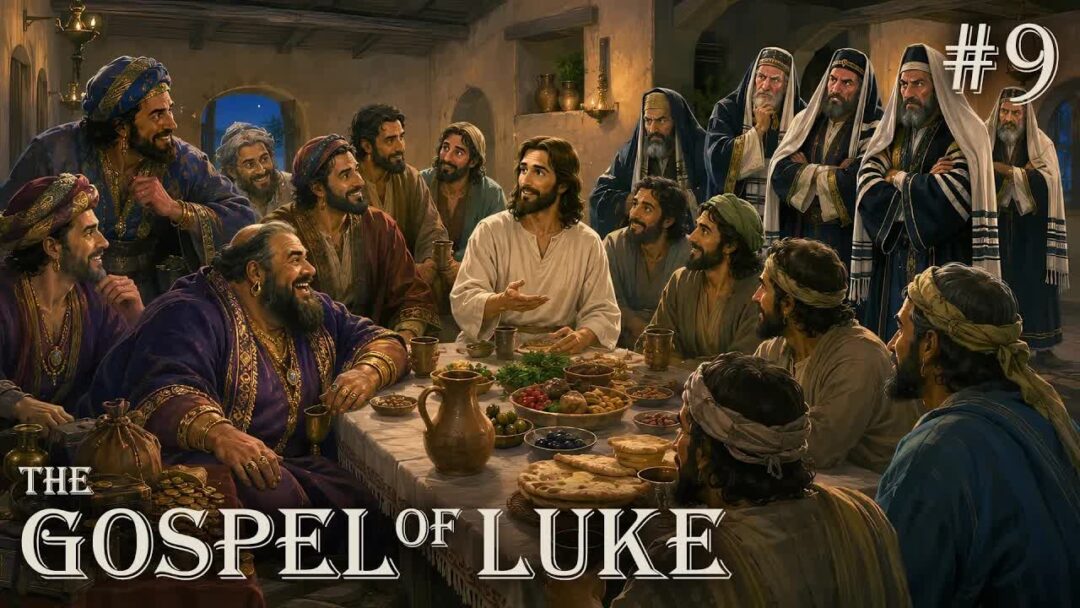
And Levi made him a great feast in his own house: and there was a great company of publicans and of others that sat down with them. But their scribes and Pharisees murmured against his disciples, saying, Why do ye eat and drink with publicans and sinners? And Jesus answering said unto them, They that are whole need not a physician; but they that are sick. I came not to call the righteous, but sinners to repentance.
Luke 5:29–32
The scribes and Pharisees become very uncomfortable, because after Matthew decides to follow Jesus, he decides he needs to have his tax-collecting friends meet Jesus as well. Clearly Matthew sees a new purpose for his life, and he wants others to share in it. So he calls up all the Roman tax collectors he can find: “We’re having dinner at my house. Come meet this Jesus I’m following now.” And because the religious leaders think they belong at every religious event, they’re also invited. Surprisingly, they actually show up. You’d think with them being tax collectors, these Pharisees and scribes would stay far away, because the religious leaders are on one side of the spectrum, “We want to follow God, we want independence for our nation,” and the tax collectors are on the other, “We’re going to steal from you and support the Roman Empire.” These are basically mortal enemies. And because Jesus ministers to all groups, we find these two enemies sitting side by side at Matthew’s table.
Of course, they start to complain: “What would make you come to Matthew’s house and sit down with a bunch of no-good, thieving, lying tax collectors who work for our enemies?” Jesus says, “They that are whole need not a physician; but they that are sick.” He says, “Ministers, you’re missing the point of ministry. Ministry isn’t about helping those who are already righteous, who already have their lives together. It’s about helping those who have nothing together, who need to change their lives. You don’t go to the districts where the most need is. You go to the places where it’s easiest. The people who are healthy don’t need to see a doctor. It’s those who are sick. But you say, ‘Unclean, unclean. You can’t come to my doctor’s office, because you’re sick and I don’t want to get sick.'”
“I came not to call the righteous.” They’re already at the table. “I came to invite the sinners who are far away.” People like Matthew, whom the disciples walked by every day and would never have expected to do anything for God, let alone write a book of the Bible. But Jesus saw his potential: “Although others may throw you aside, although others may say you have no purpose for God, I can take you and do something with you. So follow me.” If Jesus could take a sinful, thieving tax collector and use him for God’s glory, then Jesus can use your life as well.
A New Relationship
Now we see a new relationship, as Jesus redefines what it means to have a relationship with God.
And they said unto him, Why do the disciples of John fast often, and make prayers, and likewise the disciples of the Pharisees; but thine eat and drink? And he said unto them, Can ye make the children of the bridechamber fast, while the bridegroom is with them? But the days will come, when the bridegroom shall be taken away from them, and then shall they fast in those days.
Luke 5:33–35
This is still the Pharisees. They didn’t like the one answer, so they try another question to trip him up. “We’ve stated one grievance, so we might as well list off a few more. We Pharisees fast and pray often. This is part of who we are as a people. Even John the Baptist, and we’re on the edge about him, some of us like him and some don’t, but even John the Baptist taught that you need to fast and pray. Since you’ve called your disciples, none of them fast, none of them pray. You called Matthew, and instead of telling him to fast and pray, you’re at his house eating dinner. The Bible talks about fasting and praying and why it’s good. Why don’t you emphasize something so important?”
Jesus, as he often does, answers their question with another question and with an illustration: “Can the wedding guests fast while the groom is with them?” The obvious answer is no, because it would be offensive. You can’t fast while it’s time to celebrate the person of honor. When you’re at someone’s wedding, it’s not the time to say, “I’m on a specific diet. I’m not eating. I’m not going to participate in anything.” People would be offended that you didn’t participate in their celebration.
What were people praying and fasting for? For the last 400 years they had been praying and fasting for the Messiah to arrive, for the Anointed One who would save Israel to come. Well, it happened. He had arrived. He was sitting at the table with them. Their fasting and prayers had been answered. So Jesus says it’s not time to fast. Now is the time of celebration. What you fasted and prayed for has come, and it’s time to enjoy it. But there will be a time when I am gone, and then it will be time to fast and pray again as we wait for the Messiah to return a second time and take us to be with him.
Once again he teaches the importance of a new relationship. The way things used to be is different. God isn’t distant anymore. We don’t have to fast and pray all the time to get God’s attention. At that moment Jesus was right there with them. They could just go talk to him. The leper didn’t have to fast and pray for healing. He could go to Jesus and say, “Jesus, I believe in you. Heal me.” And now we have the Holy Spirit. We can still fast and pray, but we have direct access to God at any time.
New Wine, New Bottles
And he spake also a parable unto them; No man putteth a piece of a new garment upon an old; if otherwise, then both the new maketh a rent, and the piece that was taken out of the new agreeth not with the old. And no man putteth new wine into old bottles; else the new wine will burst the bottles, and be spilled, and the bottles shall perish. But new wine must be put into new bottles; and both are preserved.
Luke 5:36–38
Jesus wants to make something everybody can understand, so he uses two illustrations. First, patching a hole in an old piece of clothing. If you mix old and new fabric, when you wash it, they stretch and shrink at different rates. Put a new patch on an old garment, and eventually it just keeps ripping and tearing again. They’re incompatible. You can’t make the old and the new go together.
Second, new wine and old bottles. Here he’s rebuking the Pharisees, who are offended by these new things Jesus was doing. The Pharisees should have known about these new things, because the Bible had prophesied about them in Ezekiel and Jeremiah, and specifically Isaiah:
Behold, the former things are come to pass, and new things do I declare…
Isaiah 42:9
Behold, I will do a new thing; now it shall spring forth; shall ye not know it?…
Isaiah 43:19
So these people should have known a new thing was coming. Jesus is referring to Isaiah, Jeremiah, and Ezekiel talking about the new thing God wanted to do in Israel. “You don’t understand. The Old Testament law had a purpose.” The Bible tells us “the law was our schoolmaster to bring us unto Christ,” our teacher, to show us we’re not perfect people, and because we’re not perfect, we need somebody to save us. “That was the old thing. I’ve come to do the new thing prophesied hundreds of years ago. And you’re trying to take the old system that was supposed to teach you that you need me, patch it, and make it work. Those two things are not compatible.”
In the second part, Jesus compares this to fermenting wine in leather bottles. Each time you fermented wine, you needed a fresh bottle of new leather. There was no plastic back then, and no glassmaking that could serve the same purpose the way wine is made today. Leather was the only material useful enough. But as leather gets older, it gets tougher and less flexible. They used wine very often to purify drinks. You couldn’t drink water out of the well; it would be dirty. So you’d pour some fermented wine into your water to kill off the microbes. If you’re going to make wine, you need a new bottle, because it’s flexible and stretches. Put it in an old bottle, and when it ferments, the bottle won’t stretch. It will pop like a balloon when the pressure gets too high.
You’re trying to put the new into an old framework, but the old framework can’t hold the new. It’s going to burst at the seams, because both frameworks can’t work at the same time. If you want the new wine, you need a new container. Otherwise the old leather and the new wine will both be lost. Put fresh new wine into fresh new bottles, and the fresh leather can expand, and you’ll get a successful fermentation without losing either the wine or the bottle.
So he says, you need to change your perspective. Jesus has a new way for us. When he died on the cross, he paved the way with direct access to the Father. There are still people today clinging to the old ways: “Maybe if I’m just good enough, I can get into heaven. Maybe if I do enough good works and they outweigh my bad, I can get into heaven.” But Jesus has a new way. If you try to use the old frameworks, your system’s going to pop like a balloon. You’re not going to make it to heaven on your own actions. You can only make it to heaven through God’s actions, through Jesus Christ and his death on the cross. You need to surrender to his ways and understand there’s nothing we can do to get into heaven except have faith, like the leper and the paralyzed man, in the Messiah and the work he completed on the cross. If Jesus can transform the old ways for the people of the Old Testament, then Jesus can transform your old ways as well.
The Old Is Better?
But there is one thing we need to realize: it is hard to desire change. Jesus concludes this segment with this thought.
No man also having drunk old wine straightway desireth new: for he saith, The old is better.
Luke 5:39
In our lives, our old ways are our sinful past: living for ourselves, living for our own gratification. The new way Jesus calls us to is surrendering to him for his righteousness, to become like Jesus, love like Jesus, and serve like Jesus. “I’m here to do a new thing.” But just as new wine goes into a new bottle, sometimes the new things you have to do are a big change from the status quo. The challenge is that no one likes change. How many of you love change? They’re talking about getting rid of the time change. How much do you like it when the time changes? It’s a mess. How many of you like having to start a new job or move to a new house? It’s always inconvenient to experience change.
Jesus compares this to a man who is given fruit juice after being given alcoholic wine first. The truth is that no one who is intentionally drinking alcoholic wine is going to be happy when you swap out their wine for juice, because they’re drinking it for the specific purpose of consuming the alcohol. Swap it for fresh juice when they’re not looking, and they’ll say, “Why did you do that?” They’re not going to like it. Jesus uses this as an illustration because one of the two is clearly better than the other. The wine is alcoholic. It’s a poison by nature. What they used it for was to kill off microbes so their water was safe to drink. We know today from scientific research that alcohol kills your brain cells, raises the risk of several types of cancer, harms your liver, and of course reduces your inhibition and makes you do things you might not otherwise do. Wine has side effects because it quite literally contains a little bit of poison. The alcohol may be more indulgent, more physically pleasing, and maybe the bubbliness is nice and satisfying, but that doesn’t change the fact that it’s a poison.
So when he swaps out the old for the new, he gives us something better. The alcohol is a poison, while the juice gives you all the same nutrient and caloric benefits of the wine without the poison. In so many words he says to the Pharisees, “Those old ways you’re clinging to are a poison to you. Thinking your works are worth something is a poison to you. You’re trying to get the nutritional benefits the wrong way.” If you try to consume all your calories through alcohol, I’ve got bad news for you. It’s not going to be a good time. You’ll be vomiting, sick, ill, and getting diseases left and right. You can’t use poison to get what you need. You have to go to the healthy source. And Jesus is saying, “I am the healthy source. I am the new way. Come to me, and I will give you health. I will heal you. I will give you righteousness. I will transform you and give you what you need.”
This is the challenge. Our old ways are hard to let go of because they feel good, but they are a poison to us. We have to stop indulging in the poison and embrace something new and good for our lives. The Pharisees struggled to fit Jesus into their old framework, and the truth is we cannot fit Jesus into our old frameworks either. We have to fit our frameworks around Jesus instead.
He Makes All Things New
The question is not whether Jesus can change your life. The question is whether you are willing to let him. Jesus did not come merely to improve a few parts of our lives, but, as we saw today, to make all things new. He gives us a new hope when we feel hopeless, a new forgiveness when our past weighs us down, a new calling that gives our lives purpose, and a new relationship with God that changes the way we live. But all of that requires us to be willing to leave the old behind.
Maybe today you need a new hope. Maybe you need to receive his forgiveness. Maybe God is calling you to something, but you’ve been resisting. Or maybe your relationship with him has become shaped more by habit than by truly following Christ. Whatever it is, do not cling to the old simply because it is familiar. Let Jesus reshape your life around him.
God wants to do a new thing in your life. So, will you allow him to do something new in your life today?

Recent Comments