
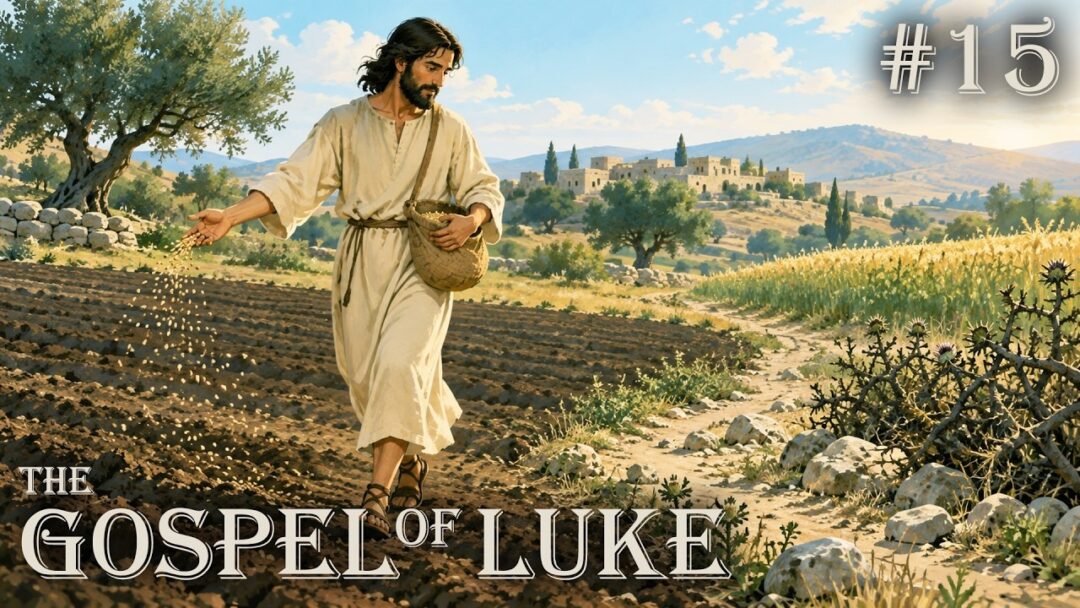
From our Sunday service on September 13, 2026, Luke 8:1-21. This is part 15 of our Gospel of Luke series. Watch the full message: Fruitful Followers – The Gospel of Luke #15 on YouTube.
In our last lesson in this series, we saw a sinful woman turn to Christ for the first time, and we compared her faith with the Pharisee’s faithlessness. We saw what it truly means to be repentant and what it truly looks like to give God everything. Today we’re going to continue to develop the topic of true faith as we see Jesus preach on the topic of fruitful followers. From our time in Scripture today:
God wants you to know that true believers will forsake everything to follow Christ and his teachings.
Women Who Forsook Everything
To do a little review, we left off last time with new followers following Jesus. We saw some women follow Christ. Let’s read that passage again, because while it connects with the last passage, it also connects with today’s.
And it came to pass afterward, that he went throughout every city and village, preaching and shewing the glad tidings of the kingdom of God: and the twelve were with him, And certain women, which had been healed of evil spirits and infirmities, Mary called Magdalene, out of whom went seven devils, And Joanna the wife of Chuza Herod’s steward, and Susanna, and many others, which ministered unto him of their substance.
Luke 8:1–3
We were introduced to these three women as examples of faith: how they were given a new life in Christ and followed him completely. Mary Magdalene had the demons cast out, and she followed Jesus throughout his ministry and was with him along the way everywhere. Joanna was the wife of Chuza. Her husband worked under Herod, and she risked everything to serve Jesus while the man who killed Jesus’ cousin was her husband’s boss. She forsook everything and followed Christ. We also see Susanna, whom we don’t know much about, but we’re told she ministered to Jesus of her substance. She took the things that were to be a blessing for her and said, “I don’t want to enjoy this wealth for myself. I’m going to give it to Christ.”
Luke purposefully places their stories as an introduction to this passage to give us an example of what it really looks like to follow Jesus. It means leaving the old behind and forsaking everything in pursuit of something better. Today we’re going to see Jesus talk about that topic.
The Parable of the Sower
First we’re going to see the parable of the sower. We talked about this in our parables series not too long ago, so I don’t want anybody zoning out. We have more time to dig into it today than we did before.
And when much people were gathered together, and were come to him out of every city, he spake by a parable: A sower went out to sow his seed: and as he sowed, some fell by the way side; and it was trodden down, and the fowls of the air devoured it. And some fell upon a rock; and as soon as it was sprung up, it withered away, because it lacked moisture. And some fell among thorns; and the thorns sprang up with it, and choked it. And other fell on good ground, and sprang up, and bare fruit an hundredfold. And when he had said these things, he cried, He that hath ears to hear, let him hear.
Luke 8:4–8
“By the wayside” means by the roadside. Here we’re introduced to Jesus’ latest parable, his most famous one of all, the parable of the sower. This parable specifically deals with the topics of faith, salvation, and the kingdom of God, and because of its foundational importance, it is included in all three of the Synoptic Gospels: Matthew, Mark, and Luke. Jesus himself says it is foundational to understanding all of his teachings. In Mark 4:13 Jesus says, “Know ye not this parable? and how then will ye know all parables?” If you can’t understand this parable, then you can’t understand the other ones either. So let’s make sure today that we understand what the parable of the sower is all about.
Why Parables?
We see in verses 9 and 10 that his disciples didn’t understand the parable.
And his disciples asked him, saying, What might this parable be? And he said, Unto you it is given to know the mysteries of the kingdom of God: but to others in parables; that seeing they might not see, and hearing they might not understand.
Luke 8:9–10
Right off the bat, the disciples didn’t get it. They didn’t get the analogy being made here. “What might this parable be about? Jesus, that went right over our heads. Would you mind explaining?” And Jesus says, “I understand that this is going to happen. I’m preaching this way on purpose.” Prophecies in the Old Testament said that Israel would be blinded to Jesus’ teaching. It was required by the Old Testament prophecies that some of Israel would be spiritually blind and only a minority of the Israelites would turn to Jesus. Why? Because Israel needed to turn on Jesus to crucify him. So Jesus spoke in parables so that only the hearts that were ready to follow him would understand. Those who didn’t give Jesus the time of day wouldn’t think about it long enough to understand what the parable meant. So Jesus says to them, “Unto you it is given to know the mysteries of the kingdom of God,” and to others it is not.
The word “mystery” in the King James is different from our word “mystery” today. In the older language, a mystery was not something undiscovered, but something that was a secret and has now been revealed. Think of Scooby-Doo when you think of mysteries. You’ve got the Mystery Machine, and in Scooby-Doo the mystery isn’t during the episode. The mystery is the end of the episode, where they reveal what was secret. So when you see the word “mystery” in your Bible, understand that it’s not talking about something secret. It’s talking about something that was secret and no longer is. Jesus says, “I told that parable as a secret, but for you, it is given to know the mystery, the explanation of what was unknown before.”
The Seed Is the Word of God
So Jesus begins to explain the parable to them, starting in verse 11.
Now the parable is this: The seed is the word of God.
Luke 8:11
The first thing explained is that the seed is God’s word. We need to understand there are two different ways you can understand “the word of God.” “In the beginning was the Word, and the Word was God”: that refers to Jesus as the Word of God. But we also have the Bible, God’s written word. So we have to ask which one this is referring to. Is the word of God here Jesus, or is it the Scriptures? In this passage, the word of God is not referring to Jesus himself but to his teachings. How do we know that? Because we are told later that the sower is the Son of man, and the Son of man is a title for Jesus. So the seed is distinct from Jesus. The seed is not the Word of God, Jesus. The seed is the word of God, the truth of Scripture. And the sower who plants the seed is Jesus, the first person who ever preached the true gospel to the world.
The Wayside
Continuing in verse 12, Jesus continues his explanation.
Those by the way side are they that hear; then cometh the devil, and taketh away the word out of their hearts, lest they should believe and be saved.
Luke 8:12
What Jesus is preaching here is a parable that is unfolding in real time. Jesus goes city to city preaching the gospel of the kingdom: it’s time to repent, because the kingdom of heaven is at hand. Turn from your sin, come to me, and you will find salvation. As he preaches that gospel, he is sowing the seed of the word of God. He is the one preaching the word to them, and the question is, what are you going to do with that word? Jesus says, “He that hath ears to hear, let him hear,” and we’ll talk in a bit about what that means. So this parable asks, “What are you going to do with the teachings Jesus gives you?”
The first example is those whose word falls by the roadside. When we talk about sowing the word, we’re talking about planting it into soil, and the soil here represents the heart of the person. If a person’s heart is receptive to the word, they are ready to receive the word and understand what it means, and the parables don’t go over their heads. If their heart is ready to receive the word, then that seed will take root and grow. But if it’s not, the seed is going to be taken away before it can grow.
The first heart we see is one that’s not doing so well. The seeds that fell by the roadside are those who listen to Jesus’ teachings but have stubborn and hard hearts. Soon after they hear Jesus’ teachings, the devil comes and distracts them again, and they never give themselves time to believe Jesus’ teaching. As a result, they are never saved. These seeds never had a chance to even take root.
When you think of a roadside today, you’re thinking of asphalt, and of course seed doesn’t take root there. But in the old days most roads were dirt that was just trampled down. So here the heart is still dirt. It’s not asphalt. It’s just been trampled down by walking. Maybe the world wore you down. Maybe the world made your perspective negative, and there’s no hope left. So when the word of God came, that heart was so trampled down and negative that it couldn’t even take the time to care about the word of God. Because that heart wasn’t receptive and there was no protection for the teachings of Christ, the devil comes with his next scheme, and that thought about Jesus is gone just as fast as it hit the ground. Because these people didn’t take time to consider Jesus’ teachings, unfortunately, they miss out on heaven.
The Rock
They on the rock are they, which, when they hear, receive the word with joy; and these have no root, which for a while believe, and in time of temptation fall away.
Luke 8:13
The seed that falls on the rock is those who listen to Jesus’ teachings and love what they hear. There were plenty of people in Israel following Jesus around who weren’t his disciples. Jesus was the hot new preacher in town. He’s touring, and everybody’s hearing about him. A lot of people got excited about Jesus. A lot of people said, “I love what Jesus has to say. I’ve been to five of his sermons. Do you know I was at the Sermon on the Mount? I was there. Were you there? No? You should have been there.” They were fans. They loved Jesus’ teaching, and they would tell everybody about it. They received the word with joy. They loved what Jesus said, but it was a surface-level love. It says they had no root. They were interested in Jesus’ words and excited about them, but it didn’t last long. They had no lasting investment in it. It was just an outward excitement about Jesus and his teachings, and their heart, that soil, had no real interest in sustaining what he had to say.
They do truly believe it a bit, but when people begin to question them about their new understanding, they are ashamed of it. Now they have to choose between following Christ and protecting their reputation, and they choose their reputation and fall away. Their faith was only outward. It never reached their heart and changed them. So they too were never saved.
Believing and Acting
It says they believed for a while. How can you say that? Isn’t salvation just belief in Christ? Well, the Bible says even the demons believe and tremble. Belief can go two different ways. There’s “I believe in something,” and there’s belief that acts.
The illustration I always use for saving faith is always the same, and it’s simple. Say you’ve got insider knowledge that Apple has a big presentation coming, and they’re going to release the best product they’ve ever made. You go around and tell everyone in your friends and family group, “There’s an Apple conference coming. I’ve got insider information, and they’re going to release a product that’s going to revolutionize the world. You need to go buy stock in Apple.” You tell and you tell and you tell. You’re excited about it, and you believe it. Then you get a bonus for $1,000, and they say, “You got a bonus for $1,000! Are you going to go buy Apple stock?” And you say, “No.” What would someone say? “Why not? You told me to go buy Apple stock because it’s going to change the world and make the stock skyrocket, but you’re not going to invest in it?” Do you really believe that Apple stock is going to skyrocket if you won’t put your money on it when you can? No, you don’t believe. You’re interested in the rise of Apple stock. But if you truly believed that stock was going to go up, you would have invested in it. You would have put your money where your mouth is.
Faith in Jesus is the same way. If you truly believe in Jesus, you’re going to invest in his teachings. You’re going to let his teachings take root in your life. You’re going to allow his teachings to change you. They’re not just going to be words you like. “I love the idea of loving my neighbor.” Guess what? Atheists love the idea of loving their neighbor. They’ll tell you that’s great. The question is, do you love your neighbor? Not, do you think it’s a good idea? Have you invested in what Jesus taught? Have you allowed it to take root in your life? Faith isn’t saying you believe something. Faith is acting on what you believe. You can’t say you believe something if you don’t act on it.
So Jesus says they are like this: they on the rock are they which, when they hear, receive the word with joy, and these have no root, which for a while believe, and in time of temptation fall away. At a certain point they have to decide, “Do I really believe these things?” Jesus says to forgive the man who betrays you, love your enemies, and when your enemy smites you, turn the other cheek. Finally the testing day comes. A man has gone to 17 of Jesus’ sermons, and somebody smites him on the cheek. In his culture, the thing to do is to strike back and save your reputation. He sits there and thinks, “I’ve been to 17 of Jesus’ sermons,” and then he strikes back. Did he believe it? No. He only followed for the cultural joy of following Jesus. When it came down to it, he didn’t truly believe the things Jesus taught.
The Thorns
Continuing in verse 14, we see another group.
And that which fell among thorns are they, which, when they have heard, go forth, and are choked with cares and riches and pleasures of this life, and bring no fruit to perfection.
Luke 8:14
The seed that falls on thorny ground is those who listen to Jesus’ teachings, but they’re distracted by the cares of this world. That literally means they get too busy with all the responsibilities they have. Let me tell you, filing your taxes is a care of this world. It’s the things you have to do. Sometimes we think the cares of this world means they fell in love with the world. No, that’s not what it’s saying; that’s the second half. The cares of this world are just the things you have to do every day. I’ve got to file my taxes. I’ve got to go to the grocery store. I’ve got to take the kids to school. I need to look up this new law for my business. Every single day, I’ve got to get up in the morning and get my coffee. The cares of this world are limitless. So these people sat down for Jesus’ teaching. They sat at the Sermon on the Mount, and then they got back to their day. “I’ve got to pay the Roman taxes. I’ll think about what Jesus said later.” And eventually, later never comes.
It says they were choked with cares and riches and pleasures of this life. So they have the cares of this world, but they also want the pleasures of this life. That’s usually what we ascribe to the cares of this world: they pursued riches and comfort. They said, “My life would be a lot easier if my business got further along. If I had more security in my bank account, then I could care about Jesus. Right now, what’s really important is that I get further ahead, and once I’m ahead, then I’ll stop and consider what Jesus said.” The people came to the message, and the seed was planted, but they were just too busy to give Jesus’ teaching the time of day. They said, “I’m just too busy right now. When I reach that next goal, then I’ll think about what I want from Jesus. Then I’ll think about whether I want Jesus’ words to actually change me.”
Unfortunately, the truth is that when you act that way, you’ll never find the time for Jesus, and you’ll never make a decision on whether that’s what you really want. In the end they’ll never complete their journey with Christ. They’ll have the gospel, but they’ll do nothing with it. And in the end they too are never saved. Boy, that’s depressing. But the good news is you don’t have to be that person.
The Good Ground
But that on the good ground are they, which in an honest and good heart, having heard the word, keep it, and bring forth fruit with patience.
Luke 8:15
The seed that falls on the good ground is those who listen to Jesus’ teaching and have a heart ready to do something with it. Rather than just hearing what Jesus says, they believe it, they do it, and they live their lives by it. It says they produce good works, and they produce more seeds of the gospel for others to take, since they truly believe and their actions show their belief. They are the ones who are truly saved.
Notice that those on the good ground are those with an honest and good heart. You have to be honest with yourself to accept the gospel. You have to be honest about who you are, because the gospel is not something people want to hear. The gospel is: I am depraved. I am sinful. I am less than, and I need Jesus. I need help because I’m not good enough. I’m not righteous enough. I fall short of God’s standard. So we have to have soil that is honest and good and ready to do something with Christ’s teaching.
It says that those with an honest and good heart hear the word and keep it. “Keep” means to protect. That’s the word you would use for somebody who guards a door. They don’t just listen to Jesus’ teaching once. After the sermon is over, they take it and hold on to it. They hold it close and protect it. They say, “I am going to live by this. This is valuable and worth preserving.” And with that protected in their heart, it says they bring forth fruit with patience. In other words, they produce good works through endurance. The other people liked the words Jesus said. They were fans of Jesus, but they didn’t really believe it. They didn’t endure. When we talk about enduring in faith, this is what we mean: not just having an amusement with Christ, but being willing to really take it in, to hold it as something valuable, and to endure in that belief.
Those who are saved are not those who simply hear what Jesus has to say and approve of it. In fact, the seed that fell on the rock loved Jesus’ teachings and believed they were true. But when it came time to follow Jesus and his teaching by changing their lifestyle, they chose acceptance with their peers over salvation and lost everything.
The Treasure and the Pearl
This is further emphasized in Matthew 13, in a section not included in Luke’s Gospel. Jesus gives another parable there for his disciples, in Matthew 13:44.
Again, the kingdom of heaven is like unto treasure hid in a field; the which when a man hath found, he hideth, and for joy thereof goeth and selleth all that he hath, and buyeth that field.
Matthew 13:44
Here we’re given another example of what it looks like to truly follow Christ. Jesus compares it to finding a treasure trove buried in a field. This was not an uncommon occurrence in that day and age, because during the various wars the Jews faced, many of those who lived outside the city walls would bury their entire life’s wealth underground to protect it from oncoming invaders. Sometimes those who buried it died in the war, or maybe they forgot where it was buried. That whole family’s wealth would be left buried in that field, sometimes for centuries, before being discovered. Before the time of Christ there was a Jewish-Roman war and a Jewish-Greek war, and as they besieged Jerusalem, families just dug holes and buried everything they owned. The truth was, most of them didn’t dig it back up, because the slaughter was so severe. It was actually so commonplace that they had created a law stating that those who owned the ground had rightful claim to any treasure buried in it.
In this parable, a man was working in a field, and he found a treasure store from one of these wars. The entire wealth of a family’s whole life was under his feet. What do you do when you have that opportunity? He’s working in the field. He can’t claim it just because he found it. He has to buy the field, and then every piece of treasure in that field belongs to him. So the natural thing is, you buy the field. But he’s just a worker. So he sells his house. He sells his donkeys. He sells his sheep. He sells his extra clothes. He sells everything he has, and he buys the field. Why? Because the field had something better. Everything he owned was worth less than that treasure in the field. If he wanted something worth more, he had to give up something in pursuit of it. He sold off everything he had from his whole old life. Every item he’d ever bought, everything he’d ever owned, everything he’d ever held dear, he left behind, because something better was waiting for him in the field. In the same way, a true believer forsakes everything in his old life in order to follow Christ and his teachings.
Then we see another parable, in verse 45.
Again, the kingdom of heaven is like unto a merchant man, seeking goodly pearls: Who, when he had found one pearl of great price, went and sold all that he had, and bought it.
Matthew 13:45–46
This example would be one more familiar to a Greek audience. At the time of Jesus’ ministry, pearls were among the most valued items on the planet. They could be worth upwards of hundreds of thousands of days’ wages, because diving for them without diving gear was extremely dangerous and time-consuming. Loss of life was very common in the industry. This parable puts us in the shoes of someone at a market who sees one of these pearls being sold way below its value. It’s one of those high-quality pearls that sells for hundreds of thousands of days’ wages. If he can buy this pearl, he will never have to work another day in his life.
So once again, what do you do when you’re given such an opportunity? It’s like the man with the Apple stock: “If I buy this stock today, I will never work another day in my life.” What do you do? You sell everything. You sell your house. You sell your clothes. You sell your car. Everything is sold, and you buy the item of value. Why? Because if you leave everything behind, you’ll gain more than you ever had. In the same way, the true believer forsakes everything in order to follow Christ and his teachings.
And let me remind you again that when you have Christ, you have rest. This man never having to work another day in his life is also a picture of the rest Christ gives us. Sure, you could try working your entire life, but you’ll never find rest, not until you’ve sold everything and taken Christ on faith.
Take Heed How Ye Hear
Back in Luke, we see the importance of a response in verses 16 through 18.
No man, when he hath lighted a candle, covereth it with a vessel, or putteth it under a bed; but setteth it on a candlestick, that they which enter in may see the light. For nothing is secret, that shall not be made manifest; neither any thing hid, that shall not be known and come abroad. Take heed therefore how ye hear: for whosoever hath, to him shall be given; and whosoever hath not, from him shall be taken even that which he seemeth to have.
Luke 8:16–18
Jesus presents himself here as having lit a candle for the disciples. He has illuminated them, so to speak, with the knowledge of this parable. And he says you don’t light a candle to hide it: “Disciples, a lot of people didn’t understand this teaching, but I want you to explain it to them.” That’s why Matthew, Mark, and Luke all have this parable, because Jesus specifically told them they needed to illuminate the world about it. He says, “You have been told this meaning so that you too can tell it to others,” so the meaning of this parable can spread to those who need to hear it. “When you light a candle, you don’t put it under a bed or cover it with a vessel. I didn’t light this candle to hide it. I lit it to give light to the world, to teach them a truth.”
Jesus reiterates in verse 17, “For nothing is secret, that shall not be made manifest.” He’s saying, “These teachings are only hidden for a time, just to fulfill that prophecy so that the crucifixion can happen. But when I am gone and I’ve fulfilled the prophecies, go and tell the world the meanings of these parables. The world will need to respond.”
Verse 18 gives us a final challenge: “Take heed therefore how ye hear.” Be careful how you listen and respond to Jesus’ teachings. That’s what the parable of the sower was all about: hearing Jesus teach and responding to his teachings. “Whosoever hath,” or another way you could translate it, whoever keeps hold of Jesus’ teachings, will be given more. Just like those in the parables who sold everything for something better: they gave up everything to pursue and take hold of the pearl of great price, to take hold of the hidden treasure. And when they held it, they were given more. However, those who do not hold on to Jesus’ teachings will in the end lose everything, or as verse 18 says, “from him shall be taken even that which he seemeth to have.”
He tells the disciples, “You need to understand what’s going on today. I’ve illuminated you on a truth. What you do with my teachings means everything.” If you listen to them, give a thumbs up, and walk away, it’s not enough. You have to believe. And I don’t mean believe as in say you believe. I mean truly believe what the word of God says. Does that mean you’ll never make a mistake? No. Does that mean you’ll never slip up? No. But it means you’re surely going to act on the teachings Jesus taught. You’re truly going to pursue Christ and what he taught. You’re not going to argue with the Bible. You’re not going to argue with the word of God. The word of God has been planted, and you say, “This is the word. I’m going to believe it. I’m going to follow it. It’s going to be my guidebook. I’m going to follow Jesus. I’m going to take up my cross. Where he goes, I go. And what he says, I don’t just say, but I do. Because I know that if I do what he says, I will plant seed in the world, the gospel will spread, the word of God will increase, and this world will become better for him, and the next infinitely better.” What is Jesus saying? Be on the right side of this story.
Ears to Hear
He already said it earlier in this chapter, and in Mark 4:23 he concludes this section by saying, “If any man have ears to hear, let him hear.” Another way you could translate that in more modern words is, “If any man has ears to listen, let him listen.” Why “listen”? Because “listen” has two meanings. It can mean I’m listening to the teacher. Or, if I was told to do something by the teacher and didn’t obey, they could say, “Why didn’t you listen to me?” as in, why didn’t you obey what I said? So Jesus concludes with this famous line, “If anyone has ears to listen, let him listen,” using a play on the two meanings of the word. He’s saying simply: if anyone is able to listen to these teachings, then let him also obey them.
It’s not enough to just say you believe. You need to act on what you say you believe. If somebody has ears to hear, let them hear. If you’re able to listen, then go obey. Do them. But if not, I’ve got bad news. If you don’t care about what Jesus says, if you don’t agree with what Jesus says, then how can you say you believe in him? Our belief is always backed up by our acting faith.
My Mother and My Brethren
Jesus gives another illustration of what a true follower is in verses 19 through 21, in a somewhat obscure way, as Jesus’ mother and his brothers appear.
Then came to him his mother and his brethren, and could not come at him for the press. And it was told him by certain which said, Thy mother and thy brethren stand without, desiring to see thee. And he answered and said unto them, My mother and my brethren are these which hear the word of God, and do it.
Luke 8:19–21
A lot of times we read this and think it’s so weird. Why did Jesus ignore his family here? Why did he kind of disown his mother and his brothers in this moment? It’s because he wants to reiterate one final time what his parable is all about, what the parable of the sower is actually teaching. He says, “My family isn’t about ties genetically. If you want to be a part of the family of God, this is what you need to do: you need to hear the word of God and do it.” It’s simple. That’s what faith is. Faith is believing something so much that it changes how you live your life.
What Will You Do with What You Have Heard?
As we close, the question each of us must answer is this: what will you do with what you have heard? We can understand Jesus’ teachings and agree with every single word he says, but true faith responds with action. It trusts him enough to follow him even when obedience costs us something great. What are you holding on to that keeps you from following Christ wholeheartedly? Is it the approval of others? Is it your comfort? Your own plans for the future, your own goals? Whatever it is, I would urge you to consider whether it is worth more than the Savior who calls you to himself.
The man who found the treasure surrendered everything with joy, because he understood the value of what he had found. When we see Jesus Christ that way, surrender becomes a natural response to his precious worth. We do not earn salvation through our obedience, but our obedience does reveal whether or not we trust the one who saves us. So respond to what he has taught you with obedience. Trust him with whatever things you are afraid to surrender, because there’s nothing we can hold on to that is worth more than belonging to him.
God wants you to know that true believers will forsake everything to follow Christ and his teachings. So, will you forsake everything and follow Christ’s teachings today?

Recent Comments