
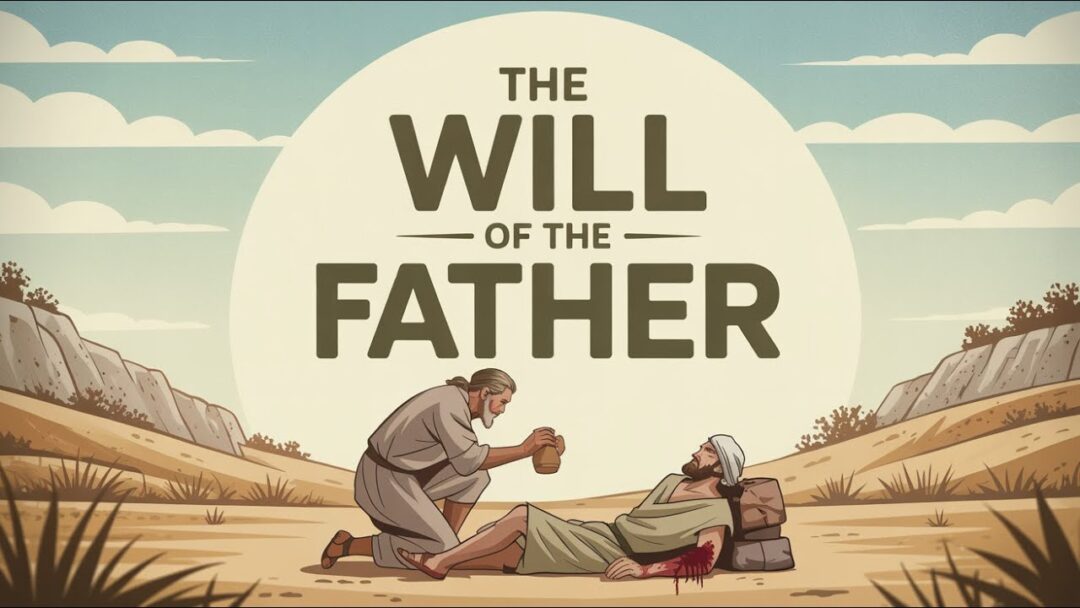
From our Sunday service on October 5, 2025, Luke 5, Matthew 22, Luke 10 and Matthew 21. This is part 8 of our Parables of Christ series. Watch the full message: The Will of the Father – The Parables of Christ #8 on YouTube.
Last week we talked about how Jesus is the only way to new life. That’s important, because it’s where our journey of faith and our walk on the path of life begins. But if that’s where our journey ends, we’ve missed out on a huge part of what the Christian life is all about. So today, as we continue our series on the parables of Christ, we’re talking about what we do with this new life and what God wants us to do when we become saved.
God wants you to serve him.
New Wine, Old Wineskins
Before we go on, I want to go over one parable very quickly. In Luke 5, a Pharisee asks Jesus why his disciples don’t fast like John the Baptist’s disciples. Jesus explains that fasting wasn’t fitting while he, the bridegroom, was present with them. The time for fasting and worship would come later, after he was taken away and his new kingdom era began. Then Jesus gives a parable.
And he spake also a parable unto them; No man putteth a piece of a new garment upon an old; if otherwise, then both the new maketh a rent, and the piece that was taken out of the new agreeth not with the old. And no man putteth new wine into old bottles; else the new wine will burst the bottles, and be spilled, and the bottles shall perish. But new wine must be put into new bottles; and both are preserved. No man also having drunk old wine straightway desireth new: for he saith, The old is better.
Luke 5:36–39
Jesus is answering why his disciples don’t fast, and the answer is that something new is coming, and you don’t mix the new with the old. Putting new cloth on an old garment doesn’t work. When you wash it, the new cloth shrinks and the old doesn’t, so the old material rips away even more, and the garment you tried to fix ends up more destroyed than it was. Mixing salvation with the law of the Old Testament would not work. The salvation Christ offers is not a patch on the old religious system, the old works-based law. It is something completely different that must stand on its own.
He also says you can’t put new wine in old wineskins, or you ruin both. Wine ferments when it’s stored, and over months it turns into alcohol. Wineskins were literally animal stomachs, and as the wine fermented, they would expand. Once they were stretched out and used, they couldn’t be used again. Put new wine in an old skin that has already expanded and dried out, and when the new wine expands, the old skin bursts. You lose the skin you could have used to store water, and you lose the wine. New life in the Spirit cannot be contained by the rigid structure of the law. The law was too rigid for the gospel, and it had to be fully replaced with something new.
Then in verse 39 Jesus says another truth: “No man also having drunk old wine straightway desireth new: for he saith, The old is better.” What he is bringing is better than what came before, even though people might not like it at first. Imagine a man at a restaurant who has been drinking glass after glass of wine, and suddenly the waiter fills his glass with grape juice. Is he going to be happy? No. “I ordered wine. You gave me juice.” Jesus says the new life he offers is going to be like that. People are used to thinking of a works-based salvation, an old, rigid system. Although that system was poisonous to them, they’re going to desire it rather than the new life that is fresh, renewing and healthy. What Jesus offers isn’t going to seem natural to desire when we’re used to consuming poison. We’re used to indulgent, self-pleasing things, but what Jesus offers us is better, even though it’s harder to accept.
Whose Image Is on You?
Our first passage is in Matthew 22. This technically isn’t a parable. It’s an illustration, but I think it fits in the same category and helps us with our topic of Christian living. The context in verses 16 and 17:
And they sent out unto him their disciples with the Herodians, saying, Master, we know that thou art true, and teachest the way of God in truth, neither carest thou for any man: for thou regardest not the person of men. Tell us therefore, What thinkest thou? Is it lawful to give tribute unto Caesar, or not?
Matthew 22:16–17
Here we meet the Herodians, a group we don’t usually see. They’re a political group, not a religious one. They want to trick Jesus in his words, and they want him to endorse Roman rule through taxes. They want to poison his ministry with political opinion so it divides his following. The Herodians believed that Roman rule should be carried out through the family line of Herod the Tetrarch, and they thought the comforts Rome gave were better than the freedom Israel had under its old system. They saw Jesus as a threat to Roman rule.
So they ask: is it lawful to pay the tribute tax to Caesar or not? It’s a controversial question meant to discredit him. If Jesus says yes, people will think he endorses Roman rule, and he angers all the Jews loyal to the old system. If he says no, he opposes Rome and becomes a political enemy of theirs, and the crucifixion would have come much sooner. What does Jesus do? He doesn’t give a yes or no. He gives an illustration. Verses 18 to 21.
But Jesus perceived their wickedness, and said, Why tempt ye me, ye hypocrites? Shew me the tribute money. And they brought unto him a penny. And he saith unto them, Whose is this image and superscription? They say unto him, Caesar’s. Then saith he unto them, Render therefore unto Caesar the things which are Caesar’s; and unto God the things that are God’s.
Matthew 22:18–21
He has them pull out a Roman coin. On it is a picture of the emperor who minted it, with whatever slogan he wanted written around the outside. “Whose image is this? Whose name is on it?” “Caesar’s.” So if the coin has his face on it and he made it, the coin belongs to him. Give back to Caesar what belongs to Caesar, and give back to God what belongs to God.
A lot of times we miss the second half of this lesson. We go to it for taxes and tithing and go on our way. Of course, if you use the dollar, whose buildings and presidents are on it? America’s. So pay your taxes to America. But that’s not the main point. Jesus also says, “Give back to God what belongs to God.” What belongs to God? What is God’s image? Genesis 1:27:
So God created man in his own image, in the image of God created he him; male and female created he them.
Genesis 1:27
God’s image is mankind, humanity, you and me. And what is God’s inscription? Jeremiah 31:33 says God’s law is written on the heart of the believer.
…I will put my law in their inward parts, and write it in their hearts; and will be their God, and they shall be my people.
Jeremiah 31:33
So we as believers have both God’s image and his inscription, just as Caesar’s coin holds both Caesar’s image and word. First Corinthians 6:20:
For ye are bought with a price: therefore glorify God in your body, and in your spirit, which are God’s.
1 Corinthians 6:20
I love this parable because it tells us so much about our Christian walk. You’re not just God’s image. We are God’s word on earth, God’s teachings on earth. We are to represent him in everything. And because his image is on us, we are supposed to surrender ourselves back to him. If we get saved and don’t surrender ourselves to him fully, we’re missing out on so much of what God is offering us.
Who Is My Neighbor?
Let’s go to Luke 10 and look at what it should look like to serve our God, in the parable of the good Samaritan. First, the context in verses 25 to 29.
And, behold, a certain lawyer stood up, and tempted him, saying, Master, what shall I do to inherit eternal life? He said unto him, What is written in the law? how readest thou? And he answering said, Thou shalt love the Lord thy God with all thy heart, and with all thy soul, and with all thy strength, and with all thy mind; and thy neighbour as thyself. And he said unto him, Thou hast answered right: this do, and thou shalt live. But he, willing to justify himself, said unto Jesus, And who is my neighbour?
Luke 10:25–29
I hope most of us have heard this parable before. Here Jesus is questioned by a teacher of the law, whose job every day is to teach people what the word of God says. He asks the question to test Jesus. He wants to know whether Jesus is a prophet, the Messiah, or neither. “What do I do to inherit eternal life?” It’s a very simple question that any Jewish person should be able to answer. So Jesus asks, “What do you read in Scripture? How do you read it?” The answer is straightforward: love God and love your neighbor. The man gets the answer he likes, and he thinks, “Jesus is telling me I’m right. This is an opportunity for me to look good. I’ll ask another question to make me look even better.” “Who is my neighbor?”
The Hebrew word for neighbor comes from the same Hebrew word we use for pasture. We talked about the Lord as our shepherd who puts us in a pasture. The word for neighbor means, in essence, people of the same pasture. So the teacher of the law is asking, “Who is in my pasture? How far does my pasture extend? Does that mean just my friends? My acquaintances? The people of my town? My tribe, my family? My entire nation of Israel?” The lawyer is asking for a linguistic interpretation of the word. Again Jesus answers not with a yes or no, but with a story. Verse 30:
And Jesus answering said, A certain man went down from Jerusalem to Jericho, and fell among thieves, which stripped him of his raiment, and wounded him, and departed, leaving him half dead.
Luke 10:30
This introduces our main character, a Jewish man making a journey between Jerusalem and Jericho. It was roughly an eight-hour trip through steep, dangerous roads that were known to have bandits on them pretty much constantly. It would have been considered very foolish to take this route alone. People really only traveled it in groups, whether one man with his servants or several family members or friends. Everybody would have recognized the situation right away. So this man is attacked by the bandits who are always there, beaten, robbed of everything he has, and left to bleed out on the side of the road. That’s a tragic situation. Let’s see what happens in verses 31 and 32.
And by chance there came down a certain priest that way: and when he saw him, he passed by on the other side. And likewise a Levite, when he was at the place, came and looked on him, and passed by on the other side.
Luke 10:31–32
Here we meet two religious leaders, a priest and a Levite, both supposed to be God’s representatives, both supposed to live out “love thy neighbour as thyself” and “love God with all your heart, soul, mind and strength.” They know the law and have no excuse to not follow God’s commands. If we made this a Christian, post-resurrection account, a believer and a Christian would be the ones walking by. Do they help? No. They purposely go out of their way to avoid him. They don’t just walk straight by and ignore him. They go all the way to the other side, to have as little contact with the dying man as possible. A priest offered sacrifice to God daily and taught the law. He held the highest position in worship, yet he looks at this man and walks to the other side to leave him to die alone. The Levite, a lesser religious leader, does the same. Anyone would expect one of them to stop, but they silently make excuses and walk by.
The Bible doesn’t tell us what their excuses were, but let’s imagine. Maybe: “If he dies and I touch him, I won’t be able to perform my temple duties. Someone else should handle this.” Under the Old Testament law, touching a dead body made you ritually unclean, and you couldn’t serve in the temple for a week. Maybe: “My responsibility to serve God would be hindered by helping this man. God’s work is more important.” Maybe: “What if the robbers are still nearby? Maybe he’s pretending to be injured and it’s an ambush. It’s not worth the risk.” Maybe: “I don’t have time. I have a schedule to keep. I have to be there at three, and if I stop, I won’t make it.” Maybe: “I can’t afford to get involved. If he dies while I’m helping him, I might be held responsible.” Maybe: “He already looks half dead. He’s a lost cause.” Or the simple excuse: “I’m sure someone else will come along who’s better equipped than I am. I’ll say a prayer for him.”
I think when we look at this story, we do everything in our power not to put ourselves in the position of the priest and the Levite. We like to put ourselves in the position of the victim and imagine facing that kind of apathy. But what God wants us to do in this parable is put ourselves in the position of the priest and the Levite. If we were walking past the dying man, what excuses would we give? How many times have we walked past an opportunity to minister to, serve or help another person, but found an excuse that was convenient for us, one that made it okay not just to ignore the problem but to actively avoid it? I know I’m guilty of that. It should make us feel guilty.
The Good Samaritan
That’s not where the story ends, praise the Lord. We get an example of a good man who does the right thing. Verses 33 to 35:
But a certain Samaritan, as he journeyed, came where he was: and when he saw him, he had compassion on him, And went to him, and bound up his wounds, pouring in oil and wine, and set him on his own beast, and brought him to an inn, and took care of him. And on the morrow when he departed, he took out two pence, and gave them to the host, and said unto him, Take care of him; and whatsoever thou spendest more, when I come again, I will repay thee.
Luke 10:33–35
When Jesus said “a certain Samaritan,” the Jews were not ready for what came next. They would have been shocked. The Jews and Samaritans hated each other on grounds of both race and religion. The Jews considered the Samaritans worse than the Gentiles. They would spit at each other, hurl insults, and sometimes it escalated to murder. In Israel you would call someone a Samaritan as an insult, and under no circumstances were you to help one, because they didn’t deserve it. And here Jesus uses a Samaritan to help a Jew.
The Samaritans were divided from the Jews for deep reasons, and there were two main ones. When the Assyrians took over Israel, some of the people intermarried with them, so they weren’t fully Jewish. The so-called purebred Jews cast them out and said, “You can’t worship in the temple anymore. You’ve married pagans, and there’s no repentance for that.” The Samaritans had made a mistake, but they eventually repented and wanted to turn back to God, and they were rejected at the temple in Jerusalem. So because they wanted to worship God, they built their own temple on Mount Gerizim. The Jews couldn’t deal with that. They said God can only be worshipped in Jerusalem, and they came and burned down the Samaritan temple. The Samaritans in turn would defile the Jewish temple, and so it went back and forth, until they wouldn’t talk to each other or sell things to each other, and the relationship was completely torn apart.
With that divide, what did the good Samaritan do? He had compassion on the one who was considered his enemy, the one who, if he were up and walking, would spit on him, slap him, or even drive a knife through his heart and call it an act of God. He saw that man dying and said, “I don’t want to be evil like that. I want to show him what good looks like.” He risked his own life to stop on that dangerous road, while the bandits were out and about. He took out his oil and wine, used the wine to clean the wound and the oil to soothe the pain, hoisted the man onto his donkey, and walked miles to the nearest inn. It would have been easy to say, “It’s too dangerous. If you die on the path, that’s the risk I have to take.” But he said, “I will risk myself to save you. I will put everything on the line for you, my enemy, because I love you.”
And that wasn’t all. He gave up his whole day to tend to the man at the inn, and then he gave two days’ wages to the innkeeper to feed and care for him, and made plans to come back, check on him, and pay whatever else it cost to keep him alive and healthy. We’re talking about two denarii here, a denarius being a whole day’s wage. That’s a two-day down payment, hundreds of dollars, after he had already gone out of his way to stabilize the man and get him somewhere safe. He didn’t just do the bare minimum that was expected. He went above and beyond. He could have put him in that inn and left. Instead he gave up not just one day but a day to come back and check on him and another day to go home. “I want to invest in you, my enemy, because I love you.” Does that sound inconvenient to you?
It’s like our first parable about the new and the old: it’s hard to embrace the new. Nobody wants the new wine when they’ve been drinking the old. It’s easy to say, “If my good outweighs my bad, I’m living the Christian walk well.” But what God wants from us is so much harder. God doesn’t want our good to outweigh our bad. He wants our good to be so great that it’s transformative, not just to those who like us, but to our enemies.
Go and Do Likewise
Then Jesus asks a question. Verses 36 and 37:
Which now of these three, thinkest thou, was neighbour unto him that fell among the thieves? And he said, He that shewed mercy on him. Then said Jesus unto him, Go, and do thou likewise.
Luke 10:36–37
Jesus flips the script on the whole question. The lawyer would have assumed the priest and the Levite, the religious leaders and people of Israel, were the neighbors, and that would have been the right answer. But those who were expected to be neighbors did not act like a neighbor at all. The right question is not “Who is my neighbor?” The right question is “Who can I become a neighbor to?” When the Samaritan showed mercy to an injured Jew who wanted nothing to do with him, he created a new relationship in that moment. Forever after, that Jew would be grateful and see that man as his neighbor.
Notice that the lawyer answers honestly, but reluctantly. He couldn’t even bring himself to say the word “Samaritan,” out of fear of speaking positively about his supposed enemy. He says, “He that shewed mercy on him.” Even knowing the truth, he couldn’t swallow it. I fear that we as Christians struggle to swallow this truth, that what God wants from us is probably more than we want to give. Jesus’s words must have cut deep. He tells the teacher of the law, the Jew of all Jews, “Go and be like the man you despise.” I don’t think any of us has achieved this level of love. If we’re honest, it’s probably farther than we’ve ever gone. I don’t think most of us have even had the opportunity to give this much to a man who is considered our enemy. But we should strive to be like that good Samaritan.
Society wants to divide us. It wants us at war with each other, broken down into groups of us versus them, and it doesn’t matter what the group is. The world naturally wants us to think we have enemies. And do we have enemies? You’d better believe you’re going to. The Bible tells us that if we’re Christians, the world will hate us. But don’t take the world’s perspective on enemies. The world wants you to say you want nothing to do with them, to get as far away as possible, to walk on the other side of the road, to let them suffer: “That man walked down that road by himself. He got what he deserved.” Don’t be like the world. Be like Christ.
Jesus says, “Love your enemies, bless them that curse you, do good to them that hate you, and pray for them which despitefully use you and persecute you.” When we see those people in society that the world tells us to hate, and that maybe some other Christians tell us to hate, the first thing we should do is realize that is not the way Jesus taught us to be. I pray that none of us would see somebody and hate them. If we see someone who doesn’t agree with us, let’s say, “God, give me an opportunity to serve them. Give me an opportunity to show your love to them. Don’t let a root of bitterness grow in my heart.”
It’s Never Too Late
One last parable, in Matthew 21, the parable of the two sons. I want to look at it because it’s never too late to be right in serving God. Maybe today you realize you haven’t loved your neighbor like you should have. Maybe there are people you’ve been talking badly about to the people around you, and the words you’ve used toward them were not Christlike, and the attitude you have toward them was not becoming of a Christian. I have good news. Jesus shows us here that it’s not too late to change your mind. Jesus is speaking to the chief priests in the temple.
But what think ye? A certain man had two sons; and he came to the first, and said, Son, go work to day in my vineyard. He answered and said, I will not: but afterward he repented, and went. And he came to the second, and said likewise. And he answered and said, I go, sir: and went not. Whether of them twain did the will of his father? They say unto him, The first. Jesus saith unto them, Verily I say unto you, That the publicans and the harlots go into the kingdom of God before you.
Matthew 21:28–31
It’s a simple story. A man has two sons. One says, “No, Dad, I don’t want to,” but afterward he feels convicted in his heart and goes and does what his father said. The other says, “Okay,” but never does it. He agreed with what his father said, but he never acted on it. It’s not enough to say, “I am serving God.” We can say it a hundred times a day, but saying it doesn’t make it true. I could say I believe in the truth of Christianity and in everything Jesus Christ said, but if I don’t do what he said, what’s the point? “Yes, Jesus, I’m going to the vineyard today. I’m going to serve you, make fruit in my life, tell people about you.” And then we say, “I never got an opportunity. It just hasn’t fallen into place yet. Maybe later. I’ve got plenty of time.” What’s the point?
On the other hand, just because you missed doing what your heavenly Father said at the time doesn’t mean it’s too late to make it right and do what God asked you to do. It would be a shame to realize, “I have missed what God wanted from me. I have missed what it means to be a Christian. I guess I’ll just never be good enough.” That’s not what God teaches. If you realize in this moment that you’re wrong, go. Make it right. The one who does the will of the Father is the one who stops making excuses and just does what the Father says.
God Saved Us to Serve
When Jesus saves us, he doesn’t put a patch on our old lives. He gives us a brand new one. The old way cannot contain what God wants to do in us through his Spirit. Salvation means transformation, and transformation means we have a new purpose. God didn’t save us to sit still. He saved us to serve.
Just as Caesar’s coin belonged to Caesar because it bore his image and inscription, you belong to God because you bear his image and his word is written in your heart. Everything about you, your body, your spirit, your gifts and your time, has his stamp of ownership. So how do we serve him? Not by empty words or religious showmanship, but by love in action, like the good Samaritan who went out of his way to show mercy and compassion to someone he considered his enemy. True service to God is seen in how we love others sacrificially, even when it’s inconvenient. Even if you’ve delayed obedience until now, the parable of the two sons reminds us it’s never too late to do the will of your Father. You may have once said, or may now be saying, no to God, but repentance means turning back and saying yes through your actions.
So this week, remember that you have a new life in Christ. Don’t try to mix it with the old. You belong to God. Give him what is his, and you are called to serve. Love others as God has loved you. Let your life declare in every action and every word, “I am serving the God who saved me.” God wants you to serve him. So will you serve him today?

Recent Comments