
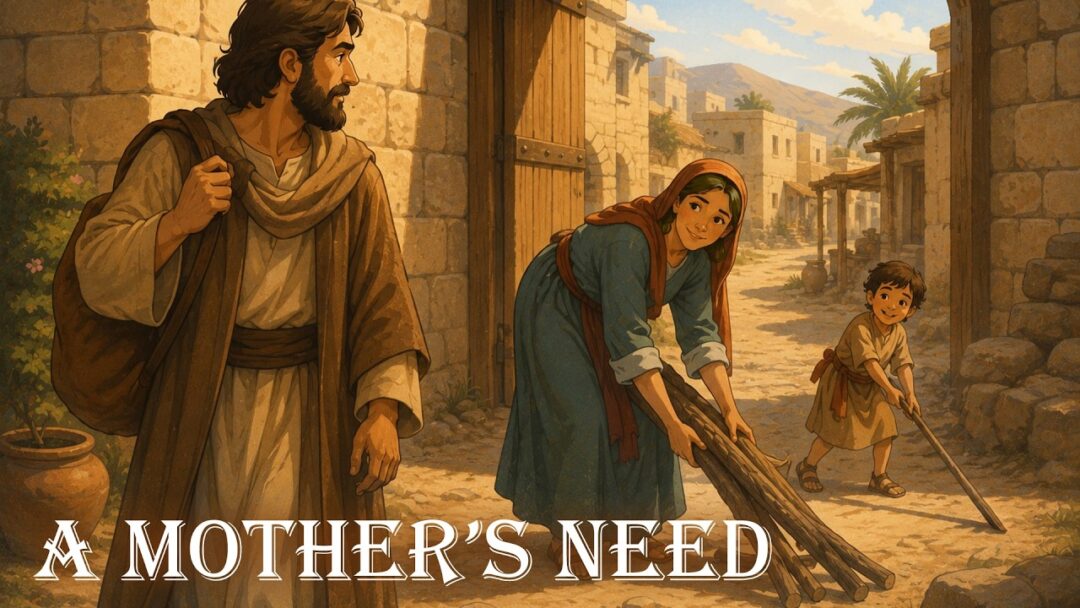
From our Mother’s Day service on May 10, 2026, 1 Kings 17. Watch the full message: A Mother’s Need on YouTube.
We’re in 1 Kings chapter 17. Today is Mother’s Day, so it’s only appropriate that we look at a story of a mother. Last time we looked at Hannah and Samuel. Today we’re going to look at the widow of Zarephath, a woman who was in desperate need. This is a story about needs.
It’s the opening story of the prophet Elijah. One of these days in the far future, I want to do a series on Elijah, so consider this a down payment on a future series. We are introduced to the prophet Elijah through this story, and it’s such an interesting way to be introduced to a prophet. It’s a story about how Elijah is sent to a woman in need, but in this woman’s need, he needs her just as much as she needs him. Through God’s miraculous providence, God brought them together to meet each other’s needs.
The lesson we want to take away from this passage today is that God wants you to know that he sees those who need him the most.
Mothers, how many of you would say there are days as a mother when you feel like you need help? I think every mother should raise their hand. Mothers, this is for you. If there’s ever a day you feel like you need help, this is the story for you, so you know that you can have it.
Elijah the Tishbite
And Elijah the Tishbite, who was of the inhabitants of Gilead, said unto Ahab, As the LORD God of Israel liveth, before whom I stand, there shall not be dew nor rain these years, but according to my word.
1 Kings 17:1
This is how we’re introduced to the prophet Elijah. There are a few things we’re told about him here, and there are some things I never realized until I studied the passage in Hebrew.
First off, he is Elijah the Tishbite. What is a Tishbite? In all our biblical archaeology, we’ve never found a town called Tishbe. When I looked at this word in the Hebrew, it caught my eye, because the word Tishbite and the word inhabitants in that verse come from the same root word in Hebrew. So why would he be a Tishbite who is of the inhabitants of Gilead? I thought that was kind of weird. Something wasn’t sitting right, so I studied it more.
Two Ways to Translate It
It turns out there are two exactly equal translations you could make of this passage. One is what the King James does: he’s a Tishbite who’s of the inhabitants of Gilead. That’s saying, in effect, “We’re not going to translate the word, because we’re not sure what it means.” The word Tishbite could refer to a place called Tishbe. In Hebrew, words can mean a lot of things depending on their context, and this one is ambiguous.
The second thing it could mean is that he was a tishbi. What’s a tishbi? The word used here would be the word for foreigner. If you look up this word in the Hebrew in every other verse in the Bible, it refers to someone who is a foreigner, a person from another country who lives as a resident in Israel. I found that super odd. I’d never heard that there are two ways to translate this. Either he’s from the town of Tishbe, which means foreigner, or he himself is a convert to the nation of Israel from a foreign nation.
I haven’t decided yet which way I land, but I thought I would let you know so you can keep it in mind as you see his introductory story. Either he was a Tishbite who settled in Tishbe, a land of foreigners, or he was a foreigner who was not born an Israelite, but converted to become an Israelite through his faith in the one true God.
Yahweh Is My God
The name Elijah etymologically means “Yah,” or Yahweh, “is my God.” What a name to have! His name is a statement of faith. It says, “I believe in the God of Israel.” This will come up later, because when he’s introduced to the woman, she knows he worships God. He never tells her, so clearly he told her his name, because his name means Yahweh is God.
Some theologians have written that this is the most perfect name in all of the Bible. It kind of lines up with the idea that maybe he was a convert to Israel rather than born from the line of Abraham, because his name is so on the nose about his faith in God. In fact, there’s no other Elijah in the Bible except the one after him in the book of Ezra and Nehemiah. So he has a very unique name.
Standing Before Ahab
Verse 1 says he said unto Ahab, “As the LORD God of Israel liveth, before whom I stand, there shall not be dew nor rain these years, but according to my word.” A lot happens in just that sentence.
The wicked King Ahab of Israel had been promoting the worship of Baal, the storm god. This was mostly due to the fact that his wife was the famous Jezebel, the princess of Sidon, whom he married to create a league between the Phoenician nation of Sidon and Israel. He wanted peace, so he married their pagan princess. And because of this, she convinced him to make Baal the official god of Israel.
So God is saying, “You’re the king of Israel. You’re supposed to be the leader of the nation that represents me. Rather than representing God, you have represented a false god, Baal. I’m going to send Elijah here to set things straight.” So Elijah stands before King Ahab to rebuke him and to tell him that, as a punishment for his grave sins, it would not rain again until an undisclosed time in the future, when God would speak again to Elijah and have the rains return.
That’s how we’re introduced to Elijah. We don’t know what he was doing before this, but the first thing we know about him is very dramatic. He goes before the king of Israel and tells him the worst news he could possibly imagine: “It’s not going to rain here, potentially forever.”
Hiding by the Brook Cherith
And the word of the LORD came unto him, saying, Get thee hence, and turn thee eastward, and hide thyself by the brook Cherith, that is before Jordan. And it shall be, that thou shalt drink of the brook; and I have commanded the ravens to feed thee there. So he went and did according unto the word of the LORD: for he went and dwelt by the brook Cherith, that is before Jordan. And the ravens brought him bread and flesh in the morning, and bread and flesh in the evening; and he drank of the brook.
1 Kings 17:2–6
God has him leave the area. Straight off the bat, God tells Elijah, “Get out of there. King Ahab is evil. Jezebel is evil. Don’t stick around in Israel. You’re going into self-exile for your own safety.”
God tells him to go to the brook Cherith. This is a stream east of the Jordan River, inside a valley. The name Cherith, or Kerith, means a place of cutting. If you look at it on Google Maps, which is a great thing I love to do with Bible locations, you get a good visual of what these places look like. It literally cuts through the mountains of Gilead. So there’s this stream called Cherith that means a cutting, and Elijah was hiding in it beneath the overhanging cliffs. People could not easily see him unless they went all the way down to the stream and looked at the foot of the cliffs. In fact, on this stream is the highest waterfall in Israel. So maybe he was at that waterfall. I don’t know.
What we do know is that he was in a place called the cutting. Once again, this signifies that he is being cut off from the people of Israel. It’s a bit on the nose, isn’t it? God says, “I want you to be cut off from Israel. Go to the place called the cutting off, or the separation.”
Fed by Ravens
He goes there, and he is fed by birds, specifically ravens. What’s interesting about ravens is that they’re an unclean animal. That’s kind of weird. You would think God would feed him with doves or pigeons of some sort that are clean and not ritually impure. But once again, God is designating this separation from Israel. Elijah is living in a place called the separation, or the divide, or the cutting, and now he’s being fed by animals that are considered impure and unclean. That’s a very uncomfortable situation for a Jewish person to be in. When they read this in Old Testament times, they would have been very aware of these facts.
So he spends time sitting near this brook, and he’s fed miraculously by God. But eventually things begin to change.
Sent to Zarephath
And it came to pass after a while, that the brook dried up, because there had been no rain in the land. And the word of the LORD came unto him, saying, Arise, get thee to Zarephath, which belongeth to Zidon, and dwell there: behold, I have commanded a widow woman there to sustain thee.
1 Kings 17:7–9
It doesn’t rain. That’s the whole point of Elijah’s mission. He told the king it wasn’t going to rain until he said otherwise. Where there’s no rain, there’s not going to be a stream. So the brook doesn’t sustain him anymore. It dries up, and God says, “I will give you another source of sustenance,” something a little less surprising than birds.
He says, “Go to Zarephath, which belongeth to Zidon.” Now, what did I just say about Queen Jezebel? She was the princess of Sidon. This is what really got me wondering about what was going on in this passage. God tells Elijah to run away from Israel, where he’s now multiple days’ journey away from any threats, and instead go to the kingdom that Ahab’s wife’s father is in charge of and live four hours away from that king. “I’m going to sustain you there.”
If I were Elijah, I’d say, “I don’t know, man. I really like the separation, the place of cutting on the other side of the Jordan River, where no one’s ever going to come because there’s nothing over here.” But God says, “No. I want you to go to the Phoenicians. I want you to leave Israel even farther behind. Go into enemy territory, and that is where I will sustain you.”
This is really interesting. If Elijah was in fact a convert from outside the line of Abraham, he may have been Phoenician. Maybe God sent him there because he would fit in better. Who knows? Maybe a Phoenician running around Israel would stand out: “That guy doesn’t look like us.” I don’t know. But one way or another, God says, “I want to send you far, far away from where I’m generally considered to dwell.”
A Wealthy Pagan City
So he goes there. It’s not an Israelite city. It’s under Phoenician and Sidonian control. Zarephath was within the boundaries of the Promised Land that Abraham was given, but when the tribe of Asher was told to take the land, they never drove out the inhabitants, so it never actually belonged to Israel.
If you want to find that city today, it’s called Sarepta. This is going to be important as it’s drawn out of the text: it was a wealthy harbor town known for pottery, metalworking, and the production of purple dyes, the most expensive, luxurious dyes in all of ancient history. The metalworking at Zarephath was so renowned that the name Zarephath actually means the place of smelting, or the refinery.
Since it was a port city, much of the trade that went south came through its ports first. Staple foods such as wine, olive oil, and grain would go through there, and the city itself produced its own supply of olive oil and grain. This city was so wealthy that archaeologists have discovered that some of its buildings had extremely elaborate columns and were adorned with very expensive marble.
This wasn’t some backwater town. This was a wealthy city with pagan temples made of marble and costly stone, chiseled by the finest craftsmen and some of the best metalworkers in the world at the time. He wasn’t going to nowhere. He was going somewhere: a famous place, a wealthy place, but also the place of Israel’s enemies.
Jesus on the Widow of Zarephath
Jesus actually talks about this passage in Luke 4.
And he said, Verily I say unto you, No prophet is accepted in his own country. But I tell you of a truth, many widows were in Israel in the days of Elias, when the heaven was shut up three years and six months, when great famine was throughout all the land; But unto none of them was Elias sent, save unto Sarepta, a city of Sidon, unto a woman that was a widow.
Luke 4:24–26
Elias is Elijah. So Jesus himself says the emphasis of this passage is Elijah being out of his comfort zone, far away from where God was said to dwell, with people of pagan ancestry. So what does Elijah do? Does he complain? Does he argue? No. He gets up and goes.
The Widow at the Gate
So he arose and went to Zarephath. And when he came to the gate of the city, behold, the widow woman was there gathering of sticks: and he called to her, and said, Fetch me, I pray thee, a little water in a vessel, that I may drink. And as she was going to fetch it, he called to her, and said, Bring me, I pray thee, a morsel of bread in thine hand. And she said, As the LORD thy God liveth, I have not a cake, but an handful of meal in a barrel, and a little oil in a cruse: and, behold, I am gathering two sticks, that I may go in and dress it for me and my son, that we may eat it, and die.
1 Kings 17:10–12
We made it to the fancy, luxurious city, but it turns out things there aren’t going well at all. The famine has already killed their entire supply line. You would think this woman, living in such a famous city with trade in staple goods like grain and olive oil, the things you need to make bread, would have access to them. She doesn’t. We’re not told why. Maybe the people of the city didn’t want to give away their traded commodities that were so scarce during the drought. Maybe they just didn’t have the resources to give her. But one way or another, this woman was left destitute.
Who Was This Widow?
What do we know about this widow woman? First, she was a Phoenician. She’s not from a tribe of Israel. She’s somebody far, far removed, someone who doesn’t live within the boundaries of Israel and has no ethnic ties to Israel. And yet God says, “I have commanded a widow woman there to sustain thee.” He doesn’t prepare someone in Israel. He prepares someone far away, somebody who has nothing to give, and he says, “I’m going to provide through her.”
We’re also told later that she lives on a property she owns that must be extremely valuable. She’s called the mistress of the house. That meant she was a landowner with a household of servants. Here’s the problem: it doesn’t do any good to have a big property and a lot of servants if you can’t put food on the table. So while she was a wealthy woman, she was just as bad off as everybody else, no matter where she lived. We’re also told she has a young son, who is probably at most around 10 years old, potentially even younger.
A Heart Willing to Help
We also see a little of the character of this woman. When he came to the gate of the city, the widow woman was there gathering sticks, and he called to her and said, “Fetch me, I pray thee, a little water in a vessel, that I may drink.” He makes a request: “Would you please go get me some water?” And what does she do? Does she say, “Foreigners in our town? Who is this guy asking me to get him water? Rude”? No. It says, “And as she was going to fetch it.” She didn’t even say a word. She just went to help him. She saw a man who needed water, she knew she could get water for him, so she just did it.
That shows us a little about the heart of this woman. She wasn’t someone who made excuses for why she couldn’t do anything. She was willing to help in any way she could.
Then Elijah makes a bolder ask. While she’s going to get the water, he says, “Bring me, I pray thee, a morsel of bread in thine hand.” You might think that’s a little rude: “Fetch me some bread while you’re at it.” I would be a little confrontational about it. This is during a famine. Bread is very expensive. This guy shows up and didn’t bring money. Who comes to a big city without bringing money? I would assume this person is irresponsible. But this lady doesn’t confront him about what he’s doing wrong.
At the End of Her Rope
What does she do? She says, “As the LORD thy God liveth, I have not a cake, but an handful of meal in a barrel, and a little oil in a cruse: and, behold, I am gathering two sticks, that I may go in and dress it for me and my son, that we may eat it, and die.”
What is she doing? She’s saying, “I’m willing to help you. I want to help you, Elijah, but I can’t. If I had the material, I would make you the bread. I would give you anything. But I’m at the end of my rope. I’m actually just getting these sticks because I’m out of firewood at home. I’m picking up these scrap sticks off the ground to bake the last little bit of flour and olive oil I have in my house, and then I don’t know what I’m going to do. I guess I’ll just die.”
So she has this broken heart. And at some point she’s been told his name, Elijah, because she knows that Yahweh is his God. In verse 12, LORD in all capitals is Yahweh. That’s what is in his name: Yahweh is my God. So she reasons, “Elijah must be a follower of Yahweh.” And she says, “As the LORD thy God liveth, I have not a cake.” In other words, “I swear on the name of your God,” the highest authority you believe in. “Honestly, if I had the ability, I would help you, but I’m at the end of my rope.”
How many of you can say, “I felt like I was at the end of my rope, somebody asked me to help, and I said, ‘I’m sorry, but I don’t have anything left to give'”? I can say I’ve been there. This is where she was. She wanted to help, but the situation of her life just didn’t allow her to.
Make Me a Little Cake First
And Elijah said unto her, Fear not; go and do as thou hast said: but make me thereof a little cake first, and bring it unto me, and after make for thee and for thy son.
1 Kings 17:13
I like how it starts. I wouldn’t have liked how it ended. First, he says, “Fear not.” Don’t be afraid. You’d think in her heart she’s thinking, “Oh, it’s good news.” But then Elijah says something that, if it were us, we probably wouldn’t respond to positively: “Don’t be afraid. Just make the bread for me first, and then make bread for you.”
Do you understand how bold a request that is? If I had just enough food for me to eat, and somebody came to me and said, “That’s okay, don’t be afraid, give it to me first,” I would be shook. I would be angry. But what does the woman do? In verse 14 he continues.
For thus saith the LORD God of Israel, The barrel of meal shall not waste, neither shall the cruse of oil fail, until the day that the LORD sendeth rain upon the earth.
1 Kings 17:14
He says, “Just give it to me first, and everything will be okay, because God’s going to take care of you.”
She Took Him at His Word
And she went and did according to the saying of Elijah: and she, and he, and her house, did eat many days. And the barrel of meal wasted not, neither did the cruse of oil fail, according to the word of the LORD, which he spake by Elijah.
1 Kings 17:15–16
She just took him at his word, probably because he was a prophet of God and spoke under God’s authority. You wouldn’t think she’d be somebody who would believe in the God of Israel. She’s not an Israelite. She doesn’t live in their area. She doesn’t have any connection to it. But outside of Israel, there was this woman who believed in God. If you look through the Old Testament, you’ll see time and time again true believers in the God of Israel who lived outside of Israel, and she’s an example. When she heard that the God of Israel promised her that if she helped this prophet she’d be okay, she said, “If he says it, I’m going to do it.”
So she goes immediately, makes the bread for him first, bakes it, and gives it to him, and he eats. And when she goes back, she finds there’s somehow still flour in the barrel, and the olive oil didn’t run out. Don’t ask me how this works. It’s a miracle. I can’t explain it. I don’t know whether, if you looked in, you’d see it rising back up to the level it was, or whether you had to close the lid first. But one way or another, God miraculously provided for this woman.
She hears a promise, and she acts in faith, believing that God would keep his promise to her. Because of that, she and her family and her servants survived off that little bit of flour and that little bit of oil for a long, long time. And Elijah stays and lives there with her.
Two Needs Brought Together
You see how God miraculously brought these two together. He brought a woman who believed in him, who was at the end of her rope and out of options. And he brought a prophet who was in exile, at the end of his rope, without options. God says, “I’ve got two problems. I’m going to bring these two believers together and help them solve each other’s problems.”
Isn’t that a beautiful picture of the body of Christ, how we as believers can help each other in the will of the Lord? And we see a miracle that is famous even today. But that’s not where the story ends.
A Mother’s Worst Nightmare
And it came to pass after these things, that the son of the woman, the mistress of the house, fell sick; and his sickness was so sore, that there was no breath left in him. And she said unto Elijah, What have I to do with thee, O thou man of God? art thou come unto me to call my sin to remembrance, and to slay my son?
1 Kings 17:17–18
Eventually she experiences a mother’s worst nightmare. “So sore” could also be translated as severe. What a tragedy. After time passes, we’re not told how much, just “many days,” so at least a couple of weeks, her son becomes sick. It doesn’t tell us with what or how. But over time he gets worse and worse until his body weakens, he goes into a coma, and eventually he just stops breathing.
This woman, naturally, is distraught and confused and has questions. She must have been saying, “I brought this prophet into my house. I brought the man of God into my house, and God has provided food for me every single day of this famine. It’s miraculous. I pour the flour out, and the flour’s back. Why in the world would he let my son die? God, you’ve been so faithful in every other area of life. Why did you choose not to be faithful to me in this? Why would you allow the worst thing that could happen to me to happen? My husband already died. I’m already a widow. No one’s going to marry me at my age. I live in a pagan country. As a believer in you, I have nothing and no one. And you took away the only thing I had left. What’s the point of the food if I don’t want to go on anymore?”
Is This Punishment?
So she confronts Elijah: “What have I to do with thee, O thou man of God?” She starts lashing out at the prophet in her heartbreak. “What have I done to you? What did I do to deserve God’s punishment in my life? Art thou come unto me to call my sin to remembrance, and to slay my son?”
“Elijah, why did you show up here in the beginning? Were you here as a blessing to feed me, or were you here to punish me for my sins? I know I’m sinful. I know I’ve made mistakes. I know God has every right to punish me. But is that why you’re here, Elijah? Was it just a front to get my hopes up that something better was coming, just for them to be crushed? Did you lift me up just so that my punishment would feel like more? My son was already going to die. I had already come to terms with the fact that my son and I were going to die. And it was okay when it was both of us. But now I’m going to survive and my son is dead. Why? I just don’t understand.”
How many of you can say you’ve been in a similar situation? Maybe not that severe, but you’ve gotten to the point of saying, “God, why? I don’t understand. Is this punishment?”
Elijah Takes It to God
And he said unto her, Give me thy son. And he took him out of her bosom, and carried him up into a loft, where he abode, and laid him upon his own bed. And he cried unto the LORD, and said, O LORD my God, hast thou also brought evil upon the widow with whom I sojourn, by slaying her son? And he stretched himself upon the child three times, and cried unto the LORD, and said, O LORD my God, I pray thee, let this child’s soul come into him again.
1 Kings 17:19–21
So Elijah is asked the question, “Are you here for my punishment?” What does Elijah do? He prays. I just noticed something here that I did not notice in my study. In verse 21 he says, “O LORD my God.” There’s a little play on words there. That’s Elijah’s name in the Hebrew: Yahweh is my God.
Elijah doesn’t answer her question from his own personal opinion. Elijah doesn’t know what’s going on, so he has to go talk to God. He brings that question to God: “Let me take this to God. Give me your son.” He takes the son, who’s lying lifeless in her lap as she cries over him. He takes him up the ladder into the loft where Elijah has been living, and he sets him down on his own bed. And he cries out, “God, did you bring me here to bring evil on this woman? Is it your intention to kill her son? Is this a punishment?”
Persistence in Prayer
He wants the answer. So he lays over the child and cries to the Lord, “Please, God, let this child’s soul come into him again.” Notice it doesn’t happen the first time. He has to pour out his heart. It’s a good application about the importance of persistence in prayer. What if Elijah had just prayed one time, “Lord, bring the son back,” and then said, “I guess he said no. Bye”? Persistence in prayer is important.
Elijah is saying, “God, I want you to prove that you are for your people. I want you to prove that you care about your people. So Lord, please bring her son back to her.”
See, Thy Son Liveth
And the LORD heard the voice of Elijah; and the soul of the child came into him again, and he revived. And Elijah took the child, and brought him down out of the chamber into the house, and delivered him unto his mother: and Elijah said, See, thy son liveth. And the woman said to Elijah, Now by this I know that thou art a man of God, and that the word of the LORD in thy mouth is truth.
1 Kings 17:22–24
God responds. “See, thy son liveth.” That was the answer to her question. She was asking, “Does God care about me?” I don’t know exactly what she was thinking, but Elijah responds to it: “See, your son is alive. See, God does care.” That’s what, in essence, he’s saying. “You asked me whether God cares, since he took your son. Yes, God cares. See, your son is alive again.”
And what does she do? She says, “Now by this I know that thou art a man of God.” What’s crazy is that the miraculous, never-ending flour and oil didn’t prove to her that he was a man of God. That wasn’t what convinced her that Elijah was a prophet. But when she saw her lifeless son come back to life as he came down from that loft, she regained faith, and she was convinced: God really does care about me. God really does see me at the end of my rope. God really does save those who follow him.
From the Beginning of the Famine to the End
And it came to pass after many days, that the word of the LORD came to Elijah in the third year, saying, Go, shew thyself unto Ahab; and I will send rain upon the earth.
1 Kings 18:1
In the next chapter, we see the conclusion. From the beginning of the famine to the end, God provided for that widow woman. She was at the end of her rope. She was out of options, and she was accepting her fate.
Yet God took a prophet from far, far away, far removed from his native land. He belonged in Israel. And God says, “I have somebody who needs help. I have somebody who believes in me and is at the end of her rope. Elijah, I know it’s really far out of the way. I know it’s out of your territory. I know it’s a long journey, and I know it’s right next to the king whose daughter wants you dead. But Elijah, she needs your help, and I’m going to use you to help her.” God saw her from all that distance away and sent Elijah to her.
Conclusion
As we come to the end of this story, we see more than just a miracle of flour and oil. We see a unique glimpse of God’s heart. At the beginning of this chapter, Elijah stands before a wicked king and announces judgment. But by the middle of the chapter, God sends that same prophet out of Israel and into Sidon, to the home of a starving widow and her dying son.
This tells us something meaningful about how God works. God wasn’t just paying attention to the people we would consider important. He wasn’t just focused on the kings and the kingdom and the rich and the powerful. He was also paying attention to a lowly widow woman, the mother of a dying son. That tells us that though she may have felt forgotten, God saw her and knew her needs where she was. When he saw those needs, he sent his prophet to her home. And through her obedience, God provided exactly what she needed in her time of need.
When her son died, she asked the question that many hurting, struggling people ask: “Is God against me?” And God answered not with a lengthy dialogue, but by providing exactly what she needed in the first place. He answered with compassion, by bringing her son back from the dead.
This widow was not an Israelite. She didn’t live at the center of religious life. I guarantee she didn’t make any journeys to the temple. She was not powerful or influential. But she was exactly the kind of person God delights to show mercy to: someone who’s empty enough to trust him, needy enough to depend on him, and willing enough to obey him.
That’s the message for us today. God sees those who need him the most. He sees you when the food is almost gone. He sees you when death enters the family. And he sees you when your heart is asking, “Has God forgotten me?” The question is not whether God sees your need. The question is whether you will trust him with it.
The widow had to give God the little she had before she saw the miracle. Elijah had to pray before he saw the boy breathe. Again, faith means obeying God before we understand what he’s doing. So today, bring your empty barrel to God. Bring him what little oil you have left. Bring him your grief, your fear, your questions, and your impossible situations. Because the God of Elijah is still the God who provides today.
God wants you to know that he sees those who need him the most. So will you trust him and allow him to do the impossible for you?

Recent Comments