
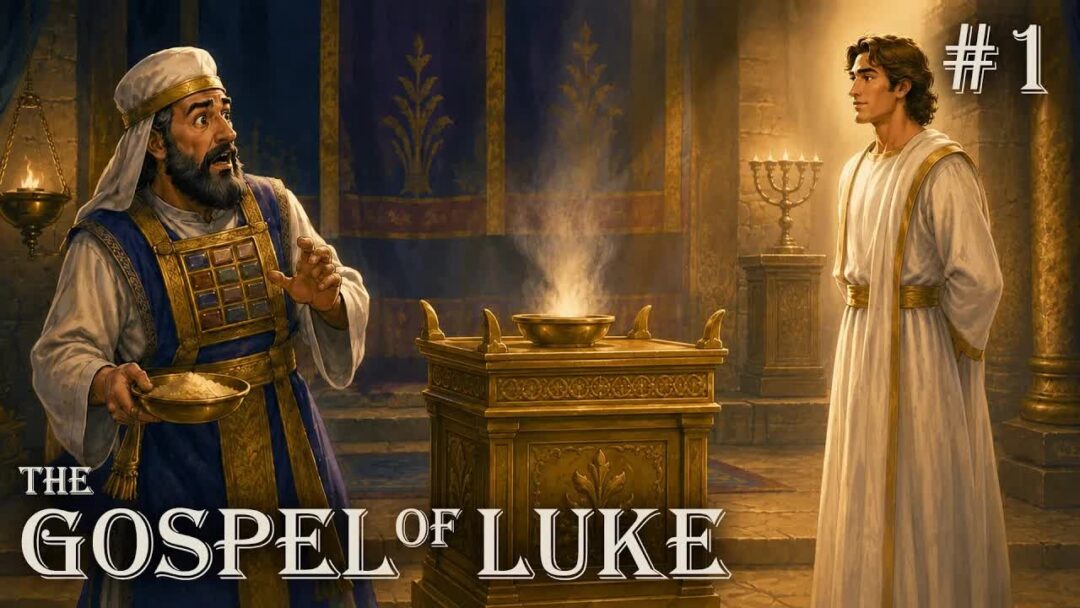
From our Sunday service on May 24, 2026, Luke 1:1-25. This is part 1 of our Gospel of Luke series. Watch the full message: A New Era Begins – The Gospel of Luke #1 on YouTube.
Today we’re starting a very long series. Effectively, what we’re going to do is make our way through the entire narrative of the New Testament. We’re going to start here in the book of Luke and work through the ministry of Jesus. Then we’re going to continue with the book of Acts, and as we go through Acts, whenever we get to a point in history where Paul wrote a letter, we’re going to stop in the book of Acts, read Paul’s letter, study it, and then continue the narrative where Acts left us off.
Over all these series, that’s going to give us a good perspective on the timeline of the Bible and help us to consider passages in their proper context. It’s definitely going to help us, when we look at Paul’s letters, to understand what was going on in the church when Paul wrote them. But before we get to the church, we need to start with the ministry of Jesus, and before we get to the ministry of Jesus, we have to start with John the Baptist. And through all of our study today, our main lesson to take away is that God wants you to know he hears you when life feels silent.
What Is the Book of Luke?
To introduce this lesson, we need to introduce the entire book of Luke, and that’s the first thing that happens in the book of Luke.
Forasmuch as many have taken in hand to set forth in order a declaration of those things which are most surely believed among us, Even as they delivered them unto us, which from the beginning were eyewitnesses, and ministers of the word; It seemed good to me also, having had perfect understanding of all things from the very first, to write unto thee in order, most excellent Theophilus, That thou mightest know the certainty of those things, wherein thou hast been instructed.
Luke 1:1–4
Verse 1 tells us that Luke set out on a mission to “set forth in order a declaration.” Another way you could translate that is to organize a narrative account. One thing you need to understand about the first two Gospels, Matthew and Mark, is that they are not written to be in chronological order. Matthew and Mark were written for theological reasons. Mark was designed to be short and easily spreadable, so that those who wished to could make copies of it and give it out as a form of evangelism. Matthew was meant to give the Jews their Messiah and present Jesus as the Messiah.
But as these Gospels were written, people began to wonder what the narrative of Jesus’s life was like. When do these events take place? “I’m confused about this passage and this passage. They seem like they’re at the same time, but they’re in different sections of the book.” And so people began to wonder, is this story true? One of these people who wondered was a man named Theophilus, who Luke is writing to. He wants evidence that the narrative of Jesus’s life is reliable and fits in with what was going on in the world at that time.
So Luke answers this need, because the church is expanding. At first it was just the Jews in the local area, but now it’s going into parts of the Roman Empire where they speak Greek, where they’ve never set foot in Israel, and they don’t have the context. Imagine someone telling you, “There was this story that happened in New York City. It was on such and such a street. You go right, then left, then about 500 steps the next way, and it’s there.” You’d say, “Where? I don’t even know where that street is.” The Greeks had no concept of Jerusalem as a city. They had no concept of what was going on politically, which the books of Matthew and Mark assumed you knew.
So Luke made a chronological narrative that includes names of the eyewitnesses and the locations of events, giving people clear evidence that Jesus was real and that his life did take place during that time in history. He wrote this for non-Jewish people who struggled with understanding some of the theological concepts of Matthew and Mark, and struggled to place things in their geographic area.
In summary, Luke’s Gospel is a chronological account of Jesus’s life and ministry, written to provide long-term evidence for the Gospel’s credibility by recording Jesus’s story within its real historical, geographic, political, and social context, and by preserving the testimony of eyewitnesses by name. The Gospel of Luke is where we get the best and strongest evidence for the historicity of Christianity, and that’s why we are going to go through Luke as our first Gospel.
Luke’s research project was completed in two parts. Part one is the Gospel of Luke, which we’re dealing with now: the major events of Jesus’s ministry. Part two is the Acts of the Apostles: the major events of the apostles’ ministry, up to the point of Paul’s arrest in Rome.
Who Is Luke?
Luke’s full name was Lucas, a wonderful Greek name. We’re not confident where he was born, but he likely called the city of Philippi his home. The books of the Bible record him going there often, and it’s probably where he lived. Luke was not a Jew, but he came to believe in Christ at some point during the early church. By trade, Luke was a physician, a doctor. He was well practiced in medicine and highly educated. The Greek writing style he used was very eloquent and very analytical, and he was up there with Paul and John in his knowledge of the Greek language.
In Acts chapter 16, we’re told he met up with the apostle Paul while he was researching for this writing project. From that point in Troas, he accompanies Paul on his journeys as Paul’s personal doctor. He assisted Paul in his missionary journeys as he went into uncharted territory. Believe me, Paul got beaten and hurt a lot. When Paul got hurt, who nursed him back to health? It was Luke, the author of the book of Luke.
Who Is Theophilus?
Theophilus is one of these people I said were interested in the chronology of Jesus’s life and ministry. He wanted to know more about Jesus, and it seems that he was struggling to believe or prove that what people were saying about Jesus was true. The name Theophilus means lover of God. Some Christians have said that maybe Theophilus wasn’t a real person, and that “lover of God” is supposed to be a generic name for Christians. I don’t know that I hold to that. I believe Theophilus was a real person. But I do think there may be a little bit of allegorical meaning there: this Gospel was written to those who love God, those who want to know more about Jesus and his ministry.
The most important thing we know about him is that he’s given the title “most excellent.” Nobody in this culture would be called most excellent unless they were in some way recognized by the Roman government. So whatever role Theophilus had, it had to be an officially recognized role. That gives us a few options:
Number one, Theophilus was a Roman official of high rank. Maybe he was a governor or a general; we’re not sure. Number two, he could have been who we know of as Theophilus of Antioch, a high-ranking officer in that city who helped with the leadership of that town, and we know Paul was in Antioch quite a bit. He could have been Theophilus ben Ananus, who was the high priest of Israel from AD 37 to 41. But this is probably unlikely, because his brother-in-law was Caiaphas, and Caiaphas was directly involved in Jesus’s crucifixion, so I feel like he would already know who Jesus was. Some say it was even his son, Matthias ben Theophilus, who served from 65 to 66. But I would not expect a Gospel written to the Greeks to be written for a Jewish high priest. I don’t think that fits, but it’s becoming a more popular interpretation.
One that I find appealing is that maybe Theophilus was actually Paul’s lawyer, and that these notes were given to Paul and his lawyer as a legal defense. Remember, this was written when Paul was imprisoned in Rome and awaiting trial. So what’s possible is that Paul’s lawyer said, “We need to prove that what Paul’s saying has evidence.” And so Luke went and collected evidence and names and places and locations in history in order to defend Paul against the wrath of the Roman government. I think that’s very interesting as well.
Why Luke?
Why was Luke the one who wrote this Gospel? Verse 3 tells us he had “perfect understanding.” The idea is that Luke himself, after he got saved, went and retraced the steps of Jesus’s ministry. He didn’t go to hearsay; he went to the eyewitnesses who saw Jesus and recorded things from their testimony, what they remembered. He put the narrative together in order, chronologically, based on eyewitness accounts, and named names when he was able to. He traced it step by step until eventually he met up with Paul and began recording the ministry in real time. So if Theophilus was Paul’s lawyer, Luke was chosen to do this because he had been recording the ministry the whole time he’d been saved, and he had these notes on hand from his research.
Four Hundred Years of Silence
Now that we know what the book of Luke is, let’s consider the context of the Gospels as a whole. After the book of Malachi, the last book of the Old Testament, God remains silent for 400 years. There were no new prophecies and no new prophets, and Israel faced a time of war and oppression as God allowed Rome to conquer the world to prepare the world for the Gospel of Jesus. Without those Roman roads and the Roman conquest, there would be no way for the Gospel message to spread. So for 400 years, as God was setting up the Gospel to spread through Rome, everything was silent. No angels, no prophets, no new words.
Multiple sources written in this period of time record that there were no prophets in those 400 years. First Maccabees records that the Jews were waiting for the next prophet, and that Simon Maccabeus, who the book is named after, was to be appointed their leader only because there were no new prophets to direct them on who their leader should be. In the book of Daniel, the angel Gabriel gave Daniel a countdown calendar of events until the time of the Messiah’s arrival. We’ve talked about that before. So despite the silence, people were anticipating the Messiah’s arrival, because they were told the exact period of time in which he would arrive.
Who Was Waiting?
Some of the groups that were looking for him were these:
Some of the Pharisees, priests, and Levites were actively waiting for either the Messiah, Elijah, or the prophet like Moses to soon appear. When John begins his ministry, they specifically ask John, “Are you the Messiah? Are you Elijah? Are you the prophet? The time is now for the Messiah to arrive. Are you him?”
We know the Samaritans knew the Messiah was coming, because the woman at the well tells us so. She says, “I know that Messias cometh… when he is come, he will tell us all things.” So the Samaritans knew it was time.
The Zealots, the radical terrorist group that was set to overthrow Rome, knew the Messiah was coming. They were purposefully training, so that when the Messiah came they could join in war with him and overthrow the Roman government. Of course, they were left disappointed. But one of them, Simon the Zealot, became a disciple of Jesus Christ.
We know the wise men in the East were looking for the Messiah, because they were watching the stars to see when the Messiah would appear.
And lastly, the Essenes in particular, whose writings we have in the Dead Sea Scrolls, recorded that they knew the time for the Messiah would soon arrive. They saw themselves as a people being prepared to walk alongside him at the end of the age when he arrived. In fact, some of them followed John the Baptist in his ministry, and some of them would become disciples of Jesus Christ themselves.
To summarize, during this period everyone was on edge. They were waiting for the silence to finally break, because they knew it was just a matter of time until an angel spoke once again. To put it into context, this is the last thing God said in the Old Testament before this, through his prophet Malachi:
Remember ye the law of Moses my servant, which I commanded unto him in Horeb for all Israel, with the statutes and judgments. Behold, I will send you Elijah the prophet before the coming of the great and dreadful day of the LORD: And he shall turn the heart of the fathers to the children, and the heart of the children to their fathers, lest I come and smite the earth with a curse.
Malachi 4:4–6
The last words they had were that a prophet would return before the day of the Lord to cause Israel to repent and be ready for their Messiah. These are the words we keep in mind as we learn the story of the birth of John the Baptist.
God Breaks His Silence
Back in Luke chapter 1, we see the beginning of the story of Jesus as God breaks his silence.
There was in the days of Herod, the king of Judaea, a certain priest named Zacharias, of the course of Abia: and his wife was of the daughters of Aaron, and her name was Elisabeth. And they were both righteous before God, walking in all the commandments and ordinances of the Lord blameless. And they had no child, because that Elisabeth was barren, and they both were now well stricken in years. And it came to pass, that while he executed the priest’s office before God in the order of his course, According to the custom of the priest’s office, his lot was to burn incense when he went into the temple of the Lord.
Luke 1:5–9
A note on names: I’m going to switch between Zacharias and Zachariah throughout this message. Zacharias is Greek, and Zachariah is Hebrew. Just know I’m talking about the same person.
The first thing we learn in verse 5 is when this event occurs. In this day and age, there were no calendars that were 100% set in stone, so you would order events based on the rulers of the time. Luke says in verse 5 that this occurred during the days of Herod the Great. Herod the Great ruled from 37 BC until his death in 4 BC. When added with the additional context that Luke gives us, this puts this event specifically in the month of October of 7 BC. Luke’s doing a pretty good job fitting the chronology in here when you can break it down to that much detail, and you can see how helpful Luke is to the historicity of Christ.
A Humble, Faithful Family
In verse 5, we see that God is going to break the silence. Not with some amazing, miraculous king being told that the Messiah is going to come. He doesn’t come talk to somebody you’d consider super important. He goes and talks to a humble servant and his wife. He goes to a family that’s older, well past their years, who are unable to have children, but despite their grief and difficulty, they have been faithful to God in prayer and service to him. For 400 years God didn’t speak to anyone. But the first thing he’s going to do is go answer someone’s prayer.
We know a little bit about Zacharias and Elizabeth. First off, they’re faithful followers of God. The Bible tells us they were blameless. That means innocent. It means you couldn’t talk bad about Zacharias, because if you did, people would say, “I don’t believe you. I believe Zacharias, because Zacharias has never done anything wrong as far as I know.” His wife is just the same. Talk bad about Elizabeth? “Nope, I don’t believe you. I’m going to believe Elizabeth, because she’s lived faithfully her entire life.”
We know that Zacharias is a descendant of Abijah. These were Aaronic priests, people from the line of Aaron, who were appointed by King David as the eighth division that would oversee the temple sacrifices for a certain part of the year. The cycle was that they would take one week at a time, about two times a year, plus maybe one of the holy weeks. There were so many priests in this day that they couldn’t all serve at the same time. During the time of King David they said, “We’ve got to organize this better, because there are just too many. So we’ll have each group come to the city for one week at a time, take a shift, and go back home. That way everybody gets to serve in the temple, and nobody gets overworked.” And they had been doing that faithfully for years.
Here we pick up on Zacharias. It’s his one-week duty in the temple, and we’re told that his job is to burn incense in the temple sanctuary. You’ve got the Holy of Holies, where the Ark of the Covenant is. Well, it wasn’t there at this time; it was lost after the exile. But you’ve got the Holy of Holies, and right outside of it this little altar of incense. Zacharias’s job was to go to that altar of incense and offer incense while the people outside spent time in prayer, asking God for the things they needed and praising him. So for all intents and purposes, Zacharias is a prayer leader, so to speak. He is the one who initiates the prayer service at the temple every morning and evening.
We also know that Elizabeth was from the line of Aaron, telling us that this is a priestly family. However, this beautiful, faithful family wasn’t all good, because we’re told that Elizabeth was barren. She was infertile. She couldn’t have children of her own, and we can tell from the story that this was very difficult for them. The temptation they would have had was to consistently ask God, “God, why is it that I was faithful to you throughout all my youth, through all of my life, and yet you didn’t give me the one thing I wanted the most? You haven’t blessed me with a child. I’ve served you all my life, but what legacy do I have? What name do I have to carry me forward? God, I’ve devoted my entire life to serving you as your minister, and I don’t feel like I’ve got what I need.”
But we find that they’re still faithful even in this grief. Instead of complaining, they decide to wait and to pray. And on this day, God had a very important role for them to begin to fulfill.
An Angel Appears
And the whole multitude of the people were praying without at the time of incense. And there appeared unto him an angel of the Lord standing on the right side of the altar of incense. And when Zacharias saw him, he was troubled, and fear fell upon him.
Luke 1:10–12
Zacharias goes into the holy place with the censer of oil to offer the incense as a sacrifice to God. Everybody’s outside praying, but he alone goes in. While the people pray, suddenly he realizes this offering is not going to be a regular shift at the temple. As he walks toward the altar, he realizes that on the right side of the altar of incense there is an angel.
We need to stop for a moment and consider the intensity of this situation. Remember, no angel has appeared for 400 years. We also need to remember that there was a very real danger in going into the temple unworthy. There were priests who would go in there, offer sacrifices, and die because they offered unworthy sacrifices. I don’t know what they saw before they died, but if I had to guess, an angel might be one of them.
So Zacharias is really scared, because he’s offering a sacrifice and he sees an angel standing there. “Oh, no. This is it. My time has come. I did something wrong. I didn’t purify myself right. I’m harboring sin.” Think about it. The text tells us that he’s been praying for a child. It might very well be that during this time of prayer, as he goes to offer the incense, he’s praying for his child. And maybe he thinks, “Maybe I didn’t word my prayer correctly. Maybe I was just bitter toward God, and now he’s going to take me, because I’ve been praying for a son all this time and maybe he’s just done with me.” He’s fearful, because he thinks judgment is coming. Put yourself in his shoes. He has no choice but to assume something is very wrong and the angel has come to take his life.
“Thy Prayer Is Heard”
But that’s not what we see as the angel speaks.
But the angel said unto him, Fear not, Zacharias: for thy prayer is heard; and thy wife Elisabeth shall bear thee a son, and thou shalt call his name John. And thou shalt have joy and gladness; and many shall rejoice at his birth. For he shall be great in the sight of the Lord, and shall drink neither wine nor strong drink; and he shall be filled with the Holy Ghost, even from his mother’s womb. And many of the children of Israel shall he turn to the Lord their God. And he shall go before him in the spirit and power of Elias, to turn the hearts of the fathers to the children, and the disobedient to the wisdom of the just; to make ready a people prepared for the Lord.
Luke 1:13–17
That would have been quite the turn of events. One second you think you’re going to die because you prayed wrong. The next you find out, “God’s answering my prayer. My son is going to be the person everybody’s been waiting for for 400 years, who ushers in the Messiah.”
The angel immediately ties what’s going to happen here to Zacharias’s prayer life. Zacharias had been praying for a son, constantly asking God, “Please give me a son. Please, I don’t understand. Please answer my prayer.” And during this sacred time of prayer at the temple, he may have been praying about this very thing. Because what does the angel say? “Thy prayer is heard.” For many years he thought that prayer wasn’t being listened to. He thought God wasn’t going to grant it. But here he finds that God was listening all along. The angel says he will have his son, and he’s going to call him John, which means “Yahweh gives grace.”
Who John Would Be
Number one, verse 15 tells us that he “shall drink neither wine nor strong drink.” This tells us that John was to be a Nazarite, a man dedicated to God who would live a humble lifestyle free from certain things. In this case, it’s emphasizing the restriction of his diet: he was not to drink anything that could appear to be alcoholic, whether that’s regular grape juice or fermented grape juice. One way or another, because he was a Nazarite, he couldn’t have it. Other things Nazarites couldn’t do: they couldn’t cut their hair, they had to wear humble clothing, and in this case, John was to live in the wilderness instead of inside the cities.
Number two, verse 15 also tells us that John the Baptist would have the Holy Spirit from his mother’s womb. This was very abnormal. When the Holy Spirit acted in Old Testament times, it was very much a short-term thing. The Holy Spirit would come upon a person to equip them for a task, and when that task was done, the Holy Spirit would leave. Here Zacharias is told that his son would have the Holy Spirit even in his mother’s womb. That would be a very comforting thing. How many of you would love to be told that God’s going to lead your child for their entire life? What a blessing: not only to hear he’s going to have a son, but that his son is going to be so important to God that God is never going to leave him or forsake him.
I’ve got good news, though. We’re in the New Testament now. That promise applies to us. I set you up there. You’re thinking, “Wouldn’t that be nice?” It is nice, and you can have it. But here, the Holy Spirit was going to be with John the Baptist every step of the way. God would guide him in his mission.
Number three, verse 17 tells us that he would come “in the spirit and power of Elias.” That tells us clearly that he is the prophet foretold by Malachi. The last thing God ever said, he’s picking up the other half of the sentence 400 years later. Zacharias was probably so excited about the idea of the Messiah and his prophet coming. Imagine the excitement when you’ve been waiting 400 years for the prophet to come, and you’re told, “You’re the prophet’s dad. Congratulations, it’s a boy!”
The last thing we learn in verse 17 is that his ministry was to turn Israel to God, so they were ready for Jesus, the Messiah. John the Baptist’s ministry was of the utmost importance. God had been preparing the secular world for years with the Roman roads and the Roman languages, so that everybody could hear the Gospel. God had prepared the secular world. It was John’s responsibility to prepare the spiritual: to go to the Essenes and the Zealots and all those who were waiting for the Messiah, and get them to have the right perspective on who the Messiah was going to be. So that when the Messiah came and John said, “Behold the Lamb of God, which taketh away the sin of the world,” they would say, “Okay, it’s time for me to follow Christ.” What a valuable mission.
Zacharias Doubts
With all these things being true and exciting, what does Zacharias do? We see his response.
And Zacharias said unto the angel, Whereby shall I know this? for I am an old man, and my wife well stricken in years. And the angel answering said unto him, I am Gabriel, that stand in the presence of God; and am sent to speak unto thee, and to shew thee these glad tidings. And, behold, thou shalt be dumb, and not able to speak, until the day that these things shall be performed, because thou believest not my words, which shall be fulfilled in their season.
Luke 1:18–20
Zacharias’s response is to doubt the angel, because both he and his wife are too old for kids. We’re told that this angel is Gabriel, and we should take that very seriously. There’s a reason why I covered Daniel before we got here. Daniel tells us that the angel who is in charge of telling the prophetic timeline for the Messiah is Gabriel. Gabriel’s the one who delivers the news about Jesus coming, and here Gabriel’s finishing his job. It seems like he was the one in charge of delivering news about Jesus.
He says, “Do you know who I am? I am Gabriel, who stands in the presence of God, and I have come to talk to you. I have left the throne room of God to come talk to you, and you don’t believe me. For 400 years you’ve been living on my words, on my timeline for the Messiah. The whole Jewish world is focused on those 70 weeks being fulfilled, and when I come, you don’t believe me.”
God’s Timing
What does he say in verse 20? “Thou shalt be dumb, and not able to speak, until the day that these things shall be performed.” Why? “Because thou believest not my words, which shall be fulfilled in their season,” or in my timeline. Zacharias wasn’t accepting God’s timeline for things. The reason he was praying is because he thought God was too late. Gabriel says, “Do you not understand God works in his timing? You’re doubting me because you think I’m too late? You think my timing wasn’t good enough? That just because you’re old, it means I made a mistake, that I waited too long for you? No, my timing comes when my timing comes.”
This is Gabriel. He literally set the timeline. “I have to bring the Messiah and his prophet at the time that the prophecy says. It doesn’t matter if you’re old.” God does what he says he will do, and he’s not going to do it the way you want it to be done. He’s going to do it the way it needs to be done.
So what should have been a high point of Zacharias’s life suddenly becomes a moment where he has to learn a lesson the hard way. Because he doubted Gabriel and doubted God, God would take away his ability to speak until his wife gave birth to his son. That’s a long time to go without talking. May we be careful that we don’t talk back to God when God’s trying to tell us things in our life. It’s good to pray. It’s good to have faith. But it’s also good not to talk back when God doesn’t answer the way we want.
What Zacharias should have done is praise the Lord that he was answering his prayer, not say, “God, why’d you answer it so late? Why’d you wait so long? Why’d you make me suffer those years without? Couldn’t you have done it a little earlier for me?” And God’s answer to that was, “Don’t you know that I left heaven to help you? Don’t you know I bridged the gap between heaven and earth to answer your prayer? And yet you think it’s not good enough?” May we not make the mistake Zacharias made.
Meanwhile, Outside
And the people waited for Zacharias, and marvelled that he tarried so long in the temple. And when he came out, he could not speak unto them: and they perceived that he had seen a vision in the temple: for he beckoned unto them, and remained speechless.
Luke 1:21–22
During this whole conversation, the people are still outside praying. They’re expecting a short prayer time. The priest goes in, he offers the incense, he says a prayer, he walks out. Prayer time over. You know how it is when somebody prays a really long-winded prayer: “Is he coming out? Is he still going on in there? Do you need to pray for 20 minutes?” The people are amazed. They’re shocked. “What is going on in there? Did he die? Did an angel strike him down? That’s happened before. It’s really strange for him to be in there so long.” So the people’s attention is fixated on the idea that something has gone wrong in the temple.
But when he comes out, he can’t speak. I don’t know if his role involved saying something like “the prayer service is now concluded,” or if he never said anything at all, but one way or another, he’s trying to wildly gesture what just happened. How do you explain what just happened when you can’t talk, and there are probably hundreds of people sitting out there? It’s a very awkward situation. But as time goes on, people begin to figure out that something happened inside, and now he can’t talk. It must have been a vision. The people must have gotten excited, because this hasn’t happened in 400 years. Surely they wanted to know what was going on, and unfortunately he couldn’t tell them. Because his mouth is shut, nobody knows that he’s going to have this son. He gestures wildly, they get an idea of what’s going on, but because he can’t speak, he doesn’t tell anyone.
A Prayer Answered
And it came to pass, that, as soon as the days of his ministration were accomplished, he departed to his own house. And after those days his wife Elisabeth conceived, and hid herself five months, saying, Thus hath the Lord dealt with me in the days wherein he looked on me, to take away my reproach among men.
Luke 1:23–25
It concludes with the prayer of Zacharias and Elizabeth being answered. They were going to have the son they’d always dreamed of, the one they’d always prayed for. Elizabeth praises God for answering her prayer and allowing her to have that baby boy who would carry on her family name, one she could be proud of, and one that God was going to use for an amazing purpose.
In this moment, nobody knows about John. Zacharias couldn’t talk to anyone. At this point, he probably hadn’t figured out he could write stuff down in chalk. He does that later. But right now, nobody knows. When he tells his wife, she decides, “Let’s keep it a secret.” So for the next five months, she secludes herself in her home to hide the pregnancy. Instead of going around talking about how she’s pregnant and making a big deal of it, she spends those five months in prayer and gratitude with God. And this will be relevant later, when Gabriel goes to talk to Mary.
Conclusion
To wrap everything together: after these 400 years of silence, God began the Gospel story by answering both a national promise and a personal prayer. Israel had been waiting for the prophet who would prepare the way of the Lord, and Zacharias and Elizabeth had been waiting for a son. In one singular announcement, Gabriel revealed that both prayers were going to be answered. John would be born, filled with the Holy Ghost, coming in the spirit and power of Elijah, and his ministry would be to prepare Israel for their Messiah.
This reminds us that God’s silence does not mean he has forgotten us or his people. God was always still working. He was always listening and moving his plans forward. When the time was right, God broke the silence, fulfilled his word, and began preparing the way for Jesus.
May we not be like Zacharias and doubt that God is working just because things seem too messy, or because from our perspective God seems to be delayed. When the time to receive the promise comes, may we not need a lesson to teach us and to keep our doubting mouths silenced.
Today, God wants you to know that he hears you even when life feels silent. So, will you trust him today?

Recent Comments