
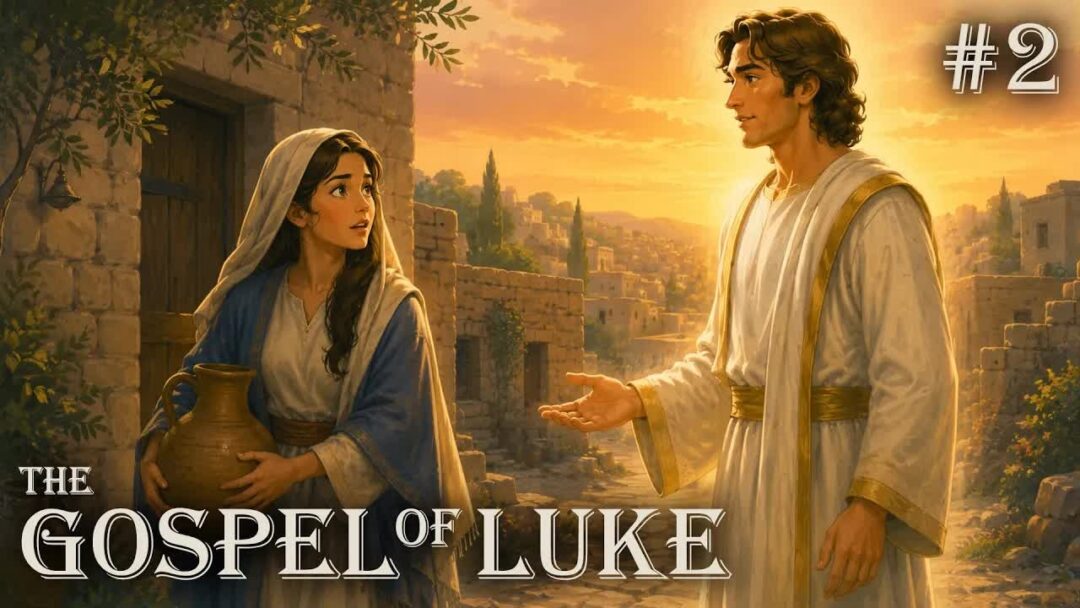
From our Sunday service on May 31, 2026, Luke 1:26-56. This is part 2 of our Gospel of Luke series. Watch the full message: The Handmaid of the Lord – The Gospel of Luke #2 on YouTube.
Last time, we started our new series on the Gospel of Luke by introducing John the Baptist. We left off with the angel Gabriel visiting the priest Zacharias to tell him that his wife would be the mother of the long-awaited prophet who would prepare the way for the Messiah. Before this time period, there were 400 years of silence. For 400 years the people waited for God’s next prophet, knowing that when that prophet came, the Messiah, Jesus Christ, would come.
Today, we’re going to see the next step on that prophetic timeline, as Gabriel visits Mary to tell her she has been chosen to be the mother of the coming Messiah. And from our time in Scripture today, God wants you to know he brings good to those who are humble.
Gabriel Is Sent to Mary
And in the sixth month the angel Gabriel was sent from God unto a city of Galilee, named Nazareth, To a virgin espoused to a man whose name was Joseph, of the house of David; and the virgin’s name was Mary.
Luke 1:26–27
Right off the bat, we’re introduced to quite a bit of information. Once again, the angel Gabriel is the one who visits Mary. God chooses Gabriel to deliver the news about the Messiah. As we mentioned last time, it’s likely that it was Gabriel who did this because Gabriel was originally given the responsibility to deliver the timeline for the Messiah. So it seems that part of his responsibilities as an angel was to deliver messages about the coming Messiah.
For the first time, though, we are introduced to Mary, the mother of Jesus. We know three things about her from this.
She Lived in Nazareth
First off, she lived in a city of Galilee named Nazareth. Most of us should be familiar with that, but there’s a lot we probably don’t know. I mentioned that the book of Luke was written to provide more context for Gentile believers who weren’t familiar with the culture and locations of Israel. So maybe, because that’s the purpose of this book, we should consider what there is to be known about the city called Nazareth.
Nazareth was a small town in lower Galilee. There were not many people who lived there. It would be considered a rural area. A lot of the disciples were from Galilee; Peter was from Galilee. People talk about how the Galileans spoke, because they were in a rural area. Their pronunciation wasn’t exactly like the rest of the Jewish people’s. They had quite a rural accent. Galilee was rural, but Nazareth was smaller and more rural than that. It’s Nathanael the disciple who, when he hears about Jesus, says, “Can there any good thing come out of Nazareth?” Nazareth was not a highly esteemed place.
So why did God have the Messiah come from there? It was a small town, but it was mostly farmland. And there was one other main occupation you could have there: a limestone quarry worker. The city of Nazareth had a limestone quarry that was used to make mostly two things: building stones and purification vessels.
The Chief Cornerstone
The building stones you might understand. At a limestone quarry, they break out the rock, shape it into bricks, and those bricks are used to build buildings. When I was in Bible college and we talked about the role of a carpenter, they mentioned that while a carpenter in Israel would work with wood, that probably wasn’t the main thing they worked with, because of all the invasions that came on Jerusalem over the centuries. Each time a country invaded, they would cut down the trees around Jerusalem and use them to build siege towers or siege ladders to attack the city. Eventually that made the trees around the city quite scarce. Wood was a rare resource. So if you were a carpenter in Israel, you would work less with wood and more with stone.
We see that Jesus and Joseph were carpenters. It’s a clearer translation to call them craftsmen in general. One of the things I learned in Bible college was that Jesus likely was one of the people who made the stones for King Herod’s building projects. So when Jesus was walking through the city of Jerusalem near the temple mount, where King Herod was doing his renovations to the temple, Jesus could have said, “Some of these bricks over here, I helped shape them.” That’s what was going on in Nazareth.
Now, what is one of the things Jesus is called? He is called the chief cornerstone. Don’t you think there’s a little bit of double meaning there that we’re supposed to take from the city of Nazareth? Not just that he was from nowhere, but that he was from the place where the cornerstones of buildings were carved out and shaped for use in building structures. Isn’t it appropriate that our Savior, the chief cornerstone, is carved out of the city of Nazareth?
Vessels of Living Water
The second thing they made from those quarries was stone purification vessels. You may remember from the wedding at Cana how Jesus has them bring out the vessels of water. Those vessels would have been limestone vessels, because they were used for ritually purifying water. If you wanted to purify yourself before working at the temple, you needed to wash yourself in living water, or flowing water. When you live in a big city on top of a hill, it’s very hard to get access to water. You couldn’t just go all the way down to the spring. So what would they do? The Bible says if you took vessels made of pure earth, i.e. limestone or granite, then you could purify yourself using the living water that was stored in those vessels. And so these ritual purification vessels were carved out of Nazareth.
But what’s another thing Jesus tells the woman at the well? He tells her he has living water. Jesus holds living water, and if you drank from it, you’d never thirst again. So Jesus there is saying, “I am a vessel of purification.” Once again, is it not appropriate that the purifying Savior who carries the living water is carved out of Nazareth, the place where they made the vessels that carry living water? You can see that the city of Nazareth is not just a random choice by God; there’s some metaphorical meaning there to be taken away.
That wasn’t the only thing Nazareth did. There’s some evidence of smaller industries: a little bit of textile industry, a little bit of glass making, and processing crops for neighboring towns and cities. But outside of that, the two main things were farmland and quarrying.
She Was a Virgin
The second thing we know is that she was a virgin. She had never known a man. She had never had any inappropriate relationship outside of marriage, so we know she was pure. And that’s important, because Isaiah prophesies about such a woman being the mother of the Messiah.
She Was Espoused to Joseph
Number three, the last thing we learn about her from these two short verses is that she was espoused, or another way you could translate that, betrothed, to a man named Joseph, who was from the line of David.
We need to understand that betrothal is very different from our modern idea of engagement. Engagement and betrothal are not the same thing. Under the legal system of Judea, a betrothed couple was already legally bound to each other. Ending a betrothal required a letter of divorce. So they were already considered married, although that marriage was not yet consummated. When it says that Mary was espoused to Joseph, that means she was legally his wife but had not yet known him in that way.
Because this was a legal marriage, the punishment for unfaithfulness during a betrothal period was death by stoning. This raises the intensity of the narrative of the birth of Jesus Christ. Mary, when she receives the immaculate conception, is taking a big risk with her life. Giving birth to Jesus shows that she doesn’t just trust God, but she trusts Joseph, her husband, because she is risking her life to carry the Messiah. If Joseph decided he didn’t want any part of this, he could divorce Mary, accusing her of unfaithfulness, and she could be put to death. On the other hand, Joseph had to take a risk as well. What if his family thought it was him who had consummated the marriage too soon, before it was permissible? Then they could both be in trouble and both receive consequences and judgment on their lives. Hopefully that puts us in the right perspective for the rest of the story.
“Thou That Art Highly Favoured”
And the angel came in unto her, and said, Hail, thou that art highly favoured, the Lord is with thee: blessed art thou among women. And when she saw him, she was troubled at his saying, and cast in her mind what manner of salutation this should be.
Luke 1:28–29
We need to put ourselves in the right mindset to understand this properly. Usually, when an angel comes, people are afraid. But in this case, she’s not afraid because it’s an angel. Why is Mary troubled? She was troubled “at his saying,” not troubled at his appearance. This isn’t a vision. If we remember how Gabriel appears in the book of Daniel, he looks like any other man. A lot of times in popular culture we picture angels with beautiful wings, as magnificent creatures. But in reality, whenever an angel appears in the real physical world, they always appear like a regular man. So when Gabriel approaches Mary, she assumes this is just another man.
He greets her with the phrase “highly favoured,” or as it’s translated directly from the Hebrew, “you are the one who is highly favored,” which literally means one who is graced. It basically means she is one who is greatly blessed with happiness and/or joy. She thinks it’s just a random man saying, “Wow, you are greatly blessed. You look so happy. You look so good.”
Then he continues and says that the Lord is with Mary. This phrase shows up a couple of times in the Bible, and it usually appears alongside somebody who’s being designated for a divine calling. God says “the Lord is with you” to Moses before he goes to Pharaoh. God says it to Joshua before he calls him to lead. He says it to Jeremiah at the beginning of his book, when he receives the calling to be a prophet. So the phrase “the Lord is with you” carries the idea of God authoring a new work in a person, and that means he will sustain the one who is going to do the work for him.
Troubled at His Saying
We understand what’s going on, but Mary herself did not. She was troubled by the saying. She doesn’t recognize Gabriel as an angel, and she’s disturbed. Why? From her perspective, a random man came up to her to flirt, saying she is greatly blessed with something, that God is with her, and that she is blessed with that something more than other women. You can see why this would be uncomfortable. She doesn’t understand the angel’s intentions.
In fact, it was strictly forbidden for there to be any kind of communication like this between a man and a woman, especially a woman who is already betrothed to a husband. She should feel very uncomfortable about this. Men should not be talking to betrothed women like this. It’s unacceptable. It’s dangerous. She could get in trouble. She doesn’t know what this man’s intentions are. So she “cast in her mind what manner of salutation this should be.” She thinks, what kind of way is this to greet a betrothed woman? And she tries to figure it out.
Gabriel Clarifies His Intent
And the angel said unto her, Fear not, Mary: for thou hast found favour with God. And, behold, thou shalt conceive in thy womb, and bring forth a son, and shalt call his name JESUS. He shall be great, and shall be called the Son of the Highest: and the Lord God shall give unto him the throne of his father David: And he shall reign over the house of Jacob for ever; and of his kingdom there shall be no end.
Luke 1:30–33
In verse 30, Gabriel clarifies: “Thou hast found favour with God.” This must have been a relief to Mary, because she finds out Gabriel is not in fact flirting with her. He’s talking spiritually, not about any physical attribute of her as a person. “Oh, this is a spiritual thing. Okay, I’m on the same page now.”
And Gabriel says she’s going to do something miraculous: conceive in her womb, bring forth a son, and call his name Jesus. That name Jesus is significant. In Hebrew, the name is Yahushua, which means Yah, or Yahweh, is my salvation. It’s a prophetic name about the role of the Messiah: the Messiah was to bring salvation to the world, and God, who was the Messiah, would bring that salvation.
He then tells her that this child would be called the Son of the Highest, that he would sit upon the throne of his father David, reign over the house of Jacob forever, and have a kingdom with no end. So we’re told that Jesus is meant to take the throne of David his forefather and usher in the kingdom of heaven, a kingdom that would never end and would be the continuation of the Davidic kingdom that came before.
“How Shall This Be?”
Then said Mary unto the angel, How shall this be, seeing I know not a man?
Luke 1:34
Naturally, this is a lot of information, and Mary has questions. It’s a very good question. “Gabriel, you’re saying that I’m going to have a child, but I’m betrothed now to a man. It would be inappropriate for me to divorce my husband. Am I going to have the seed through my husband? I’ve had no relationship with him. It’s inappropriate for me to have a relationship with him before the time of consummation. That would be sinful. Gabriel, how is this going to be? I’ve not known a man. I can’t divorce my husband, and I can’t sleep with my husband because it’s not the proper time. How does this work?” This isn’t a lack of faith. This is a genuine question.
And the angel answered and said unto her, The Holy Ghost shall come upon thee, and the power of the Highest shall overshadow thee: therefore also that holy thing which shall be born of thee shall be called the Son of God. And, behold, thy cousin Elisabeth, she hath also conceived a son in her old age: and this is the sixth month with her, who was called barren. For with God nothing shall be impossible.
Luke 1:35–37
Mary is told that Jesus would not be made through some normal means of procreation, but that he would be miraculously conceived by the power of the Holy Spirit. The Holy Spirit would overshadow her and rest upon her, and through a miracle of the Holy Spirit, God himself would cause Jesus to be born. Because of this, he would quite literally be called the Son of God.
Go See Elizabeth
God doesn’t leave her with no evidence here. He wants her to have faith, so he gives her a chore to do to increase her faith. He tells Mary to go see her cousin Elizabeth, who she’s known for years to be barren and infertile. “Go visit your cousin.” Up to this point, Elizabeth has kept herself secluded from the rest of society to keep her pregnancy a secret, so Mary doesn’t know her cousin is pregnant. And so God says, “Go see Elizabeth. I want you to see the miracle I’ve done in her. She’s six months pregnant with John the Baptist. What was impossible with man is possible with God. So go see her and see what I can do.”
In verse 37, he says that famous phrase we’ve all heard before: “For with God nothing shall be impossible.” In the Greek, that is literally “because each word will not be impossible with God,” which is a little confusing to us as English speakers with the double negative. If we remove the double negative, it translates to “because each word will be possible with God.” There’s nothing God can’t do. So if God calls you to do something, he will enable you to do every single word of it, because God can do anything and everything he wants to do.
Mary Accepts Her Calling
Unlike Zacharias before her, Mary does not doubt what God calls her to do. She doesn’t overthink the mechanisms of how it would work. She doesn’t ask any more questions than she needs to. What does she do? We see in verse 38 that she accepts her calling.
And Mary said, Behold the handmaid of the Lord; be it unto me according to thy word. And the angel departed from her.
Luke 1:38
Mary has heard all she needs to know. She just wanted to know which direction she was supposed to go in following the Lord. And when God told her, “There’s nothing you need to do. I’m going to cause a miracle,” she said, “Be it unto me, Lord. Let it happen to me. Let me be your handmaid.” Another word you could use for that is a female servant or slave. “God, consider me your servant. I put myself under your mastership to do with me what you need to do. God, use me for your purpose. Be it unto me according to your word.”
The Cost of Saying Yes
This was a big step to take. Let me remind you again what it was like to be pregnant outside of marriage in this culture. We’re not talking about some side-eyes like we have today. We’re talking about the real risk of a death penalty, of a stoning, of an end to your life. And if you were given mercy, there was still going to be the same judgment you’d face today. People thinking, “Oh, she’s too young. She ruined her relationship with Joseph. She’s got that scarlet letter on her. She’s so disgusting.” The testimony she’d kept her whole life was going to be at risk.
And we know this is the case, because we’re told that even her own children, during the time of Jesus’s ministry, did not believe in Jesus Christ. If they didn’t believe Christ was the Messiah, then they didn’t believe their mother was telling the truth about their brother’s birth. They didn’t believe Jesus was miraculously born. They believed their mother was unfaithful to their father. Take that in for a second. For 30 years, Mary had to have her own children think of her as an unfaithful woman. That is a hard thing to carry. And yet Mary says, “I know the shame that comes with this mission. But Lord, let it be done to me as you have said.”
Mary Visits Elizabeth
After she accepts the mission, she follows God’s instruction.
And Mary arose in those days, and went into the hill country with haste, into a city of Juda; And entered into the house of Zacharias, and saluted Elisabeth.
Luke 1:39–40
She goes to visit Elizabeth to see God’s promise to her, to see that God can do the impossible. And we see her calling confirmed when she gets there.
And it came to pass, that, when Elisabeth heard the salutation of Mary, the babe leaped in her womb; and Elisabeth was filled with the Holy Ghost: And she spake out with a loud voice, and said, Blessed art thou among women, and blessed is the fruit of thy womb. And whence is this to me, that the mother of my Lord should come to me? For, lo, as soon as the voice of thy salutation sounded in mine ears, the babe leaped in my womb for joy. And blessed is she that believed: for there shall be a performance of those things which were told her from the Lord.
Luke 1:41–45
Here we see that when she visits Elizabeth, there is a prophetic word left for her. If you remember from last time, we were told that John the Baptist was going to have the Holy Spirit from the time of his conception to the time of his death. The Holy Spirit would never leave his side. And so, even in the womb, he carries a prophecy. Well, he couldn’t quite speak from the womb; it was a little bit muffled in there. So the Holy Spirit overshadows Elizabeth to speak on his behalf. John the Baptist kicks his mother, transferring the Holy Spirit to her in a way, and she begins to speak.
“Blessed Art Thou Among Women”
First off, she says, “Blessed art thou among women.” That should be a familiar phrase. Where did we just hear it? When Gabriel came to visit Mary, that is what he said. Now, when she meets Elizabeth, that same exact phrase is repeated to her without anybody telling Elizabeth what had happened. This is God showing Mary that what is said here is not from Elizabeth, but from God.
“Blessed is the fruit of thy womb.” Here we’re told that Mary has already conceived by the Holy Spirit on her way to visit her cousin. The work of God has already begun. Jesus Christ is already in her womb. And Elizabeth says, “And whence is this to me, that the mother of my Lord should come to me?” Once again, this shows that God was literally in the flesh in Jesus in the womb, and that Elizabeth realized the Messiah was God and that Mary was the mother of her Lord.
Blessed Is She That Believed
In verses 44 and 45 we see a contrast with Zacharias. Last time, Zacharias was told by Gabriel that his wife would conceive in her old age, and he doubted, and he was condemned. Here we see the opposite. When Mary was told about this miraculous conception, she believed, and because of it she wasn’t condemned, but praised. “Blessed is she that believed.” Mary had faith that what God said was true. Though it didn’t make sense in her mind how it would work, she followed it anyway.
Mary’s Song of Praise
With this being said, Mary can’t help but write a psalm of praise to God, and it ties in all the events that had happened so far.
And Mary said, My soul doth magnify the Lord, And my spirit hath rejoiced in God my Saviour. For he hath regarded the low estate of his handmaiden: for, behold, from henceforth all generations shall call me blessed. For he that is mighty hath done to me great things; and holy is his name.
Luke 1:46–49
First off, she starts where we started today. Mary thanks God for considering a poor, humble woman like her. A woman from a no-name city called Nazareth. A woman from a place where there wasn’t much to her story except to one day be married, have children, pass on the family name of her husband, and die. A lowly, poor woman whom the people of the region mocked and the people of the nation were unaware of. God saw her, and God wanted to do something great for her and through her. God saw that poor woman from a no-name tiny town. He saw her faith and her humility, and he chose her to do one of the greatest works of the Bible: bringing the Messiah into the world.
And Mary, knowing the reality of the situation, says, “I realize now all generations from now on will call me blessed. They will know that the Lord blessed me. They’ll know that the Lord saw my humility.” She was just so thankful for that blessing. So she continues by praising the Lord for the truth of his character, and she wants to teach people that if something like this can happen to her through God, then the same thing can happen to you.
And his mercy is on them that fear him from generation to generation. He hath shewed strength with his arm; he hath scattered the proud in the imagination of their hearts. He hath put down the mighty from their seats, and exalted them of low degree. He hath filled the hungry with good things; and the rich he hath sent empty away. He hath holpen his servant Israel, in remembrance of his mercy; As he spake to our fathers, to Abraham, and to his seed for ever.
Luke 1:50–55
God Lifts Up the Humble
Here Mary proclaims a truth for us today. Verses 50 and 51 tell us that God is merciful to those who fear him. “His mercy is on them that fear him from generation to generation. He hath shewed strength with his arm; he hath scattered the proud in the imagination of their hearts.” Mary tells the truth that God lifts up those who are humble, who submit themselves to him, who aren’t prideful and arrogant. But those who are prideful and arrogant, he knocks down a notch. He kicks them off their pedestal. He humbles them. Mary wants you to know today that if you are humble, God will lift you up. But if you are proud, be afraid, because God will knock you down. He will humble you. He will put you where you need to be to lose some of that pride.
God Provides for the Poor
Verse 53 talks about how he provides for the poor: “He hath filled the hungry with good things; and the rich he hath sent empty away.” Mary lived there in that poor mining town. She knew what it was like to be poor. She knew what it was like to struggle. But she says God gives the poor what is good. God may not give the poor everything they want, but he’s going to give them what they need when they come to him in humility.
But the rich are going to come to him in prayer and ask God to do all these things in their life, and God’s going to say, “No, I’m going to send you away with nothing, because you have what you want. You’re hoarding all the things in your life with your greed and your pride and your arrogance. Because you’re holding on to all those things, I’m not going to give you anything else. You have your reward. Enjoy it. Live with it. You get nothing more.” So while the rich have no relationship with God, because they love their riches more than that relationship, the poor who long for connection with God will have their needs fulfilled. They will have good things and blessings in their life. Although they may not have all the comforts of the rich, they will have the comfort of God.
God Keeps His Promises to Israel
And lastly, Mary connects what is going on in her life with the promises to Israel: “He hath holpen his servant Israel, in remembrance of his mercy; as he spake to our fathers, to Abraham, and to his seed for ever.” Holpen means helped. She wants Israel to remember that God has remembered his people by bringing the Messiah into the world. The promise of the Messiah was made all the way back in Genesis, when Adam and Eve were cast out of the garden. Then that promise was made again to Abraham, that his seed would be a blessing to all nations. And when Mary received this promise, she knew what it meant. She knew her Torah. She knew her Old Testament. “All generations are going to call me blessed, because I am going to give birth to the blessing of Abraham, who is going to bless all nations of the world.”
So she doesn’t want to make this all about her. She wants it to also be about her people: “Israelites around me, I want you to know that God has kept his promise to you, and God is keeping his promise to me. And if God’s keeping his promise to all of us, I want all generations to know that God will keep his promises to you.” Mary doesn’t just make this about herself; she makes it about what God is doing in the lives of others. Instead of saying, “I am so blessed, I am so blessed,” she says, “God has blessed me. Let me show you that if he’s done it for me, the least of these, he can do it for you as well.”
Three Months with Elizabeth
And Mary abode with her about three months, and returned to her own house.
Luke 1:56
Instead of going back home to Nazareth, Mary decides to stay with Elizabeth for three months before returning home. Think about that for a second. We’re going to get there later in this series, but Joseph doesn’t know about this baby yet, and Mary is deciding to spend the first three months away from Joseph. Surely this is going to bring some questions. Surely this is risky. I’m not sure why she decides to stay. We’re not told. But Elizabeth went into hiding for a time, and a lot of people conclude that was about her spending time in prayer. Maybe Mary did the same thing. She spent three months just enjoying the blessing of God without any of the questions. But soon she will have to go home, face Joseph, and explain to him what has happened.
Conclusion
As we bring today’s account to a close, we see the truth Mary herself proclaims: God brings good to those who are humble. Mary was not powerful or wealthy. She probably wasn’t even noticeable to the people of her own region. She was just a young woman from a small town, living in a humble condition with a consistent faith in God. God saw her, recognized the greatness of her faith and humility, and chose her to carry one of the greatest works in all of human history: bringing the Messiah into the world.
This is the pattern Mary praises God for in her psalm. God shows mercy to those who fear him. He does not work according to the values of this world, favoring those who have the most and are the most powerful. This world honors pride, power, wealth, and status. But God delights to bless those who humbly trust him.
Mary’s response shows us what humble faith really looks like. She did not understand everything God wanted to do, but she did know this calling would be costly to her. She knew this calling could cause misunderstanding and bring shame, danger, and difficulty. But despite the challenges she knew were ahead, she still said, “Behold the handmaid of the Lord; be it unto me according to thy word.” And that is the kind of humility God blesses: humility that focuses on the greatness of God rather than the greatness of oneself. Mary believed that if God had spoken, then God would perform it. And because she humbled herself before the Lord, God brought good to her. And through her, he brought goodness to the whole world through Jesus Christ.
So the question for us is this: Will we humble ourselves before God the way Mary did? Will we trust God’s word even when we don’t understand the whole plan? Will we obey God even when the calling brings difficulty? And will we always believe that his way is good?
God wants you to know he brings good to those who are humble. So will you dedicate yourself to humbly follow him today?

Recent Comments