
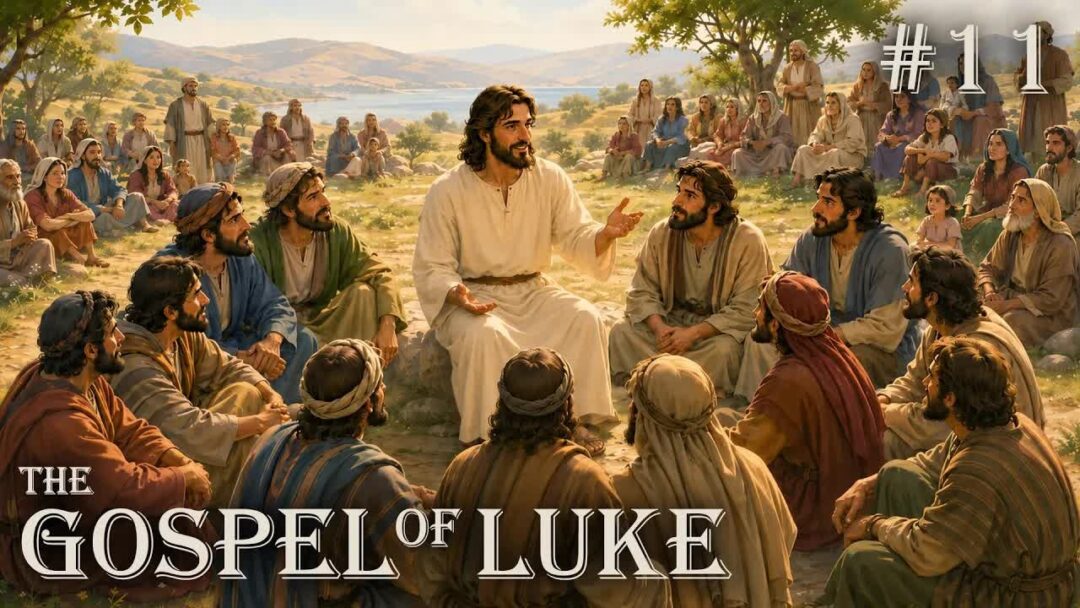
From our Sunday service on August 9, 2026, Luke 6:12-36. This is part 11 of our Gospel of Luke series. Watch the full message: Training the Twelve: Part I – The Gospel of Luke #11 on YouTube.
Last time, we saw Jesus confronted by the Pharisees as they sought to discredit his ministry, and the lesson culminated in Jesus continuing to minister in the will of the Father despite the Pharisees’ attempts to plot with their mortal enemies, the Herodians, to destroy him. Now we see Jesus prepare for a new era of teaching. At the beginning of his ministry, it was just Jesus who went town to town teaching. He went from Capernaum to one city and the next and the next, and slowly, over the weeks of our study, he’s been picking up a disciple here and there along the way. Now things are beginning to change. His ministry is progressing, and soon he will not be going himself to each and every city. He will go to one city, and his disciples will be sent to others, two by two, to preach the message to all of Israel. But before the disciples are ready for this next step, they must first learn what it means to be a disciple of Christ. So Jesus takes his disciples and begins training them in what it means to follow him.
God wants you to be merciful like he is merciful.
All Night in Prayer
And it came to pass in those days, that he went out into a mountain to pray, and continued all night in prayer to God. And when it was day, he called unto him his disciples: and of them he chose twelve, whom also he named apostles;
Luke 6:12–13
Right off the bat, notice how important prayer was in the life of Jesus. We see it recorded multiple times in Scripture that Jesus leaves the disciples and goes off by himself to pray. Jesus is both fully man and fully God, and yet in the incarnation, even God himself, as God the Son, takes time alone in prayer with the Father. If Jesus needed to get alone with God, how much more do we as Christians need to take time to get alone in prayer with God?
This was a very important time. Jesus was preparing to choose the twelve apostles, those special disciples who would go on to preach his name to all nations of the world, and he takes this task very seriously. The incarnation is complicated. I don’t know all the limitations that were placed on Jesus, but it appears that he wanted to be absolutely 100% sure that the disciples he chose were the ones God wanted to use. Jesus doesn’t just say, “I’m God the Son. I’m going to go pick them.” He spends the entire night in prayer. He wants no doubt about who these twelve apostles are. It was probably one of the most important moments in his ministry. Eleven of these men would continue his ministry after his death, and one of them was prophesied to betray him. If you mess up these twelve disciples becoming apostles, the whole ministry suffers.
No doubt he was also praying for those disciples who would begin to follow him in a new way. Later down the road, near the crucifixion, Satan goes into Peter and speaks through him, and Satan hath desired to have Peter, that he may sift him as wheat. The second these disciples step into this role, Satan is going to come after them. So there’s no doubt in my mind that as Jesus prepares to choose these disciples, he also prays for each and every one of them for the big, massive task they were about to take on.
Disciples and Apostles
Notice the two words used in verse 13: “he called unto him his disciples: and of them he chose twelve, whom also he named apostles.” What is the distinction between a disciple and an apostle? All apostles are disciples, but not all disciples are apostles. The word disciple in the original language simply means a student of someone. If you went to school and had a professor or teacher, whether college or elementary, you would be a student of that teacher, their disciple. Jesus had a lot of students, people who would follow him from message to message and learn his teachings. The twelve are sent first, and later we have seventy disciples sent out to preach to all the cities of Israel. There were only ever twelve apostles, but there were many, many disciples.
How was an apostle different? In its original language, an apostle is a messenger sent by someone as a representative. It literally means a sent one. This word was often used in a political context to mean someone like an ambassador or an envoy to another nation. Jesus called these men apostles from the perspective of the kingdom of heaven. They are spiritual envoys, spiritual ambassadors: “my representatives of the kingdom of heaven, whom I send out to preach of the kingdom of heaven and get people to join the kingdom of heaven.” There might be people today who call themselves apostles, but there were only ever twelve apostles. Why? Because they were quite literally sent by Jesus.
The Twelve
Simon, (whom he also named Peter,) and Andrew his brother, James and John, Philip and Bartholomew, Matthew and Thomas, James the son of Alphaeus, and Simon called Zelotes, And Judas the brother of James, and Judas Iscariot, which also was the traitor.
Luke 6:14–16
Here we get the official list of the twelve. They go by multiple names throughout the Bible. It was very common in this day and age for people to have more than one name, mostly because of the mixing of cultures, and also because there were only a few Hebrew names in circulation. There were plenty of people in Jesus’ day named Jesus, Yeshua, the Joshua in English. There were probably more Joshuas in Jesus’ day than there are Joshuas today. They all had similar names, so they would also go by other names so that people wouldn’t get confused about who you were talking about. Let’s look at them one by one.
First, Simon, son of Jona. He went by Simon or Simeon, or, as you probably know him better, Peter. He was nicknamed Cephas, which means a stone. He was a married man who lived in Capernaum but was born in Bethsaida.
Then Andrew, son of Jona, Peter’s brother. He was the first disciple called by Jesus. He was the one who went and told Peter about Jesus, because he was a disciple of John. He was also born in Bethsaida but worked and lived in Capernaum.
Then James, the son of Zebedee. He was one of the two sons of thunder. He was later known in history as James the Greater, or, if you watch The Chosen, Big James. He was a fisherman who worked with his father, Zebedee, in the fishing trade alongside Simon and Andrew, who were partners in their business. They grew up around Capernaum and had a business there. They were called the sons of thunder because they were known to jump into action before Jesus even asked them to, and sometimes when he didn’t want them to. These two brothers were known to get into trouble.
The other brother is John, son of Zebedee. He also worked under Zebedee as a fisherman, and he’s the second of the two sons of thunder. You may also know him as the beloved disciple, the disciple whom Jesus loved, and the author of the book of John.
Then Philip of Bethsaida. Honestly, Scripture doesn’t tell us much about Philip except that he was from Bethsaida. It’s interesting, because Philip comes up a couple of times, and yet we know very little about him. We can conjecture he was probably a disciple of John the Baptist, based on how he met Jesus and the circumstances around it. When Philip was called, he went and got his best friend Nathanael and told him about Jesus.
That leads us to the next disciple, Nathanael son of Tolmai, the friend of Philip. You may also know him as Bartholomew. It might surprise you, but Bartholomew isn’t actually a name. It means son of Tolmai in the Aramaic, so his full name is Nathanael son of Tolmai. Once again, we don’t know much about him, other than that he was amazed that God knew he was sitting under a tree.
Then Matthew son of Alphaeus, also called Levi. He worked as a tax collector for the Roman Empire, and he seems like the odd one out of the bunch. But when you think about it, it makes a lot of sense why Jesus called this tax collector. Being a tax collector, he would be well acquainted with writing things down, and we just so happen to have a Gospel in the Bible called Matthew, which, according to the historians of the days when the Gospels were written, was the first Gospel written. I’ve gone on a whole study of this over the years. Modern scholars will tell you Mark was written first, but it’s absolute nonsense. Every single person who was around 50 to 100 years after the Gospels were written unanimously agrees that Matthew wrote his Gospel first, in Aramaic. Then Mark. Then Matthew was translated into Greek, then Luke, and then John. They all unanimously agree on the order. Secular historians have gone crazy trying to explain it away, saying they were all written by people who didn’t know Jesus, and that only works if you make Mark the first one. So they’ll tell you Mark was written first. No, it was Matthew. Why? Because Jesus saw a tax collector who could write and said, “Man, I need somebody to write all this down.” Matthew was the man who could write, and when Jesus died and he was told to go, he made a Gospel account to help minister to the growing church.
Then Thomas. His nickname was Didymus, which means the twin. We don’t know why Thomas was called the twin. There are multiple theories. Some think he was Matthew’s twin brother, because it says “Matthew and Thomas.” Maybe they were twins; we don’t know. Some conjecture that he looked like Jesus, and that’s why he was called the twin. We’ll never know for sure, but his nickname was Didymus.
Then James the son of Alphaeus, later known as James the Lesser, also potentially Matthew’s brother.
Then Lebbaeus Thaddaeus. Out of all of them, he’s the only one for whom we get both a surname and a first name. He’s also called Jude. He’s the brother or son of James, depending on how you translate that word. We don’t know much else about him.
Then Simon the Zealot. Once again, we don’t know much about him, but we know he was zealous, because that was his nickname. He was eager for Christ, or, as some also believe, before his calling he was part of the group of Jews who wanted to overthrow the Roman Empire. He was excited about the idea of the Messiah coming and ready to go fight alongside the Messiah, but when the Messiah came, he found out that Jesus wasn’t about fighting. He was about changing hearts for the kingdom of God. So Simon took his zeal for freedom from Rome and put it into Jesus’ ministry instead.
And lastly, but certainly not to be forgotten, Judas Iscariot, the son of Simon, also known as the betrayer or traitor, the one Jesus picks out, recognizing and knowing immediately that he would inevitably betray him.
So Jesus takes these twelve people: four of them fishermen, two or so definitely disciples of John the Baptist, one tax collector, and a Zealot. Man, there’s a ragtag team of people, not who you would consider the most qualified. Matthew’s probably the only one we know for sure could really write well. We know Peter wrote First and Second Peter, but it didn’t seem like Peter was a big writer early on. These aren’t the most educated or the most qualified, but boy oh boy, were they equipped to do what Jesus wanted them to do.
Teaching His Disciples
These specific twelve are chosen, and we see them assemble for the first time.
And he came down with them, and stood in the plain, and the company of his disciples, and a great multitude of people out of all Judaea and Jerusalem, and from the sea coast of Tyre and Sidon, which came to hear him, and to be healed of their diseases; And they that were vexed with unclean spirits: and they were healed. And the whole multitude sought to touch him: for there went virtue out of him, and healed them all.
Luke 6:17–19
We’re told here what Jesus’ teachings often looked like. Jesus was teaching his disciples directly. He picks the twelve and calls them out for this specific sermon. It isn’t addressed to the crowds, but to his disciples, to equip them for ministry. The innumerable multitude listening around him just happen to be there. This is for people who are sold out for Christ. We also see that the sick and demon-possessed came from all the surrounding cities to be healed at Jesus’ teaching sessions with his disciples, because the people knew that if Jesus simply touched them, their problems would go away. During these teaching sessions Jesus would set aside time to heal these people of their diseases and remove those distractions from hearing the sermon he was about to preach. With all these things said and done, Jesus begins to train his twelve disciples for the mission they’re about to go on.
The Beatitudes
He begins by teaching the Beatitudes, which are blessings for faithfulness.
And he lifted up his eyes on his disciples, and said, Blessed be ye poor: for yours is the kingdom of God. Blessed are ye that hunger now: for ye shall be filled. Blessed are ye that weep now: for ye shall laugh. Blessed are ye, when men shall hate you, and when they shall separate you from their company, and shall reproach you, and cast out your name as evil, for the Son of man’s sake. Rejoice ye in that day, and leap for joy: for, behold, your reward is great in heaven: for in the like manner did their fathers unto the prophets.
Luke 6:20–23
The first thing Jesus talks about in his address to his newly chosen disciples is the Beatitudes, the things that, if you do them, you will be blessed. You’ll notice through this sermon that Jesus brings things out in sets of four. Let’s look at each one.
Blessed Be Ye Poor
The first thing he says to this team he has just pulled aside and told, “You will be my apostles. I am sending you as envoys, ambassadors of the kingdom of heaven,” is, “Blessed be ye poor: for yours is the kingdom of God.” Oh, great. Off to a great start. “I’m chosen to be a spiritual ambassador, and the first thing is, blessed are you poor.” What is Jesus saying? “Disciples, apostles, a life of discipleship means sacrificing your pursuit of wealth. You cannot serve both God and wealth.” Jesus says this in Matthew 6:24:
No man can serve two masters: for either he will hate the one, and love the other; or else he will hold to the one, and despise the other. Ye cannot serve God and mammon.
Matthew 6:24
Notice that Jesus doesn’t pick out his disciples until after Peter, Andrew, James, and John leave their business to follow him. And it’s not long after that Matthew is picked, and he goes too. Matthew leaves his job. Andrew, Peter, James, and John leave their jobs. Then he says, “Blessed be ye poor.” What’s the context? They all just left their jobs. “You made the right choice. You gave up your pursuit of wealth and comfort for the kingdom of heaven. Blessed are you poor, because the kingdom of heaven belongs to you. You are citizens of this kingdom, and not only citizens. You are now its ambassadors. Though your wealth is sacrificed in serving me, those who sacrifice wealth for the kingdom will inherit something so much better: a blessed place in the kingdom of God.” It’s not such a bad start after all. Blessed are you poor? I’ll give you all my money for that.
Blessed Are Ye That Hunger Now
“Blessed are ye that hunger now: for ye shall be filled.” A life of discipleship means a life of discomfort. Remember, the twelve and then the seventy will be sent into Israel to preach. One of the things Jesus says is, “Don’t bring any money with you. Don’t bring a money bag. You’re going to rely on the kindness of strangers.” Jesus tells them straight up, “There are going to be days when you go hungry. You’ll go to a city and preach, and they’ll reject you and kick you out, and you won’t have a place to spend the night. You’ll spend the night on the side of the road, in the dirt, hungry.” But Jesus had already told them, “Blessed are ye that hunger now: for ye shall be filled.” It’s uncomfortable. Although a life of discipleship may make you uncomfortable, ultimately God promises he will sustain you. I love how The Chosen deals with this: “I might let you be hungry, but I will feed you.” Jesus doesn’t promise to take away all the issues of life. But he promises that when the rubber meets the road and you’re at the end of your rope, he will sustain you. “If you give up your comfort for me, I promise I will get you through it, and I’ll see you on the other side.” Although they’d give up comfort and sometimes want more food, God said, “I will ensure you never starve.”
Blessed Are Ye That Weep Now
Number three: “Blessed are ye that weep now: for ye shall laugh.” A life of discipleship means a life of hardship. They’d be led into difficult situations and be well acquainted with sadness and loss. But although they’d have to deal with hardship in service to others, he promises them that they will someday laugh again. While there would be times of difficulty, their ultimate reward was eternal joy over the work they had accomplished. Even Jesus struggled with these times of weeping. Think of Lazarus dying: “Jesus wept,” the shortest verse in the Bible. When we’re called to serve others, it puts us in situations that are going to break our hearts. Not always did God do the things people wanted him to do, and they mourned over the hardship. There would be days when they went to the cities, were rejected, and probably cried on their way out, because they had the word of God and the life, and the people just didn’t want it. But Jesus says, “If you go and do the hard thing, and at the end of the day you weep, blessed are you, because when you enter heaven you won’t be weeping over what you did. You’ll be rejoicing, because you did the will of the Father even when it was hard.”
Blessed Are Ye When Men Shall Hate You
On the fourth, Jesus ups the ante and really tells them what it’s going to be like to serve him: “Blessed are ye, when men shall hate you, and when they shall separate you from their company, and shall reproach you,” or mock you, “and cast out your name as evil, for the Son of man’s sake.” A life of discipleship means a life of conflict. Most people didn’t like what Jesus had to say, and because the disciples’ only job was to teach what Jesus said, they weren’t going to like the disciples either. If you choose the life of discipleship, you commit yourself to preaching what Jesus preached, teaching what Jesus taught, and living like Jesus lived, and if you do that, it’s going to make people uncomfortable. For the Pharisees, it called them to a standard and called out their hypocrisy, and they didn’t like being held to a standard they didn’t want to live by. To the Romans, it looked like a condemnation of their political rule, and they didn’t like the politics that got involved with preaching the truth. The lay people who sat under the false Pharisees heard teachings from the word of God and said, “These aren’t like what I heard before, and I don’t believe you.” They hated them and thought of them as false teachers. As these disciples and apostles went out into the world and preached, even after Jesus, the world would just get worse and worse, until Nero came and it became illegal even to speak the name of Christ.
But Jesus says that when you get to that point and the conflict comes, don’t weep, because this is a blessing: “Rejoice ye in that day, and leap for joy: for, behold, your reward is great in heaven: for in the like manner did their fathers unto the prophets.” You know what they did to the prophet Isaiah? They cut him in half. We look so favorably on all the prophets in our Bibles today, but what did the people of their day do? They mocked them, spit on them, kicked them, threw them out, and punished them. Jeremiah had his words written in a book and read to the king, and the king “cut it with the penknife, and cast it into the fire.” The whole thing had to be written over again. So Jesus says, “If you’re going to be my disciple, be ready for conflict, because every time I’ve ever told somebody they need to change, I’ve had the same reaction. They didn’t like it. There might be some who get convicted and convert, but the vast majority of people are just not going to like it. They aren’t going to want to listen to what you have to say. The truth is, there’s going to be conflict. But rejoice, because you have my blessing for all of it.”
The Woes
He begins with four blessings, four beatitudes for obedience. Then he goes to what we call the woes, which are curses on those who reject them.
But woe unto you that are rich! for ye have received your consolation. Woe unto you that are full! for ye shall hunger. Woe unto you that laugh now! for ye shall mourn and weep. Woe unto you, when all men shall speak well of you! for so did their fathers to the false prophets.
Luke 6:24–26
See the parallelism? One is the blessings for obedience. The other is the curses for disobedience. Let’s look at them one by one.
Woe Unto You That Are Rich
“Woe unto you that are rich! for ye have received your consolation.” Those who pursue wealth in this life over Christ will not make it to heaven. If you choose to follow wealth and reject Christ, you’re going to have a woe, a trouble coming your way, because you have chosen to serve yourself through wealth instead of God. “Those of you who choose to do so instead of being my disciple, woe to you. Brace yourself for what is coming.” If you don’t pursue the kingdom of heaven and you pursue wealth, when you stand before him and he asks why you should get in, you’ll say, “Well, I made a lot of money.” Jesus will say, “That’s not good enough.” “I gave enough money to the church.” That’s not good enough. “I called you to follow me in obedience.” “Well, I thought if I was just a little more greedy I’d have a better life. I chose to be greedy instead of believing in you. I thought I’d be good enough, that wealth would be good enough, and that if I just used my wealth the right way, I could get into heaven.” Jesus will say, “No. Woe. Cursed. There is no place for you here.”
Woe Unto You That Are Full
Number two: “Woe unto you that are full! for ye shall hunger.” Those who pursue indulgence in this life over Christ will not make it to heaven either, because they rejected his call. They’ll be left in an eternal state of unfulfilled desire. Think of the story of the rich man and Lazarus. Lazarus suffers his entire life going hungry, and the rich man indulges himself. He doesn’t give anything to the man starving outside his gate. Both die. Lazarus ends up in Abraham’s bosom, and the rich man ends up in hell, tormented: “I just need the tip of a finger in water. I just need some water.” Well, in your life you had plenty of water, rich man. You indulged yourself. You lived in comfort and in all the pleasures of the world. If you live in the pleasures and reject Christ, your eternal state is going to be one of starvation and hunger and longing that will never be fulfilled. Woe unto you for what is coming.
Woe Unto You That Laugh Now
Number three: “Woe unto you that laugh now! for ye shall mourn and weep.” Is it wrong to laugh? That’s not what he’s saying. He’s saying that those who pursue entertainment and pleasure in this life over Christ will not make it to heaven, because they chose to indulge themselves in pleasure over their salvation. Instead of spending eternity in happiness and joy, they will eternally mourn and weep because of that choice.
When All Men Shall Speak Well of You
Number four: “Woe unto you, when all men shall speak well of you! for so did their fathers to the false prophets.” There were people in this day and age, the Pharisees being a major group of them, who would go around pretending to be disciples of God, pretending to be teachers of God’s truth, and the people loved them. The Pharisees wore the scriptures on their garments and walked around with an aura of spirituality. The people came to them to solve their needs: “the mighty priests, the mighty scholars, the scribes, the Pharisees, they’re so wise, they can help me with all my problems.” They got all the pats on the back and praise you could ever want. But God himself despised them. Why? Because they were false prophets. What they taught was what pleased the people, what the people wanted to hear, not what God was actually saying. They twisted the scriptures into what they wanted them to be.
They would allow a man not to take care of his elderly parents as the law said. The law said you need to take care of your elderly parents and use your money to take care of them. And they would say, “If you want to give it to our treasury instead, to the religious leaders as a tithe, you don’t need to take care of your parents.” God hated them, because his law said clearly to take care of your elderly parents, and they would take the money for themselves. “You who choose to be patted on the back and praised for your religiosity, I’ve got bad news for you. That’s all the praise you’re ever going to get. When you stand before God and he asks why you did what you did, and you say, ‘I did it for you,’ he’ll say, ‘Liar, I never knew you.'”
The condemnation here is very, very cruel. Those who choose to gain popularity and power through smooth talking, giving people what they want to hear, will also miss heaven, because they chose popularity over following God, and they’ll receive the same condemnation as those who followed the false prophets of the Old Testament. So Jesus tells his disciples, “You will be blessed, but I’ve got some news. Those who stand against you have nothing to gain from it. Don’t be upset about them. Their judgment is coming. What you do for me will be blessed.”
Love Your Enemies
To make it more practical for them, he gives them an example of a higher standard of morality. We call it loving your enemies.
But I say unto you which hear, Love your enemies, do good to them which hate you, Bless them that curse you, and pray for them which despitefully use you.
Luke 6:27–28
Jesus doesn’t want to leave them with these cryptic beatitudes without a practical way to implement them. So he gives them the most obvious and easy thing to do to make sure you follow the four blessings and avoid the four woes. “I can summarize this in one action: love your enemies.” To love your enemies by nature means living less for yourself and more for others. You can’t be indulging yourself in the pleasures of the world while you’re focused on loving people who hate you. If you want to follow these blessings in your life, the easiest thing to do is just love your enemies. And once again he gives four examples of what obeying this command looks like.
And unto him that smiteth thee on the one cheek offer also the other; and him that taketh away thy cloke forbid not to take thy coat also. Give to every man that asketh of thee; and of him that taketh away thy goods ask them not again. And as ye would that men should do to you, do ye also to them likewise.
Luke 6:29–31
Four practical examples for the four beatitudes and the four woes.
Turn the Other Cheek
Number one: if someone hits you on the cheek, turn the other to them. I’ve heard some real fancy preachers online try to twist this into something it’s not. They come up with a nonsense historical theory that in one culture, hitting someone with one hand took away their honor, but if you offered the other cheek, it took away the honor of the one who hit you, and you got the honor. No, nonsense. Jesus isn’t talking about that. Skip down to verse 36 and see what Jesus is talking about: “Be ye therefore merciful, as your Father also is merciful.” This isn’t about protecting your rights and dignity. It’s about being merciful because God is merciful. So let’s get rid of that thought right off the bat. I see it on TikTok. I see it on YouTube. It’s nonsense. It’s not about making yourself look good. It’s about being merciful like God. If someone hits you on one cheek, turn to them the other. In other words, don’t fight back. Don’t return evil for evil. Let God be the judge. You have mercy. If somebody hits you, your first instinct is to throw hands back. Jesus says, “Don’t. Turn the other cheek. Be the bigger man. Walk away. Have mercy.”
Thy Coat Also
Number two: if someone takes away your outer garment, give him your inner one as well. I’ve seen this one twisted too: “When you took off your outer garment, that was one thing, but when you take off your inner garment, you’re in your underwear, you’re naked, and it’s a shame to see someone naked, so the shame is on them instead of you.” Nonsense. What does the passage tell you it’s talking about? Be merciful, because your Father is merciful. If someone steals your outer garment, give him the inner one as well. If they steal from you, go to them: “Do you need something? Are you lacking what you need? You can have my coat.” Be kind to them. Be merciful. If someone steals your cloak because they don’t have anything to wear, give them something else. Be the bigger man. Be the bigger woman. Do the right thing even when confronted with wrong. Don’t get revenge; seek mercy.
Give to Every Man That Asketh
Number three: give to those who ask, and if they steal from you, don’t ask for it to be returned. If they take away your cloak, they might need it. Don’t seek revenge on them for stealing it. Do what God would do. Be merciful. If somebody asks you for money or help, help them if you can. Always be willing to help where you can. If they steal from you because of their need, don’t go prosecute them in the courts. Help them. Be merciful. If you own a store and someone steals bread from it, don’t call the police on them for trying to feed their family because they have nothing on their table and they’re starving. Go say, “You’re starving and you need help? Let me give you more bread.” Be merciful, because your Father is merciful.
As Ye Would That Men Should Do to You
Number four: “as ye would that men should do to you, do ye also to them likewise.” Do the things for people that you wish others had done for you. Think back to the times you were struggling and wished somebody had been there to help. Take that feeling, look at the people around you, and find somebody in that same position. “I wish that when I was in that spot, somebody had done something for me. Now let me do for them what I wish I’d had.” Why? Be merciful, because your Father is merciful. If you do these things, you will be blessed, because that’s what it looks like to be a disciple, an envoy of the kingdom of God.
Be Ye Therefore Merciful
He explains this idea of loving your enemies.
For if ye love them which love you, what thank have ye? for sinners also love those that love them. And if ye do good to them which do good to you, what thank have ye? for sinners also do even the same. And if ye lend to them of whom ye hope to receive, what thank have ye? for sinners also lend to sinners, to receive as much again. But love ye your enemies, and do good, and lend, hoping for nothing again; and your reward shall be great, and ye shall be the children of the Highest: for he is kind unto the unthankful and to the evil. Be ye therefore merciful, as your Father also is merciful.
Luke 6:32–36
Do we see the point? Loving your enemies is the most pure form of selfless love. If you love those who love you, that love is expected to be returned. If we’re kind to people and they’re mean to us, we’re offended. What does that mean? It means that when we’re kind to people, we expect them to be kind back. That’s the bare minimum. Doing good to those who do good to you is even one step further removed. It’s repayment. If someone helps me move to a new house, and I go help them when they move, I’m not doing them a favor. I’m repaying them for what they already did. There’s a transaction there. And if you do good expecting something in return, you haven’t done good at all. You’ve made a business deal. Jesus says you pat yourself on the back for doing these things, but that’s not love. That’s not mercy. That’s business. That’s social economics.
What’s really love is loving your enemies. When you love your enemies, it’s not expected. When somebody’s mean to you, they don’t expect anything in return. It’s the opposite of repaying a debt, and you personally have nothing to gain from it. That’s why it’s so blessed by God. Though you have no debt to repay and no expectation of a reward, God will repay you through his blessing. You’ll obtain the blessings mentioned in the Beatitudes and avoid all the condemnations of the woes. And most importantly, you’ll be like God, because he is merciful even to those who do evil, and he is merciful every day.
Following Jesus means learning to be like him, and that includes learning to see people the way God sees them. It’s easy to be kind to those who are kind to us, generous to people who can repay us, and loving toward people who already love us. But Jesus calls his disciples to do something greater. He calls us to show mercy even when there is nothing in it for us, in those moments when we’re mistreated and the other person doesn’t even deserve it. That’s the kind of mercy that reflects the character of God himself, because God is kind both to the unthankful and to the evil.
Jesus was preparing these men to represent him to the world, and as the church, the body of Christ, the same principles apply to us. People should be able to look at the way we treat others and see our heavenly Father reflected in us, especially when those we are dealing with are those who have hurt us. When someone gives you a reason not to show mercy, remember that may be the very moment when you have the greatest opportunity to show them what God looks like.
God wants you to be merciful like him. So, will you choose to be a person who shows mercy today?

Recent Comments