
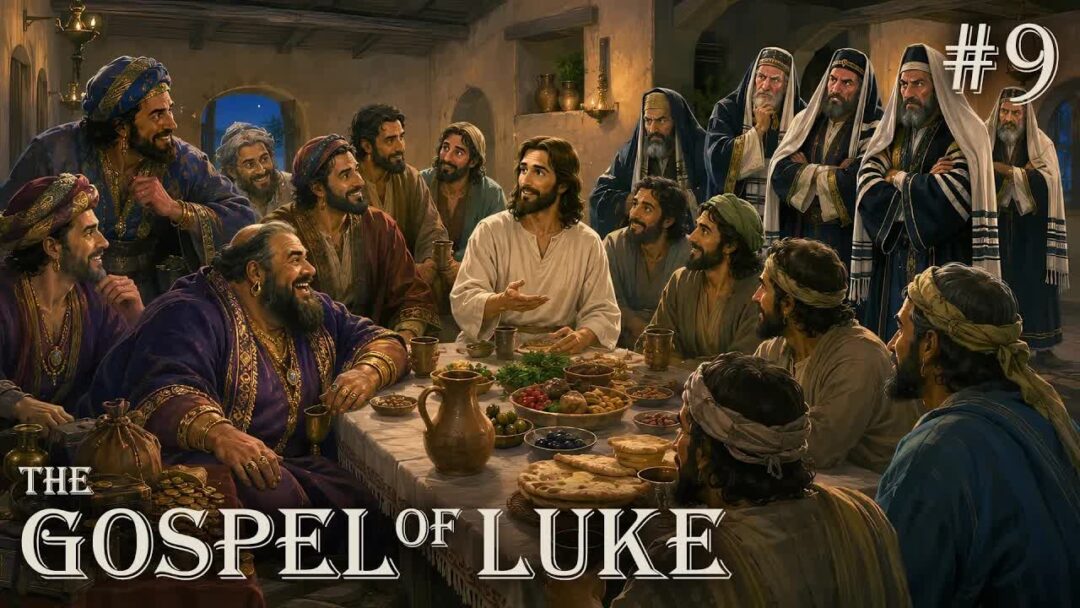
From our Sunday service on July 26, 2026, Luke 5:12-39. This is part 9 of our Gospel of Luke series. Watch the full message: A New Thing – The Gospel of Luke #9 on YouTube.
The question is not whether Jesus can change a life, but whether we are willing to let Him. The fishermen had to learn that following Him meant more than being enthusiastic about His teaching; it meant trusting Him with what had supplied their security. As Luke continues, we see that Jesus does not call people away from the old merely to leave them empty. He gives hope, forgiveness, purpose, and a new relationship with God. God wants you to know He wants to do a new thing in your life.
Hope for the Person Who Has None
The first man we meet is full of leprosy. His condition has separated him from ordinary community and religious life, and he has no cure to offer himself. Yet he has heard enough about Jesus to come with faith. He does not ask whether Jesus possesses the power to cleanse him. He asks whether Jesus is willing. That difference matters.
And it came to pass, when he was in a certain city, behold a man full of leprosy: who seeing Jesus fell on his face, and besought him, saying, Lord, if thou wilt, thou canst make me clean. And he put forth his hand, and touched him, saying, I will: be thou clean. And immediately the leprosy departed from him.
Luke 5:12–13
Jesus answers the very question the man brings. He reaches out, touches him, and declares His willingness. The leprosy immediately leaves. A life that seemed to have no future has changed in a moment. God wants to give you hope too. This man has nothing with which to repair his own condition, but he can come to Jesus in faith. The Lord who gives him a new future has not become unable to give hope to us.
Jesus also gives that hope a purpose. He tells the man to show himself to the priest and make the offering Moses commanded, as a testimony. Jesus tells him not to spread the news around, because the growing crowds can hinder the work of teaching from city to city. The man does not keep that instruction, and Jesus eventually withdraws into the wilderness and prays. The mercy is real, but receiving it does not make obedience unimportant. The new hope Jesus gives is meant to be used for His glory.
Forgiveness No One Else Can Give
The next scene carries us beyond the need for physical healing. Jesus is teaching while religious leaders listen, and a paralyzed man is brought by friends who are determined to get him before the Lord. The crowd blocks the way, but they will not let that be the end of their effort. They carry him onto the roof and lower him into the room. Yet Jesus first speaks to a need that reaches deeper than the condition everybody can see:
And when he saw their faith, he said unto him, Man, thy sins are forgiven thee. And the scribes and the Pharisees began to reason, saying, Who is this which speaketh blasphemies? Who can forgive sins, but God alone? But when Jesus perceived their thoughts, he answering said unto them, What reason ye in your hearts? Whether is easier, to say, Thy sins be forgiven thee; or to say, Rise up and walk? But that ye may know that the Son of man hath power upon earth to forgive sins, (he said unto the sick of the palsy,) I say unto thee, Arise, and take up thy couch, and go into thine house.
Luke 5:20–24
Jesus sees faith and gives forgiveness. The man does not first deliver a carefully worded request for his sins to be forgiven. Jesus knows his heart. Salvation is not produced by the words we manage to say; it is God’s gift received through faith. That is why I want us to notice this moment before rushing to the healing. Jesus is doing something none of the teachers around Him can do. The man has been brought to someone who can change not only his physical circumstances but his standing as a sinner before God.
The religious leaders recognize the size of the claim. Only God can forgive sins, so they regard Jesus’ words as blasphemy. But Jesus is not making a claim He cannot support. Anyone could say that sins were forgiven without offering something the crowd could test. Telling a paralyzed man to rise, pick up his bed, and go home is different. When the man immediately does it, the visible healing confirms the authority Jesus has claimed. He is no ordinary preacher. The one who forgave that man’s sins can forgive yours as well.
A Calling for the Person Others Overlook
That authority is not exercised only toward people already regarded as suitable for religious life. Jesus next sees Levi, whom we also know as Matthew, sitting at the tax office. Here is a man whose work makes him an unlikely candidate in the eyes of those around him. Yet Jesus sees a purpose for him that others do not see. The call is simple, and so is Luke’s account of the response:
And after these things he went forth, and saw a publican, named Levi, sitting at the receipt of custom: and he said unto him, Follow me. And he left all, rose up, and followed him.
Luke 5:27–28
Matthew does not stay at the receipt of custom merely approving of the invitation. He rises and leaves it. The new calling means trusting Jesus with what he gives up, just as the fishermen had to do. But the change also reaches outward. Matthew makes a great feast and brings his tax-collecting friends into the company of Jesus. He has found someone worth following and wants people he knows to meet Him. A life other people might have dismissed has become a means of bringing them into contact with the Lord.
The religious leaders complain about the company Jesus keeps. To them, eating with tax collectors and sinners is an accusation against His ministry. Jesus answers by showing that the very need they despise is the reason He is there. A physician does not refuse the sick because they are sick. Their sickness is why they need him. Ministry is not simply choosing the people whose lives are already put together and avoiding everybody whose condition makes the work difficult:
And Jesus answering said unto them, They that are whole need not a physician; but they that are sick. I came not to call the righteous, but sinners to repentance.
Luke 5:31–32
Jesus calls sinners to repentance. That does not leave Matthew where he was, but neither does it treat his past as proof that he has no future in God’s service. The man others overlooked will be used for God’s glory. We know him as the writer of a Gospel, but at this point we see him simply responding to the invitation and opening his home. If Jesus could take this tax collector and give him a new purpose, He can use your life too. What others have assumed about you does not exhaust what He can do with you.
A New Relationship, Not a Patch on the Old
The complaints continue, now concerning fasting. Why do other religious disciples fast while Jesus’ disciples eat and drink? His answer turns their attention from a religious practice to the person present with them. Wedding guests do not fast while the bridegroom is there. They celebrate him. The Messiah for whom people have waited has come, and His presence changes the moment. Jesus does not say there will never be a time to fast. He says that when the bridegroom is taken away, that time will come. They must understand their practice in relation to Him.
That is a new relationship, not merely a different religious schedule. The man with leprosy could come directly to Jesus with his need. The paralyzed man could be brought before Him. Through Christ’s work on the cross, we have direct access to the Father, and we have the Holy Spirit. We can still fast and pray, but we do not have to treat God as someone whose attention is always out of reach. Jesus illustrates the problem of trying to force what He brings into an unchanged framework:
And he spake also a parable unto them; No man putteth a piece of a new garment upon an old; if otherwise, then both the new maketh a rent, and the piece that was taken out of the new agreeth not with the old. And no man putteth new wine into old bottles; else the new wine will burst the bottles, and be spilled, and the bottles shall perish. But new wine must be put into new bottles; and both are preserved. No man also having drunk old wine straightway desireth new: for he saith, The old is better.
Luke 5:36–39
An old garment and a piece taken from a new one do not simply become a sound garment by being joined. New wine also requires a container able to receive it. Jesus is not offering a patch that will make a system of self-righteousness successful. The law showed people their need for Christ; it could not become an alternative to Him. We cannot get into heaven by arranging enough good actions to outweigh the bad. We can only come through God’s action, through Jesus Christ and His death on the cross. We must surrender our ways and trust the work He has done.
The difficulty is that the old can remain attractive simply because it is familiar and gratifying. We may prefer our sinful ways even while they poison our lives. Jesus calls us instead to His righteousness, to love and serve as He does. We cannot fit Him into a framework that preserves our old priorities unchanged; our framework must be shaped around Him. Perhaps you need hope, forgiveness, a calling, or a relationship with God that has become more than habit. Do not cling to the old merely because it is familiar. God wants to do a new thing in your life. Will you allow Him to do it?
Recent Comments