
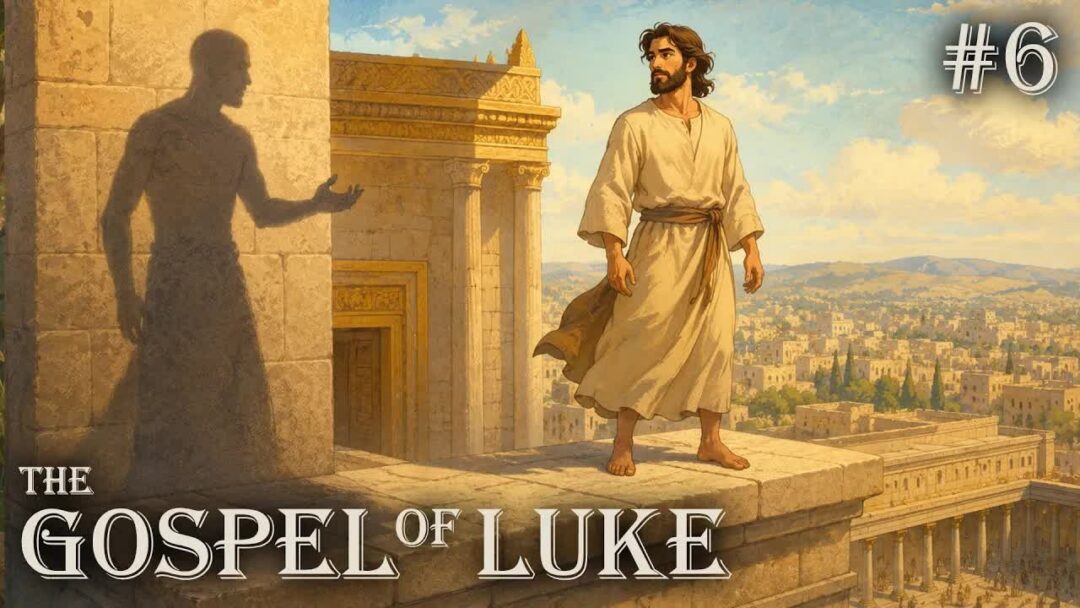
From our Sunday service on June 28, 2026, Luke 4:1-15. This is part 6 of our Gospel of Luke series. Watch the full message: The Temptation – The Gospel of Luke #6 on YouTube.
Not everyone who quotes the Bible is telling us what God means. Satan himself knows how to quote Scripture, and he uses it in the wilderness to make disobedience look spiritual. We need to understand its meaning and obey the God who gave it. Jesus shows us how as Satan attacks through the desire to enjoy, the desire to possess, and the desire to be acknowledged. God wants you to beware of those who twist Scripture for their agenda, and He wants you to be able to overcome Satan’s attacks.
Obedience Before Appetite
Immediately after His baptism, Jesus goes into the wilderness under the leading of the Holy Spirit. For forty days He eats nothing and is tempted by the devil. He is fully God and fully man, and He faces the reality of human weakness rather than merely observing it from outside. He is our sinless representative, the sacrifice whose death will cover our sins. In His victory He also gives us an example to follow:
And Jesus being full of the Holy Ghost returned from Jordan, and was led by the Spirit into the wilderness, Being forty days tempted of the devil. And in those days he did eat nothing: and when they were ended, he afterward hungered. And the devil said unto him, If thou be the Son of God, command this stone that it be made bread. And Jesus answered him, saying, It is written, That man shall not live by bread alone, but by every word of God.
Luke 4:1–4
Food is good, and hunger is not itself a sin. The temptation lies in taking a good thing outside the setting God has appointed for it. The Spirit has led Jesus into this fast, and Satan urges Him to satisfy His desire against that instruction. That is the lust of the flesh: the desire to sin for enjoyment. We recognize the same pattern in gluttony, drunkenness, or taking what belongs within marriage outside its bounds. A natural desire does not become our authority simply because we feel it strongly. God determines how His gifts are to be enjoyed.
Satan also presses the question of identity. If Jesus truly is the Son of God, why not command the stone to become bread? The divine Word through whom the world was made certainly has the power. But the ability to do something is not permission to do it. Jesus answers from Scripture rather than accepting Satan’s claim that His hunger or His identity gives Him a reason to step outside the Father’s will.
His answer comes from a passage about Israel’s own hunger in the wilderness. God humbled and tested His people so they would learn that life depends on more than the satisfaction of the moment. Jesus is not producing a religious phrase to escape a difficult conversation; He is applying the truth of a passage that addresses the very issue before Him:
And he humbled thee, and suffered thee to hunger, and fed thee with manna, which thou knewest not, neither did thy fathers know; that he might make thee know that man doth not live by bread only, but by every word that proceedeth out of the mouth of the LORD doth man live.
Deuteronomy 8:3
Obedience is more beneficial than the pleasure we want right now. That is the lesson Satan’s proposal tries to hide, and it is the lesson Jesus refuses to abandon. We overcome this kind of temptation by placing God’s Word above the desires of our bodies. We must ask whether receiving it in this way agrees with what God has told us to do.
Possession Is Not Worth Worship
When the first appeal fails, Satan offers another kind of satisfaction. He shows Jesus the kingdoms of the world and promises their power and glory in return for worship. This is the lust of the eyes, the desire to possess. Greed and envy make what we see seem necessary for our happiness, even when God has not given it to us. Here the offer is vast, but the principle is the same: obtain what you want by surrendering the obedience you owe to God.
And the devil, taking him up into an high mountain, shewed unto him all the kingdoms of the world in a moment of time. And the devil said unto him, All this power will I give thee, and the glory of them: for that is delivered unto me; and to whomsoever I will I give it. If thou therefore wilt worship me, all shall be thine. And Jesus answered and said unto him, Get thee behind me, Satan: for it is written, Thou shalt worship the Lord thy God, and him only shalt thou serve.
Luke 4:5–8
Satan offers a shortcut around suffering. Jesus will redeem the kingdom, but His mission leads through the cross. The temptation is to grasp the result without following the Father’s way. Satan still offers things that seem to make life easier while drawing people away from salvation and service. He does not need everyone to become openly hostile to God. Distracting a person long enough to keep him from surrendering to Christ serves his purpose too. A comfortable life can be part of the deception if it persuades us that we have no need to receive God’s gift.
Jesus refuses the offer because God alone is to be worshiped and served. There is no room beside that obedience for a bargain with Satan. Every aspect of life belongs in His service. If getting what we want requires giving up what God commands, the offer is not a blessing, however much power or ease it appears to promise.
Scripture Used Against Its Meaning
The temple temptation brings the danger closest to the language of faith. Satan challenges Jesus to throw Himself down, supporting the proposal with a promise about God’s protection. He has heard Jesus appeal to Scripture and now appeals to Scripture himself. But quoting the words does not mean he is honoring their meaning. He is trying to turn a promise for those following the Lord into permission to test the Lord by deliberate disobedience:
And he brought him to Jerusalem, and set him on a pinnacle of the temple, and said unto him, If thou be the Son of God, cast thyself down from hence: For it is written, He shall give his angels charge over thee, to keep thee: And in their hands they shall bear thee up, lest at any time thou dash thy foot against a stone. And Jesus answering said unto him, It is said, Thou shalt not tempt the Lord thy God.
Luke 4:9–12
This is the pride of life, the desire to be acknowledged. A dramatic rescue at the temple would appear to offer immediate recognition without the long work of ministry. But Jesus compares Scripture with Scripture. The promise Satan quotes cannot cancel God’s instruction not to test Him. We walk by faith, not by arranging tests that require God to prove His care. We cannot put ourselves outside His will and then demand the protection promised in following Him.
The warning reaches into the teaching we hear now. Satan can make something destructive look righteous, and his teachers can use religious language to reassure people in their sin. That is why a church experience, a confident personality, or an impressive title cannot be our test of truth. We must know God’s Word well enough to recognize when somebody is using it to manipulate us. Paul warns us that appearances can be deliberately misleading:
And no marvel; for Satan himself is transformed into an angel of light. Therefore it is no great thing if his ministers also be transformed as the ministers of righteousness; whose end shall be according to their works.
2 Corinthians 11:14–15
A teacher may quote passages about love while ignoring passages that identify sin. Calling homosexuality acceptable on that basis does not change what Scripture says. Nor does telling people to embrace every desire because it feels natural explain why we need redemption. We are born in sin and need to become like God, not remain unchanged. The same distortion appears in promises that God’s love guarantees everything we want. These teachings make disobedience attractive while overlooking what God actually requires. Jesus’ answer directs us back to the whole meaning of Scripture, not a fragment selected to please us.
Victory Without a Shortcut
After the temptations, Satan leaves for a season. Later he again tries to turn Jesus away from the cross through Peter’s protest against His coming death. We must not assume that overcoming an attack once means we can stop being vigilant. The enemy returns with reworked offers, and the same desires can be used again. We need to stay grounded in the truth rather than rely on the memory of a previous victory:
And when the devil had ended all the temptation, he departed from him for a season. And Jesus returned in the power of the Spirit into Galilee: and there went out a fame of him through all the region round about. And he taught in their synagogues, being glorified of all.
Luke 4:13–15
Jesus returns in the power of the Spirit and begins teaching through Galilee. He does not gain recognition by jumping from the temple, obtain the world’s kingdoms by worshiping Satan, or use His power to escape the obedience the Father requires. He does the work faithfully. His example joins the answer to temptation with the life that follows it. Victory is not merely refusing something once; it is continuing to trust God and serve Him without taking the shortcuts that would undermine His purpose.
We face the same kinds of offers: enjoyment outside God’s design, possessions at the cost of obedience, and recognition gained by demanding that God serve our plans. Satan may even quote Scripture to make them sound right. So stay full of the Spirit, grounded in the Word, and committed to obeying God. Compare Scripture with Scripture and receive it in its context. God wants you to beware of those who twist Scripture for their agenda, and He wants you to be able to overcome Satan’s attacks. Will you follow Christ’s example?
Recent Comments