
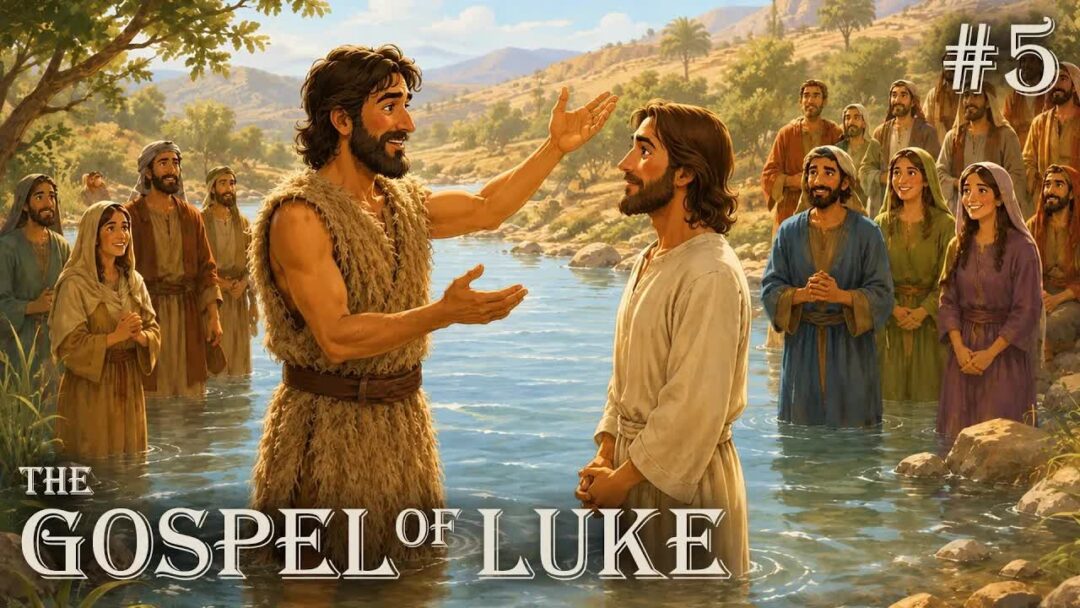
From our Sunday service on June 21, 2026, Luke 3:1-22. This is part 5 of our Gospel of Luke series. Watch the full message: The Revealing – The Gospel of Luke #5 on YouTube.
God wants you to change your mind about sin. That is the message John the Baptist brings as he prepares people for the Messiah, and it is not a call to improve our religious appearance while leaving our hearts untouched. Family, position, reputation, and familiarity with the things of God cannot take the place of repentance. If we are going to receive the Savior who came to deliver us from sin, we cannot continue defending that sin as though it were harmless.
Luke sets this ministry in a real time and place. He names the rulers and religious authorities so his readers can locate these events in history. This is not a comforting mythology about people who never lived. Jesus is the Son of God come in the flesh to change the world. Into that setting comes John, the son of Zacharias, preaching in the country around Jordan. His task is to prepare the way for someone greater than himself, and the road that needs preparation is the condition of people’s hearts.
A Change Deeper Than a Ceremony
John calls the people to a baptism of repentance for the remission of sins. Remission means forgiveness, and repentance means a change of mind that leads to a change of action. He is not asking people merely to feel uncomfortable for a moment. They need to see sin as God sees it and then live in light of that understanding. The prophecy about preparing the Lord’s way therefore reaches into their own response to God:
And he came into all the country about Jordan, preaching the baptism of repentance for the remission of sins; As it is written in the book of the words of Esaias the prophet, saying, The voice of one crying in the wilderness, Prepare ye the way of the Lord, make his paths straight. Every valley shall be filled, and every mountain and hill shall be brought low; and the crooked shall be made straight, and the rough ways shall be made smooth; And all flesh shall see the salvation of God.
Luke 3:3–6
Baptism gives outward expression to that change. The word means to dip, and the action is a public identification with what God is doing through John’s ministry. It is not water removing sin. The person is confessing that what God says is right and that his own sinful way must be left behind. As an outward sign of dedication, baptism shows the response John is calling for; it cannot replace that response. The purpose of his ministry is to get people ready to follow Jesus, not simply to gather a crowd willing to undergo a ceremony.
That distinction explains the severity of John’s rebuke. Some arrive with the assumption that belonging to Abraham’s family gives them a secure place before God. But John will not allow ancestry to stand where repentance belongs. Matthew identifies the Pharisees and Sadducees among those receiving this correction. Religious leadership does not protect a hypocrite from the truth any more than family heritage does:
Then said he to the multitude that came forth to be baptized of him, O generation of vipers, who hath warned you to flee from the wrath to come? Bring forth therefore fruits worthy of repentance, and begin not to say within yourselves, We have Abraham to our father: for I say unto you, That God is able of these stones to raise up children unto Abraham. And now also the axe is laid unto the root of the trees: every tree therefore which bringeth not forth good fruit is hewn down, and cast into the fire.
Luke 3:7–9
The warning is not empty language. Judgment is coming, and trees without good fruit will be cut down. God can raise up children to Abraham from stones; He does not depend on people who claim the name while refusing His call. We need to hear the same correction when we assume that church attendance, Christian parents, or cultural Christianity makes us followers of God. Nobody is saved by borrowing someone else’s belief. The question is whether we have changed our own minds about sin and whether our lives show evidence of that repentance.
Fruit in Ordinary Conduct
The people ask what they should do, and John’s answer is wonderfully practical. A changed heart ought to change what happens to the extra coat and the food we have kept for ourselves. He does not send them away with an impressive religious task while their neighbors remain cold and hungry. He directs them to the need already within their reach. Tax collectors and soldiers then ask the same question, and he speaks directly to the conduct involved in their work:
And the people asked him, saying, What shall we do then? He answereth and saith unto them, He that hath two coats, let him impart to him that hath none; and he that hath meat, let him do likewise. Then came also publicans to be baptized, and said unto him, Master, what shall we do? And he said unto them, Exact no more than that which is appointed you. And the soldiers likewise demanded of him, saying, And what shall we do? And he said unto them, Do violence to no man, neither accuse any falsely; and be content with your wages.
Luke 3:10–14
If you have excess, use it to help somebody in need. That challenges us because we are very capable of describing ourselves as struggling while overlooking how much we possess. We compare ourselves with other people around us and decide we have little, though our closets contain things someone else desperately needs. But we cannot claim to want God’s character while refusing the generosity that belongs to it. He cares for the poor, and what we have left unused can become a way to care for them too.
The tax collectors need repentance no less than the rest of the crowd. Their work has given them opportunities to take more than they are owed, using their position for gain. John does not tell them to abandon the job simply because people resent the government they serve. He tells them to stop the extortion. Those wanting the tax collectors to quit must hear that honest service is possible, while the tax collectors must surrender the wrongful profit they have treated as part of their income. John’s concern is truth, not pleasing his audience.
The soldiers receive the same kind of instruction. They must stop intimidation, false accusation, and discontent with their wages. Power is not permission to take advantage of someone who has less of it. John brings them back to doing their work rightly rather than using the threat of force to extract money. Repentance is not an abstraction that leaves our ordinary dealings unchanged.
The One John Cannot Replace
Such teaching leads the people to wonder whether John himself might be the Christ. He speaks differently from the leaders they know, and the expectation of the Messiah is already in their hearts. But accepting that attention for himself would destroy the purpose of his ministry. John has come to prepare people for the Messiah, not to become an alternative to Him. He immediately turns them toward the one whose authority and power far exceed his own:
John answered, saying unto them all, I indeed baptize you with water; but one mightier than I cometh, the latchet of whose shoes I am not worthy to unloose: he shall baptize you with the Holy Ghost and with fire: Whose fan is in his hand, and he will throughly purge his floor, and will gather the wheat into his garner; but the chaff he will burn with fire unquenchable.
Luke 3:16–17
John can baptize with water, but Jesus brings the transforming work to which that sign points. John can warn people of judgment, but the Messiah will separate the genuine from the false. The wheat will be gathered, and the chaff will face unquenchable fire. So John’s humility is not merely a modest way of speaking about another teacher. He recognizes the difference between announcing God’s work and possessing the authority to carry it out. He is not worthy even to unloose the coming one’s sandals. His listeners need Christ, not a permanent attachment to the messenger.
Identified with the Savior
Then Jesus comes to be baptized. John at first objects, as Matthew records, because Jesus does not need the repentance he has been preaching. Jesus tells him to allow it in order to fulfill righteousness. This is not a sinner obtaining salvation through water. It is the sinless Savior identifying Himself with humanity in the work of redemption. His baptism connects Him publicly with the ministry through which God has prepared the way and reveals Him as the promised one:
Now when all the people were baptized, it came to pass, that Jesus also being baptized, and praying, the heaven was opened, And the Holy Ghost descended in a bodily shape like a dove upon him, and a voice came from heaven, which said, Thou art my beloved Son; in thee I am well pleased.
Luke 3:21–22
God has given John a way to recognize the Messiah: the Spirit will descend and remain upon Him. John receives that sign and bears witness that Jesus is the Son of God. Those who have listened to John are to follow the one he announces. Jesus’ baptism also helps us understand our own. We are not baptized to remove our sins, but to show who we belong to. The outward identification points to the Savior and the redemption He accomplishes, not to an ability in the water itself.
John continues to speak the truth, even when it reaches people able to punish him for it. He rebukes Herod’s wicked conduct, including his sinful marriage, and is imprisoned. His message does not change to protect his position. Common people must give, tax collectors must stop stealing, soldiers must stop abusing power, and a ruler must repent of immorality. No station makes sin acceptable. So ask yourself honestly: have I changed my mind about my sin? God wants you to change your mind about sin. Will you turn from it and follow Jesus today?
Recent Comments