
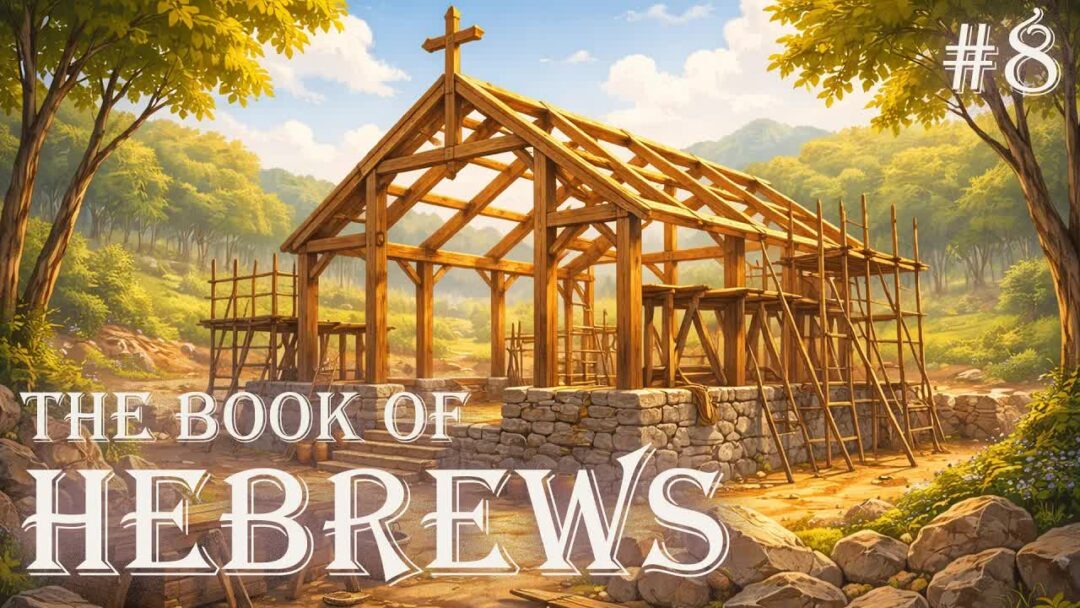
From our Sunday service on March 22, 2026, Hebrews 11:1-12:4. This is part 8 of our Hebrews series. Watch the full message: A Foundation of Faith – Hebrews Series #8 on YouTube.
We are in the final section of Hebrews, where everything that has been said about Christ is brought to bear on faith itself. The whole book has been about faith, but here we are shown why we should persevere: God has already laid down a foundation of faith throughout the Scriptures to encourage us. God wants you to know that He has laid a foundation of faith throughout all of Scripture to encourage us.
Faith Is a Foundation
The writer begins by telling us what faith is, and why the elders obtained a good report:
Now faith is the substance of things hoped for, the evidence of things not seen. For by it the elders obtained a good report.
Hebrews 11:1–2
Faith is not a vague feeling. It is the substance of things hoped for, the evidence of things not seen. It is a foundation you can stand on, even when you cannot yet see the outcome. From the very beginning, God has been building that kind of testimony into the Bible, so that when we are tempted to quit we would remember that we are not the first to trust Him.
By faith we understand that the worlds were framed by the Word of God, so that things which are seen were not made of things which do appear. Creation itself is the first great exhibit. We were not there, but God has told us how it began, and faith receives His Word. All things were made by Him, and without Him was not anything made that was made. Then the chapter begins to name the people who stood on that same foundation. Abel offered a more excellent sacrifice than Cain, and God testified of his gifts. Though he is dead, he still speaks, because a life of faith leaves a testimony that outlasts the person who first offered it. Enoch walked with God and was taken, and the lesson attached to his life is one we cannot skip:
But without faith it is impossible to please him: for he that cometh to God must believe that he is, and that he is a rewarder of them that diligently seek him.
Hebrews 11:6
Without faith it is impossible to please Him. He that comes to God must believe that He is, and that He is a rewarder of them that diligently seek Him. Noah believed a warning about things not yet seen, prepared an ark to the saving of his house, and became an heir of the righteousness which is by faith. He was not declared righteous because he was already safe, but because he took God at His Word when there was not yet a flood to point to. In each case the pattern is the same: God spoke, they trusted what they could not yet prove with their eyes, and God counted it as righteousness. That is why this chapter is a foundation and not a museum. These lives were recorded so that we would know what faith looks like when the promise is still ahead of us.
They Saw the Promises Afar Off
Abraham was called to go out, not knowing where he went. He left behind what was familiar because it was enough that God wanted him there. He looked for a city which has foundations, whose builder and maker is God. Sarah received strength to conceive, because she judged Him faithful who had promised. These were not people who already held the finished promise in their hands:
These all died in faith, not having received the promises, but having seen them afar off, and were persuaded of them, and embraced them, and confessed that they were strangers and pilgrims on the earth. For they that say such things declare plainly that they seek a country. And truly, if they had been mindful of that country from whence they came out, they might have had opportunity to have returned. But now they desire a better country, that is, an heavenly: wherefore God is not ashamed to be called their God: for he hath prepared for them a city.
Hebrews 11:13–16
They saw the promises afar off, were persuaded of them, and embraced them. They confessed that they were strangers and pilgrims, and they desired a better country, that is, an heavenly. God is not ashamed to be called their God, and He has prepared for them a city. In that sense they were already greeting from a distance the One in whom all those promises would be fulfilled. That hope was tested again when Abraham was asked to offer Isaac, the very son of the promise. He went up, willing to obey, because he believed that if God required it, God was able to raise him even from the dead. Isaac, following his father’s lead, also walked in faith. Isaac, Jacob, and Joseph then carried the same hope forward, blessing the next generation and looking beyond death itself, because they were persuaded that God would keep what He had said.
Moses refused to be called the son of Pharaoh’s daughter, choosing rather to suffer with the people of God than to enjoy the pleasures of sin for a season. He forsook Egypt, kept the passover, and led the people through the sea, not because the danger was small, but because he endured as seeing Him who is invisible. His faith was not only a private conviction. It led a whole people to move when God said to move. By faith the walls of Jericho fell, after the people obeyed a command that looked like foolishness to the world, and Rahab did not perish with those who believed not, because she received the spies in peace and trusted the God of Israel. The writer says that time would fail him to tell of Gideon, Barak, Samson, Jephthah, David, Samuel, and the prophets, who through faith subdued kingdoms, and of others who were tortured, mocked, imprisoned, and slain, not accepting deliverance, that they might obtain a better resurrection. They did not all see the promise completed in their own lifetime. God had provided some better thing for us, that they without us should not be made perfect. Their foundation was real, and it was always meant to be built upon by those who came after.
A Great Cloud of Witnesses
That is why the next chapter turns to us:
Wherefore seeing we also are compassed about with so great a cloud of witnesses, let us lay aside every weight, and the sin which doth so easily beset us, and let us run with patience the race that is set before us, Looking unto Jesus the author and finisher of our faith; who for the joy that was set before him endured the cross, despising the shame, and is set down at the right hand of the throne of God.
Hebrews 12:1–2
We are compassed about with so great a cloud of witnesses. These are not spectators waiting to see if we fail. They are testimonies already given, a foundation already laid, calling us to lay aside every weight and the sin which so easily trips us, and to run with patience the race set before us, looking unto Jesus, the author and finisher of our faith. He endured the cross, despised the shame, and is set down at the right hand of the throne of God. The first readers had not yet resisted unto blood. The people in this chapter had. Consider Him, then, lest you be wearied and faint in your minds. The point is not that God has failed to prove Himself. Scripture has given us more than enough evidence. From Abel to the prophets, from a man who offered a better sacrifice to men and women who would not accept deliverance, God has been laying a foundation so that we would not give up. The question is whether we will build on the foundation He has already laid, or let weight and sin ruin what He means to do with our lives.
Will we set aside what slows us down? Will we stay away from the sins that so easily drag us down? Will we trust what we cannot see, and endure as those before us did? God wants you to know that He has laid a foundation of faith throughout all of Scripture to encourage us. Will your life build on the foundation of those who came before? And will your life leave a new testimony of faith for others to build on? The story of faith is not finished, and God still means to add to it through people who will trust Him when they cannot yet see the end. That is how a foundation becomes a living testimony for the next generation as well.
Recent Comments