
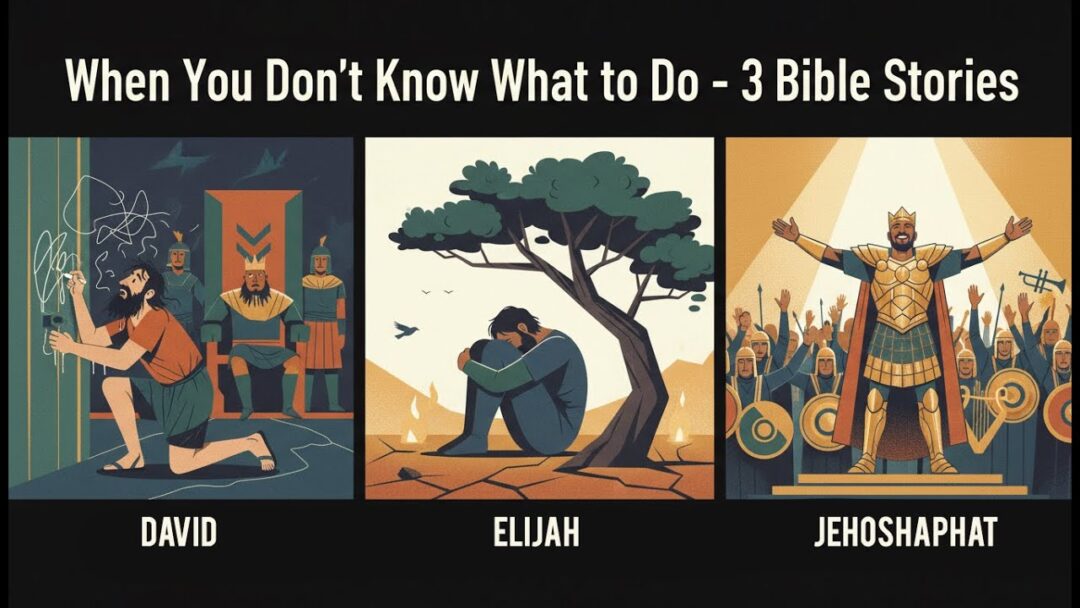
From our Sunday service on January 4, 2026, three Bible stories from 1 Samuel 21, 1 Kings 19 and 2 Chronicles 20. Watch the full message: When You Don’t Know What to Do on YouTube.
There are going to be moments in your life when you do not know what to do, moments when you are stuck like a deer in headlights and overwhelmed. How you respond in those moments can have a big effect on the result. I have felt that myself. Our church had quite a surprise, and for the first time in my life I genuinely thought I was having a nightmare. It was not a bad dream. It was real, and I did not know what to do. If I am having a struggle, I am likely not the only one. We will look at three people in Scripture who found themselves completely lost for direction. God wants you to rely on Him.
Fear-Driven Desperation
Our first response is David’s. He has just learned from Jonathan that King Saul wants him dead. The prophet has anointed David as the next king, and David flees alone. In his desperation he runs straight into Philistine territory, to Gath, Goliath’s hometown.
And David arose, and fled that day for fear of Saul, and went to Achish the king of Gath.
1 Samuel 21:10
He does not stop and pray. He does not ask God for direction. He panics, and the first thing he reaches for is a weapon: Goliath’s sword, the sword of the giant he slew in the power of God, a sword too big for him, a sword he himself had already proved God is stronger than. When he loses faith for a moment, he goes to man’s defense instead of turning to the Lord, and then seeks help from the very people God told Israel to drive from the land. He thinks he will lay low, but the moment he arrives the king’s servants recognize him as the one who killed Goliath. He is sore afraid, and he still does not turn to God. He feigns madness, scratches at the doors of the gate, and lets the spittle fall down on his beard, so that Achish will send him away. The anointed king of Israel pretends to be a lunatic just to survive.
What went wrong? David allowed fear to replace his prayers. Rather than waiting on God’s direction, he tried to control the situation in the only ways he knew how. Sometimes not knowing what to do will make us do just about anything to escape that feeling. I have seen it at a previous job. Someone made a mistake, and instead of confessing it they panicked, tried to cover it up, and made the situation far worse than if they had come clean at the beginning. David would not give the control to God or trust that He is sovereign. He escapes, but nothing about his actions reveals trust or wisdom. Later, in the cave of Adullam, he finally sits down to think, and he writes Psalm 34.
I sought the LORD, and he heard me, and delivered me from all my fears.
Psalm 34:4
When he stopped trying to do things in his own power and went to the Lord, God answered him right away and delivered him from the fears that had driven those foolish decisions. He then says, in effect, taste and see that the Lord is good; blessed is the man that trusteth in Him. Do not make the same mistake. When you do not know what to do, do not panic. Center yourself on God. Many are the afflictions of the righteous, but the Lord delivereth him out of them all. Had David waited on God, his dignity would not have been taken from him.
Despair-Driven Withdrawal
Our second response is Elijah’s, and it comes right after one of his most famous accounts. On Mount Carmel he has called down fire from heaven, and the prophets of Baal have been shown to be false. You would think this is a high moment. That is not what happens. When Jezebel hears what he has done, she swears he will be dead by tomorrow.
But he himself went a day’s journey into the wilderness, and came and sat down under a juniper tree: and he requested for himself that he might die; and said, It is enough; now, O LORD, take away my life; for I am not better than my fathers.
1 Kings 19:4
At the high point of his work, we see him at the lowest he ever goes. Like David, he does not go to God for help. He goes to Beersheba, leaves his servant there, and flees into the wilderness, where he freezes in depression and shock. “I am not better than my fathers” means the prophets before him tried to get Israel to repent, and they are no closer than when they started. He thinks he has failed just like them. Where David tried to do anything to get control, Elijah does the opposite. He does absolutely nothing, and he does not even have the energy to take care of himself. So God sends an angel to feed him, and the angel says the journey is too great for thee. The angel gives him just enough to keep going, and he goes forty days and forty nights to Horeb, the mount of God, another name for Sinai.
God comes and asks him, What doest thou here, Elijah? Elijah answers that Israel has forsaken the covenant and slain the prophets, that he only is left, and that they seek his life. God then makes a grand show of His power: a wind that shatters the rocks, an earthquake, a fire. In all that chaos, Elijah realizes the Lord is not in it. After the noise disappears, all that is left is a still small voice, a gentle whisper. God was not in the chaos. God was in the little silent moments in between. When Elijah hears it, he wraps his mantle around his face, because if you see God’s glory you will die. That is ironic: he had been asking God to take his life, but when the Lord actually shows up, he covers his face. God will not let him sulk any longer. He tells him what he should have asked at the beginning. There are jobs waiting: anoint Hazael over Syria, Jehu over Israel, and Elisha as prophet in his room. It is not all on him, and he is not alone. God has left seven thousand in Israel whose knees have not bowed to Baal.
What went wrong? He was emotionally exhausted and depressed. He isolated himself, became stagnant in the purpose God called him to, and let the chaos overwhelm him rather than letting God’s peace calm and sustain him. Elijah does not sin loudly by blaspheming God. He just quietly quits his role and goes into self-exile. God’s question implies, why aren’t you where I want you to be? There is a purpose for you.
Faith-Driven Dependence
Now a good example: King Jehoshaphat in 2 Chronicles 20. Multiple kingdoms are coming to war against Judah, and there is no military solution. Jehoshaphat feared, just as David and Elijah feared. But instead of doing anything in his own power, or doing nothing, he set himself to seek the Lord and proclaimed a fast throughout all Judah. He remembers what God has already done. These invading armies are Gentiles, but is God not also sovereign over the Gentiles? Has He not kept His promises since Egypt? Jehoshaphat admits the truth, and he does not leave it there.
O our God, wilt thou not judge them? for we have no might against this great company that cometh against us; neither know we what to do: but our eyes are upon thee.
2 Chronicles 20:12
We do not know what to do, but we know who to look to. When he found himself without direction, he did the one thing David and Elijah forgot. He went to God for help, because he knew God had been faithful before. When he seeks the answer, God gives him comfort.
And he said, Hearken ye, all Judah, and ye inhabitants of Jerusalem, and thou king Jehoshaphat, Thus saith the LORD unto you, Be not afraid nor dismayed by reason of this great multitude; for the battle is not yours, but God’s.
2 Chronicles 20:15
This is not your battle to fight. This is God’s battle to fight for you. Do not rely on your own strength. I have the power. Jehoshaphat invests everything in that truth. Rather than putting his best men on the front lines, he puts the singers there, to praise the Lord, for His mercy endureth for ever. They march toward the battlefield singing, and as they sing the invading armies betray one another until every army that came to destroy the nation has been eliminated before Judah even arrives.
Jehoshaphat did not pretend to be strong. He anchored himself in God rather than in his ability to gain control. He did not humiliate himself like David, and he did not sit idle, sulking and frozen, like Elijah. He made an intentional effort to go to God and worship Him. They still had to walk through the feeling of being hopeless, but when it came time to face it, God walked them straight through.
Each of us will face moments when we do not know what to do, and we have a choice in how we respond. David ran ahead of God, ended up in the wrong places, and lost his dignity. Elijah shut down, withdrew from his calling, and sat under the weight of despair. He did not rebel. He just quietly gave up. Jehoshaphat admitted honestly before God that he did not know what to do. He did not run or freeze. He said, our eyes are upon Thee, and that admission made a world of difference. Not knowing what to do is not a failure of faith, but refusing to look to God in that moment is. So do not let fear push you into places God never called you, and do not let despair convince you that you are alone or finished. Turn your eyes to the Lord. Seek Him first, and worship before you see the outcome. Sometimes the most faithful thing you can say is, I do not know what to do, but God, I know You do. God wants you to rely on Him. Will you choose to rely on Him today?
Recent Comments