
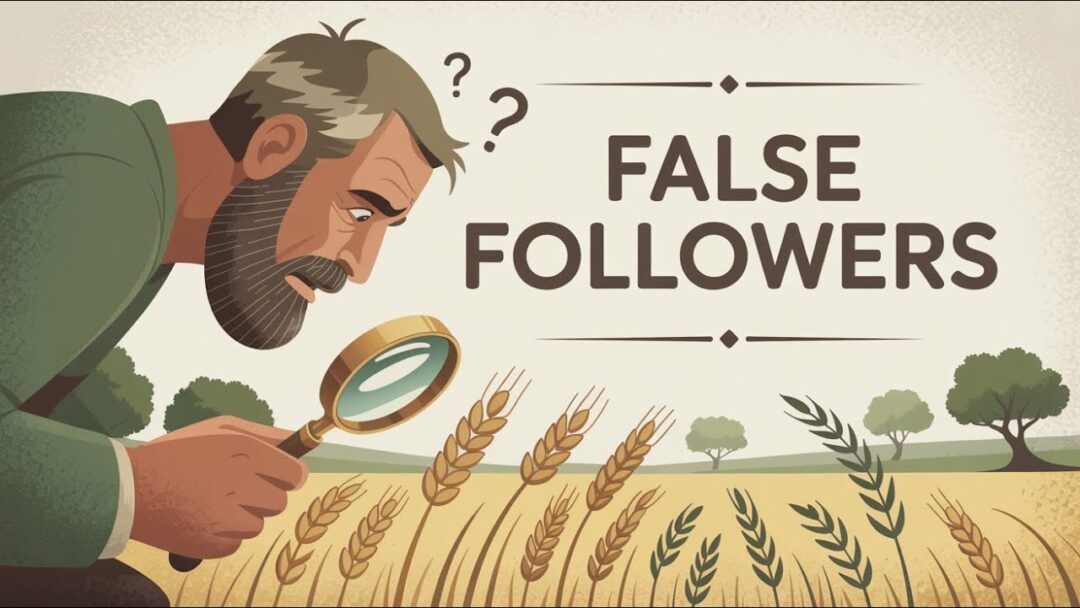
From our Sunday service on November 2, 2025, Matthew 13, Luke 9 and Matthew 25. This is part 12 of our Parables of Christ series. Watch the full message: False Followers – The Parables of Christ #12 on YouTube.
Last time the warning was to be watching and working as we await the Lord’s return, and not to be lazy. Today we continue in the parables of warning and look at what Jesus teaches about so-called false followers: people who profess Christ but do not actually follow Him in their lives. God wants you to know that the kingdom of God belongs only to those who are His true followers. We will look first at the breadth of the kingdom, and then at the separation at Christ’s return.
Wheat, Tares, and a Job That Is Not Ours
This comes right after the parable of the sower, which Jesus said is the foundation for understanding all of His parables. The sower is about how people grow into salvation. Now He talks about people who appear to grow into salvation but are not truly part of the same group.
Another parable put he forth unto them, saying, The kingdom of heaven is likened unto a man which sowed good seed in his field: But while men slept, his enemy came and sowed tares among the wheat, and went his way.
Matthew 13:24–25
Tares are a weed that, when young, appears almost indistinguishable from wheat. The enemy, Satan, plants false believers in the field: people who want the benefit of the kingdom but not the surrender it calls them to. Maybe they want the social comfort, the friendships, or the philanthropy. They come in among the church and pretend to profess Christ, but in their hearts they are not surrendered to Jesus.
When the blade springs up, the servants notice the tares and ask if they should gather them up. The farmer says no, lest while they gather the tares they root up the wheat with them. Let both grow together until the harvest. The servants represent anybody who serves God, you and me. The servant panics and, in parable form, says, God, do you want me to kick them out? And the farmer says, in effect, this job is not for you.
This is a very important part of the lesson: God does not call us to rip the tares out of the kingdom. We are not as good at detecting false Christians as we think we are. The path to salvation is a time of growth. It does not happen all at once. If you try to cast out the false believer, you may rip up someone who is only having a mild trip-up, or someone whose heart the Spirit has already touched.
Think of someone severely addicted to drugs or alcohol, chemically dependent, who has heard the gospel and knows there is hope, but is still addicted. It will not be easy, and it will not happen overnight. Some people see that struggle and say, If they really loved God they would be over that by now. That is not always how it works. If we begin to decide for ourselves who is sincere, we may go to the person in recovery who is doing the hardest thing they have ever done and tell them to get out, and that plant, which was going to produce salvation, gets ripped out before salvation ever comes. It is not our position to judge the validity of someone’s walk toward faith. There are false followers among us. We must remember that in this parable the time of harvest represents the moment of salvation. We can never know for sure ourselves whether someone will be saved until their salvation is fully realized. Jesus knows. We do not. Some people may seem hopeless in their walk and then, years later, repent and be saved.
James and John give us an example in Luke 9. When they are rejected in Samaria, they want to call down fire, as the prophets did, and have those people killed. Jesus rebukes them: Ye know not what manner of spirit ye are of. With their zeal they had mistaken their role. The Son of man is not come to destroy men’s lives, but to save them. Christian, your job is not to destroy lives. Your job is to save them. We wrestle not against flesh and blood. If someone preaches that we should war against the unsaved, they are not speaking from Scripture but from a sinful and prideful heart. We are in the time of mercy and grace. The day of wrath is coming. We are going to meet the Lord in the air, and then the war begins. Do not start the war before the first shot has been fired, and do not help Satan get more on his side.
The Net, and Fruit at the End
Jesus says a similar thing with the parable of the net.
Again, the kingdom of heaven is like unto a net, that was cast into the sea, and gathered of every kind: Which, when it was full, they drew to shore, and sat down, and gathered the good into vessels, but cast the bad away. So shall it be at the end of the world: the angels shall come forth, and sever the wicked from among the just, And shall cast them into the furnace of fire: there shall be wailing and gnashing of teeth.
Matthew 13:47–50
They drag the net across the floor of the sea and it picks up everything: fish, but also crabs, snakes, coral. The kingdom will attract things God wants and things God does not want. The “bad” in the Greek is rotten or decaying. Because the kingdom is so open, not everything caught in it is what God is looking for.
We will see in the church, more often than we would like, scandals: false teachers, abusers, manipulators who use the kingdom for wealth, fame, political movements, or, God forbid, to indulge sinful desires. We should not be shocked. Jesus told us this would happen. That is why pastors must protect children and those who cannot protect themselves, and why we get our doctrine from the Bible, not from popular speakers using the kingdom for power. Not all false followers are horrible people. Some are just lonely. You will see people, not to pick on Catholics, who go to church simply because they are culturally Catholic. It is not always extreme, and not everything needs an extreme reaction. We rely on Christ to separate the good from the bad, and we focus on our own walk.
At Christ’s return, the same picture appears again as sheep and goats.
When the Son of man shall come in his glory, and all the holy angels with him, then shall he sit upon the throne of his glory: And before him shall be gathered all nations: and he shall separate them one from another, as a shepherd divideth his sheep from the goats: And he shall set the sheep on his right hand, but the goats on the left.
Matthew 25:31–33
What identifies the righteous is fruit. Do not get me wrong. I am not saying salvation depends on good works, but I am one hundred percent saying that all salvation produces good works. You do not work for salvation, but salvation makes you work. Not everybody produces the same amount, and not everyone produces fruit at the same time. We cannot write someone off because they have not produced fruit in the first few years. We do not get to judge, but we watch so that we can protect ourselves from false followers.
The King says the sheep fed the hungry, gave drink to the thirsty, took in the stranger, clothed the naked, visited the sick, and came to the prisoner. It does not have to be dramatic. Maybe someone is having trouble with their card and you say, Let me get that for you. A cup of water in Jesus’s name has its reward. If it is winter and somebody cannot afford a coat, go buy them one. Taking in the stranger, in King James language, means a foreigner who needed a safe place. Coming to the prisoner means having mercy even on those who do not deserve it. The righteous are confused. They ask when they ever served Him, and He answers, Inasmuch as ye have done it unto one of the least of these my brethren, ye have done it unto me. As Paul says, everyone is the offspring of God. Not all are His children, but all are His offspring, and Jesus is our brother. When you served the overlooked, you served Him.
The goats are sent into everlasting fire, prepared for the devil and his angels, because they passed by those same needs. Scripture says that to him that knoweth to do good, and doeth it not, to him it is sin. Once again, good works are not required to get salvation, but true salvation is always followed with good works. If no one in your community notices any good works in you, maybe you should see whether those works are really good.
Jesus never told us to pull up the weeds or judge the hearts of men. Judgment is His responsibility, not ours. Until He returns, we live as wheat among tares, shining like a light in a dark field. So ask yourself: are we living as wheat, producing fruit, or only blending in? Are we serving Christ by serving the least of these? And are we trusting the Lord to bring justice in His time, or trying to bring our own corrupt form of judgment before the time? God wants you to know that the kingdom of God belongs only to those who are His true followers. Will you choose to be a true follower today?
Recent Comments