
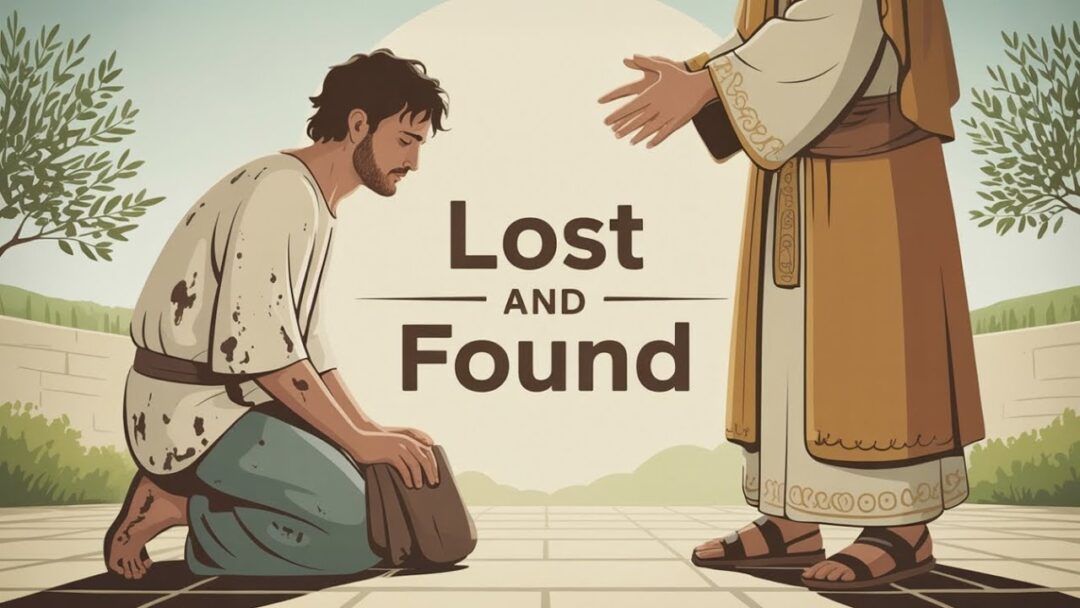
From our Sunday service on September 14, 2025, Luke 15 and Matthew 18. This is part 5 of our Parables of Christ series. Watch the full message: Lost & Found – The Parables of Christ #5 on YouTube.
We have been talking about Jesus’s teaching on prayer and how we receive good gifts from God. For the next stretch of this series we turn in a slightly different direction, to how God feels about salvation and how He pursues people who are far from Him. God wants you to know He relentlessly pursues the lost.
Why Jesus Told These Parables
We begin in Luke 15, which gives us the context.
Then drew near unto him all the publicans and sinners for to hear him. And the Pharisees and scribes murmured, saying, This man receiveth sinners, and eateth with them.
Luke 15:1–2
It is a gift when Luke tells us exactly why a topic comes up. The three parables we will cover today come up specifically because the Pharisees and scribes murmured that Jesus receiveth sinners, and eateth with them. They thought it was wrong for Him to welcome that kind of company. These parables teach three things. First, all humans, saved or not, belong to God. As Paul tells us, all of humanity is God’s offspring, but not everybody is God’s son or daughter. Second, those who are unsaved are unsaved because they have been separated from God. They are God’s offspring, but through their sin they are separated and must be found again. Third, the unsaved becomes saved when he is reunited with God.
The Lost Sheep
Our first parable is the lost sheep, how God leaves the righteous to pursue the lost. What man of you, having an hundred sheep, if he lose one of them, doth not leave the ninety and nine in the wilderness, and go after that which is lost, until he find it? In Jesus’s day sheep were expensive livestock, and shepherds did not take their loss lightly. Shepherding was also a communal effort. Shepherds traveled together with their flocks, so the ninety-nine are not left unprotected with no one watching them. The shepherd takes his flock through a treacherous mountain pass, and along the way one sheep falls to one of the dangers. When he gets back to the community he notices the one is missing, and he goes after that which is lost, until he finds it.
Jesus knows that the ninety-nine believers who have already come to faith in Him do not need His protection in the same way as the one who is in danger. He leaves them safe and goes after the one. When the shepherd gets back to his community, he invites them to celebrate together. Jesus tells us this community represents heaven: there is joy in the presence of the angels of God over one sinner that repenteth. Matthew 18 makes the same point. The Son of man is come to save that which was lost, and it is not the will of your Father which is in heaven that one of these little ones should perish.
God does not want anybody to be lost. Some people teach that God chooses who will and will not be saved, but that is not what the Bible says. God does not want to lose one sheep on the mountain pass, and He will do anything He can to bring it home. From a human perspective it may seem reckless to leave everything you own to pursue the one sheep. But Jesus says they are safe, and He is going to pursue the one and bring him home, because He loves and values him. All of us belong to God, whether saved or not. We are all the offspring of His creation. We are of immense value to Him, and He is doing everything He can to bring us home. For us, that means two things. First, do not push away the lost whom God spends such an expense to rescue. What a shame it would be if we got to heaven and God said, Do you know how much I was pursuing that soul? He was ready to give his life to Me, but you caused him to stumble and fall away. Make sure we are not in the way of their return home. Second, do not spend so much time focusing on the saved flock that we forget those in imminent danger. We in the church love each other, and we are supposed to. But we must not be so distracted with each other that we delay rescuing those in danger.
The Lost Coin
Next, Jesus gives a parable for those who may not be familiar with shepherding. A woman has ten pieces of silver, loses one, lights a candle, sweeps the house, and seeks diligently till she finds it, then calls her friends and neighbours to rejoice. The lost coin would have been a silver coin called a drachma, worth roughly a day’s wage in Israel. So she has ten days’ worth of wages and loses one. In terms of buying power, it would be enough for about sixteen days’ worth of raw food, or six pre-made loaves of bread. She is a poor peasant woman without regular income. Today it would be roughly like having a thousand dollars and losing a hundred-dollar bill somewhere in your house. She is losing a tenth of everything she has, and she has no way to get more. She has to search diligently, because this is ten percent of her wealth, and she needs to survive.
This woman does not have much money, but she lights a candle. Do you understand the expense of lighting a candle? You had to buy the oil for the lamp. It is not like today, when you flip a switch and get light cheaply. She searches the house with a lantern, burning oil she cannot afford to replace. That is what God is saying: I am sparing no expense to find you. And we know the expense is Jesus Christ, His Son. The light also often represents the Holy Spirit. God uses the Holy Spirit to reveal His truth to people so that they can be found. God values us, sends the Spirit to reveal us, and pays a great expense to draw men to Himself.
The Lost Son
Lastly we have the parable of the prodigal son. We will take the first half today. More accurately you could call it the parable of the two sons, but today we stay with the younger. The younger son asks for the portion of goods that falleth to him, takes his journey into a far country, and wastes his substance with riotous living. Would this be normal in the first century? Absolutely not. It would have been extremely dishonoring to your parents, and financially devastating, because he is asking for his inheritance while his father is still alive, as if his father were already dead.
This is the picture. All people are God’s offspring, but God does not make them follow Him. The son says, I want to live my life my way. I am leaving. And God says, Go. It is your choice. So he goes far away, wastes his substance, and quickly his money is gone. Then there arises a mighty famine, and he begins to be in want. He joins himself to a citizen of that country, who sends him into his fields to feed swine, and he would fain have filled his belly with the husks that the swine did eat, and no man gave unto him. The foolish son has quickly wasted everything his father gave him, and he finds himself in the most shameful work a Jewish man could imagine, wishing he could eat what the pigs were eating.
Then he comes to himself. How many hired servants of my father’s have bread enough and to spare, and I perish with hunger! I will arise and go to my father, and will say unto him, Father, I have sinned against heaven, and before thee, and am no more worthy to be called thy son: make me as one of thy hired servants. That is how God works as well. Everybody is a sinner. Everybody is guilty of death and guilty of hell. And nobody has to go there. Not one person in hell will be there because they did not know. Everyone who is there will be there because they chose to be. The only thing that stops you from getting into heaven is humbling yourself and saying, Everything I need is back home. It is with my Father. I am His offspring, but I am not acting as His son. I need to go home and be His son.
The father’s response was so much greater than the son could have imagined. While he was yet a great way off, his father saw him, and had compassion, and ran, and fell on his neck, and kissed him. The son went home planning to say he would be like one of the servants. Before he can even finish, the father puts the best robe on him, a ring on his hand, and shoes on his feet, and calls for the fatted calf. This is all God requires of us: God, I was wrong. I am a sinner, and I am unworthy. When we admit that, God says, Come home. He never stops pursuing, and He never stops welcoming His children home.
The lost sheep, the lost coin, and the prodigal son all remind us of a very powerful truth: God relentlessly pursues the lost because He values each of us so highly. For us the challenge is twofold. First, we must remember God’s perspective. Every person we meet, saved or unsaved, belongs to God, is infinitely valuable to Him, and is someone He is pursuing. Second, we must join Him in that pursuit, and not stand in the way of anyone coming home. God wants you to know He relentlessly pursues the lost. Will you be a part of His mission and help pursue the lost today?
Recent Comments