
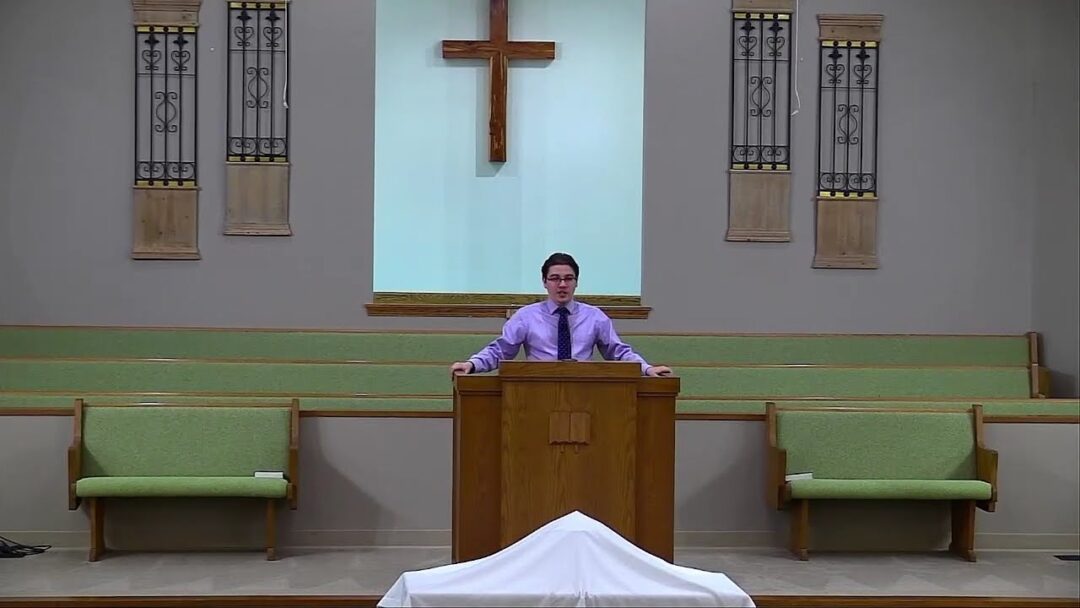
From our Sunday service on December 15, 2024, Genesis, Jeremiah, Isaiah, and Micah. Watch the full message: A Time Foretold: The Prophecies of Christmas on YouTube.
We have the pleasure of looking at the prophecies of Christmas, the promises God made in advance about the coming of His Son. Prophecy, in this sense, is not a vague prediction or a coincidence. It is God telling in advance what He will do, with enough specifics that it cannot be dismissed. He did not leave the promise in general terms and hope we would guess. He named the line, the town, the manner of the birth, and the work the Messiah would do, layer on layer, so that when it happened we would know it was Him. We celebrate His birth because those promises have been fulfilled. The close of all of this is not a slogan. The promise has been fulfilled, and even if it were just one person, Christ would have come.
The First Promise
The first prophecy comes with bad news first. In Genesis 3, Eve doubted what God had said. The serpent questioned whether God had really spoken, and she reached for what God had forbidden, and sin entered the world. Then, before any human being could invent a way back, God spoke to the serpent.
And I will put enmity between thee and the woman, and between thy seed and her seed; it shall bruise thy head, and thou shalt bruise his heel.
Genesis 3:15
This is what many have called the protoevangelium, the first telling of the gospel. There would be enmity between the serpent and the woman, and between his seed and her seed. The serpent would bruise His heel, and He would bruise the serpent’s head. A bruise to the head is lethal. A bruise to the heel can cripple you, even amputate, and you can still live. From the beginning, God promised that the Messiah would defeat Satan and undo the damage he did, and that the cost to the Messiah would be real, but not final.
God later confirmed the promise to Abraham. In Genesis 22, after Abraham was willing to offer Isaac, God said, “By myself have I sworn.” This was not a conditional promise that depended on Abraham keeping up his end, as if the whole plan could collapse if one man failed. God swore by Himself that in Abraham’s seed all the nations of the earth would be blessed. The blessing was never going to rest on Abraham’s strength. It was going to rest on God’s oath. Then in Genesis 49:10, Jacob said the sceptre would not depart from Judah until Shiloh come, and unto Him would the gathering of the people be. Shiloh is the Peacemaker. The word “people” there is often used of the nations. The church would be gathered from every tribe, and the promise was never meant for only one family in one land.
God With Us
The promise also named how He would come, and what He would be called.
And he said, Hear ye now, O house of David; Is it a small thing for you to weary men, but will ye weary my God also? Therefore the Lord himself shall give you a sign; Behold, a virgin shall conceive, and bear a son, and shall call his name Immanuel.
Isaiah 7:13–14
This is not a normal judges-style birth, a child raised up in the ordinary way to deliver Israel for a season. A virgin would conceive, and His name would be Immanuel, “God with us.” God Himself would step into the world. And He did not come only for the manger scene. He lived about thirty years of ordinary life before the public ministry began. He paid Roman taxes. He carried luggage. He lived among disease. He lived among fertility struggles and family concerns, under the same kinds of pressures ordinary people still know. In other words, He is saying, “I’m not taking the easy way out.” To the atheist who says, “He has no idea what it’s like,” the answer is that He does. He knows what it’s like to live in a fallen world, because He lived in one, not as a visitor for a weekend, but as a man among us.
Micah 5 adds another layer of specificity, so the promise cannot be dismissed as a lucky guess. The Messiah would come out of Bethlehem Ephratah, little among the thousands of Judah, and yet out of that town would come a ruler in Israel. That was not a random small town. Temple sacrificial lambs were born there, and the shepherds outside Bethlehem were raising temple lambs. David himself had been raised among sacrificial sheep in those same fields. When the angels appeared to shepherds, they appeared to men already living in the picture. Micah also says His goings forth have been from of old, from everlasting. This is not merely a child from David’s line. This is God Himself, stepping into the very place where sacrificial lambs were being prepared.
Behold, the days come, saith the LORD, that I will raise unto David a righteous Branch, and a King shall reign and prosper, and shall execute judgment and justice in the earth. In his days Judah shall be saved, and Israel shall dwell safely: and this is his name whereby he shall be called, THE LORD OUR RIGHTEOUSNESS.
Jeremiah 23:5–6
Jeremiah says God will raise unto David a righteous Branch, a King who shall reign and prosper, and execute judgment and justice in the earth. And this is the name whereby He shall be called, THE LORD OUR RIGHTEOUSNESS. It is not only that He is righteous. It is that His righteousness is placed on us. The Messiah does not merely show us a better way to live. He becomes our righteousness.
Isaiah 53 tells us what that would cost. He would be a man of sorrows, acquainted with grief. He lived a carpenter’s life, under bosses, among ordinary work and ordinary wounds, long before the cross made those sorrows visible to the world. He would be wounded for our transgressions, and by His stripes we are healed. The word “many” in that chapter is important. The payment is sufficient for anyone who will take it, and it is sufficient even for one. It can also be left on the table. The promise is as wide as “whosoever will,” and as personal as whether you will receive it.
A New Covenant
Jeremiah 31 tells us the effect of Christ taking on the sins of the world. In those days they shall say no more, “The fathers have eaten a sour grape, and the children’s teeth are set on edge.” Everybody was going to die for their own sin. Like a sour grape, the bitterness of sin was being passed down. Then God promised a new covenant, not according to the covenant they broke. The old promise was the law: if you keep all My rules, you’ll make it to heaven. They broke it like five minutes after it was made, with the golden calf at the foot of Sinai. In the new covenant, God would put His law in their inward parts, and write it in their hearts, not merely in the hand. And through this Messiah, God says, “I will forgive their iniquity, and I will remember their sin no more.”
Jeremiah also says they shall teach no more every man his neighbour, saying, “Know the LORD.” Nobody’s going to have to go around saying, “Have you heard of Yahweh?” The most famous person in history is Jesus. I read an article from Nerd in the Word making that point, and it holds up. The question now is not, “Have you heard of Him?” Almost everyone has. The question is, “What do you think about Jesus?”
We’ve seen many of the prophecies about Jesus. From Genesis, the Messiah’s purpose was clear: to defeat Satan and undo the damage he did. From the prophets, His coming would be specific enough that it could not be written off as coincidence, down to Bethlehem and the layers around that town. From Jeremiah, He would be our righteousness, and He would make a new covenant in which God remembers our sin no more.
The Messiah’s promise didn’t come after there were billions of people on earth. It came when there were only two in the garden. I believe with all my heart that even if only one person were in that garden, the Messiah still would have come. He would still have lived those thirty years under Roman oppression, paying taxes, walking dusty roads, and bearing ordinary grief, even for one. The size of the crowd was never the reason He came. The love of God for that one person was the reason. The ancients hoped for the fulfillment of the promise, but we can have hope, because that promise has been fulfilled. Jesus knows what it’s like to have pain, and He’s here to heal us and to walk with us in it. One day there will be eternity with no more sorrow, no more death, and no more curse, and we will be back to the garden. The ancients waited for a promise they had not yet seen. We look back on a promise that has already been kept in His birth, His death, and His resurrection, and forward to the day it is finished in full. Will you receive the Messiah who came, even if it had been only for you?
Recent Comments