
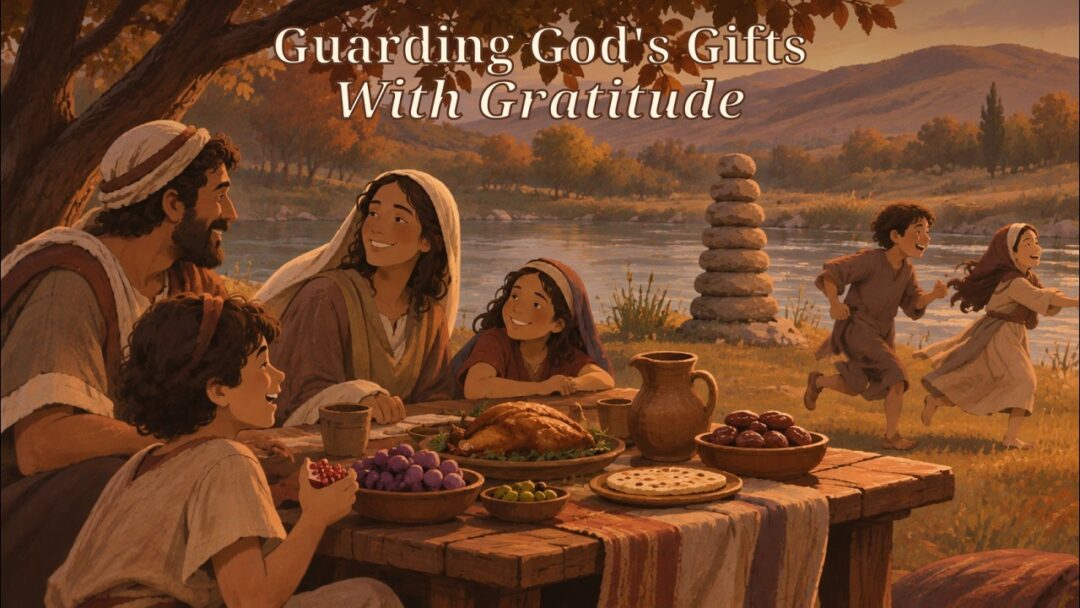
From our Sunday service on November 22, 2026 (Thanksgiving), Psalm 78:1-8. Watch the full message: Guarding God’s Gifts with Gratitude – Thanksgiving 2026 on YouTube.
Psalm 78 is our key passage today. It’s where we get the structure of our sermon, but we’ll be jumping around quite a bit as we look at three important topics about thankfulness and why thankfulness is so important.
Thanksgiving is a time we have dedicated to stopping and reflecting on the good things God has done for us. But do you know why it is important to stop, remember, and thank God for all these things? One of the greatest dangers we face is that the longer we enjoy something good, the easier it becomes to forget how we received it, how much it meant to us, and what it takes to preserve that goodness for the future.
Today we’re going to look at Psalm 78 and some accompanying Scripture to see how remembering God’s goodness encourages us to remain faithful to Him and to pass that faithfulness on to those who follow us. From our time in Scripture today, here is what God wants you to know:
God wants you to remember His past goodness so that you and your children can continue to receive the blessings of His goodness in the future.
In Psalm 78, Asaph invites God’s people to listen to what their fathers had taught them. At the time of this writing, it had been over 400 years since Israel conquered the Promised Land, and over 450 years since God brought them out of Egypt. They had seen times when they remembered God’s goodness and times when they forgot. By this point they had learned how important it is to remember the Lord’s goodness and to keep setting aside time and memorials to give thanks to Him.
The Need to Praise God for His Goodness
First, we’re going to look at the need to praise God for His goodness. Psalm 78 is titled “Maschil of Asaph,” and it opens like this:
Give ear, O my people, to my law: incline your ears to the words of my mouth. I will open my mouth in a parable: I will utter dark sayings of old: Which we have heard and known, and our fathers have told us. We will not hide them from their children, shewing to the generation to come the praises of the LORD, and his strength, and his wonderful works that he hath done.
Psalm 78:1–4
The rest of the psalm is a list of things Asaph wants the people of Israel to remember about God’s goodness: all the things God had done in their history to provide miraculously for them in their time of need. Today we’re just going to look at the introduction, where Asaph tells us why he is reminding the next generation of all the goodness of God.
He says he is doing this for three reasons: “shewing to the generation to come the praises of the LORD, and his strength, and his wonderful works that he hath done.”
First, he wants to praise the Lord for what He has done. Another way to say that is that he’s doing it to increase the gratitude the next generation has for the acts God has accomplished.
Second, he wants to demonstrate God’s power, His strength. He wants to teach the children who come after him how powerful their God is. God is not just a God of ideas or an idea of morals. He is an active, acting God with real power and real authority to do real things in this world. Another way to say that is that Asaph is doing it to increase their faith, because when they see God’s power, they will not doubt.
Third, he wants to show how God does wonderful things. God had done many things in Israel, and when Asaph teaches them why God did them, it begins to reveal God’s attributes to the people who follow after him. We can’t see God. We can’t look Him in the face and have a clear conversation like we do with our neighbor. But the attributes of God are clearly taught through His actions in this world. So Asaph wants to show his children God’s attributes: His goodness, His faithfulness, His longsuffering, His patience, His tolerance of our sins, and His mercy and grace to forgive us of our sins.
So Asaph says that if he does these things and reminds the next generation, he will teach them to praise the Lord, which increases their gratitude; to see God’s power, which increases their faith; and to see how He does wonderful things, which shows them His attributes. What Asaph is teaching us is that the reason we should intentionally stop to remember what God has done is to increase our appreciation of God’s provision, to increase our reliance on God, and to be reminded of who God really is.
We’ll see today how, as the Israelites enjoyed the Promised Land, they forgot what God was all about. They forgot who He was. They forgot about His attributes. And as they forgot why God was important, they ultimately ignored Him altogether. So if we want to have a godly model of gratitude, we too should make sure we do these three things.
Remembering Takes Intentional Effort
As Christians, one thing we need to realize is that remembering God’s goodness requires intentional effort on our part. This is the part the Israelites didn’t realize. They had heard the command when they entered the land not to forsake the Lord and not to forget the Lord. They did a few little things to try to remember Him, but they forgot that it takes effort to remain thankful.
Even David himself had to remind his own soul not to forget what God had done for him. In Psalm 103, David says, “Forget not,” do not forget God’s benefits:
Bless the LORD, O my soul: and all that is within me, bless his holy name. Bless the LORD, O my soul, and forget not all his benefits.
Psalm 103:1–2
In this psalm, David orders his own soul not to forget the benefits the Lord has given him. Gratitude is not something that comes naturally. Life is so fast that if we do not take time to be thankful, we’ll forget, and we’ll never realize how blessed we truly are.
If you read verse 2 at face value and really let it sink in, you might think to yourself, “How could I forget all the benefits God has given me?” But the truth is, we so often forget all His benefits. You might remember one thing here or one thing there, but if we were to lay it all out in a book, how many pages would it take to list all the good things God has given us that we have never stopped to give thanks for? How many have we never allowed to affect us, to teach us about God, and to teach us to honor Him and value Him? We should bless the Lord at all times, because there are always blessings coming in that we’ve completely overlooked.
Life was fast in David’s day, but boy oh boy, life is even faster today. There are so many things going on. In America we’re a working economy. We work, work, work. Some of us are working 60 or 70 hours a week. I’ve known people working up to 80 hours a week, and that’s crazy. We’re a go, go, go society, moving from one thing to the next, to the next, to the next. If David had trouble finding time when he was king of Israel, then we’re going to have trouble today with everything fighting for our attention: the entertainment, the responsibilities, the jobs, the XYZ and ABC. The list could go on forever. There’s always something to distract us and make us forget all the benefits of God. So we must tell our soul, “O my soul, forget not the benefits of the Lord.” Don’t be so busy that you forget all the things God has done for you.
We can also become so focused on what we wish were different in our lives, and on all the things we have to do, that we fail to recognize the good God has already put in our lives. We forget simple things such as forgiveness, mercy, and daily provision. David lists these in verses 3 through 5 as things we should always be thankful for:
Who forgiveth all thine iniquities; who healeth all thy diseases; Who redeemeth thy life from destruction; who crowneth thee with lovingkindness and tender mercies; Who satisfieth thy mouth with good things; so that thy youth is renewed like the eagle’s.
Psalm 103:3–5
Here David lists many things we quickly forget about. God provides these things almost daily, if not every single day, and yet we forget to be grateful for them. He lists forgiveness of our iniquities, healing of our diseases, His redemption, His kindness, His mercies, and His food. We can always be thankful for God’s forgiveness, for our health, for our salvation, for God’s kindness, for His mercy, and for the food on our table.
But when life gets busy, it’s so easy to forget that if we’re alive, we’ve still got some health to be thankful for. If we’re not hungry, it’s easy to forget that we could be starving, but God has allowed us to be full and satisfied. It’s easy to forget all the sins we commit without even thinking about it that God, in His mercy, has forgiven. We need to take time to remember, to pray, and to thank God for the prayers He has answered. We need to remember all the difficulties He has brought us through and the blessings we have begun to take for granted because they’re in the past.
It’s easy to thank God for the things He’s doing now, but once those things are weeks or months behind us, we’re almost like the children of Israel in the wilderness. After they were freed from slavery in Egypt, they said, “Man, I miss the fruit and the vegetables back in Egypt. They were so good.” We look at them and say, “How in the world could you forget you were a slave in Egypt?” But how often have we forgotten the great things God has done in our own lives?
There were moments when we were at the end of our rope. We didn’t think we had anywhere to go, and we thought, “This is it. I’m done. It’s over.” Then suddenly the world around us moved in such a way that every situation worked out for good, just like the Bible told us it would. We said, “Wow, that was amazing. I’ll never stress out next time. God had my back.” Then next time comes, and there we are like the children of Israel: “It was so much easier before. What will I do now?” We repeat the same cycle as the Israelites, remembering God’s goodness and then forgetting it, thanking God for His goodness and then getting angry at Him for not giving us some other thing we wanted on the side. So David encourages us: don’t forget. Tell your soul to remember the benefits God has given you.
The Need for Memorials
Both David and Asaph tell us it is important to remember to be thankful for what God has done. But why is it important? What happens if we forget? That brings us to the need for memorials. Back in Psalm 78, verses 5 and 6 continue the explanation:
For he established a testimony in Jacob, and appointed a law in Israel, which he commanded our fathers, that they should make them known to their children: That the generation to come might know them, even the children which should be born; who should arise and declare them to their children.
Psalm 78:5–6
Here Asaph records how God commanded the Israelites to make an intentional effort to teach their children to be grateful for the things God had done. The children were never going to know the struggles of the wilderness wanderings. They were never going to know the difficulty of the conquest of Canaan, when even tribes Israel didn’t have to attack came out of their way to attack them. The Amorites did this on Israel’s journey: Israel was just passing by the Amorite land, and the Amorites came out to fight and kill them. Yet God protected them.
The children had the joy of not having to deal with that hardship, but with that comes a challenge: being able to appreciate God when you haven’t seen Him do those miraculous things. Some of us are parents who have seen God come through in ways we could never comprehend, and the truth is, we will never be able to tell our children just how much that means, because they never went through the hardship. So God told the Israelites when they entered the land to be careful to make gratitude for God an intentional, everyday thing, because their children weren’t going to know the hardships they knew.
If you’re blessed by God, those hardships won’t be there for your children, and they’ll live a life without knowing that hardship. But the challenge is that when you live a cushy, comfortable life, you aren’t grateful for that cushy, comfortable life. Maybe when you were younger, life was really hard. You were scraping by to make the bills. Maybe your landlord had to delay your rent a couple of times. Now it’s been 20 or 30 years, and you’ve never missed a payment on anything. Life has been smooth, and you forget those hard days. And your kids won’t know what that was like. They won’t know that difficulty.
So what do we do? How do we get our children to know how good God is when they haven’t seen the hardships God has already brought us through? That’s the question in this section. God intends the knowledge of His works and His commandments to be passed from one generation to the next, and every generation has a responsibility to teach the next generation to follow in its footsteps. But what one generation learns through hardship may be enjoyed by the next generation without its knowing what made it possible to begin with. If we want our children to appreciate the blessings they inherit, we must teach them about the God who provided them.
The Danger of Forgetting
Before Israel entered the Promised Land, Moses warned them to recognize the danger of forgetting:
When thou hast eaten and art full, then thou shalt bless the LORD thy God for the good land which he hath given thee. Beware that thou forget not the LORD thy God, in not keeping his commandments, and his judgments, and his statutes, which I command thee this day: Lest when thou hast eaten and art full, and hast built goodly houses, and dwelt therein; And when thy herds and thy flocks multiply, and thy silver and thy gold is multiplied, and all that thou hast is multiplied; Then thine heart be lifted up, and thou forget the LORD thy God, which brought thee forth out of the land of Egypt, from the house of bondage.
Deuteronomy 8:10–14
God warned Israel that as they enjoyed all the blessings He provided, those blessings could cause them to forget Him. These families would live in beautiful homes. They would bring in full harvests. The struggles of life that had kept them faithful would be gone, and their children would know nothing but the joys of the Promised Land. God says, in effect, “You’ll be full, you’ll be satisfied, and you’ll have everything you need in this life. But when you have everything you need in this life, don’t forget what you need in your spiritual life.”
It’s easy, when we’re satisfied physically, to forget our spiritual needs. But God warns them: if you struggle to remember Me in your blessing, that blessing will be taken away. It won’t last, because the only reason you’re blessed is your gratitude toward Me and your living by My principles. When those principles fall apart, your society will fall apart, and destruction will come.
The hungry man remembers his need for food. The sick man remembers his need for healing. The troubled man remembers his need for God’s help. But when those needs are met, we can easily forget our need for, and dependence on, God. The prosperity God blesses us with becomes dangerous when it makes us forget the One who gave it to begin with. When everything is going well, it’s easy to forget all the instructions and commands He gave us for a moral life. It’s easy to forget His desire for justice and His laws. However, if we want to remain blessed, hold on to those blessings, and pass them on to our children, we need to remember these things even in our successes.
If the Israelites forgot God, then just like the people of Canaan they were removing, they too would share the same fate:
And it shall be, if thou do at all forget the LORD thy God, and walk after other gods, and serve them, and worship them, I testify against you this day that ye shall surely perish. As the nations which the LORD destroyeth before your face, so shall ye perish; because ye would not be obedient unto the voice of the LORD your God.
Deuteronomy 8:19–20
“I testify against you this day” means, in other words, “I’m telling you today.” The Canaanites were being removed from the land because of their ungodliness: child sacrifice, idolatry, immoral relationships, and horrible cults that did horrible things, bringing death and destruction. God said, “Enough is enough. I’m driving them from the land, and I’m replacing its inhabitants with those who follow My commands. I’m taking away the wealth and comfort of the Canaanites so they can learn their need for God, and I’m giving it to you because you’re following Me.”
Then comes the warning: “I’m taking the blessings away from the wicked and giving them to the faithful. But here’s the truth: if your faithfulness wanders, I will take back the blessings I gave you, just like I did to the people before you. If you forget Me in the comfort I give you, I’ll take it away.” So it’s important to tell your children not to make the same mistakes as the people of the land, because all the blessings you build up over your lifetime, they will lose when God has to take them away to teach them their need for Him.
Joshua’s Memorial Stones
At first the people took these things seriously, and they took steps to make sure they remembered all the things God had done. Joshua started this push for remembrance in Joshua chapter 4:
And those twelve stones, which they took out of Jordan, did Joshua pitch in Gilgal. And he spake unto the children of Israel, saying, When your children shall ask their fathers in time to come, saying, What mean these stones? Then ye shall let your children know, saying, Israel came over this Jordan on dry land. For the LORD your God dried up the waters of Jordan from before you, until ye were passed over, as the LORD your God did to the Red sea, which he dried up from before us, until we were gone over.
Joshua 4:20–23
Here Joshua sets up a memorial to remind the next generation of God’s goodness, not just in his own generation but even in the generation before. Remember, the generation that wandered in the wilderness had died out, and Joshua was one of the last of them. He says, in effect, “I’ve put these memorial stones by the river so that when you walk along the Jordan, your kids will see this pile of stones and ask, ‘What is that, Dad? What’s that, Mom? What’s that there for?'”
And the parent answers, “Let me remind you, son, of what God did for us. When we marched into Canaan to possess the land, this river miraculously dried up, and we walked through on dry ground right into the Promised Land. God gave us mighty victory over our enemies, even those who went out of their way to destroy us. God gave us victory after victory because we were faithful to Him, and, my boy, if you are faithful to God, He will give you the victory as well. And it wasn’t just my generation. Even your grandfather was a slave in Egypt, and when the greatest power in the world came chasing after us, God divided the Red Sea, and we walked on dry ground. Just as He did for Grandpa, and as He did for your dad, He can do the same for you.”
It was a beautiful attempt to preserve that memory for a future generation. The twelve stones represented the twelve tribes of Israel, showing that all of them shared in the goodness of God. If we too want to remind the next generation of the goodness of God, we need to set up reminders and memorials intentionally, so that we have opportunities to instill gratitude in our children. We must take intentional measures to ensure that the knowledge of God’s goodness does not die with our generation.
The Need for Living Gratitude
Joshua established a memorial to preserve the knowledge of God’s goodness. But the question becomes, did the generation that followed remain faithful? Was it enough? That brings us to our third point: we have a need for living gratitude. In Judges 2:7 we see the beginning of a generation who forgot:
And the people served the LORD all the days of Joshua, and all the days of the elders that outlived Joshua, who had seen all the great works of the LORD, that he did for Israel.
Judges 2:7
At first, the memorial stones worked. Those fathers and grandfathers told their children about God’s goodness. As long as the original generations lived, they passed on the stories of God’s miracles and provision, and they remained faithful. But how did things go once that generation was gone?
And also all that generation were gathered unto their fathers: and there arose another generation after them, which knew not the LORD, nor yet the works which he had done for Israel. And the children of Israel did evil in the sight of the LORD, and served Baalim: And they forsook the LORD God of their fathers, which brought them out of the land of Egypt, and followed other gods, of the gods of the people that were round about them, and bowed themselves unto them, and provoked the LORD to anger. And they forsook the LORD, and served Baal and Ashtaroth.
Judges 2:10–13
The generation that followed heard the stories, but something was missing. They saw the memorial stones, but the truth was, they never knew the Lord’s goodness for themselves. They sat around the table with their families at the Sabbath day meals, not unlike what we’re going to do at Thanksgiving, and they talked about all the goodness of God. But hearing about God’s goodness from their parents wasn’t the same as knowing God’s goodness in their own lives.
The text says they did not know the works God had done. That means God hadn’t done anything for them. While the parents told the stories of how God worked in their lives, they didn’t set their children up to live out God’s will in a way that God would do miraculous things for them. And because the children had no personal relationship with God and no personal walk with God, they didn’t have anything to be thankful for. They just took for granted everything their parents had received, including the Promised Land. Sure, when their parents died, that land was passed to them. But they didn’t work for it. They didn’t know how God had provided in miraculous ways to get it. They hadn’t had to go out of their way to be faithful to God. So when their parents died, they said, “Well, those were good stories. I know it worked out well for my parents. I know it benefited my parents. But what’s in it for me?”
The generation that had seen God’s works served Him all their lives, and we praise the Lord for that. They had set up memorials, but they never really used them for their children. As a result, the next generation did not know any of the works God had done, and they had seen no works in their own lives either. So they turned to other gods. The failure to pass on the knowledge of God’s goodness had consequences far beyond the first generation.
Let Your Children Need God
We cannot assume that those who inherit the blessings God has given us will immediately inherit the faith that got us those blessings to begin with. We need to tell the next generation how God has worked in our lives, but we also need to make sure they get to experience God’s provision too. Share your testimony. Remember what God has accomplished. But we cannot expect the next generation to appreciate what we fail to teach them to appreciate. Being around memorials of God’s goodness is not a substitute for living in gratitude yourself.
Raise your children to learn to depend on God. When you have the ability to solve all of your children’s problems, it’s tempting as a parent to do it. But sometimes that’s not the best thing to do. The Israelites solved all their children’s problems. Their children didn’t have to rely on God to get them through anything. So when their parents died, they said, “Well, what do I need God for? I have everything I need.”
Parents, it’s important to give your children opportunities to get out there in the world and need God, to have to rely on Him and walk through life alongside Him. One great way to do that is to serve in your church or in your community, to see the hardship in the world around you, and to walk alongside God to heal the people around you. We need to get out of our comfort zone, to do things that make us uncomfortable and serve God in ways that make us uncomfortable, so that we have to say, “Okay, I don’t know what to do, but I’ve got to do something, so God, You’re going to have to carry me the rest of the way.” It’s only when people get to the end of their rope and realize how much they need God that they really remember how important it is to have God in their lives. We don’t want to make the same mistake as the Israelites and never give our children an opportunity to rely on their Heavenly Father.
Going back to Psalm 78, look at verses 7 and 8:
That they might set their hope in God, and not forget the works of God, but keep his commandments: And might not be as their fathers, a stubborn and rebellious generation; a generation that set not their heart aright, and whose spirit was not stedfast with God.
Psalm 78:7–8
Asaph says these children need more. They need to live in hope and live in faith, not just hearing about it but living it for themselves. Their fathers were stubborn and rebellious because they had what they needed, and they thought the rules were just extra things they didn’t need. They thought faithfulness to God was extra, and that if they stopped being faithful to God, they could keep all the blessings God had given them. That’s not how it worked. Their parents had only become so blessed because God saw their faithfulness and rewarded it. It’s important that we teach our children not to take those things for granted.
Paying Our Vows
So what do we do? What do we teach our children and instill in them? Psalm 116:12-19 tells us what we should give to the Lord:
What shall I render unto the LORD for all his benefits toward me? I will take the cup of salvation, and call upon the name of the LORD. I will pay my vows unto the LORD now in the presence of all his people.
Psalm 116:12–14
And verse 17 continues:
I will offer to thee the sacrifice of thanksgiving, and will call upon the name of the LORD.
Psalm 116:17
We need to pay our vows to the Lord. We need to be serving the Lord. We can thank the Lord for all the things He’s done. We can even go on the news channel and say, “I thank Jesus for everything.” But we need to pay the Lord back by doing His commandments, by going out into the world, being a light, and serving the Lord. When our children see us serving, and when our children are serving, they will see the Lord in ways they never would have seen if they had just sat on the sidelines and enjoyed all the blessings God has given you.
And when it’s all said and done, we can do as verses 17 and 18 describe. We can say, “I have paid my vows. Now I will offer the sacrifice of thanksgiving. I will sit down with my household in faith and thank the Lord for all the things He has done.” The psalmist considers how he himself should respond to God’s goodness, and he concludes that he should do it by paying God back for all His goodness to him, and then he will sit down and thank the Lord for all of His blessings.
We can never repay God for all of His gifts, all of His grace, all of His mercy, and all of His compassion. But we can devote ourselves to Him in response to it. You can never impress the Lord. So why don’t we, as a generation, go and show our children and our children’s children what it looks like to be thankful for what the Lord has done?
Guarding Tomorrow’s Blessings
To tie all these thoughts together: remembering God’s goodness is essential to preserving our faithfulness to Him. When we reflect on what God has done, we strengthen our confidence in Him, we deepen our appreciation for His provision, and we renew our commitment to obey Him. The danger of forgetting God’s goodness is that we may continue to enjoy His blessings while gradually abandoning the principles by which He allowed us to have them in the first place. Genuine gratitude should strengthen our dependence on God, even when all of our needs are met.
We must also be intentional about making gratitude a core part of parenting. Those who inherit our blessings will not necessarily inherit the faith that got us those blessings. We must teach our children what God has done for us, demonstrate through our lives how we respond to His goodness, and encourage them to recognize His provision in their own lives. Our desire should be for them to develop a personal gratitude toward God that motivates them to remain faithful to Him long after we are gone from this earth.
This Thanksgiving, let’s do more than just count our blessings. Let’s consider how we are responding to them. Are we trusting God more because of what He has done? Are we more committed to living according to His Word? Are we teaching those who follow us to do the same? The best way we can guard tomorrow’s blessings is by cultivating gratitude today that produces lasting faithfulness to God.
God wants you to remember His past goodness so that you and your children can continue to receive the blessings of His goodness in the future. So will you determine today to always remember His goodness?

Recent Comments