
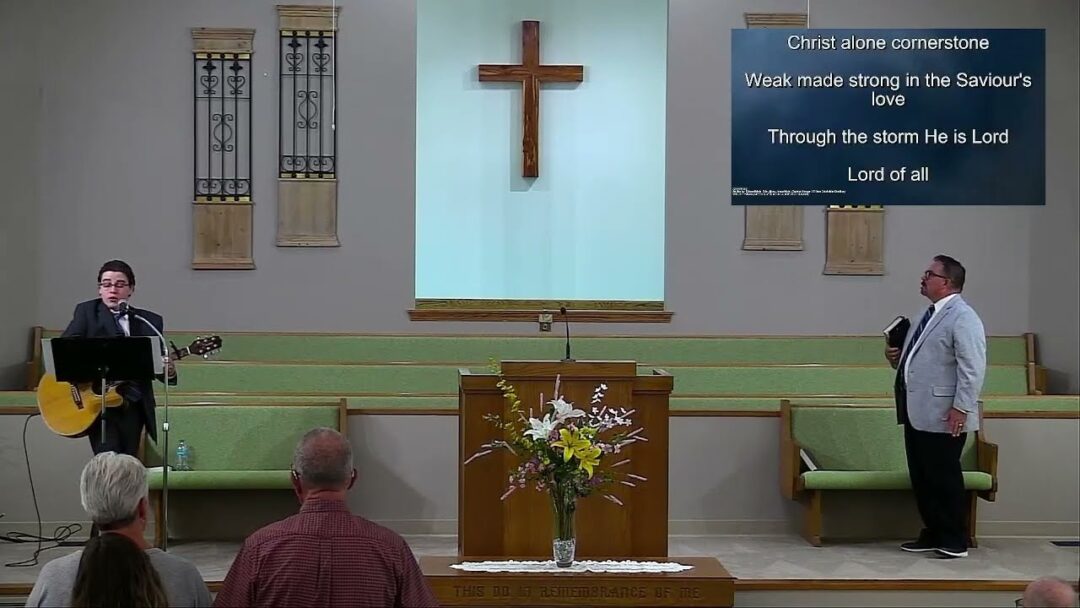
From our Sunday service on July 28, 2024, Hebrews 5, Matthew 28, Romans 12, 1 Peter 4, 2 Corinthians 10, Luke 21, Ephesians 4, Galatians 5, and Revelation 3. Watch the full message: Beyond the Basics on YouTube.
Last time we talked about the Holy Spirit and His role in the life of the believer. I’d like to talk about what God’s vision for the church looks like when the Spirit is working in the believer and he begins to do the will of God. I also have a vision for this ministry, if you were to vote me in as senior pastor. But my vision doesn’t matter if it doesn’t line up with the vision God has for His church, so before we talk about me, let’s talk about God’s vision.
“Babe” here isn’t talking about a babe in the modern sense but a baby. The letter to the Hebrews is written not to a pastor but to believers in general, to the average church member. “For when for the time ye ought to be teachers.” All of us are called to be, in some way, a teacher. The author has this charge: “You’re supposed to be teachers by now. You have need of milk and not strong meat.” Christians can be unskilled at being a Christian. The Christian walk is a skill that must be developed. We want to be that fully developed Christian, able to tell what is good and evil. I have three phases of the Christian walk: the beginning, the building, and the body.
Phase One: The Beginning
At the end of Matthew, the last thing Jesus does while He’s here on earth is give His disciples one singular call. The first step is that they must hear the truth about the gospel. Jesus also says to baptize them, to immerse yourself in the water and identify yourself with the body of Christ. The third part is “teaching them to observe all things.” Faith and baptism are the bare minimum, the basis for the steps that follow.
Phase Two: The Building
Then comes the building phase. In Romans 12, “ministry” isn’t ministry in the modern sense of church ministry. It’s ministering to others, to the ability God has granted you. “He that exhorteth” is encouragement. “He that giveth, let him do it with simplicity.” If you’re going to give a gift to the church, don’t do it in front of the whole congregation. Don’t come up in the middle of the message and say, “I’d like to give a check of $10,000 to Lakeview Baptist Church.” “He that ruleth, with diligence.” That’s talking about pastors. If you’re going to be in charge of a church, you need to be diligent and focused on the needs of the church. That applies to me if you vote me in. “He that sheweth mercy, with cheerfulness.” You can have mercy on someone and not be happy about it. Mercy that’s given out of resentment is not mercy at all. No matter what the skill is, if we have it, we should use it.
As every man hath received the gift, even so minister the same one to another, as good stewards of the manifold grace of God. If any man speak, let him speak as the oracles of God; if any man minister, let him do it as of the ability which God giveth: that God in all things may be glorified through Jesus Christ, to whom be praise and dominion for ever and ever. Amen.
1 Peter 4:10–11
1 Peter 4 teaches us that the best you can do is what God calls you to. “As every man hath received the gift.” Everyone in here has a talent given to you by God, no exceptions, and you have already received it. Here Peter is drawing back to the parable of the talents. The talent was a form of money, but it was an illustration, and it just so happens that in English the word means both. If you remember anything about that parable, it’s not that everybody received the same gift but that everybody received a gift of a different size. Some received five, some two, some one. Everybody has a different measure of talents, and yet God wants us to use them all to the extent we were given. “If any man speak, let him speak as the oracles of God.” If you’re called to speak, say what God said and nothing more. It doesn’t have to be the most profound and heart-moving message. Just say what God said. And if any man minister, let him do it as of the ability which God giveth. Just because we can’t do something better than someone else doesn’t mean we shouldn’t do it at all.
Don't Compare Yourself With Others
For we dare not make ourselves of the number, or compare ourselves with some that commend themselves: but they measuring themselves by themselves, and comparing themselves among themselves, are not wise. But we will not boast of things without our measure, but according to the measure of the rule which God hath distributed to us, a measure to reach even unto you.
2 Corinthians 10:12–13
Those who compare themselves among themselves are not wise. I was reading a book called Not a Fan, and it raised a really good point: when we compare ourselves among ourselves, we always compare ourselves to the one that’s most convenient. If we’re not doing enough, we compare ourselves to the person who’s doing the least. But if we’re comparing ourselves in ministry, we say, “I’m not good enough as this minister up here who’s so talented.” I once had a person in our class who gave a Bible illustration about a child getting run over by a car. The teacher said, “That is the worst illustration I’ve ever heard in my life. Never say it again.” When God is putting a call on my heart, I’m never going to say, “I can’t be called because I’m not as good as the guy who gave the worst illustration ever.” I’m going to say, “I’m not as good as Billy Graham.” But God isn’t asking you to be that person. God is asking you to be you. There are people with megachurches who have so many skills and aren’t using all of them. We look at them and say, “They’re so amazing,” and in God’s eyes they aren’t even doing everything He’s called them to do. The poor widow in Luke 21 didn’t give the largest amount, but she gave the biggest percentage of what she had.
Good Enough for God
The committee mentioned that I’m still learning and have shortcomings as a person. I’m glad they didn’t share them, so let me share some of my own. I started in youth group just leading music. Then the guitar player was graduating, and he said, “Zach, why don’t you learn guitar to lead when I’m gone?” I thought, “I’ve never picked up a guitar in my life.” God put it on my heart, so I did, and I had only played for two or three weeks before I started leading. To this day I can’t play an F. If I said, “He can tab that guitar, and I can only do chords, so I should not lead music,” then I’d be missing out. I can play chords on the piano, but I can’t play like Shannon. God has allowed me to have enough talent to do what He’s called me to do, and I can’t get beyond that. Some have said, “I can’t teach Sunday school because there are professional teachers who can do it better.” If you’re going to teach Sunday school, you’re 50 percent of the way there if you just pick a good snack. You don’t have to be the best. You just have to be willing. If you do your best, God says, “That’s good enough for me.” There are times when I’ll play the wrong chord, or lose track in my message. Who are we to place limits on God because of our own lack of ability? Jesus didn’t come down because we had the ability to save ourselves. Does ministry have to be in Lakeview Baptist Church? No. There are other ministries outside this church.
Phase Three: The Body
I know thy works, that thou art neither cold nor hot: I would thou wert cold or hot. So then because thou art lukewarm, and neither cold nor hot, I will spue thee out of my mouth.
Revelation 3:15–16
Phase three is the body. God gave some as pastors and teachers, for the perfecting of the saints, till we all come to a perfect man. That isn’t someone without sin. This is a person who has found completeness in Christ. God doesn’t call us to Christianity to be happy. C. S. Lewis talks about this. He says he wouldn’t recommend Christianity as a religion for someone who’s looking for comfort. If you’re looking for comfort, you’ll find it at the bottom of a beer bottle, where you forget your problems and they go away. But Christianity is for someone who wants to be transformed, and who wants to be joyful despite life’s circumstances. And God uses Laodicea as a warning. Six miles north, Hierapolis had bubbling hot springs that comforted the weary. Nine miles east, Colossae had ice-cold fresh springs. Laodicea built a fancy aqueduct and wanted both, but the water was lukewarm, full of calcium, and disgusting. An ancient writer says it was better to drink than the volcanic waters up the road, better than an active volcano. God says, “I want you to do something. I don’t care if it’s warmth to comfort somebody, or cold to refresh somebody. I want you to be useful, not just bitter and stagnant.” The water also picked up bacteria, so all it was good for was toilet water and fountains. Are we just good for nice displays of Christianity? God forbid we be like Laodicea, baby Christians who never learn to walk in the Spirit. Francis Chan once wrote, though I’m not endorsing everything he wrote, “God doesn’t call us to be comfortable. He calls us to trust Him so completely that we are unafraid to put ourselves in situations where we will be in trouble if He doesn’t come through.” The hard part is stepping out into the unknown and praising God through your actions, saying, “God, I know I’m maybe not the best person in the world to do this, but I’m a person in the world willing to do this.”
Recent Comments