
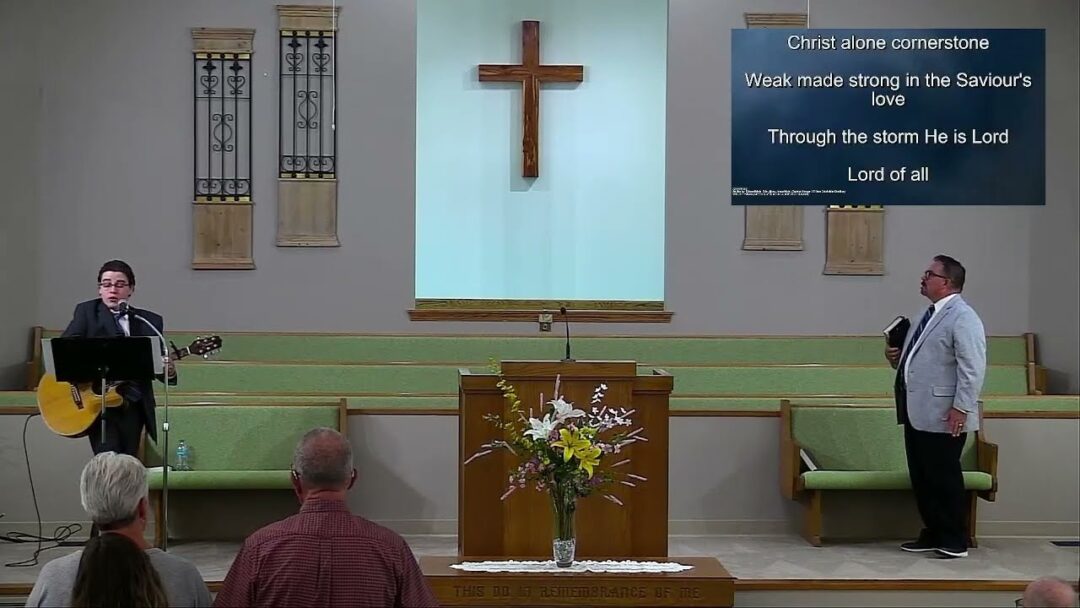
From our Sunday service on July 28, 2024, Hebrews 5, Matthew 28, Romans 12, 1 Peter 4, 2 Corinthians 10, Luke 21, Ephesians 4, Galatians 5, and Revelation 3. Watch the full message: Beyond the Basics on YouTube.
Last week we talked about the Holy Spirit and His role in the life of the believer. Today I’d like to talk about what God’s vision for the church looks like when the Spirit is working in the believer and he begins to do the will of God. Next week I’m going to talk about what my vision would be for this ministry if you were to vote me in as senior pastor. But my vision doesn’t matter if it doesn’t line up with the vision God has for His church, so before we talk about me, let’s talk about God’s vision. I’ve been thinking about this message for a long time, and I feel God put it on my heart that now is the right time.
A Completed Christian
We’re going to look at three main points, but first, here is a passage that introduces our concept. Hebrews 5:12–14 talks about a completed Christian.
For when for the time ye ought to be teachers, ye have need that one teach you again which be the first principles of the oracles of God; and are become such as have need of milk, and not of strong meat. For every one that useth milk is unskilful in the word of righteousness: for he is a babe. But strong meat belongeth to them that are of full age, even those who by reason of use have their senses exercised to discern both good and evil.
Hebrews 5:12–14
“Babe” here isn’t talking about a babe in the modern sense but a baby. What’s important about this passage is that the letter to the Hebrews is written not to a pastor but to Hebrews in general, believers in this Jewish community. In many books where we see instructions about the church, they’re targeted toward church leadership. Here the letter is targeted to the average church member, and every church member. It says, “for when for the time ye ought to be teachers.” If that’s targeted to all believers in general, what does that mean about all believers?
Last week we talked about spiritual gifts, and one of them is the gift of teaching. The Bible tells us here that all of us are called to be, in some way, a teacher. That may not be a teacher in Sunday school or in a classroom, but in some way we are to reflect God in our lives by teaching others about God. The author of Hebrews has this charge against these believers: “You’re supposed to be teachers by now. You’ve been in the church for years. You’ve been learning the principles of God. But for some reason I’m writing this letter to people who should be teaching others the basic fundamentals of the faith, and you have need of milk and not strong meat.” You should be doctrinally stronger than you are right now. You should have the basics down enough that you can go out into the world and teach. That might look like telling people at your job what the Bible says. It might look like finding a newer Christian who has so many questions about the Bible and wants to know, “Where do I find the topic of salvation in the Bible?” If you’re a Christian and you know anything about the Bible, you know Romans is a great place to start. As Christians, we are all called at some level to be a teacher.
So how do we become a teacher? The author says you’re “unskillful in the word of righteousness.” That’s talking about the Bible. Christians are called to be skilled in the Bible so they can teach others about Christ and be an encouragement. He summarizes it by saying “by reason of use have their senses exercised to discern both good and evil.” So we’re learning a few things. First, there’s a time for all Christians to be teachers. Second, Christians can be unskilled at being a Christian. Third, the Christian walk is a skill that must be developed. Look at that last verse: “having their senses exercised.” You’re not going to find a moment in your life when you’re suddenly ready to be a teacher. It’s something you practice, develop, and build up over time.
So how can we build up our Christian walk to the point that we can become teachers and fulfill this goal God has placed in every believer’s life? We want to be that fully developed Christian. The idea is completeness, or perfection, where a fully developed Christian can be an effective Christian, able to tell what is good and evil and knows what God has called them to do. What does this process look like? I have three phases of the Christian walk to look at today. Phase one is the beginning, phase two is the building, and phase three is the body.
Phase One: The Beginning
How many of you remember what happens at the end of the book of Matthew? What is the last thing Jesus does while He’s here on earth? He gives His disciples an instruction. He summarizes everything that’s going to come in the letters later, and He gives one singular call for all believers who were present there on the mountain in Galilee.
And Jesus came and spake unto them, saying, All power is given unto me in heaven and in earth. Go ye therefore, and teach all nations, baptizing them in the name of the Father, and of the Son, and of the Holy Ghost: Teaching them to observe all things whatsoever I have commanded you: and, lo, I am with you alway, even unto the end of the world. Amen.
Matthew 28:18–20
His disciples are already trained. He’s been teaching them for years, and now He says, “You’re going to go out there and make converts.” This brings us to the first phase of the Christian walk. There are three beginning steps of the believer, and they’re called to teach all nations.
The first step is that they must hear the truth about the gospel. You can’t start your journey as a believer without first being told about the gospel. You can’t get to the last phase of your Christian walk if you’ve never accepted Christ as your Savior.
Jesus also says to baptize them. The second part of the believer’s beginning is to take believer’s baptism, to immerse yourself in the water and identify yourself with the body of Christ and the Holy Spirit. We talked last week about how we are immersed in the Holy Spirit and how baptism is a picture of that. If you want to get to this teaching phase of your Christian walk, we have to follow the first command God gave to His believers, and that is to be baptized. If anybody hasn’t been baptized and wants to be, come talk to me or to Pastor about it. We’re more than happy to do that. If you want to get to the part of Christianity where you see the most blessing and see God work in your life, you have to get that first step down.
The third part is “teaching them to observe all things.” You have to know how to live the Christian walk. The disciples were sent out to teach and convert, and that’s not it. We don’t just baptize them and let them go. Jesus says, “You need to teach them what they need to know.” That raises a question: if we need to teach all things, what are all these things we need to know so that they can go and make disciples themselves?
The first steps of the believer are faith and baptism, but this is just the bare minimum. It’s the basis for the steps that follow, the steps that help build us up as believers. We have faith in the gospel, we respond to it, and we join in baptism.
Phase Two: The Building
So let’s go to the second phase of the Christian walk, the building phase. There will be a little overlap with last week’s message, because we’re talking about our role in the church, but we’re going to different passages. We get saved, we get baptized, and we need to start learning, because we can’t go out and teach if we’ve never learned. Romans 12:4–8 tells us about how all Christians have different roles.
For as we have many members in one body, and all members have not the same office: So we, being many, are one body in Christ, and every one members one of another. Having then gifts differing according to the grace that is given to us, whether prophecy, let us prophesy according to the proportion of faith; Or ministry, let us wait on our ministering: or he that teacheth, on teaching; Or he that exhorteth, on exhortation: he that giveth, let him do it with simplicity; he that ruleth, with diligence; he that sheweth mercy, with cheerfulness.
Romans 12:4–8
Here we see a different list of gifts from last week’s. We couldn’t talk about them all last week, but we can talk about a few more today. “Ministry” here isn’t ministry in the modern sense of church ministry. It’s ministering to others, taking care of others and being a blessing to others. What does it mean to minister “on our ministering”? It means to minister to the ability God has granted you. If your gift is ministry, and your job is to comfort and minister to others, then God calls you to minister to the ability He gave you.
“He that teacheth” is talking about formal teaching. “He that exhorteth” is encouragement, encouraging someone in their Christian walk. Maybe somebody is considering going into ministry and is struggling with difficulty. Exhortation is to encourage them: “Hey, you can do this. There are verses in the Bible that tell me you can do it through Christ no matter how difficult it gets.” Encouragement could also be for somebody going through a medical difficulty.
“He that giveth, let him do it with simplicity.” This is talking about giving gifts to the church. If you’re going to give a gift to the church, don’t do it in front of the whole congregation on Sunday. Don’t come up in the middle of the message and say, “I’d like to give a check of $10,000 to Lakeview Baptist Church.” Give in simplicity. Don’t brag about it or tell everyone about it. Just give from the heart as God has led you to do.
“He that ruleth, with diligence.” That’s talking about pastors. If you’re going to be in charge of a church, you need to be diligent and focused on the needs of the church. That applies to me if you vote me in. If you rule, you’ve got to rule with diligence.
“He that sheweth mercy, with cheerfulness.” This one’s a fun one. You can have mercy on someone and not be happy about it. I like that they put this little detail in there. If your gift is mercy, if you’re always so forgiving, at least be happy when you do it, because mercy that’s given out of resentment is not mercy at all.
So we have a role to play in the church, and we’re all equipped with a different skill set. No matter what it is, if we have it, we should use it. If it’s teaching, teach. If it’s giving, give, but be humble. If it’s encouragement, encourage.
The Best You Can Do Is What God Calls You To
I’m going to read 1 Peter 4:10–11. You don’t need to turn there. This passage teaches us something, so listen carefully: the best you can do is what God calls you to. I’ll explain that in a moment.
As every man hath received the gift, even so minister the same one to another, as good stewards of the manifold grace of God. If any man speak, let him speak as the oracles of God; if any man minister, let him do it as of the ability which God giveth: that God in all things may be glorified through Jesus Christ, to whom be praise and dominion for ever and ever. Amen.
1 Peter 4:10–11
I’ve read this passage a lot of times, and it didn’t stick out to me until I started this study and looked at it carefully to see if I’d missed anything. And I did miss something. “As every man hath received the gift.” Everyone in here has a talent given to you by God, no exceptions. Every single one of you has something. So that’s a conclusion we can already make from verse 10: everyone has a gift, and they have already received it.
Then it says, “minister the same one to another, as good stewards of the manifold grace of God.” Here Peter is drawing back to the parable of the talents, where Jesus talks about how He gave a talent to each person. The talent was a form of money, but it was an illustration, and it just so happens that in English the word means both. He gave these people money and said, “Invest this money, bring it back, and bless the master of the house.” God gives us these talents, and each of us has one. He says, “I’ve given you this ability. Now use it and spread the kingdom. Make the kingdom bigger than it was before, and when I return, I’m going to see what kind of work you’ve done with what I’ve given you.” If you remember anything about the parable of the talents, it’s not that everybody received the same gift but that everybody received a gift of a different size. Some received five, some two, some one. Everybody has a different measure of talents, and yet God wants us to use them all to the extent we were given.
This passage also emphasizes, “If any man speak, let him speak as the oracles of God.” If God has called you to speak, what does He want you to speak? “I’m not a good speaker. I can’t speak. I don’t have the skill of speaking well.” What does Peter say? If you speak, speak the oracles of God, the sayings of God. Listen to this, because it’s really deep: speak what God told you to say, that’s it. If you’re called to speak, say what God said and nothing more. That doesn’t sound so difficult anymore, does it? It doesn’t have to be the most profound and heartmoving message. It doesn’t have to be so well spoken that it sounds like it was written by the director of the largest university in the world. If any man is called to speak, let him just say what God said. That’s what God is calling us to. It’s not complicated. It’s so simple.
What about the next one? “If any man minister, let him do it as of the ability which God giveth.” If our job is to minister to others, how much does God want us to minister? To the best of the ability He gave you. Why? “That God in all things may be glorified through Jesus Christ.” So if you’re going to speak, speak what God gave you to say. If you’re going to minister, minister in the ability God gave you. Our talent and area are going to differ from person to person, and just because we can’t do something better than someone else doesn’t mean we shouldn’t do it at all.
Don’t Compare Yourself With Others
2 Corinthians 10:12–13 talks about comparing ourselves among ourselves.
For we dare not make ourselves of the number, or compare ourselves with some that commend themselves: but they measuring themselves by themselves, and comparing themselves among themselves, are not wise. But we will not boast of things without our measure, but according to the measure of the rule which God hath distributed to us, a measure to reach even unto you.
2 Corinthians 10:12–13
Once again, Paul is teaching the same idea as Peter. Those who compare themselves among themselves are not wise. I was reading a book called Not a Fan in preparation for this message, and it raised a really good point. When we’re in our marriage and having a fight, we always go to this comparison routine: “Well, I’m not like so-and-so, who doesn’t let their wife or husband do this.” It’s funny how, when we compare ourselves among ourselves, we always compare ourselves to the one that’s most convenient. If we’re not doing enough, we compare ourselves to the person who’s doing the least. But if we’re comparing ourselves in ministry, we say, “I’m not good enough as this minister up here who’s so talented.” It’s funny how the measurement changes when the situation changes. When we say, “I can’t minister,” we don’t say it’s because we’re worse than the worst minister on the planet.
I once had a person in our class who gave a Bible illustration about a child getting run over by a car. The teacher said, “That is the worst illustration I’ve ever heard in my life. Never say it again.” Now, when God is putting a call for ministry on my heart, I’m never going to say, “God, I can’t be called to ministry because I’m not as good as the guy who gave the worst illustration ever.” I’m going to say, “God, I’m not as good as Billy Graham. I’m not going to be able to do a ministry that big. I don’t think I’m qualified. I don’t think I’m capable, because I’m not as good as this person way above me.” But God isn’t asking you to be that person. God is asking you to be you. God is the one who decided how many gifts you have.
Give All You Have
Luke 21:1–4 gives a good illustration from Jesus about offering all that we have.
And he looked up, and saw the rich men casting their gifts into the treasury. And he saw also a certain poor widow casting in thither two mites. And he said, Of a truth I say unto you, that this poor widow hath cast in more than they all: For all these have of their abundance cast in unto the offerings of God: but she of her penury hath cast in all the living that she had.
Luke 21:1–4
Here the rich men were so proud of themselves because they had so much money and so much to give to the ministry, and people were always praising them: “You give so much money to the temple. You give so many gifts. You are such a good person.” Jesus says the one who gave more is the person who didn’t give the largest amount but gave the biggest percentage of what she had. This widow cast in everything she had to live on, trusting God to provide the rest.
That applies to our Christian walk as well. God isn’t impressed by the person who’s so gifted, with all their skills, and who uses only 10 percent for God. There are people with megachurches who have so many skills and aren’t using all of them. We look at them and say, “Oh, they’re so amazing. I could never minister like them,” and in God’s eyes they aren’t even doing everything He’s called them to do. When we compare ourselves among ourselves, we’re being foolish, and we’re missing the point that God has called us to do what we can to the best of our ability.
My Own Experience
The committee mentioned in the meeting that I’m still learning and have shortcomings as a person. I’m glad they didn’t share them, so let me share some of my own, because I can’t use anybody else as an illustration. God called me to the ministry, and it wasn’t easy for me. It was a process, like it is for everyone. I started in youth group just leading music. I naturally loved singing. That one was easy for me. But there came a point when the person playing the guitar was going to be graduating, and he said to me, “Zach, why don’t you learn guitar to lead when I’m gone?” I thought, “I’ve never picked up a guitar in my life. Why would I learn? I’m not skilled in that.” He said, “You know music enough,” and God put it on my heart to do it, so I did. I had only played guitar for two or three weeks before I stepped up in front of the youth group and started leading music. There’s no reason we have to be professional at whatever ministry we need to do in order to get up there and do it.
To this day, one of my shortcomings is that I can’t play this song in the original key. I can’t play an F. But just because I don’t have the ability to play an F doesn’t mean I can’t use my talent for the ministry. There’s someone in our church who can play the guitar a hundred times better than I can. If I looked at him and said, “He can tab that guitar, and I can only do chords, so I should not lead music, I should not worship, because I can’t do it as well as he can,” then I’d be missing out on the opportunities God has given me for ministry. It’s the same with the piano. I can play chords on the piano, but I can’t play like Shannon. God has allowed me to have enough talent to do what He’s called me to do, and no matter how hard I try, I can’t get beyond that. I can’t get to the next level of guitar playing. God has not allowed it for me, and I don’t believe it’s ever going to happen. But despite that, there’s still something I can do. I’m never going to be the greatest speaker on the planet, and I’m never going to be the most knowledgeable about the Bible, but despite this, there’s still more I can do.
Some of us have been given talents to use, and we’ve decided that because our talent isn’t developed to the point we think is good enough, we’re just not going to use it. Some of us have been afraid to step up as teachers. We have a need here for teachers in our Sunday school. I don’t want to convict you today. This is from the heart, to encourage you and show you that you can do all things through Christ. Some of you have said, “I can’t do this because I’m not a professional teacher. There are people in our church who are professional teachers, and they can do it better than me.” God hasn’t called you to be a professional teacher. That’s not your role in life, but God can call you to teach in a Sunday school. I’ve also mentioned this in joking before, but it’s true: if you’re going to teach Sunday school, you’re 50 percent of the way there if you just pick a good snack. Teaching Sunday school is simple because you’ve read your Bible.
I talked to a person who wanted to be a pastor and was struggling. He said, “I can’t do the college work. It’s too much.” I said, “You don’t need the college work. You just need to learn something every single week. If you learn one thing every week, you will always have something to share with your congregation.” Christian, if you can learn one thing from your Bible each week, you can teach a Sunday school. We’re not even asking you to teach every week. Once a month, God can enable you to do the ministry. You don’t have to be the best. You just have to be willing.
Good Enough for God
Let me read again the point I made at the beginning: the best you can do is what God calls you to. If God has called you to it and you do it to the best of your ability, that’s good enough, because that is what God called us to. The verse says, “if any man minister, let him do it as of the ability which God giveth.” It’s not to the ability of another person. If you do your best, and even if you don’t think you did well enough, God says, “That’s good enough for me.”
My best isn’t the same every week. I’ll be honest about that. There are times when I’ll play the wrong chord on the piano. There are times when I’ll lose track in my message. Today I somehow didn’t save the introduction to my message downstairs. But that’s fine. I did my best, and God says, “That’s what I want.” You’re going to mess up from time to time. Don’t be embarrassed. God can empower you to move beyond that. Who are we to place limits on God because of our own lack of ability? Isn’t that the whole point of Christianity? Jesus didn’t come down because we had the ability to save ourselves. Jesus came because we were unable to free ourselves from the shackles of sin. Who are we to place limits on God because of our inability? That’s why we’re here, and that’s why we’re in the church. So let’s step up and say, “Where am I now? What do I have, and what can I give to Jesus?”
That’s the building phase: getting yourself into a ministry. Does it have to be in Lakeview Baptist Church? No. There are other ministries outside this church, and we’ll talk about some opportunities next week during my vision. The important thing is that if we’re going to have a skill in our Christian walk, we need to exercise it. We don’t start with everything figured out. We start volunteering in the unknown, and we work and grow as we continue to serve.
Phase Three: The Body
Next we look at the body phase. The Bible calls us to be the body of Christ, the image that we are the hands and feet of Jesus to the world, whether to other Christians in our church or to the unsaved outside our doors. Either way, we are to be Christ’s hands and feet. Ephesians 4:11–13 tells us what our goals are.
And he gave some, apostles; and some, prophets; and some, evangelists; and some, pastors and teachers; For the perfecting of the saints, for the work of the ministry, for the edifying of the body of Christ: Till we all come in the unity of the faith, and of the knowledge of the Son of God, unto a perfect man, unto the measure of the stature of the fulness of Christ:
Ephesians 4:11–13
We see a lot of spiritual gifts here that we don’t have anymore. None of us are apostles. It’s impossible for any of us to be an apostle, because the apostles were those who lived and walked with Christ while He was on the earth. Most of us, I’m pretty sure all of us, don’t have the gift of prophecy. Some of us could be evangelists or pastors, and we did conclude already that all are called to be teachers in some way.
What is the reason for being a teacher? This passage lists three main ideas. The first is “the perfecting of the saints.” This is the process we’re talking about, getting from the baby Christian to the mature Christian. We need people in the ministry who have figured out what serving God looks like, who can go alongside new believers and lead them down the path they’ve already walked, to make the believer complete in Christ. To be perfect doesn’t mean to be without flaws. In the Hebrew and Greek, the idea of “perfect” is complete, not missing anything. New Christians need someone to lead them along, and that’s part of the role of being a teacher.
The second is “the work of the ministry.” That’s serving others through our actions, getting our boots on the ground and doing the work of God, whether that’s helping those in need, spreading the gospel, studying your Bible and teaching others how to study theirs, assisting someone, or prayer. The third is “the edifying of the body of Christ.” That happens from Christian to Christian, encouraging one another in our walks. We can give words of encouragement to those going through a hard time and encourage those who feel a call to step up to the plate and have faith in God.
So we know the reasons: perfecting the saints, working the ministry, and edifying the body of Christ. What is the result we’re looking for? There are three results. The first is “the unity of the faith,” a church that isn’t divided. In early Christianity there were a lot of different opinions about what Jesus was saying and about which letters were actually written by Paul. There was division about what Paul taught and what the Bible taught, and they had all these schisms. God says, “I need the church to step up to be teachers so that we can teach each other what is true and be unified in our faith and in our devotion to God.” The second is “the knowledge of the Son of God.” If we don’t have teachers, how are we going to know about the Bible? If nobody is willing to teach it, who is going to teach the next generation in Sunday school? If someone doesn’t step up to be the next pastor, who is going to teach? So we need Christians who are willing to perfect the saints, work the ministry, and edify the body, to bring unity and knowledge.
The third is to make “a perfect man.” Once again, this isn’t someone without sin. This is a person who has found completeness in Christ. What does that completeness look like? We read this last week, in Galatians 5:22–23, the attributes of a complete Christian.
But the fruit of the Spirit is love, joy, peace, longsuffering, gentleness, goodness, faith, meekness, temperance.
Galatians 5:22–23
That’s what a perfect saint looks like. It’s someone who has unconditional love and happiness that doesn’t depend on life’s circumstances. God doesn’t call us to Christianity to be happy. C. S. Lewis talks about this. He says he wouldn’t recommend Christianity as a religion for someone who’s looking for comfort. If you’re looking for comfort, you’ll find it at the bottom of a beer bottle, where you forget your problems and they go away. But Christianity is for someone who wants to be transformed and changed, and who wants to be joyful despite life’s circumstances, though not necessarily having everything in life be a happy moment. The true Christian who goes through hardship will find peace even in the most difficult times.
Joy is being positive no matter what. Peace is being comforted no matter what. Longsuffering is endurance in the face of difficulty, no matter how long a trial goes on or how high the pressure is: “God, I know You’ll get me through this.” Gentleness is the idea of integrity, of somebody who has power over another and doesn’t misuse it. Goodness is doing kind things. Faith is trusting God. Meekness is humility. Temperance is self-control, not falling into sin all the time or into every vice that comes before you. That’s what a completed Christian looks like. If the church is building people who have these attributes, then the church is doing its job.
A Stagnant Christian: The Church of Laodicea
So what does a stagnant Christian look like? Turn to Revelation 3. I’m going to read it, because we’re short on time.
And unto the angel of the church of the Laodiceans write; These things saith the Amen, the faithful and true witness, the beginning of the creation of God; I know thy works, that thou art neither cold nor hot: I would thou wert cold or hot. So then because thou art lukewarm, and neither cold nor hot, I will spue thee out of my mouth. Because thou sayest, I am rich, and increased with goods, and have need of nothing; and knowest not that thou art wretched, and miserable, and poor, and blind, and naked: I counsel thee to buy of me gold tried in the fire, that thou mayest be rich; and white raiment, that thou mayest be clothed, and that the shame of thy nakedness do not appear; and anoint thine eyes with eyesalve, that thou mayest see. As many as I love, I rebuke and chasten: be zealous therefore, and repent. Behold, I stand at the door, and knock: if any man hear my voice, and open the door, I will come in to him, and will sup with him, and he with me. To him that overcometh will I grant to sit with me in my throne, even as I also overcame, and am set down with my Father in his throne. He that hath an ear, let him hear what the Spirit saith unto the churches.
Revelation 3:14–22
This is a warning to the church of Laodicea. This is a church of spiritual babies. They never got on fire for Christ, they never devoted themselves to Christ, and they never got past the basic things. Laodicea was a wealthy city. It made so much money from its textile industry and tourism. It had a stadium, multiple temples, a gymnasium, two amphitheaters, a senate house, and a medical school, which is why Jesus talks about anointing their eyes. They had all the modern conveniences and comforts of Rome: a stadium to play sports in, temples to worship in, a gymnasium for athletics, amphitheaters for music, a political center at the senate house, and a medical school to train people for jobs. That city seemed like it had it all together. But the problem was that it had no natural water supply.
Six miles north, in Hierapolis, there was a bubbling hot spring, used to create warming baths to comfort and soothe the weary body. It had a really famous bathhouse, and people would travel from all over when they were sore and their backs were hurting and sit in those natural hot springs, and the bubbling warm water would bring them comfort. Laodicea saw that and said, “That’s nice. We want something like that.” They also looked nine miles to the east, to Colossae, which had ice-cold fresh springs piped into aqueducts into the city for cool, refreshing drinking water on a hot day. They said, “Colossae has a great aqueduct. We have the money. Let’s get one too.”
So Laodicea created its own aqueduct. It was unique. It was connected to a spring a few miles south and used a brand-new pressurized pipeline that went down into the valley and back up. It was so fancy that it was used for public water fountains, bathhouses, public bathrooms, and baptismal locations, and all the water drained through an underground pipe system. There was just one problem with the water system at Laodicea: the water was disgusting. It was full of calcium and other minerals and couldn’t be drunk. What did Laodicea want? They wanted something like Hierapolis, hot water that was good to comfort them, soothe their pain, and be profitable. They wanted the cold water of Colossae that could refresh them on hot days. But their water was lukewarm and disgusting. It wasn’t cold to refresh you, and it wasn’t warm to soothe you. There’s an ancient writer who says it was better to drink than the volcanic waters at the bathhouses up the road. That’s not a great comparison. It tastes better than an active volcano. It was disgusting, and it wasn’t something people wanted to drink.
God uses Laodicea as an example. You have all this money and all these gifts and all this stuff, but you’re like your water system. “I want you to do something. I don’t care what it is. I don’t care if it’s warmth to comfort somebody hurting, or warmth to encourage someone in a difficult time, or cold to refresh somebody with something exciting. What I want Laodicea to see is for you to be useful for something, not just bitter and stagnant.” The water also picked up bacteria on its way there, so it wasn’t even safe to drink without purifying. All it was good for was toilet water and fountains. What are we as a church doing with our gifts? Are we able to be refreshing to other people? Are we able to be soothing to other people? Are we just good for nice displays of Christianity, or just to get rid of some waste once in a while? A lot of Christians focus so much on the parts of the Bible that say “don’t do this, don’t do that” that we forget what we need to do. And God forbid we be like Laodicea, baby Christians who never learn to walk in the Spirit.
Conclusion
A Christian is meant to have a purpose and a use for the kingdom. All of us have a skill we can use, and the truth is, I think a lot of us aren’t using it to its full potential. Everyone has a part to play, and not everyone has the same role. Francis Chan once wrote something good, though I’m not endorsing everything he wrote. He said, “God doesn’t call us to be comfortable. He calls us to trust Him so completely that we are unafraid to put ourselves in situations where we will be in trouble if He doesn’t come through.” If you haven’t put yourself out there and said, “I’m going to do something God wants me to do, and the only way I can do it is God working through me,” then that’s a shame. It’s easy to put ourselves in situations where we need God to do things through us.
I also wrote this part: the easy part of being a Christian is having your sin nature transformed by God, getting into church, and praising Him with your words. The hard part is changing yourself, stepping out into the unknown, and praising God through your actions. Many of us haven’t quite made it to that phase of our lives, stepping out of our comfort zone for Christ and saying, “God, I know I’m maybe not the best person in the world to do this, but I’m a person in the world willing to do this.”
Next week I’m going to talk about my vision for the church, and part of that vision is helping build opportunities for us to move out of the baby phase and into the phase where we’re getting out of our comfort zone and doing things for Jesus. I hope you’ll be here next week as I talk about our vision and some of the opportunities we could have to be hot for Christ, to be cool for Christ, to encourage and comfort those outside our doors.

Recent Comments