
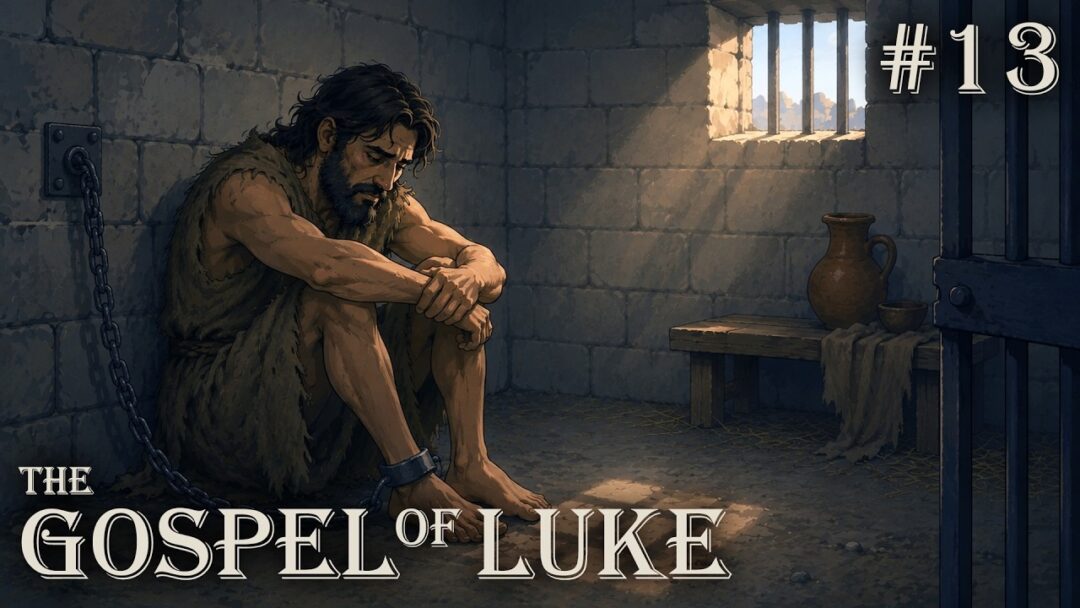
From our Sunday service on August 23, 2026, Luke 7:11-35, with the parallel in Matthew 11:20-30. This is part 13 of our Gospel of Luke series. Watch the full message: Doubt and Denouncement – The Gospel of Luke #13 on YouTube.
There is a difference between struggling to trust God and deciding that we will not trust Him. Both may involve questions, but the hearts behind those questions are not the same. In Luke 7, John the Baptist brings his uncertainty to Jesus, while religious leaders refuse the repentance God calls them to. Jesus responds very differently to those two kinds of people. I want you to see that difference clearly, because a believer weighed down by difficulty needs reassurance, not the mistaken idea that every struggle is outright rejection. God wants you to know He comforts those who struggle in faith, but He outright condemns the faithless.
Compassion Before the Question
We first see His compassion at the gate of Nain. A funeral procession is coming out of the city, carrying a widow’s only son to burial. She has already lost her husband, and now she has lost her son as well. The loss reaches beyond her grief into her future security, because he was the one who would care for her. Jesus sees her weeping and does not pass by. Before Luke brings us to John’s struggle, he shows us what kind of Lord John is asking about:
And when the Lord saw her, he had compassion on her, and said unto her, Weep not. And he came and touched the bier: and they that bare him stood still. And he said, Young man, I say unto thee, Arise. And he that was dead sat up, and began to speak. And he delivered him to his mother.
Luke 7:13–15
Jesus does not merely tell the woman to stop crying and leave her in the same situation. He acts out of compassion, speaks to the dead man, and gives him back to his mother alive. The people glorify God, and news of what has happened spreads through the surrounding region. Eventually John’s disciples bring the report to John himself. Here is another sign of the Messiah’s power, another reason to rejoice. But for a man sitting in prison, the report also sharpens a question he has been carrying about his own situation.
When Faith Needs Reassurance
John has been imprisoned after speaking the truth about the ruler’s sinful conduct. He has announced the Messiah and faithfully done the work God gave him, yet he remains confined while he hears about wonderful things happening elsewhere. He sends two disciples to ask Jesus whether He really is the one who should come, or whether they should look for another. That is a painful question from someone who had proclaimed Him. John’s expectations and his actual circumstances do not seem to fit together, and he needs an answer.
The prophecies spoke about healing and good news to the poor, but also about liberty to captives. John hears of other promises being fulfilled while he is still in a prison cell. From where he sits, it feels as though he has been forgotten. The difficulty is not simply that he has heard too little about Jesus. It is that he does not understand why the one doing these things has not changed the circumstances that hurt him most. Jesus answers by directing John’s messengers to what they have seen and heard:
Then Jesus answering said unto them, Go your way, and tell John what things ye have seen and heard; how that the blind see, the lame walk, the lepers are cleansed, the deaf hear, the dead are raised, to the poor the gospel is preached. And blessed is he, whosoever shall not be offended in me.
Luke 7:22–23
The evidence is there. Jesus is doing the work the Scriptures said the Messiah would do. Yet He does not promise John release from prison. John will not receive the ending he wants; he will be put to death. The reassurance Jesus gives is therefore not a promise that faith will make everything happen according to John’s expectations. He calls John not to stumble over Him when the outcome is different. John can trust that God’s promises are being fulfilled even though he cannot see how his own suffering fits into them.
After the messengers leave, Jesus speaks to the crowd about John. Does He dismiss him as weak because he has asked for reassurance? No. He reminds them that John is no reed shaken by the wind and no man living in luxury. John is a strong, self-controlled servant, a prophet and the messenger sent to prepare the Messiah’s way. His struggle has not erased the work God gave him. To have a struggle of faith is not a sign of weakness. It doesn’t mean you’re a pushover or somebody who can’t deal with difficulty. It just means you’re struggling.
John also shows us what to do with that struggle. He does not simply turn away; he goes to the source and asks for help. We can do the same when we need reassurance instead of pretending that we have no questions. Jesus points him back to the truth and lifts him up rather than knocking him down.
The Refusal That Receives No Comfort
The crowd’s response shows us a different problem. Some have received John’s baptism of repentance, acknowledging that they are sinful and need a Savior. Others refuse that very counsel. Their religious position has become a reason to think they do not need to repent. They are not asking how to trust God through circumstances they cannot understand. They are rejecting what He says about their need:
And all the people that heard him, and the publicans, justified God, being baptized with the baptism of John. But the Pharisees and lawyers rejected the counsel of God against themselves, being not baptized of him.
Luke 7:29–30
Jesus compares this generation to children insisting that everyone else play their game. John lives simply and fasts, and his critics say he has a demon. Jesus eats and drinks with people, and they call Him a glutton and a drunk. The two accusations cannot be explained by a sincere desire to receive God’s messenger. Whatever form the ministry takes, they find a reason not to listen. Their complaint changes, but their refusal stays the same. Unlike John, who wants an answer that will help him trust, these critics do not intend to respond to the evidence before them.
Matthew records the stern words Jesus speaks against the cities where so many of His mighty works have been done. They have seen the miracles and still will not repent. Chorazin and Bethsaida receive a warning that cities condemned for rebellion would have responded differently if they had seen those same works. Jesus does not offer comfort to a heart that sees the truth and refuses it:
Woe unto thee, Chorazin! woe unto thee, Bethsaida! for if the mighty works, which were done in you, had been done in Tyre and Sidon, they would have repented long ago in sackcloth and ashes. But I say unto you, It shall be more tolerable for Tyre and Sidon at the day of judgment, than for you.
Matthew 11:21–22
Capernaum receives the same kind of warning, compared with Sodom in the day of judgment. Having Jesus in their midst has not made refusal less serious; it has made their responsibility greater. They have received evidence and opportunity, yet still will not turn to Him. The problem is not John’s painful uncertainty. It is the determination to preserve their own righteousness and reject the Savior. Jesus warns of greater condemnation for those who know the truth and refuse it. We must not confuse His gentleness toward a struggling believer with indifference toward that rejection.
The Rest He Offers
But condemnation is not His final word to those willing to come. Jesus thanks the Father for revealing these things to the humble, to people who come like children ready to learn rather than insisting they already know enough. That brings us to His invitation. The Lord who has just denounced unrepentant cities invites the burdened to find rest in Him:
Come unto me, all ye that labour and are heavy laden, and I will give you rest. Take my yoke upon you, and learn of me; for I am meek and lowly in heart: and ye shall find rest unto your souls. For my yoke is easy, and my burden is light.
Matthew 11:28–30
John carried a severe burden, and we will carry difficulties too. When we come to Christ for faith and strength, He is not waiting to crush us for needing help. He is meek and lowly in heart. He calls us to learn from Him, and He gives rest to people exhausted by trying to carry everything on their own. Those who are ready to acknowledge their need find Him welcoming, not contemptuous. We do not have to become people who have every answer before we can come to Him. We come because we need what only He can give.
The religious leaders had made obedience oppressive, laying burdens on people who knew they could never be enough. Jesus offers what those burdens cannot provide. He will bear sin at the cross, and those who come to Him can stop trying to establish their own goodness as their hope. His invitation is to trust Him and learn His teaching. The humility that says, ‘I need a Savior,’ is different from the pride that says, ‘I am already good enough.’ One comes for help; the other refuses to admit that help is necessary.
So when your faith struggles, bring that struggle to Christ. John needed reassurance, and Jesus gave him truth to hold on to without promising that his prison door would open. The real danger is not having a question in a difficult season, but deciding that no answer God gives will move us to repent and believe. We have seen both responses in this passage, and Jesus does not treat them as the same. God wants you to know He comforts those who struggle in faith, but outright condemns the faithless. Will you come to Him for help, learn from Him, and find your rest in Him?
Recent Comments