
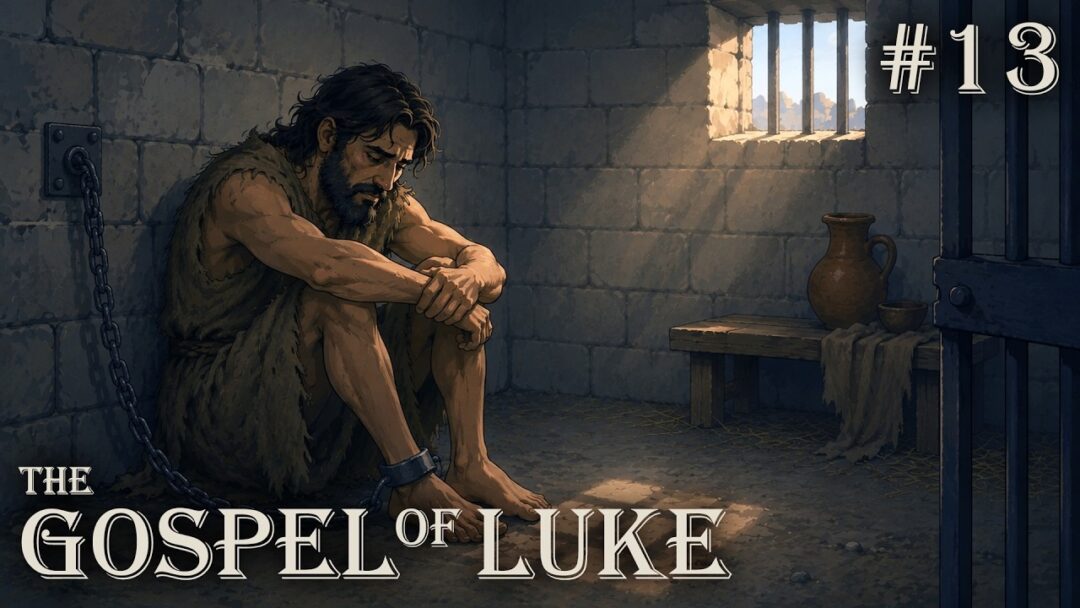
From our Sunday service on August 23, 2026, Luke 7:11-35, with the parallel in Matthew 11:20-30. This is part 13 of our Gospel of Luke series. Watch the full message: Doubt and Denouncement – The Gospel of Luke #13 on YouTube.
We’re continuing our series on the book of Luke. Over the last two messages we saw Jesus begin his disciples’ training by teaching them the importance of mercy and of obedience to God’s commands. We first looked at mercy, and how God called his disciples to be merciful because God is merciful. Then last time we looked at obedience, as Jesus said, “You call yourselves my followers, but you don’t follow my commands.”
Now that his disciples have been taught what it looks like to follow Jesus, it’s time for Jesus to return to preaching in the cities around Galilee. Jesus and his disciples will head out of Capernaum, the headquarters of Jesus’ ministry, and seek out their next destination. As we look through this passage, here is the lesson God wants you to take away from it.
God wants you to know he comforts those who struggle in faith, but he outright condemns the faithless.
A Widow in Nain
And it came to pass the day after, that he went into a city called Nain; and many of his disciples went with him, and much people.
Luke 7:11
Jesus leaves Capernaum and sets off for the city of Nain. It’s not a city we talk about much in the Bible; it really only comes up here. The city of Nain is southwest of the Sea of Galilee. If you can picture the Sea of Galilee, just go down and to your left, and there you will see the city of Nain. It’s about 20 miles away from Capernaum, likely about a day’s journey, hitting a few cities on the way. Nain is where Jesus and his disciples will begin to preach again about the kingdom of heaven. And what is the preaching of the kingdom of heaven? It is the preaching that it’s time to repent. The Messiah is here. Prepare your hearts for his ministry.
Now when he came nigh to the gate of the city, behold, there was a dead man carried out, the only son of his mother, and she was a widow: and much people of the city was with her.
Luke 7:12
When Jesus and his disciples arrive in Nain, they see a very, very sad situation unfolding in front of them. A dead man is being carried out of the city gates to be buried. In this day you could not bury your people within the city. It was a health hazard. So when somebody died, they would be carried outside of the city to be buried, oftentimes in a hill region in a tomb. As was the tradition of the Jews, they would put them in a tomb for a while until their body decayed and it was just their bones. Then they would take the bones and put them in an ossuary. So this man had been dead a long time. It’s not like he had just died a couple of seconds ago. He had died, and they were carrying out his body to bury him. They’ve already mourned him. It’s over. End of story.
Jesus sees this man being carried out, and beside him is a woman. We are told soon that she is weeping. This woman was the man’s mother, and she was a widow. What’s interesting about this story is that a lot of times when we talk about the widow of Nain, we assume that because he’s a son, he’s young. But it appears this man is somewhere between 16 and 30 years old. The Greek word used is neaniskos, and it means he is no longer considered a child. In Jewish culture you’d say he had already reached his bar mitzvah, the age of over 13 or 14. It also means somebody under the age of 40. So it’s like our phrase in English, “young adult.” He wasn’t a little boy.
This woman has had this child for 16 to 30 years. Her husband has died. She is most likely past the age when she can have kids, and her son was the one who was supposed to take care of her for the rest of her life. She didn’t just lose her husband. She didn’t just lose her son. She also lost her financial security. This woman Jesus sees at the gate has lost literally everything. She has no legacy. She has no inheritance. She has nothing left. And Jesus walks into the city and sees this woman, no doubt bawling her eyes out over her situation. It’s a place nobody would want to be in, and I hope nobody here can imagine what that feels like.
Compassion
So what does Jesus do? Let’s see his response in verses 13 through 15.
And when the Lord saw her, he had compassion on her, and said unto her, Weep not. And he came and touched the bier: and they that bare him stood still. And he said, Young man, I say unto thee, Arise. And he that was dead sat up, and began to speak. And he delivered him to his mother.
Luke 7:13–15
That word “bier” means coffin. Jesus sees this funeral procession on its way to the graveside to put the man in the tomb, and he goes up and says, “Woman, stop crying.” I don’t know if that would have helped in the moment. She was probably really confused: “What do you mean, stop crying? Do you see this? Do you see my life?” The casket is being carried, and Jesus puts his hand on it and stops it. I can’t imagine what’s going on in these people’s heads: “Who is this guy?” He just put his hand on the casket and stopped it from moving forward. He just stopped the procession. He told the woman to stop crying, and then he looks at the dead man and says, “Get up.” And when God speaks, you listen. The man wakes up, begins talking with everyone, and comes back to life.
Jesus sees this woman weeping, crying, and struggling. He tells her to stop crying, and he does something miraculous in her life. Why does he do it? Verse 13 says he “had compassion on her.” If you think Jesus isn’t a compassionate person, there it is, laid out right in front of you. Jesus is a man of compassion. Today we’re going to see how Jesus is compassionate, especially with those who doubt. And if God is compassionate through Jesus, then he’s going to be compassionate with you now. I hope you know that today.
A Great Prophet Is Risen
And there came a fear on all: and they glorified God, saying, That a great prophet is risen up among us; and, That God hath visited his people. And this rumour of him went forth throughout all Judaea, and throughout all the region round about. And the disciples of John shewed him of all these things.
Luke 7:16–18
It appears this was a region Jesus had not been to yet in his preaching. We’re still really early in Jesus’ ministry. It seems he had never visited the city of Nain; this is his first time there. They haven’t even heard about the things he’s been doing at Capernaum and in Bethsaida. They had no idea of the miracles he had done. They didn’t know there was a prophet going around. So when Jesus does this miracle, they say, “A great prophet is risen up among us,” and “God hath visited his people.”
These phrases are Messianic. Because of the time and date when this is occurring, they understand that this isn’t just a one-off thing, but the fulfillment of all the prophecy of the Old Testament. They immediately identify Jesus with the Messiah: that great prophet who would be like unto Moses, and God visiting his people, which spoke of how the Messiah would come as God in the flesh. They see this man risen from the dead in an unexplainable, miraculous way, and because they’re so excited, word begins to spread. It goes from person to person, and eventually it makes it back to John the Baptist.
John’s Question
John is in prison right now. John has been having some rough times. Herod had made an unlawful marriage, a very immoral one. I won’t get into the details; we’ve talked about it before. But this marriage was entirely sinful, and John the Baptist, preaching righteousness, denounced Herod, who was technically not a king but the tetrarch of the region. Because of that, he has been thrown in prison for speaking out against the political leadership.
So John the Baptist is in prison, and he has somebody on the inside. They call to him: “Hey, John, wake up. Wake up. Your cousin Jesus, the one you proclaimed as the Messiah, did this miracle in Nain. He raised somebody from the dead, and they’re saying the Messiah has come, that he’s revealed himself, and he’s going all around doing miracles. John, it’s happening. The wheels are beginning to turn in prophecy. The things you talked about are occurring.” So what does John do?
And John calling unto him two of his disciples sent them to Jesus, saying, Art thou he that should come? or look we for another? When the men were come unto him, they said, John Baptist hath sent us unto thee, saying, Art thou he that should come? or look we for another?
Luke 7:19–20
John’s response to the miracle is a little different from the response of the people who lived in Nain and the surrounding regions. It’s even a little different from that of John’s own disciples. They were excited about the Messiah. But John the Baptist had doubt. He says, “Are you really the one who should come? Are you really the Messiah? Or should we look for somebody else?”
You know why? Because there was a prophecy about the Messiah raising the dead. There was a prophecy about the gospel being preached to the poor. There was a prophecy about all these things, but one of them was that the prisoners would be released. And here is John the Baptist, who preaches the truth, sitting inside a prison cell while all the other miracles of the prophecy are said to be happening. John looks around and says, “I’ve seen the prophecies fulfilled, maybe through you guys, but where’s freedom to the prisoner? I’m sitting here in a horrible cell under Herod, under the Roman Empire, in horrible, filthy, disgusting conditions, being fed slop and garbage, and guess what? The prisoners haven’t been released yet. So you go tell my cousin Jesus, ‘Are you really the Messiah, or should we look somewhere else?'”
John is struggling. He’s having a crisis of faith, because what his relationship and walk of faith should look like to him isn’t quite what it looks like in reality. His expectations aren’t being met in the way he wants them to be. So he sends his disciples to ask this very serious, very hurtful question: “Are you really the Messiah?” Because, in so many words, it kind of feels like you’ve forgotten me.
Go Tell John
And in that same hour he cured many of their infirmities and plagues, and of evil spirits; and unto many that were blind he gave sight. Then Jesus answering said unto them, Go your way, and tell John what things ye have seen and heard; how that the blind see, the lame walk, the lepers are cleansed, the deaf hear, the dead are raised, to the poor the gospel is preached. And blessed is he, whosoever shall not be offended in me.
Luke 7:21–23
The Greek here is a bit ambiguous on whether Jesus performed these healings before the question was asked or after. It could really be read either way, but it doesn’t matter. The point is that when the disciples of John arrived, Jesus had been doing miracles all day. He had been literally fulfilling those prophecies in Isaiah. I’ll read off two of them.
Then the eyes of the blind shall be opened, and the ears of the deaf shall be unstopped. Then shall the lame man leap as an hart…
Isaiah 35:5–6
The Spirit of the Lord GOD is upon me; because the LORD hath anointed me to preach good tidings unto the meek…
Isaiah 61:1
And that same passage goes on to say, “to proclaim liberty to the captives.” There are also other prophecies that reference these specific lines, but Jesus is saying, “These ones in Isaiah are fulfilled in front of your eyes. You disciples have been here for these healings. You know I’m fulfilling prophecy right now. So go and tell John what you have heard and seen: that I am fulfilling prophecy this very day.”
But notice that he doesn’t say the line about liberty to the captives. He leaves it out, because, unfortunately, John is never going to get out of that prison. John is going to stay in there, and one day he’s going to be put to death. His head is going to be brought in a charger. It’s not a beautiful end to John the Baptist’s story. Jesus doesn’t have words of comfort in this moment. The cost of following Jesus is going to be an expensive cost.
But Jesus does have one word of encouragement in verse 23: “And blessed is he, whosoever shall not be offended in me.” That word “offend” means to stumble, to be tripped up. Jesus says, “It’s not time for me to proclaim liberty to the captive yet.” That was talking about freedom from sin. John the Baptist was seeing it as “I should be free from literal prison cells,” because in that moment that’s what he really wanted. But Jesus says, “I can’t promise John freedom, but I can tell him this: the one who doesn’t stumble in faith following me, who isn’t tripped up and stays down, that person is blessed. If he can get back up on his feet, maybe things won’t happen the way he wants, but I can promise him a blessing down the road for his faithfulness.”
More Than a Prophet
So Jesus sends them back to John, and he begins to address the people about John’s lack of faith.
And when the messengers of John were departed, he began to speak unto the people concerning John, What went ye out into the wilderness for to see? A reed shaken with the wind? But what went ye out for to see? A man clothed in soft raiment? Behold, they which are gorgeously apparelled, and live delicately, are in kings courts.
Luke 7:24–25
Jesus begins by asking the people why they traveled out of the big cities into the middle of nowhere to hear John the Baptist speak. It’s clear from the context that everybody had heard about John the Baptist’s struggle in faith. It’s not really what you would want to happen. You don’t really want to know that the second biggest spiritual leader in Israel at the time is struggling to believe in the Messiah right now. But this is a very open and public thing, and Jesus addresses the problem head-on. Is he going to condemn John the Baptist for doubting, or is he going to lift him up?
He starts by saying, “What did you go out into the wilderness to see? A reed shaken with the wind?” In other words, somebody who’s just a pushover, weak, who snaps and breaks and falls over when difficulty comes? Or were you looking for someone firm and strong? Then he says, “What did you go out to see? A man clothed in soft raiment,” somebody who lived in comfort and luxury? No, he says, those are in kings’ courts. People who live in luxury don’t live without a home in the wilderness.
John the Baptist was known for being a strong-willed and self-controlled man. Jesus is saying, “I want you all to know that John the Baptist is not weak. Don’t think John the Baptist is a reed shaken with the wind. Don’t think he’s somebody who can’t handle difficulty. Let me tell you, John the Baptist is strong. He’s tough.” To have a struggle of faith is not a sign of weakness. It doesn’t mean you’re a pushover or somebody who can’t deal with difficulty. It just means you’re struggling.
So Jesus doesn’t condemn John; he praises John. John doesn’t just give up. He goes to the source. He goes to God and asks for clarification. He set an example for us. What should we do when we struggle with doubts? Go to the source and ask God, “I’m struggling right now. I just need some reassurance.” His disciples went, and Jesus gave him that reassurance.
But what went ye out for to see? A prophet? Yea, I say unto you, and much more than a prophet. This is he, of whom it is written, Behold, I send my messenger before thy face, which shall prepare thy way before thee. For I say unto you, Among those that are born of women there is not a greater prophet than John the Baptist: but he that is least in the kingdom of God is greater than he.
Luke 7:26–28
Jesus continues by praising John’s strength. John was not just an average man. He was a prophet, greater than all the other prophets who came before him. He was not just called a prophet; he was called to be the messenger of Israel, the one who would pave the road ahead of the Messiah. So Jesus says, “Don’t minimize John. John is not just a prophet. He’s a divine messenger.” That word in the Greek is “angel.” He’s sent by God for an amazing purpose, so don’t look down on him just because he struggles a little bit.
John would end up sharing the same fate as the prophets before him. The unfortunate truth is that John the Baptist was a prophet, Jesus was also a prophet, and you know what happens to prophets? Almost unanimously, they’re all put to death. John the Baptist was going to have the same story as all the other prophets, because they spoke the truth. Because they stood on God’s word, they’d be put to death for it. And Jesus says there’s not going to be a greater prophet this side of the kingdom of heaven than John the Baptist. Elijah doesn’t even compare. Moses doesn’t even compare, because what John the Baptist did was infinitely more important: he paved the way for the Messiah.
The Least in the Kingdom
Let’s read verse 28 again: “For I say unto you, Among those that are born of women there is not a greater prophet than John the Baptist: but he that is least in the kingdom of God is greater than he.” Why is he that is least in the kingdom of God greater than John? Because those who make it to Pentecost and receive the Holy Spirit are going to receive a calling much greater than all the Old Testament prophets. No longer is the Spirit with the prophet; the Spirit of God indwells all believers.
Why is John the Baptist the greatest of the old covenant? Because, unfortunately, John the Baptist isn’t going to live long enough to see the new one. Before the day of Pentecost comes and the Spirit of God indwells believers, John the Baptist is going to be beheaded. Jesus is saying a really sad thing here, because Jesus knows his cousin John isn’t going to make it to see the cross. But he says, “Of all the people under the old covenant, John is the greatest. But I want you to know something: when I’m finished with my work on the cross and I’ve sent the Spirit to be with you, each and every believer is going to have a greater ministry than John the Baptist ever had.”
That should mean something to you today, because we are on the other side of the cross. We have the Spirit of God, and God says that each and every one of us is called to a ministry greater than that of John the Baptist. So what is your ministry? What are you doing? Are you making a name for the kingdom of heaven or not?
Two Responses
And all the people that heard him, and the publicans, justified God, being baptized with the baptism of John. But the Pharisees and lawyers rejected the counsel of God against themselves, being not baptized of him.
Luke 7:29–30
Now we have a shift in the story. It’s not specifically about John anymore; it’s about the crowd, and we see two groups of people. We see all the people and the tax collectors, and they’re all praising God because they were followers of John the Baptist. When Jesus praises John the Baptist, they lock in: “That’s our guy. We were followers of John the Baptist. Now we’re followers of you. We’re in on this all the way.” That means they believed in the baptism of repentance. They said, “We are sinful. We need a Savior. We give up on our good works, and we give it all to God.”
On the other hand, there were the Pharisees and the lawyers, those doctors of the law who taught the law in the religious educational system. Those Pharisees and lawyers “rejected the counsel of God.” The counsel of God, once again, was that you need to repent, that your good works are worthless, that you need to be baptized in repentance and say you need God to be your Savior. The doctors of the law didn’t agree with that philosophy. They said, “We’re religious leaders. We teach the law every day. We follow all the rules. We don’t need to repent. We don’t need to tell God we’re sorry, because we’re really good.” So they refused to repent.
Children in the Marketplace
So Jesus begins to rebuke the hypocrisy of this generation.
And the Lord said, Whereunto then shall I liken the men of this generation? and to what are they like? They are like unto children sitting in the marketplace, and calling one to another, and saying, We have piped unto you, and ye have not danced; we have mourned to you, and ye have not wept. For John the Baptist came neither eating bread nor drinking wine; and ye say, He hath a devil. The Son of man is come eating and drinking; and ye say, Behold a gluttonous man, and a winebibber, a friend of publicans and sinners! But wisdom is justified of all her children.
Luke 7:31–35
Jesus begins by rebuking the hypocrites of this generation by stating it like it is: “Oh, you think you’re wise and righteous? Do you know that wisdom is justified by the results of its actions? And guess what, Pharisees? Your results are lacking.” We get that from verse 35: “wisdom is justified of all her children.” When you’re a wise person and you live wisely, your wise choices are going to produce good results, good fruit. Once again we’re coming back to that idea of fruit. The word for fruit and for giving birth in the Greek is the same word; it just means to produce. Your wisdom will produce something. What the lawyers and the religious leaders produced was a bunch of miserable, depressed people, because they took the rules and the instructions of God, made them oppressive, and forgot why they were there. So Jesus says, “You’ll be justified by the results of your actions, and Pharisees, you’re not measuring up.”
Jesus compares them to small children. I’m sure this was offensive. He compares them to small children playing pretend games in the marketplace. These kids demand that the adults play along with their games, with their act, and then they get upset when the adults don’t play pretend with them. “We have piped unto you, and ye have not danced” is actually a reference to Aesop’s fable of the fisherman piping. They’re kids quoting a rhyme from the story: “We piped for you. Dance, dance, dance.” They’re playing the flute: “Dance for me. I’m the fisherman from the story.” “We have mourned to you, and ye have not wept. I’m telling you what to do, and that’s just how it works in the story, so play pretend with me.” Jesus says, “That’s what you’re like. You’re like a bunch of kids telling people, ‘Do this. Do this. Do this.’ And you get mad when they don’t follow you, but you’re just playing pretend.” Pharisees, religious leaders, stop being fake. Wake up. You’re a bunch of children.
In the same way, they wanted the people, and Jesus himself, to act contrary to what God’s nature demanded of them. They rejected Jesus for not playing by their rules, even though their rules weren’t what God wanted. Their accusations were not based on reality. We see this in verses 33 and 34: “For John the Baptist came neither eating bread nor drinking wine; and ye say, He hath a devil. The Son of man is come eating and drinking; and ye say, Behold a gluttonous man, and a winebibber, a friend of publicans and sinners!”
John the Baptist didn’t drink any grape juice, so he couldn’t be accused of being drunk. That was part of his Nazarite vow. And he fasted; John’s disciples fasted all the time. The Pharisees loved that. But even though they loved those things John the Baptist did, they still said he was demon possessed. John the Baptist followed all of the instructions of the Pharisees; he just lived in the wilderness. “Well, we can’t knock him down, because he’s following all of our rules, so we’ll just say he’s demon possessed.”
Jesus says, “What is wrong with you people? John the Baptist did every stinking one of the 613 rules you set up, and you still weren’t happy with him. Then I come on the scene and I don’t follow all 613 of your rules, and what do you say about me? ‘He’s a glutton and a drunk. He doesn’t fast. His disciples don’t fast. He just loves eating all the food. He’s there to get fat and indulge himself, and he’s a drunk because he drinks wine sometimes. Don’t listen to him.'” Jesus says it doesn’t matter. Your accusations aren’t based on reality. If I followed all the things of the law, you’d do the same thing to me that you did to John. If I followed every one of your teachings, you’d just come up with another excuse for why you don’t need to listen to me.
Two Kinds of Faith
Contrast this with John the Baptist. John the Baptist struggled in faith because he was in a time of difficulty, and he wanted answers. The Pharisees struggled with faith because they rejected faith outright. They wanted nothing to do with it. They didn’t give Jesus the time of day. It didn’t matter how much evidence God gave them. He raised a man from the dead, and they still made excuses: “Well, it was a demon.” What do I have to do, Pharisees, for you to stop making excuses and listen? The answer was that there was nothing Jesus could do to change their minds.
That’s where we get the two comparisons of faith in this passage. John was willing to have faith despite his circumstances. The Pharisees weren’t willing to have faith no matter what their circumstances were. And Jesus responds to them completely differently. He praises John the Baptist in his struggle, but you’re going to see that for the Pharisees he has no comfort.
Woe unto the Cities
Turn over to Matthew 11, verse 20. Luke doesn’t include this part here (he records similar words later, in Luke 10), so we’ll go to Matthew and put them in parallel so we can see what Jesus does. After this happens, Jesus stands up and says these words.
Then began he to upbraid the cities wherein most of his mighty works were done, because they repented not: Woe unto thee, Chorazin! woe unto thee, Bethsaida! for if the mighty works, which were done in you, had been done in Tyre and Sidon, they would have repented long ago in sackcloth and ashes. But I say unto you, It shall be more tolerable for Tyre and Sidon at the day of judgment, than for you.
Matthew 11:20–22
Chorazin was a city about two and a half miles from Capernaum, where Jesus often stayed in between trips. That means Chorazin was a place where Jesus often did miracles, because we’re told that when people came to him to be healed, he healed them every time. So Chorazin saw Jesus heal people from their city. Bethsaida was about five miles from Capernaum, and it was where many of the disciples were actually born. When the disciples traveled to see their families, Jesus often went with them, so Jesus was in Bethsaida all the time. And where Jesus is, there are healings. So miracles were done in Bethsaida too.
In these two cities right next to Capernaum, Jesus had shown clearly, without a doubt, that he was who he said he was. But not everybody in those cities was okay with that. Not all of them accepted Christ as the Messiah. They weren’t like John the Baptist; they were like the Pharisees. They saw the miraculous things and chose not to take the baptism of repentance. They chose not to say, “We need a Savior. Our good works are useless.” Instead they said, “I’m good. What do I need to repent for? I’m a pretty good person.”
So Jesus gives them a huge condemnation in verse 22: “But I say unto you, It shall be more tolerable for Tyre and Sidon at the day of judgment, than for you.” What’s up with Tyre and Sidon? Jesus compares them to these two cities, which God denounced not through just one prophet but through at least three: Isaiah, Ezekiel, and Amos. In these Old Testament books, Tyre and Sidon were condemned for their arrogance and rebellion. But even these two cities, denounced in three books for arrogance and rebellion, are going to have a better day in hell than the people of these cities. Why? Was it because they doubted like John the Baptist did? No, it’s because they had the faith of the Pharisees. They didn’t care what God did in their lives. They chose to reject him. They said, “Our deeds are good enough. We don’t need to repent. We don’t need to follow you.” And Jesus says, “Because you have seen the miracles and I’ve shown you that I’m true, and you still reject me, hell for those down there in Tyre and Sidon who don’t believe is going to be a lot less painful than for you, because you knew the truth and you still rejected it.”
Capernaum
And thou, Capernaum, which art exalted unto heaven, shalt be brought down to hell: for if the mighty works, which have been done in thee, had been done in Sodom, it would have remained until this day. But I say unto you, That it shall be more tolerable for the land of Sodom in the day of judgment, than for thee.
Matthew 11:23–24
During Jesus’ earthly ministry, Capernaum was Jesus’ headquarters, so it was quite literally the most heavenly place on earth during this time. What is heaven? Heaven is the abode of God. Where did Jesus live most of the time? Capernaum. So the closest place to heaven was the place where Jesus stayed, at Peter’s house. He says, “Capernaum, you’re exalted unto heaven. Literally, for the time of my ministry, heaven dwelt in your city.” And yet there were still people in that city who would reject him.
Remember the example of punishment in the Old Testament, Sodom and Gomorrah, the cities of the plain on which God rained fire from heaven and destroyed them for their wickedness? Jesus says, “Capernaum, I’m telling you, in the day of judgment, if you don’t repent and turn to me, it’s going to be a better day in hell for Sodom than it’s going to be for you.” Why? Because you doubted me? No, because you rejected me outright, knowing that I was who I said I was. Those who rejected Jesus’ message of repentance after living so long alongside him would have a greater condemnation than Sodom, the most famous example of judgment.
Come unto Me
Does Jesus leave us there? No. He praises the faithful in verses 25 through 30.
At that time Jesus answered and said, I thank thee, O Father, Lord of heaven and earth, because thou hast hid these things from the wise and prudent, and hast revealed them unto babes. Even so, Father: for so it seemed good in thy sight. All things are delivered unto me of my Father: and no man knoweth the Son, but the Father; neither knoweth any man the Father, save the Son, and he to whomsoever the Son will reveal him. Come unto me, all ye that labour and are heavy laden, and I will give you rest. Take my yoke upon you, and learn of me; for I am meek and lowly in heart: and ye shall find rest unto your souls. For my yoke is easy, and my burden is light.
Matthew 11:25–30
You see what Jesus is doing. It’s split across two Gospels, but you can see what’s happening this day in this city. Jesus ends by thanking God for those faithful believers who did follow him, who did repent, even though they might struggle. You might be weak and heavy laden with many burdens in your life. You might have a lot you’re carrying right now. But you know what? Jesus thanks God for you, even in your struggles.
In this world we’re going to carry a lot of burdens. We’re going to go through a lot of difficulties. John the Baptist went through a very severe difficulty. Being in Herod’s prison was not a good place to be. And when he struggled with faith because of the difficulty, God didn’t knock him down; he lifted him up. Jesus says, “If you’ve got burdens on you, if you’re heavy laden, come to me, just like John’s disciples did on John’s behalf. I will give you rest. My yoke is easy. Learn of me; I’m meek and lowly in heart. I’m not here to condemn you. If you reject me outright, there’s condemnation, but if you’re coming to me for help, for faith and strength, I’m meek and lowly in heart. I’m going to be gentle with you. I’m going to lift you up. I’m going to give you the strength you need to find rest for your souls in that time of difficulty.”
Jesus thanks God for those who accept him in faith, those who are humble and ready to learn. Not those who saw themselves as something great, who knew everything and had everything together, but those who said, “We’re just babies. We’re inexperienced. We have so much in our lives we need to grow in.” Those who came to Christ as babes, ready to learn and ready to be lifted up, Jesus embraced with open arms. To these people who were ready to grow, Jesus gave an invitation: “Come, and I will give you rest. It’s time to stop working so hard on your own.”
The religious leaders had done the exact opposite. They had made obedience to God a burden (compare Matthew 23:4, “they bind heavy burdens and grievous to be borne”): 613 rules of burden to carry. Jesus knew that for the people it was oppressive and exhausting. They were tired, and they knew they couldn’t be enough. And he says, “Good news. The kingdom of heaven is approaching, and the time to carry those burdens is over. Come to me. I’ll take those burdens off you. You don’t need to worry about being good enough, because I’m going to die on that cross. I’m going to take your sins. If you come to me, you can lay those sins, those burdens, upon me. I will lift you up, I will comfort you, and I will give you what you need to be made perfect in me.” So Jesus says to them simply, “Trust in me. Come to me in your moments of weakness, in your moments of doubt. Just obey my teachings, because the things I ask you to carry are easy to carry, and you will find your rest in me.”
Bring Your Struggles to Him
Throughout this passage we see that faith is not defined as the absence of questions or struggles. John the Baptist had faithfully served God, yet in prison he reached a point where he needed reassurance. Jesus never condemned John for his questions. Instead, he pointed John back to the evidence of what God was doing and reminded him that his promises were being fulfilled, even if it didn’t look the way John the Baptist had imagined it would.
The real danger to a walk with Christ was not a struggling faith, but a heart that had already decided it would not believe. The religious leaders rejected both Jesus and John outright, despite the evidence. We also saw Jesus rebuke cities that had witnessed his miracles and still refused to repent. Their problem was not a lack of evidence. It was that they refused to respond to the evidence God had already given them.
That finally brings us to Jesus’ invitation: “Come unto me.” When your faith is struggling, Jesus does not tell you to pretend you have no questions. He invites you to bring those struggles to him, learn from him, and find rest in him.
God wants you to know he comforts those who struggle in faith, but outright condemns the faithless. So, which side will you be on?

Recent Comments