
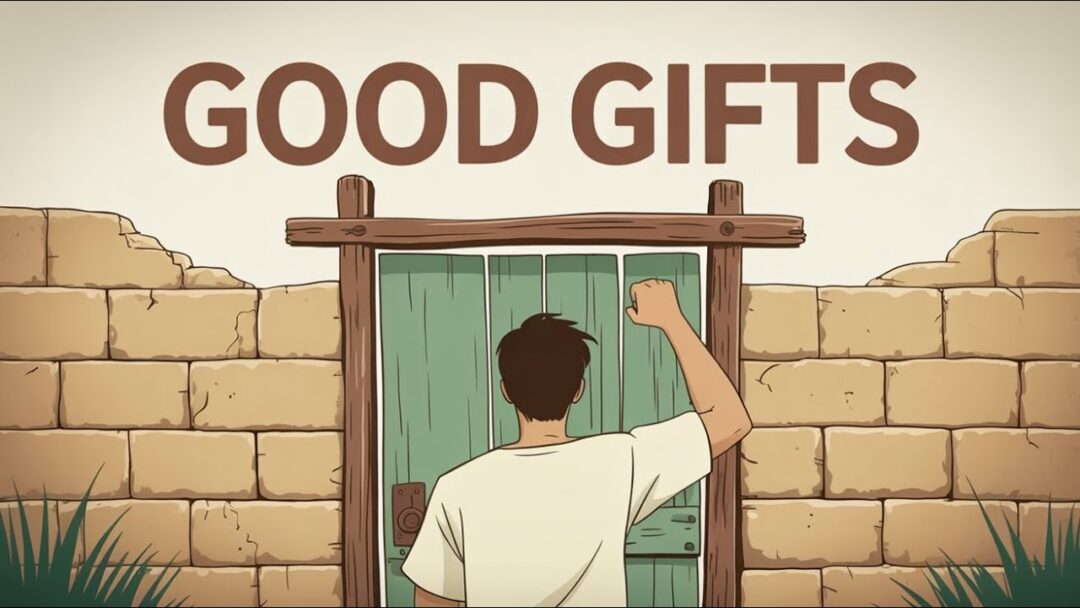
From our Sunday service on September 7, 2025, Luke 18 and Luke 11. This is part 4 of our Parables of Christ series. Watch the full message: Good Gifts – The Parables of Christ #4 on YouTube.
We have been talking about the growth and the value of the kingdom. Today we take a bit of a detour to talk about receiving good gifts from God. Jesus taught about prayer, and about how we can align our prayers with God’s desires and receive what is truly good. God wants you to pray with faith and humility so He can give you what is truly good.
The Persistent Widow
We start with the parable of the widow, which some call the parable of the unjust judge, to learn about endurance in our prayer life.
And he spake a parable unto them to this end, that men ought always to pray, and not to faint;
Luke 18:1
Luke gives us the application before he even introduces the story: men ought always to pray, and not to faint. There is a wicked judge who fears not God and regards not man, which makes him very bad at his job. An unnamed widow comes and asks him to avenge her of her adversary. He will not, for a while. But she does not give up. Day after day she goes to his office and says, Take my case. Defend me. Fulfill the duty of a judge and bring me justice. At last, because of her persistence, he does it, not because he cares, but because she is wearing him out.
And shall not God avenge his own elect, which cry day and night unto him, though he bear long with them? I tell you that he will avenge them speedily. Nevertheless when the Son of man cometh, shall he find faith on the earth?
Luke 18:7–8
Notice that God is not being called an unjust judge. The unjust judge is the unjust judge, and God is God. Jesus wants us to compare human judges with God so that we will see how much more God will hear His own elect, who cry day and night unto Him. He may bear long with them, but He will avenge them, and He says He will do it speedily. That can feel like a tension. We cry day and night, He bears long, and yet He also says the answer will come speedily. God’s timing is not our timing. When we pray for the first time, it may not align with His timing. We may not yet be at the point where the answer would actually be good for us. He is not ignoring us. He is not like the judge who had to be worn down. He is a Father who already intends to do what is right, and He will not despise the broken who keep coming. The question Jesus leaves hanging is this: when the Son of man comes, shall He find faith on the earth? Are you going to give up praying before God answers? Is your faith going to faint in the waiting? Earlier we talked about how earthly courts can be as unjust as the people they convict. That is not our Father. Psalm 51 says the sacrifices of God are a broken spirit, and a broken and a contrite heart He will not despise. We have assurance that when the broken come to Him, He hears them.
The Pharisee and the Publican
Luke 18:9 tells us the next parable was spoken unto certain which trusted in themselves that they were righteous, and despised others. Two men go up into the temple to pray, a Pharisee and a publican. The Pharisee stands and prays thus with himself: God, I thank thee, that I am not as other men are, extortioners, unjust, adulterers, or even as this publican. I fast twice in the week, I give tithes of all that I possess. He spent his prayer praising himself for how good he was, for how regularly he fasted and how much he tithed. Notice that he prayed with himself. He was not really talking to God. He was performing a review of his own resume in the temple. The publican, a Jewish tax collector, stands afar off, will not lift up so much as his eyes unto heaven, but smites upon his breast and says, God be merciful to me a sinner. He humbles himself, knowing he is unworthy, and asks for forgiveness. This man went down to his house justified rather than the other. If we want God to do something in our lives, we have to be humble. God is not going to answer a prideful prayer. If you say a prayer in pride, the Lord is not going to be impressed by your fasting, your tithing, or your comparison with the person standing beside you. He is looking for the one who knows he needs mercy.
Ask, Seek, Knock
The Lord’s Prayer in Luke 11 is an example of how to pray. The Gospels record Jesus going off to pray dozens of times, so it is natural that a disciple asked, Lord, teach us to pray. He said, When ye pray, say, Our Father which art in heaven, Hallowed be thy name. Our Father in heaven, may Your name be set apart as holy. Thy kingdom come. Thy will be done, as in heaven, so in earth. The angels in heaven obey God perfectly, and we are asking that the same obedience would be true on earth, and in us. This prayer is not first about my comfort. It is about God’s name, God’s kingdom, and God’s will, and only then about my needs. Give us day by day our daily bread: enough to get by, not more than we need or less than we need. It is a prayer against both panic and greed. Forgive us our sins; for we also forgive every one that is indebted to us. It is not only forgive me, but help me to forgive. Lead us not into temptation; but deliver us from evil: do not lead us into testing where we will trip up and fail, but rescue us from evil.
That prayer is the context for the friend at midnight. A man goes to a friend at midnight and asks for three loaves, because a traveler has arrived and he has nothing to set before him. The neighbor says he cannot get out of bed. In that day the whole household slept in the same room, and getting up would disturb everyone. But the friend does not give up. He knocks again, because his guest is hungry. Because of his importunity, the man rises and gives him as many as he needeth. If persistence can get a bad friend out of bed, how much more will a good God answer you if you are faithful to ask? The lesson from the human side of the parable is not that God is sleepy and annoyed. It is that even a poor friend can be moved by faithful asking, and our Father is not a poor friend.
And I say unto you, Ask, and it shall be given you; seek, and ye shall find; knock, and it shall be opened unto you. For every one that asketh receiveth; and he that seeketh findeth; and to him that knocketh it shall be opened.
Luke 11:9–10
If you want something, you have to go after it. Things do not always fall into your lap. Then Jesus makes clear what God will do. If a son asks bread of any of you that is a father, will he give him a stone, or a serpent for a fish, or a scorpion for an egg? If ye then, being evil, know how to give good gifts unto your children, how much more shall your heavenly Father give the Holy Spirit to them that ask Him? God shows up in this parable not as the reluctant friend, but as the good father. Imagine your own child coming to you at midnight, hungry, asking for bread. You would not hand him a stone, a serpent, or a scorpion. You would get up. And you are evil compared with God. How much more will He give what is truly good? The end of the gift is not merely bread. It is the Holy Spirit. We could talk all day about our wish lists, but Jesus points us to the gift the Father most wants to give: Himself, His Spirit, His presence and help in the life of the one who asks.
We have seen that prayer is not about empty words, pride, or giving up when answers do not come right away. The widow keeps coming. The publican bows low. The friend at midnight knocks again. The child asks a father for bread. In every picture, the person who receives is the one who comes honestly and does not faint. Prayer is not about convincing God to do what we want. It is about persistent faith, humble dependence, and aligning ourselves with His will, spending time to draw near to our Father consistently, so that He can give us what is truly good. God wants you to pray with faith and humility so He can give you what is truly good. Will you begin building a faithful prayer life today, so that you can receive the good gifts He wants to give?
Recent Comments