
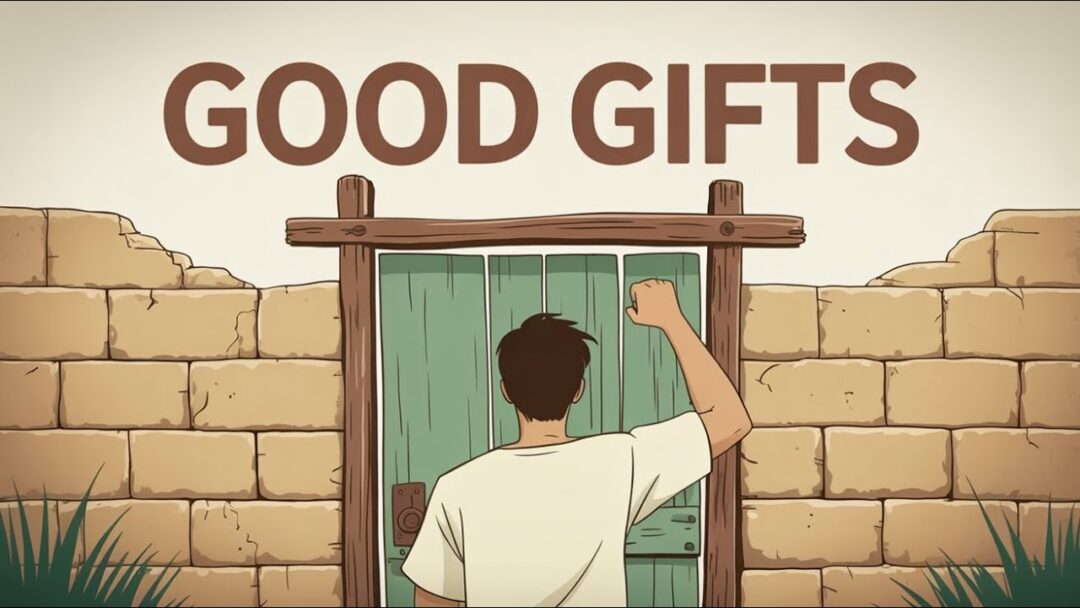
From our Sunday service on September 7, 2025, Luke 18 and Luke 11. This is part 4 of our Parables of Christ series. Watch the full message: Good Gifts – The Parables of Christ #4 on YouTube.
Today we’re in our series on the parables of Christ, and we’re taking a bit of a detour from where we’ve been the last few weeks to talk about receiving good gifts. Another way to title this message is praying and receiving. Last week we saw how the kingdom of God started small and grew into a large group of believers all across the world, how it takes faithful followers of Christ to share the good news so the kingdom can continue to grow, and how God invites everyone to be a part of it.
Today we’re looking at some of the things Jesus taught about prayer, and how we can align our prayers with God’s desires and receive good gifts from our heavenly Father.
God wants you to pray with faith and humility so he can give you what is truly good.
The Persistent Widow
We’ll first look at the parable of the widow, which some call the parable of the unjust judge, to learn about endurance in our prayer life. Look at verse 1 to start.
And he spake a parable unto them to this end, that men ought always to pray, and not to faint;
Luke 18:1
As a pastor, this is one of the best kinds of verses you can find, because Luke gave us the application right at the start, before he introduced the parable. Why was this parable told? “That men ought always to pray, and not to faint.” That makes my job easy. We are supposed to pray consistently and faithfully, and not give up just because we haven’t received an answer. With that in mind, here is the parable.
Saying, There was in a city a judge, which feared not God, neither regarded man: And there was a widow in that city; and she came unto him, saying, Avenge me of mine adversary. And he would not for a while: but afterward he said within himself, Though I fear not God, nor regard man; Yet because this widow troubleth me, I will avenge her, lest by her continual coming she weary me.
Luke 18:2–5
The context is that there’s a really wicked judge who doesn’t care about pleasing God or people, which makes him very bad at his job. An unnamed widow comes and asks him to protect her from someone who is oppressing her. We’re not told what it is. In this kind of scenario it might involve an inheritance or a kinsman-redeemer situation, where her husband has died and she’s supposed to have something that isn’t being given to her. The Bible doesn’t tell us the exact situation, but we have a poor, defenseless widow who needs a judge to make a decision on her behalf. And the judge says, “I don’t want to deal with your case. It’s not worth my time,” and pushes her away. He shuns her because there’s nothing in it for him. Maybe he was taking bribes, and she was too poor to pay one.
But this widow doesn’t give up. Day after day she goes to the judge’s office and says, “Take my case. Defend me. Fulfill the duty of a judge and bring me justice.” Every single day. The word translated “troubleth” in the Greek is, by its etymology, literally to give a beating or to cut with many cuts. Another way to translate it is “she annoyed me” or “she beat me down until I listened.” Eventually the annoyance of this woman coming becomes a bigger problem than just hearing the case to get rid of her. The judge decides to bring justice only because she consistently asked for it, through many tiny cuts.
And the Lord said, Hear what the unjust judge saith. And shall not God avenge his own elect, which cry day and night unto him, though he bear long with them? I tell you that he will avenge them speedily. Nevertheless when the Son of man cometh, shall he find faith on the earth?
Luke 18:6–8
Notice that God is not being called an unjust judge. The unjust judge is the unjust judge, and God is God. Jesus wants us to compare human judges with God so that we understand how much greater he is as the ultimate judge. This judge is evil. He doesn’t care about justice, only about taking a paycheck. But even he could be convinced to do the right thing by being annoyed enough. If the unjust judge would bring justice, then God, the most just of any judge, will surely bring justice, even though sometimes God is patient with evildoers. God is patient with us when we mess up. So when we see injustice, we have to realize it’s the same God who delivers the justice. If he’s patient with me and you, he’ll be patient with them as well, even though it doesn’t benefit us in this time. God is a just judge, but he is patient, and he gives everybody an opportunity to repent before he brings down the hammer.
In the morning service we talked about Ecclesiastes 3, where Solomon looks at the courtrooms and finds them just as evil as the criminals they convict, with injustice running rampant. He comes to the conclusion that God has a time and a place for everything, and that one day God will judge them. This is the same situation.
The sacrifices of God are a broken spirit: a broken and a contrite heart, O God, thou wilt not despise.
Psalm 51:17
Psalm 51 says God loves the sacrifice of a broken spirit, and that when the broken come to him he will not despise them. We have assurance in the Bible that when we go to our just judge, he will not turn us away or ignore us. He will hear our case, and he will not delay. God’s justice comes exactly when it is meant to. The more important question is whether, when he arrives, he will still find his people faithful. Verse 8 says he will avenge them speedily. He is a judge ready to execute judgment. But Jesus says, more importantly, when the Son of man comes, will he find faith on the earth?
God’s timing is not our timing. When we pray for the first time, it may not align with God’s timing. We may not be at a point in our life where we are going to receive an answer. We pray, and God says, “Not right now,” and we wait and wait and wait. Do we give up? Do we say, “God’s answer is obviously no. God doesn’t care about me. God is unjust”? No. We give up our prayers to him in the right way. Not by saying, “If God’s not going to fulfill it right now, I’m not going to pray about it anymore,” but by saying, “God, I’m going to put this prayer into your hand. I’m going to trust your timing. I’m going to be faithful to continue to pray so that when it’s your time to act, I’m still praying.”
There’s a double question here. Will the Son of man find faith on the earth? Are you going to give up praying before God answers your prayer? Is your faith going to be weaker than God’s deliverance? God might say, “Not today. Not today. Not today.” That doesn’t mean I say, “God doesn’t care. God doesn’t love me.” It means I need to be faithful on God’s timing and not my own. If it were up to me, I’d say, “God, you’ve got about twenty seconds to answer.” That’s not the way God works. Jesus says more importantly that we should look at ourselves when we’re in this position, not say, “God, why aren’t you answering?” but ask, “God, am I faithful? What’s the point of my praying if I’m not faithful to you? If I’m only praying to get what I want and not because I trust in you, what is my prayer worth?”
The Pharisee and the Tax Collector
We continue that idea in verse 9, where we learn about humility in prayer.
And he spake this parable unto certain which trusted in themselves that they were righteous, and despised others:
Luke 18:9
Once again, Luke conveniently tells us exactly what we’re supposed to understand. We need to be careful, because we might think we’re righteous while in our hearts we’re proud and despise those around us. This parable is aimed at the Pharisees, to help them realize their hypocrisy. They were so self-righteous and so self-honoring that rather than helping God, they actively hindered him. So Jesus slaps them around a little with this parable.
Two men went up into the temple to pray; the one a Pharisee, and the other a publican. The Pharisee stood and prayed thus with himself, God, I thank thee, that I am not as other men are, extortioners, unjust, adulterers, or even as this publican. I fast twice in the week, I give tithes of all that I possess. And the publican, standing afar off, would not lift up so much as his eyes unto heaven, but smote upon his breast, saying, God be merciful to me a sinner. I tell you, this man went down to his house justified rather than the other: for every one that exalteth himself shall be abased; and he that humbleth himself shall be exalted.
Luke 18:10–14
Two people go to the temple to get alone with God. One is a Pharisee, a religious leader and teacher of the law. The other is a publican, a Jewish tax collector who worked with the Romans to collect taxes from the Jews. Tax collectors were among the most hated people in Israel. They were known not only for taking money and giving it to the conquering army of Rome, but for stealing from the people they collected from, charging extra and pocketing some of the money. In that day tax collectors weren’t even allowed to go into the synagogues and listen to the Sabbath preaching. They were banned from religious activity. So this man stood far off at the temple. He went to pray, but he wasn’t at the front gate, because people didn’t like him and he didn’t want to create a stir or be noticed. He says, “I know I’m hated. I’m going to stay far back.”
The Pharisee spent his prayer praising himself for how good he was, for how regularly he fasted and how much he tithed. Look at verse 11. It says he “prayed thus with himself.” The passage doesn’t say he prayed to God. This is to be understood as praying to himself. That act of pride nullified his prayer. It was no longer about him and God, or seeking anything from God. It was about telling God how good he was. In his whole prayer, he never asked God for anything. He had concluded in his heart that he had arrived and that there was nothing he could do better. What do you even say to that? A man like that, God can’t work with. He praises only himself, and in the process he beats down the tax collector standing far off. If he calls the person he’s praying to “God” and the Bible says he’s praying to himself, he must believe that he himself is God, the standard of morality and the source of wisdom. What a sad estate for a so-called teacher of the law.
What does the tax collector do? He humbles himself, knowing he is unworthy, and asks for forgiveness. We don’t know whether he was stealing from his people or what he was praying about. But he realizes that he has not arrived, that he is not perfect, that he cannot help himself. He is so ashamed of his sinful state that he doesn’t even dare to look up to heaven. He says, “God, I need your help.” And Jesus says this man went down to his house justified rather than the other.
If we want God to do something in our lives, we have to be humble. God is not going to answer a prideful prayer. If you say a prayer in pride, the Lord is not going to justify you. The Pharisee did not set himself up for success by praising himself. He set himself up for God to knock him down a few pegs. What’s our application? Prayer is not about “me, me, I, I.” God will answer only prayers made with proper humility. If it’s not done humbly, God will humble the proud and lift up the humble.
The Lord’s Prayer
Next, let’s look at the Lord’s Prayer as an example of prayer, in Luke 11:1. We covered the Sermon on the Mount, which includes this prayer, in our early service, so we won’t go deep today, but I want to review it because it’s the context for our next parable.
And it came to pass, that, as he was praying in a certain place, when he ceased, one of his disciples said unto him, Lord, teach us to pray, as John also taught his disciples.
Luke 11:1
The Gospels record Jesus going off to pray dozens and dozens of times. He spent a lot of time in prayer. So it’s natural that when he returned from wherever he’d been to be alone with God, his disciples said, “You go out there and pray all the time. Could you show us how to pray like you pray?” And Jesus happily shared with them what prayer should look like.
And he said unto them, When ye pray, say, Our Father which art in heaven, Hallowed be thy name. Thy kingdom come. Thy will be done, as in heaven, so in earth. Give us day by day our daily bread. And forgive us our sins; for we also forgive every one that is indebted to us. And lead us not into temptation; but deliver us from evil.
Luke 11:2–4
Let’s look at these one by one. First, “Our Father which art in heaven, Hallowed be thy name.” In other words, “Our Father in heaven, may your name be set apart. May it be holy. May it mean something.” God’s name won’t mean something unless we represent it well on earth. When people ask, “Are you religious?” and we say, “Yes, I’m a Christian,” we wear the name of Christ as our title. If we want that name to mean something, we need to represent it well. There are many Christians who don’t represent Christ well and bring shame on his name. So if we want God’s name to be set apart, we are praying that we represent God well, and that the people around us realize there is something different about being a follower of him. This comes out of Exodus 20, where it says not to take the name of the Lord in vain. Don’t hold it as something with no value. When you say you do something for God, you had better be doing it. We lift up his name by living a godly, God-honoring life.
Next, “Thy kingdom come. Thy will be done, as in heaven, so in earth.” This draws on the fact that the angels in heaven obey God perfectly. When God says to do something, the angels do it. When God says sing, the angels sing. So Jesus says, pray that when God calls you to do something, you will go and do it. Notice that this prayer is corporate. It’s not “may I do your will,” but “thy will be done.” It says “give us our daily bread,” not “give me my daily bread.” Prayer is not about ourselves. Pray for the church as a whole, and include yourself in it. So pray, “Lord, give me the desire to fulfill your will.”
Next, “Give us day by day our daily bread.” Another way to say it is, “God, give me enough to get by. Don’t give me more than I need or less than I need. Help me to be content with it.” Jesus tells us that if we’re faithful to him, we don’t need to worry about our clothes or our food, because our heavenly Father knows we need those things. But we still need to pray, because we need to be reminded that God is going to give us what we need, no extra and no less, and we need to be content with what he has provided.
Next, “Forgive us our sins; for we also forgive every one that is indebted to us.” Once again it’s not just about me. It’s not only “forgive me,” but “God, help me to forgive others as well.” The Bible says if we can’t forgive others, how can God forgive us? It’s easy to pray, “God, forgive me.” It’s hard to say, “God, help me to forgive others.” But if we want to be like Christ, that’s something we need.
Lastly, “Lead us not into temptation; but deliver us from evil.” In other words, don’t lead us into testing and trials where we will trip up and fail, but rescue us from the evil one and the temptation of Satan. Help us persevere in our faith and uphold your name. This is a natural follow-up to forgiveness. There’s no reason to pray to be forgiven if you’re not also going to pray to stay pure. God can forgive your sins, but what’s the point if you’re just going to do it again? So don’t just pray to be forgiven, but pray that you won’t fall into that temptation a second time.
The Friend at Midnight
This is the context for the next parable, the friend at midnight and the good father, where we learn about receiving through prayer, beginning in verse 5.
And he said unto them, Which of you shall have a friend, and shall go unto him at midnight, and say unto him, Friend, lend me three loaves; For a friend of mine in his journey is come to me, and I have nothing to set before him? And he from within shall answer and say, Trouble me not: the door is now shut, and my children are with me in bed; I cannot rise and give thee. I say unto you, Though he will not rise and give him, because he is his friend, yet because of his importunity he will rise and give him as many as he needeth.
Luke 11:5–8
This is the first half of a two-part parable, the human side. It’s the same setup Jesus used a few minutes ago with the unjust judge, only now we have an unfriendly friend. A friend has another friend visit unexpectedly, at midnight. If you were traveling in the first century, midnight would be literally the worst time to travel. Nobody would expect a friend to show up then. Because it’s so late, the man has no leftover food for his friend who has been traveling through the wilderness. So he goes to a neighbor down the road: “He’s my friend. He might have some leftover bread. Could you lend me some?”
And the neighbor says, “I have bread, but I’m not giving it to you. I can’t get out of bed. I’ll disturb the whole house.” In that day everybody slept in the same room, so if he got up he’d wake the kids. “I finally got them to sleep. If I get up and give you the bread, they’ll wake up. It’s too much of an inconvenience. Go away.”
But the friend doesn’t give up. He knows his traveling friend is hungry and worn out, so he knocks again. “Go away. I’m not getting up. My kids are asleep.” Eventually the kids wake up. “Dad, there’s somebody at the door.” “I know. Go back to sleep.” The whole house is in chaos and the knocking continues, until the man says, “This is not going to get better unless I give you bread.” He doesn’t just give him a loaf. As verse 8 says, “he will rise and give him as many as he needeth.” “Okay, what do you want? I’ll give you whatever you want. Just stop knocking.” The inconvenience of getting up and settling the kids back to sleep became less than the inconvenience of his friend’s knocking.
So here is the human perspective again. If persistence can get a bad friend out of bed, how much more would a good God answer your prayer if you are faithful to continue praying? It’s not that God doesn’t answer because we inconvenience him. He wants to use our time seeking an answer to refine our perspective and desires and make us more like him. God is not a bad friend. It’s not as if God in heaven is saying, “I don’t want to get out of bed and help you.” I can show you that, because the second half of the parable continues in verses 9 and 10.
And I say unto you, Ask, and it shall be given you; seek, and ye shall find; knock, and it shall be opened unto you. For every one that asketh receiveth; and he that seeketh findeth; and to him that knocketh it shall be opened.
Luke 11:9–10
The lesson from this human-perspective parable is that if you want something, you have to go after it and do what you need to do to get it. Things don’t always just happen. If the man had walked away after the first knock, or stayed in his house and said, “I guess you don’t have food,” he wouldn’t have got what he wanted. But he persevered, and because he sought what he needed passionately and to the best of his ability, it was given to him. In the Greek, “ask,” “seek,” and “knock” are not one-time actions. You need to be asking, seeking, and knocking continually. It’s constant, not once.
The Good Father
And here Jesus wraps it up and makes clear what God will do, in verses 11 to 13.
If a son shall ask bread of any of you that is a father, will he give him a stone? or if he ask a fish, will he for a fish give him a serpent? Or if he shall ask an egg, will he offer him a scorpion? If ye then, being evil, know how to give good gifts unto your children: how much more shall your heavenly Father give the Holy Spirit to them that ask him?
Luke 11:11–13
The bad friend is compared with a good father. God shows up in the parable not in the friend but in the father. Imagine your son coming to you at midnight and saying, “My friend’s here. I don’t have food. Could I borrow a loaf of bread?” Any good father will be happy to give him the bread. But notice it’s not just bread. Would he give him a stone? No. If he asks for a fish, will he give him a serpent? The father gives so much more than what you ask for. If a bad friend can be convinced through persistence, then a good God who gives you more than you ask for will give you even more when you ask in prayer consistently and faithfully. Instead of giving up when your timing doesn’t match God’s, you wait on God’s timing for that reward. If an earthly father would give a good gift to his son, how much more would God, our heavenly Father, be willing to give a good gift to us?
Notice the end of the parable, in verse 13: “how much more shall your heavenly Father give the Holy Spirit to them that ask him?” We could talk all day about our physical needs and praying for them, but in both of these parables Jesus talks about the Holy Spirit and spiritual fulfillment. Prayer isn’t just about our needs on earth. It’s about our needs in our heart, our spirit and our mind. If we need transformation in our lives, God is ready to give it. If we have needs, God has already promised to take care of them. So the question is, where is your heart? Remember in the first parable, “when the Son of man cometh, shall he find faith on the earth?” Are we going to lose faith because God doesn’t answer in our time, or because he doesn’t always give us what we want and instead gives us what we need? God forbid. God wants us to be faithfully asking, seeking and knocking, knowing that he gives good gifts and that he will provide.
Good Gifts from Our Father
We’ve seen that prayer is not about empty words, pride, or giving up when answers don’t come right away. Prayer is about persistent faith, humble dependence, and trust in the goodness of our heavenly Father. The unjust judge gave in because of persistence and annoyance, but God, who is perfect, just and loving, delights to hear and answer his people. We saw the Pharisee who exalted himself and left empty, while the humbled tax collector found mercy and went home justified. Jesus reminds us that when we ask, seek and knock, we are coming to a Father who knows how to give the best gifts, in fact the Holy Spirit, the gift who shapes us to become more like him.
Prayer is not about convincing God to do what we want, but about aligning ourselves with his will, spending time to draw near to our Father consistently, humbly and faithfully, trusting that in his time and in his way he will answer us with what is truly good for us. God wants you to pray with faith and humility so he can give you what is truly good. So will you begin building a faithful prayer life today, so that you can receive God’s good in the future?

Recent Comments