
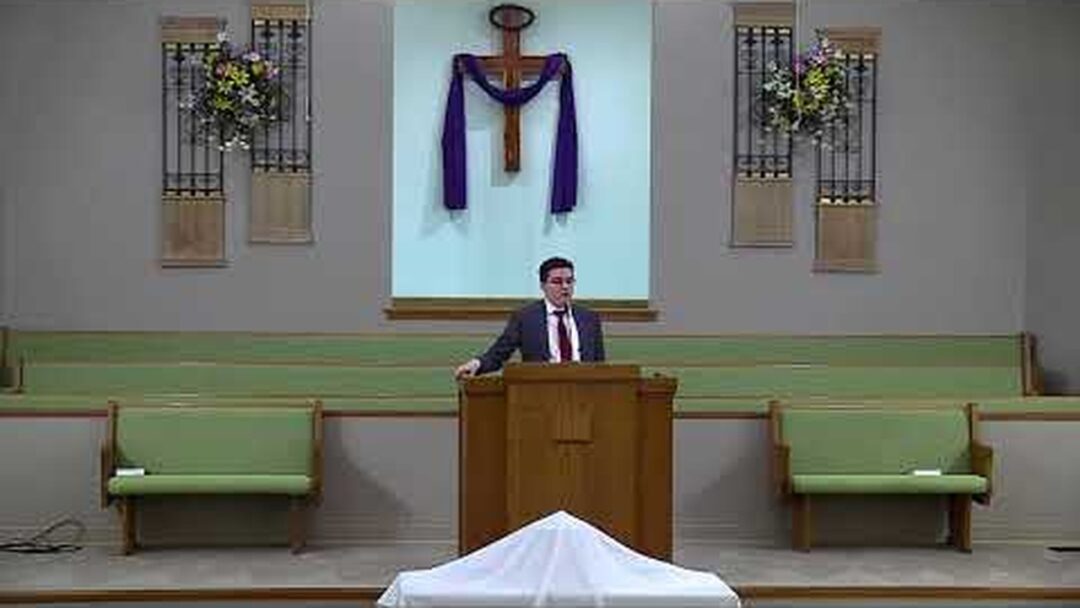
From our Palm Sunday service on March 24, 2024, Luke 24:13–31 and Isaiah 52:13–53:12. Watch the full message: It Pleased the Lord on YouTube.
This message was from Palm Sunday, the Sunday when we remember Christ’s triumphal entry into Jerusalem, where He declares Himself the Messiah and the people cry out, “Hosanna, Son of David!” A lot of us think of hosanna as just a “praise the Lord” statement, but it’s more beautiful than that. It’s not just a word but a phrase, hosha na. Na is the Hebrew word for “please,” and hosha is the word for “save” or “deliverance.” When the people cried out “Hosanna in the highest,” they weren’t just praising the Lord. They were saying, “Please save us. Please save us, Son of David. Please save us to the highest extent.”
Two Sad Disciples on the Road to Emmaus
Some context for Luke 24. Jesus had just died on the cross and risen again, and had appeared to the Marys and the disciples. Two followers of Jesus are talking about His death when they encounter the resurrected Jesus Himself on the road to Emmaus. Their eyes were holden so that they should not know Him. God supernaturally stopped them from recognizing who He was. Jesus walks up and asks, in effect, “What are you guys talking about? What are you so sad about?” Cleopas answers, “Art thou only a stranger in Jerusalem?” In other words, “Are you a foreigner visiting Jerusalem? You have no idea what just happened here. They crucified this prophet of ours.” “Well, they said He rose from the dead. Other people corroborate the story. They say the tomb is empty. But the tomb is just empty, and we don’t know if He rose from the dead.”
Then he said unto them, O fools, and slow of heart to believe all that the prophets have spoken: Ought not Christ to have suffered these things, and to enter into his glory? And beginning at Moses and all the prophets, he expounded unto them in all the scriptures the things concerning himself.
Luke 24:25–27
Jesus says, in effect, “Don’t you understand the Old Testament? It talks about Me. It foretold this. Did you not learn from the Scriptures?” They were sad, but had they known the Scriptures, they could have been celebrating what Jesus had done for them. So what did Jesus do? He took them to the Old Testament to explain what He accomplished for them. One of my teachers said about this passage that the greatest tragedy was not being ignorant about God but knowing about God without being willing to put faith in Him. These people had all the facts. But they lacked the faith. I’d like to look at what are called the servant songs, specifically song number four, which foretells the Messianic prophecy of a servant who would come to suffer for our salvation.
Christ Exalted and Humiliated
The first stanza is about how Christ is exalted. Then it says three things about Him: He will be exalted, extolled, and very high. It’s like a trinity of exaltation. But that’s not all. It says many would be “astonied” at Him. We don’t use that word in modern English, and it’s a very strong word. The best equivalent is “appalled.” It says His visage was so marred more than any man. They should have known, when they saw Jesus walking up that hill to Golgotha to be nailed to a tree, so marred from the whips and the beatings and the spitting, that this was a sign of the Messiah being fulfilled before their eyes. He would “sprinkle many nations.” The work done by this suffering servant is not just for Israel. It goes to all the nations. Anybody can claim to be the Son of God. Anybody can claim to remove your sins as far as the east is from the west. But no one can claim to rise from the dead without rising from the dead. They said He had been dead three days, too long for Him to just come back from sleeping. That tomb had a real body in it.
It says He will “grow up before him as a tender plant.” Christ grew up in pretty humble beginnings, in a nowhere town, with the first days of His life spent being sought to be killed by King Herod. He was a tender plant in what is called “dry ground.” Israel was spiritually dead. They hadn’t had a prophet for 400 years. The temple was full of corruption, greed, pride, and hypocrisy, and in this dry desert of Israel the Messiah would come. It says He would have “no form nor comeliness.” He just looked like any other person who grew up in rural Nazareth. He is despised and rejected of men, including His own brothers. It wasn’t until after the resurrection that they believed. He was “a man of sorrows, and acquainted with grief.” There’s a really interesting phrase here: “we hid as it were our faces from him.” In the Hebrew there’s a very specific word that’s not normally used. It means that when you’re in the presence of this person, you feel uncomfortable looking at them, and you turn away. There was someone who made us uncomfortable, whether because they were poor or because they looked like they were on some kind of drug. We turned our head the other way and pretended we never noticed them. We can just imagine Jesus walking toward the cross and people turning their faces, because it’s so grotesque and they don’t want to be associated with even acknowledging it.
Christ Our Propitiation
But he was wounded for our transgressions, he was bruised for our iniquities: the chastisement of our peace was upon him; and with his stripes we are healed. All we like sheep have gone astray; we have turned every one to his own way; and the LORD hath laid on him the iniquity of us all.
Isaiah 53:5–6
This man whom we couldn’t look at is still humiliated by society. It’s really interesting that there are two words here that mean “carry.” The first is “carry” in the simple sense, like you would carry a purse, something light and easy. I like to liken it to carrying a dog, since it’s very fun to have a dog on your lap. But the second word, “carried our sorrows,” doesn’t have a good connotation. It’s the idea of being forced by your employer to grab a heavy bag of bricks, put it on your back, and carry it even though you don’t want to. He has not just carried our sins but borne them. Yet when He did this for us, we considered Him “stricken, smitten of God, and afflicted.” The Pharisees thought that Jesus was being punished for saying He was God, but the truth was far from that. “The chastisement of our peace was upon him.” That peace is shalom. It is the punishment that was done so that we could have a peaceful existence. That sin had to be paid for one way or another, and God gave us the option. He says, “I will come down as Jesus Christ to earth. I will nail Myself to that cross. I will take your sins on Me, and you won’t have to pay for them.” “All we like sheep have gone astray.” Christ died for the sins of the whole world, not just for the sins of Christians. Can you believe this is the Old Testament? It was written before Christ, around 700 BC, and it is word for word New Testament doctrine.
It Pleased the Lord
Yet it pleased the LORD to bruise him; he hath put him to grief: when thou shalt make his soul an offering for sin, he shall see his seed, he shall prolong his days, and the pleasure of the LORD shall prosper in his hand.
Isaiah 53:10
“It pleased the Lord to bruise him.” That word “pleased” is the same word we would translate as “desire” or “will” or “want.” God wanted to bruise Him because He wanted to make an offering for sin so His seed could be saved. First, He will see His seed. I believe it’s Peter who says that Jesus descended into the prison and preached to those in prison. We know that during those three days He descended and talked to the believers who had come before. Second, He will prolong His days. If the Messiah is going to die, how is He going to prolong His days? Here it’s prophesied that He will rise again. Third, the pleasure of the Lord will prosper in His hand. The Bible tells us the Lord is not willing that any should perish but that all should come to repentance. When He sees the travail of Christ’s soul, He will be satisfied. All the punishment that we deserve would be placed on Him, and in that moment God would look down and say, “It is enough,” or, as Jesus says, “It is finished.” “Therefore will I divide him a portion with the great.” That word “great” in Hebrew has to do not with great as in quality but great as in quantity. The Bible tells us we are joint heirs with Christ.
Breaking Bread with the Risen Christ
The greatest tragedy is not being ignorant of God but knowing what God did and not understanding what it’s all about. Because of Jesus Christ, we don’t have to be like the people on the road to Emmaus, who were sad and wandering around unsure of what to do. Jesus said, “Why are you sad? Three days ago was the greatest day in human history. You don’t have to live in your guilt anymore. You can come to the cross and lay down your sins, because I’ve paid them in full.” There is no salvation in anyone but Christ. These disciples broke bread with Christ. The Bible says that where two or more are gathered together, He is there in the midst, and He also tells us to have the Lord’s Supper as often as we meet, to remember what Christ did for us. Here Christ sat down, broke bread with them, and identified Himself as the risen Christ. I’m sure they thought about the breaking of bread and remembered the Last Supper that had happened a few days before. The Lord’s Supper is a time of celebration, not to be sorrowful for Christ’s death but to be thankful and celebrate our salvation.
Recent Comments