
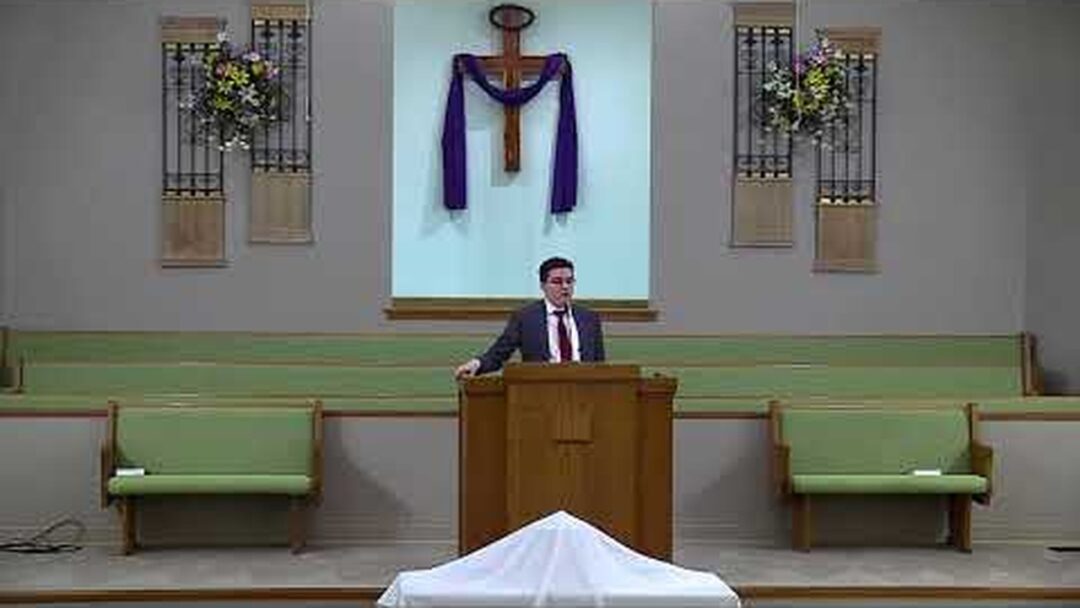
From our Palm Sunday service on March 24, 2024, Luke 24:13–31 and Isaiah 52:13–53:12. Watch the full message: It Pleased the Lord on YouTube.
What Palm Sunday Cried Out
This time of year you can tell a lot about a church by what they talk about. It’s more important than ever that we lead people to the cross. We preach Christ and Him crucified.
Today is Palm Sunday, the Sunday when we remember Christ’s triumphal entry into Jerusalem, where He declares Himself the Messiah to all His people and they cry out, “Hosanna, Son of David! Blessed is He who cometh in the name of the Lord! Hosanna in the highest!” There He declares Himself the Messianic King.
If you were here in the first service, I gave a little bit of Hebrew lesson on that word hosanna. A lot of us think of it as just a “praise the Lord” statement, but it’s more beautiful than that. It’s not just a word but a phrase, hosha na. Na is the Hebrew word for “please,” and hosha is the word for “save” or “deliverance.” When the people cried out “Hosanna in the highest” on that Palm Sunday, they weren’t just praising the Lord and they weren’t just calling Jesus the Son of David. They were saying, “Please save us. Please save us, Son of David. Blessed is He who comes in the name of the Lord. Please save us to the highest extent.”
That’s what we remember in this Easter season: Christ’s death, burial, and resurrection. What I want you to get from this lesson today is that God wants you to understand His work on the cross. We’re going to look at some people who struggled to understand it, and we’re going to learn from Jesus how important it is that we understand what He accomplished.
Two Sad Disciples on the Road to Emmaus
Some context for Luke 24. Jesus had just died on the cross and risen again, and had appeared to the Marys and the disciples. He had started to appear to other believers outside the twelve disciples, so there was now talk around Jerusalem about what was going on. Some had believed that Jesus had risen from the dead, and others had not. As we jump into this passage, two followers of Jesus are talking about the death of Jesus when they encounter the resurrected Jesus Himself on the road to Emmaus.
And, behold, two of them went that same day to a village called Emmaus, which was from Jerusalem about threescore furlongs. And they talked together of all these things which had happened. And it came to pass, that, while they communed together and reasoned, Jesus himself drew near, and went with them. But their eyes were holden that they should not know him. And he said unto them, What manner of communications are these that ye have one to another, as ye walk, and are sad? And the one of them, whose name was Cleopas, answering said unto him, Art thou only a stranger in Jerusalem, and hast not known the things which are come to pass there in these days? And he said unto them, What things? And they said unto him, Concerning Jesus of Nazareth, which was a prophet mighty in deed and word before God and all the people: And how the chief priests and our rulers delivered him to be condemned to death, and have crucified him. But we trusted that it had been he which should have redeemed Israel: and beside all this, to day is the third day since these things were done. Yea, and certain women also of our company made us astonished, which were early at the sepulchre; And when they found not his body, they came, saying, that they had also seen a vision of angels, which said that he was alive. And certain of them which were with us went to the sepulchre, and found it even so as the women had said: but him they saw not.
Luke 24:13–24
Their eyes were holden so that they should not know Him. God supernaturally stopped them from recognizing who He was. Jesus walks up and asks, in effect, “What are you guys talking about? What are you so sad about?” Cleopas answers, “Art thou only a stranger in Jerusalem?” In other words, “Are you a foreigner visiting Jerusalem, someone who just got into town today? You have no idea what just happened here. They crucified this prophet of ours.”
These disciples had followed His ministry, and now they were struggling because they didn’t know what to believe about the cross. They didn’t know what the cross was about, and they were struggling to come to terms with it. “Well, they said He rose from the dead. Other people corroborate the story. They say the tomb is empty. But the tomb is just empty, and we don’t know if He rose from the dead. We don’t really know what’s going on.” And what does Jesus say to them?
Then he said unto them, O fools, and slow of heart to believe all that the prophets have spoken: Ought not Christ to have suffered these things, and to enter into his glory? And beginning at Moses and all the prophets, he expounded unto them in all the scriptures the things concerning himself.
Luke 24:25–27
On the road to Emmaus, these two disciples did not understand what the cross was about, and Jesus says, in effect, “Don’t you understand the Old Testament? It talks about Me. It foretold this. It told you this was coming. Did you not learn from the Scriptures?” They were sad, but had they known the Scriptures, they could have been celebrating what Jesus had done for them. Because of their lack of knowledge about God’s salvation, they struggled. They knew He was a prophet. They knew He had done great miracles and given great speeches. They knew He died, and they knew He was meant to be a redeemer and savior. They knew there were claims that He rose from the dead. But they did not have the full picture of the cross.
So what did Jesus do? He took them to the Old Testament to explain what He accomplished for them on the cross, and that’s what we’re going to do today. One of my teachers said about this passage that the greatest tragedy was not being ignorant about God but knowing about God without being willing to put faith in Him. These people had all the facts. They knew that Jesus had risen from the dead, or at least there were reports. But they lacked the faith.
The Fourth Servant Song
Today I’d like to look at what are called the servant songs, specifically song number four, which foretells the Messianic prophecy of a servant who would come to suffer for our salvation. Our passage starts in Isaiah 52, the last three verses. It’s a prophecy about the Messiah and how He would be the Savior of Israel. There are a couple of stanzas, as you could say. We don’t really have an English word for these sections of the Hebrew songs, but you can consider them stanzas, and each talks about the Messiah and some of the things He is going to do.
Christ Exalted
The first stanza is about how Christ is exalted. It starts in Isaiah 52:13.
Behold, my servant shall deal prudently, he shall be exalted and extolled, and be very high. As many were astonied at thee; his visage was so marred more than any man, and his form more than the sons of men: So shall he sprinkle many nations; the kings shall shut their mouths at him: for that which had not been told them shall they see; and that which they had not heard shall they consider.
Isaiah 52:13–15
Here we see a picture of the Messiah as the Israelites saw Him at the time Jesus came, a man to be lifted up. “He shall deal prudently” means He will be wise in understanding. Then it says three things about Him: He will be exalted, extolled, and very high. It’s like a trinity of exaltation. The Hebrew word for “raised” is the word for lifted up and exalted. He will be raised in three ways, and that is how highly exalted Christ will be.
But that’s not all Christ was going to be. It says many would be “astonied” at Him. We don’t use that word in modern English, and it’s a very strong word. The best equivalent in modern English is “appalled.” They will be appalled by Him. This is why the people on the road to Emmaus struggled. They didn’t know the Scriptures. They only knew that Christ the Messiah would be lifted up. They didn’t know that He would be appalling to some, and that others would reject Him. It says His visage was so marred more than any man, and His form more than the sons of men. They should have known, when they saw Jesus walking up that hill to Golgotha to be nailed to a tree, so marred from the whips and the beatings and the spitting by the other people, that this was a sign of the Messiah and the prophecy being fulfilled before their eyes. But because they didn’t know the Scriptures, they never understood what Christ was doing for them.
He would “sprinkle many nations,” and kings would shut their mouths at Him. The work done by this suffering servant is not just for Israel. It goes to all the nations, for all people for their salvation. In the end they will shut their mouths. They will be able to see the reality of what they had not seen or heard. There is going to be a change in the world that shakes the very foundations of the nations around them, and we see that in history.
Christ Humiliated
So Christ was extolled. We also see Christ as humiliated, starting in Isaiah 53:1.
Who hath believed our report? and to whom is the arm of the LORD revealed? For he shall grow up before him as a tender plant, and as a root out of a dry ground: he hath no form nor comeliness; and when we shall see him, there is no beauty that we should desire him. He is despised and rejected of men; a man of sorrows, and acquainted with grief: and we hid as it were our faces from him; he was despised, and we esteemed him not.
Isaiah 53:1–3
Look at verse 1: “Who hath believed our report?” Is this not exactly what happened on the road to Emmaus? They had heard the report that the Scriptures were fulfilled, that Christ had risen from the dead, and that our sins had been paid for. This messenger who claimed to be the Son of God, who claimed to be the key to salvation, has been vindicated through the resurrection. Anybody can claim to be the Son of God. Anybody can claim to remove your sins as far as the east is from the west. Anyone can claim to be the Son of Man and Son of David. But no one can claim to rise from the dead without rising from the dead. They said He had been dead three days, too long for Him to just come back from sleeping. If He’s dead, He’s really dead. That tomb had a real body in it. Jesus says, in effect, “Don’t you understand that God is going to vindicate His Prophet? He’s going to vindicate the Messiah. He’s going to raise Him up to prove that everything He said was real. Don’t you know the Scriptures?” Who has believed the report? What Jesus did was unbelievable, and that is what makes it so amazing.
It says He will “grow up before him as a tender plant.” “Before him” means in the presence of God. Christ grew up in pretty humble beginnings, right? In a nowhere town, with the first days of His life spent being sought to be killed by King Herod. He was a tender plant. It was a delicate situation for Jesus to come to the earth in, but God would protect the Messiah and help Him grow in what is called “dry ground.” Israel was spiritually dead. They hadn’t had a prophet for 400 years. The temple was full of corruption, greed, pride, and hypocrisy, and in this dry desert of Israel the Messiah would come.
It says He would have “no form nor comeliness,” and that when we see Him there would be no beauty that we should desire Him. Jesus wasn’t the best-looking guy. He wasn’t the tallest guy, the most muscular guy, or the most charismatic guy. He just looked like any other person who grew up in rural Nazareth. He didn’t have the fancy education that the apostle Paul had. He was just a normal guy, not somebody who would stick out as someone you’d want to follow.
Verse 3 says He is despised and rejected of men. Jesus was rejected by a lot of people, including His own brothers when He was doing His ministry. Even His brothers didn’t believe He was the Messiah right away. It wasn’t until after the resurrection that they believed. He was despised by many people.
It says He was “a man of sorrows, and acquainted with grief.” I find this really comforting, that Jesus was a man who dealt with grief. “Acquainted” means He was familiar with it. We don’t know a lot about His first thirty years, but we do know a little from this prophecy, that He was familiar with hardship and sorrow. We know one situation with Lazarus, who dies, and Jesus mourns over him. But it says here that Jesus throughout His life was acquainted with grief. He was a man of sorrows.
There’s a really interesting phrase here: “we hid as it were our faces from him.” In the Hebrew there’s a very specific word that’s not normally used, and we really don’t have an equivalent word in our language for it. It means that when you’re in the presence of this person, you feel uncomfortable looking at them, and you turn away. I don’t think we like to admit it, but I think we’ve all been here somewhere in our lives. There was someone who looked like what we would consider less than ourselves, someone who made us uncomfortable, whether because they were poor or because they looked like they were on some kind of drug. Instead of thinking about helping them and interacting with them, we pretended we didn’t see them. We turned our head the other way and pretended we never noticed them in the first place. That’s what this Hebrew word is talking about. We can just imagine Jesus walking toward the cross and people turning their faces, because it’s so grotesque and they don’t want to be associated with even acknowledging it. That’s how Jesus was treated as He paid for our sins. He was despised, and we did not esteem Him. We didn’t consider Him in His hardship.
Christ Our Propitiation
Next, Christ is our propitiation.
Surely he hath borne our griefs, and carried our sorrows: yet we did esteem him stricken, smitten of God, and afflicted. But he was wounded for our transgressions, he was bruised for our iniquities: the chastisement of our peace was upon him; and with his stripes we are healed. All we like sheep have gone astray; we have turned every one to his own way; and the LORD hath laid on him the iniquity of us all.
Isaiah 53:4–6
This man whom we couldn’t look at and didn’t want to consider, so humiliated, is not the one humiliated by society today? A lot of times there are people who try to humiliate Christians. It’s often because there’s not a lot of kickback when you humiliate a Christian, since we’re taught to turn the other cheek. But even today Christ is despised and pushed away: “No, no, no, that’s not the solution. It’s embarrassing that you think Christ is the solution to your problems. Don’t push that on anybody else. Don’t talk about that. You should be embarrassed.” That’s the mistake they made in the first century when Christ went to the cross. This man who was so grotesque is the man doing our salvation. He has borne our griefs and carried our sorrows.
It’s really interesting that there are two words here that mean “carry.” The first is “carry” in the simple sense, like you would carry a purse, something light and easy to carry. I like to liken it to carrying a dog, since it’s very fun to have a dog on your lap. That’s a normal word for “carry.” But the second word, “carried our sorrows,” is another word for “carry” in Hebrew, and it doesn’t have a good connotation. It’s the idea of doing something somewhat forced, like being forced by your employer to grab a heavy bag of bricks, put it on your back, and carry it even though you don’t want to. He has not just carried our sins but borne them. He’s been weighed down by them, and He’s put in the work to carry them.
Yet when He did this for us, we considered Him “stricken, smitten of God, and afflicted.” The Pharisees thought that Jesus was being punished for saying He was God, but the truth was far from that. Christ took our sins on His back and paid for them on the cross. He “was wounded for our transgressions” and “bruised for our iniquities.” “The chastisement of our peace was upon him.” That peace is shalom, a word we’ve heard before. It is the punishment or correction for our welfare. It’s the punishment that was done so that we could have a good life, so that we could experience a peaceful existence. Christ took our sins so that we could have peace.
That sin had to be paid for one way or another, and God gave us the option. He says, “I will come down as Jesus Christ to earth. I will nail Myself to that cross. I will take your sins on Me, and you won’t have to pay for them.” There is a discipline for our correction. There is a punishment for what we’ve done wrong. The question is whether we are going to trust in Christ to remove it, or try on our own and condemn ourselves to the lake of fire.
Verse 6 warns us: “All we like sheep have gone astray.” Christ died for the sins of the whole world. He didn’t just die for the sins of Christians. He died for everybody, so everybody has the opportunity to accept it. Reading this passage, can you believe this is the Old Testament? It was written before Christ, around 700 BC, and it is word for word New Testament doctrine: all we like sheep have gone astray, all have sinned and come short of the glory of God, but the Lord has laid the iniquity of us all on Him. Why did Christ die? He died so that we could put our sins on the cross and have fellowship with Him.
Christ Submissive to the Father
The next stanza is that Christ is submissive to the Father, in verse 7.
He was oppressed, and he was afflicted, yet he opened not his mouth: he is brought as a lamb to the slaughter, and as a sheep before her shearers is dumb, so he openeth not his mouth. He was taken from prison and from judgment: and who shall declare his generation? for he was cut off out of the land of the living: for the transgression of my people was he stricken. And he made his grave with the wicked, and with the rich in his death; because he had done no violence, neither was any deceit in his mouth.
Isaiah 53:7–9
If the people on the road to Emmaus didn’t yet get what the cross was all about, they should have gotten it from this passage. “He was taken from prison” means He was imprisoned and taken to the courthouse, and that is exactly what happened to Jesus. “Who shall declare his generation?” Who will declare what He’s done? Why? Because He’s been cut off. What’s interesting is that these people on the road to Emmaus hadn’t heard what God had done. Nobody was there to tell them why, because Jesus was cut off from the land of the living. I don’t think there’s any other way to interpret that passage about the Messiah than that the Messiah was meant to die. These people had missed this part. They saw the Messiah as just a rescuer from life’s problems, not a rescuer from salvation problems. But here it says He’s cut off out of the land of the living. Why? “For the transgression of my people.” That’s you, that’s me, that’s believers. Christ was cut off from the land of the living because of us. And it says He made His grave with the wicked and the rich in His death, because He had done no violence, neither was any deceit in His mouth. He was killed for speaking the truth and doing what was right, because the Pharisees wanted to put Him to silence.
Christ Vindicated
But this isn’t where it ends. The last stanza says Christ is vindicated.
Yet it pleased the LORD to bruise him; he hath put him to grief: when thou shalt make his soul an offering for sin, he shall see his seed, he shall prolong his days, and the pleasure of the LORD shall prosper in his hand. He shall see of the travail of his soul, and shall be satisfied: by his knowledge shall my righteous servant justify many; for he shall bear their iniquities. Therefore will I divide him a portion with the great, and he shall divide the spoil with the strong; because he hath poured out his soul unto death: and he was numbered with the transgressors; and he bare the sin of many, and made intercession for the transgressors.
Isaiah 53:10–12
First, let’s deal with verse 10: “It pleased the Lord to bruise him.” What does that mean? That word “pleased” is the same word we would translate as “desire” or “will” or “want.” God was pleased to bruise Him. God wanted to bruise Him because He wanted to make an offering for sin so His seed could be saved. The word “pleasure” later in the verse is the same word in Hebrew as “pleased.” So there are going to be three things that happen when Christ dies on the cross for our sins.
First, He will see His seed. In other words, those who had died before Christ who had faith in the Messiah coming to remove their sins from them, those who believed in God without yet seeing the promise fulfilled, He would see His offspring. I believe it’s Peter who says that Jesus descended into the prison and preached to those in prison. We know that during those three days He descended and talked to the believers who had come before. We saw that fulfilled.
Second, He will prolong His days. If the Messiah is going to die, how is He going to prolong His days? Here it’s prophesied that He will rise again. Though He is cut off, God will prolong His days through the resurrection.
Third, the pleasure of the Lord will prosper in His hand. Where “pleasure” is being will or desire, the will of the Lord shall prosper in His hand. What is the will of the Lord? The Bible tells us the Lord is not willing that any should perish but that all should come to repentance. The will of God is that all are saved. So the last prophecy about the Messiah is that people would come to salvation through Him. When He sees the travail of Christ’s soul, He will be satisfied. Jesus’s sacrifice would satisfy the just nature of God. All the punishment that we deserve would be placed on Him, and in that moment God would look down and say, “It is enough,” or, as Jesus says, “It is finished.” And as we’ve seen from this passage, it wasn’t just for some. It was an opportunity for all.
Verse 12 talks about an inheritance: “Therefore will I divide him a portion with the great.” That word “great” in Hebrew has to do not with great as in quality but great as in quantity. I’ll divide His portion with the great quantity, a multitude of people. The Bible tells us we are joint heirs with Christ. I will take the gift that was for Christ, the inheritance that was for Christ, and share it with a great multitude of people who put faith in Him, and we will receive that heritage. Christ is vindicated because He poured out His soul to death and was raised again.
Do You Understand What Christ Did for You?
So what do we get from this passage today? As I told you before, the greatest tragedy is not being ignorant of God but knowing what God did and not understanding what it’s all about. We have Palm Sunday and Easter to celebrate a great work Christ did for us, the suffering He endured for our salvation. Because of Jesus Christ, we don’t have to be like the people on the road to Emmaus, who were sad and wandering around unsure of what to do. Jesus said, “Why are you sad? What’s going on? Don’t you know about the prophecies about Me? Don’t you know what I’ve just done? Three days ago was the greatest day in human history. You don’t have to live in your guilt anymore. You don’t have to live in your shame anymore. You can come to the cross and lay down your sins, because I’ve paid them in full.”
You don’t have to try anymore. As we talked about in the first service today, the stone that the builder rejected has become the chief of the corner. Trying to build your good works up isn’t going to work. You need that cornerstone as a foundation. You might be trying to build up your life, but without Christ you’re nothing. With Christ as the foundation stone, you can start building up good works, but those good works will never get you saved. There is no salvation in anyone but Christ, “neither is there salvation in any other.”
Here’s my question for you. Do you understand what Christ did for you? Have you really let that sink in, how ashamed and humiliated He was, how rejected He was, and the pain He endured for you? Have you accepted that gift of salvation on the cross? Are you thankful for the gift Christ gave you, or are you still sad like these men, who didn’t realize they had a reason to rejoice?
Breaking Bread with the Risen Christ
Let’s go back to Luke 24 and see how their story ended, starting back in verse 27.
And beginning at Moses and all the prophets, he expounded unto them in all the scriptures the things concerning himself. And they drew nigh unto the village, whither they went: and he made as though he would have gone further. But they constrained him, saying, Abide with us: for it is toward evening, and the day is far spent. And he went in to tarry with them. And it came to pass, as he sat at meat with them, he took bread, and blessed it, and brake, and gave to them. And their eyes were opened, and they knew him; and he vanished out of their sight.
Luke 24:27–31
These disciples broke bread with Christ. Today we’re about to have the Lord’s Supper, or communion, and we’re about to partake of bread with Jesus. The Bible says that where two or more are gathered together, He is there in the midst, and He also tells us to have the Lord’s Supper as often as we meet, to remember what Christ did for us. Unlike these people on the road to Emmaus, we should understand what the Gospels said about Christ and what Moses and the prophets said. Let’s not take the Lord’s Supper in vain, forgetting its purpose. Here Christ sat down, broke bread with them, and identified Himself as the risen Christ. I’m sure they thought about the breaking of bread and remembered the Last Supper that had happened a few days before. Today we are called to break bread with Jesus and remember the sacrifice He made for us.
We don’t have to live in sadness. This Lord’s Supper is a time of celebration, not to be sorrowful for Christ’s death but to be thankful and celebrate our salvation. We too can celebrate like the disciples on the road to Emmaus, because we can understand the work of God. I pray you’ve all accepted it today.
If you have not accepted the work of God in your life, if you’re still trying to get to heaven on your own, if you still think your works are good enough to get you there, I’d encourage you after the service to come forward and talk with me and let me share with you how you can know for sure you’re going to heaven when you die. Christ has paid it all on the cross, and He’s shown it through all these prophecies. There’s not a doubt that He was who He said He was.

Recent Comments